
Prevalence and Associated Factors of Utero-Vaginal Prolapse at Gov ernmental Hospitals in Addis Ababa, Ethiopia: A Cross-Sectional Study
Keywords:
Utero-vaginal prolapse, Risk factors, EthiopiaAbstract
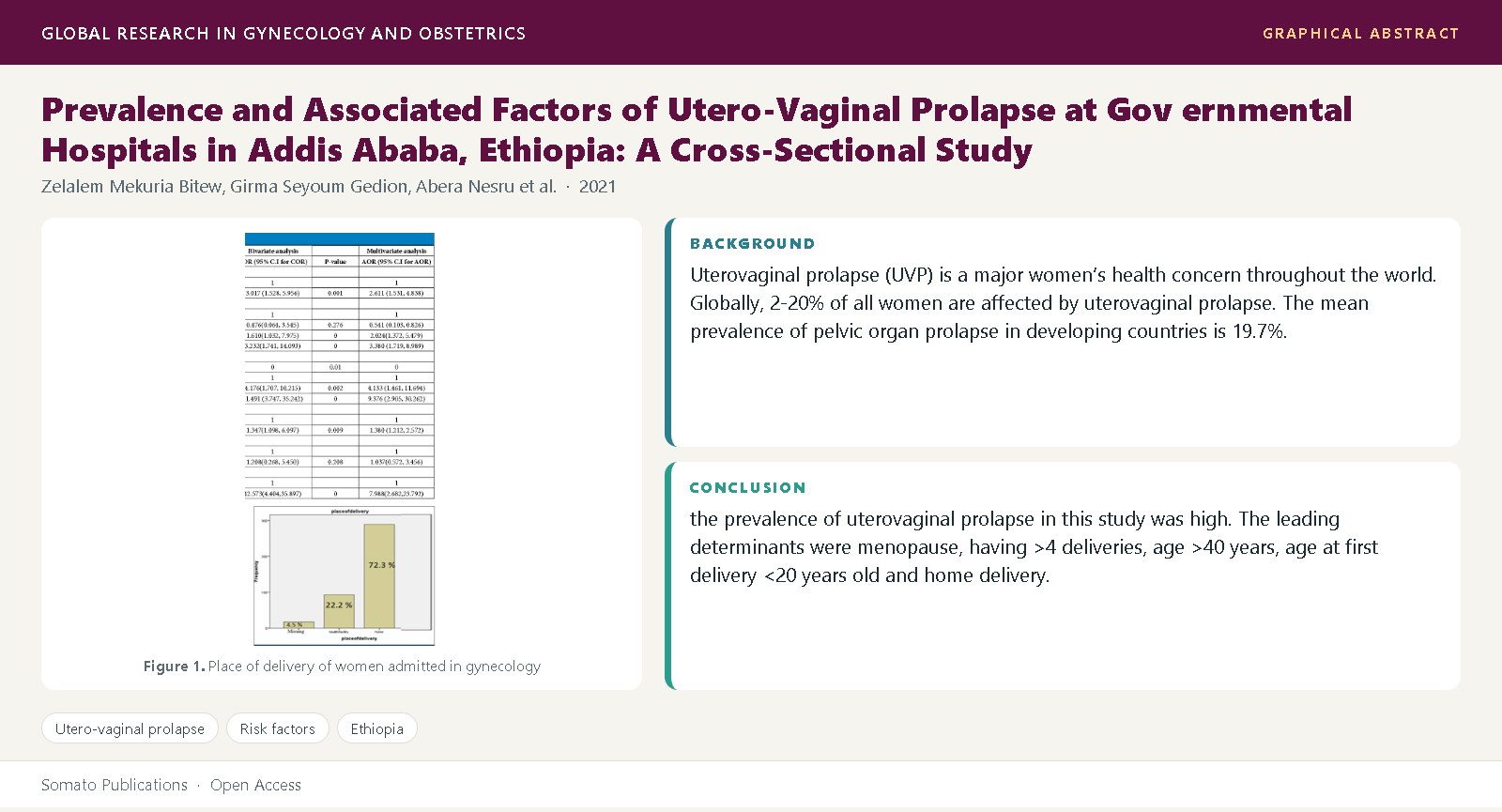
Background: Uterovaginal prolapse (UVP) is a major women’s health concern throughout the world. Globally, 2-20% of all women are affected by uterovaginal prolapse. The mean prevalence of pelvic organ prolapse in developing countries is 19.7%. The prev alence of utero vaginal prolapse among all gynecological operations in Ethiopia is 18.55%. Uterovaginal prolapse is a source of severe morbidity and psychological upheaval to the patient. It negatively affects socioeconomic and reproductive activity of affected women. Methodology: institution based cross-sectional study was employed retrospectively in Addis Ababa city governmental hospitals by reviewing the medical chart of women admitted in gynecology ward for two years, from March 2017 to February 2019 G.C. A randomly selected 400 medical charts of women admitted in gynecology wards were included in the study. The data was entered to EpiData 4.4 and analyzed using SPSS version 24 statistical package. Bivariate and multivariate logistic regression were carried out. Result: The prevalence of utero-vaginal prolapse is 12.8 % per total number of patients who admitted at gynecology ward of Addis Ababa city governmental hospitals. The determinants of utero-vaginal prolapse were menopause (AOR = 2.611), age > 40 years (AOR = 2.143), parity of >4 (AOR = 4.201), age at first delivery <20 years old (AOR = 7.988) and home delivery (AOR = 1.380). Conclusion: the prevalence of uterovaginal prolapse in this study was high. The leading determinants were menopause, having >4 deliveries, age >40 years, age at first delivery <20 years old and home delivery.
References
Doshani, A., Teo, R.E., Mayne, CJ., Tincello, DG. (2007) Uterine prolapse. Bmj,335(7624):819–823.
Khatri, RB. (2018) Situation of Uterine Proplapse in Salyan, Muguand, Bajhang Districts of Nepal: A Clinic Based Study. Health Prospect, 10(2011):10-13.
Bump, RC., Mattiasson, A., Bø, K., Brubaker, LP., DeLancey, JO., Klarskov, P., et al. (1996) The standardization of terminology of female pelvic organ prolapse and pelvic floor dysfunction. Am J ObstetGynecol, 175(1): 10-17.
Sumathi, N.,Nandhini, CC.(2017) Uterovaginal Prolapse-A Study in South Indian Women. Sch. J. App. Med. Sci, 5(4F): 1698-1704.
Hendrix, SL., Clark, A., Nygaard, I., Aragaki, A., Barnabei, V., McTiernan, A. (2002) Pelvic organ prolapses in the Women's Health Initiative: gravity and gravidity. Am J Obstet- Gynecol, 186(6): 1160-1166.
Cardozo, L. (1995) Prolapse. In: Whitfield CR, ed, Dewhurst’s textbook of obstetrics and gynaecology for postgraduates. Oxford: Blackwell Science, 642-652.
Walker, GJ., Gunasekera, P.(2011) Pelvic organ prolapses and incontinence in developing countries: review of prevalence and risk factors. IntUrogynecol J, 22(2): 127-135.
Lukman, Y. (1995) Utero-vaginal prolapse: a rural disability of the young. East Afr Med J, 72(1): 2-9.
Reay Jones, NHJ., Healy, JC., King, LJ., Saini, S, Shousha, S., Allen-Mersh, TG.(2003) Pelvic connective tissue resilience decreases with vaginal delivery, menopause and uterine prolapse. Br J Surg,90(4): 466-472.
Gumanga, SK., Munkaila, A., Malechi, H. (2014) Social demographic characteristics of women with pelvic organ prolapse at the Tamale Teaching Hospital Ghana. Ghana Med J, 48(4): 208-213.
Gjerde, JL., Rortveit, G., Muleta, M., Adefris, M., Blystad, A. (2017) Living with pelvic organ prolapse voices of women from Amhara region Ethiopia. Int Urogynecol J, 28(3): 361-366.
Muleta, M., Hamlin, EC., Fantahun, M., Kennedy, RC., Tafesse, B. (2008) Health and social problems encountered by treated and untreated obstetricfistula patients in rural Ethiopia. J Obstet Gynaecol Can, 30(1): 44-50.
Fritel, X., Varnoux, N., Zins, M., Breart, G., Ringa, V. (2009) Symptomatic pelvic organ prolapses at midlife quality of life and risk factors. Obstet Gynecol, 113(3): 609-616.
Pathak, K., Khanal, S. (2018) Factors Associated with Uterine Prolapse among Married Women of Reproductive Age Group of Gorkha District. International Journal of New Technology and Research, 4(3): 72-77.
Wusu-Ansah, OK., Opare-Addo, HS. (2008) Pelvic organ prolapses in rural Ghana. Int J Gynaecol Obstet, 103(2): 121-124.
Megabiaw, B., Adefris, M., Rortveit, G., Degu, G., Muleta, M., Blystad, A., et al. (2013) Pelvic floor disorders among women in Dabat district northwest Ethiopia: a pilot study. Int Urogynecol J, 24(7): 1135-1143.
Younis, N., Khattab, H., Zurayk, H., El-Mouelhy, M., Amin, MF., Farag, AM. (1993) A community study of gynecological and related morbidities in rural Egypt. Stud Fam Plann, 24(3): 175-186.
Henok, A. (2017) Prevalence and factors associated with pelvic organ prolapse among pedestrian back-loading women in Bench Maji Zone. Ethiop J Health Sci, 27(3): 263-272.
Asresie, A., Admassu, E., Setegn, T. (2016) Determinants of pelvic organ prolapse among gynecologic patients in Bahir Dar North West Ethiopia: a case-control study. Int J Womens Health, 8: 713-719.




