
Mechanistic Approach to the Pathophysiology and Genes Associated with Uterine Cancer: A Review
Keywords:
Uterine cancer, Gene expression, Pathophysiology, Risk factors, Diagnosis, Surgical interventionAbstract
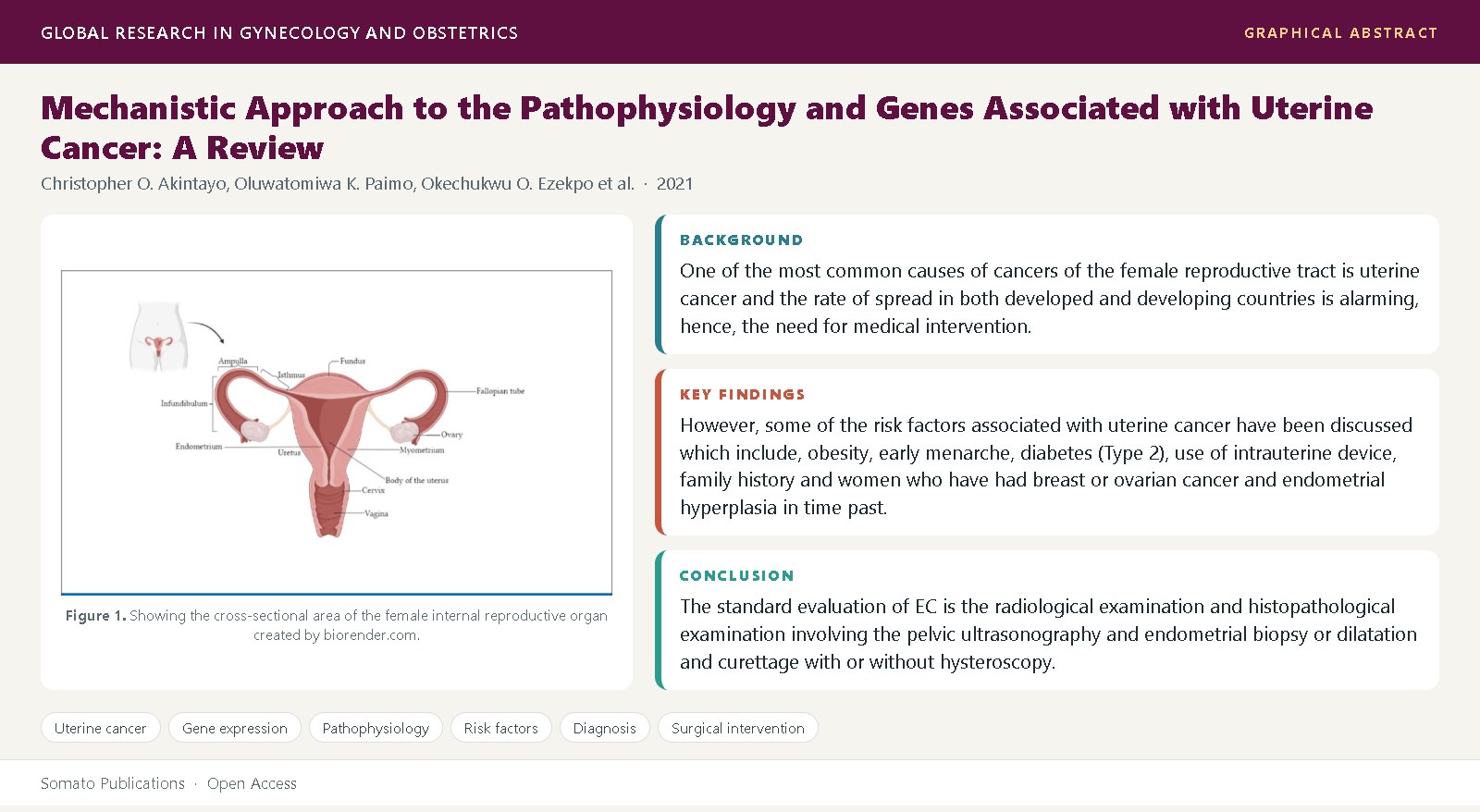
One of the most common causes of cancers of the female reproductive tract is uterine cancer and the rate of spread in both
developed and developing countries is alarming, hence, the need for medical intervention. The pathogenesis of uterine can
cer/endometrial carcinomas is key as well as the implicated genes in the diagnosis. This review focuses more on the molec
ular aspect (involving gene expression) in uterine cancer. However, some of the risk factors associated with uterine cancer
have been discussed which include, obesity, early menarche, diabetes (Type 2), use of intrauterine device, family history
and women who have had breast or ovarian cancer and endometrial hyperplasia in time past. Moreover, early diagnosis and
adequate intervention have been proven to be safe in affected individuals (women). Mutation in the genetic makeup leads to disease onset when not properly corrected. As in the case of endometrial cancer, several mismatched genes have been
identified such as MLH1, MSH2, MSH6, deletion of EPCAM found in the family history with Lynch syndrome. PTEN have also
been mutated in several patients. However, the diagnosis of endometrial cancer can be done based on clinical, radiological
and histo-pathological examination. All three will give a concise and informative description about the progression of endo
metrial cancer in order to administer proper treatment and progression. The standard evaluation of EC is the radiological
examination and histopathological examination involving the pelvic ultrasonography and endometrial biopsy or dilatation
and curettage with or without hysteroscopy.
References
Pask, A. (2016) The reproductive system. Adv Exp Med Biol, 886: 1–12.
Olshansky, E. (2014) U n i t t w o.
Vaamonde, D., du Plessis, SS., Agarwal, A. (2016) Exercise and human reproduction. Induced fertility disorders and possible therapies. Exerc Hum Reprod Induc Fertil Disord Possible Ther, 1–351.
Fahy, K. (2007) Anatomy and Physiology for Midwives by Coad and Dunstall (second ed.), Elsevier, Edinburgh 2005. Women and Birth, 20: 91.
Robboy, SJ., Kurita, T., Baskin, L., Cunha, GR. (2017) New insights into human female reproductive tract development. Differentiation, 97: 9–22.
Thompson, L. (2019) The Fallopian Tubes (Uterine) - Structure - Function - Vascular Supply.
O' neill, T. (2014) How to ensure it’s a boy (according to 100-year-old pregnancy guides)
Mattson, S., Smith, JE. (2004) Core curriculum for maternal-newborn nursing. St. Louis: Saunders
Jing, Y., Run-Qian, L., Hao-Ran, W., Hao-Ran, C., Ya-Bin, L., Yang, G., et al. (2020) Potential influence of COVID-19/ ACE2 on the female reproductive system. Molecular Human Reproduction, 26(6): 367-373.
Nguyen, J., Duong, H. (2020) Anatomy, Abdomen and Pelvis, Female External GenitaliaStatPearls. StatPearls Publishing
The Vulva - Structure - Innervation - TeachMeAnatomy.
Siegel, R., Naishadham, D., Jemal, A. (2013) Cancer statistics. CA Cancer J Clin, 63(1): 11–30.
Burke, WM., Orr, J., Leitao, M., Salom, E., Gehrig, P., Olawaiye, AB., et al. (2014) Endometrial cancer: A review and current management strategies: Part I SGO Clinical Practice Endometrial Cancer Working Group. Gynecol Oncol, 134(2): 385-392.
Oliver, KE., Enewold, LR., Zhu, K., Conrads, TP., Rose, GS., Maxwell, GL., et al. (2011) Racial disparities in histopathologic characteristics of uterine cancer are present in older, not younger blacks in an equal-access environment. Gynecol Oncol, 123(1): 76-81.
Society for Medical Oncology (2018) ESMO Patient Guide Series based on the ESMO Clinical Practice Guidelines.
Felix, AS., Gaudet, MM., Vecchia C, La., Nagle, CM., (2016) Analysis of the Epidemiology of Endometrial Cancer Consortium, 136(5): 1–26.
Ayre, SI., Elit, L. (2014) The epidemiology of endometrial cancer. In: Endometrie432e7tfral Cancer: A Comprehensive Clinical and Translational Update.
Kempers, MJE., Kuiper, RP., Ockeloen, CW., Chappuis, PO., Hutter, P., Rahner, N., et al. (2011) Risk of colorectal and endometrial cancers in EPCAM deletion-positive Lynch syndrome: A cohort study. Lancet Oncol, 12(1): 49-55.
Meyer, LA., Broaddus, RR., Lu, KH. (2009) Endometrial cancer and lynch syndrome: Clinical and pathologic considerations. Cancer Control, 16(1): 14–22.
Mismatch Repair Defects and Microsatellite Instability (2007)
Kempers, MJE., Kuiper, RP., Ockeloen, CW., Chappuis, PO., Hutter, P., Rahner, N., et al. (2011) Risk of colorectal and endometrial cancers in EPCAM deletion-positive Lynch syndrome: A cohort study. Lancet Oncol, 12(1): 49–55.
Bonadona, V., Bonaïti, B., Olschwang, S., Grandjouan, S., Huiart, L., Longy, M., et al. (2011) Cancer risks associated with germline mutations in MLH1, MSH2, and MSH6 genes in lynch syndrome. JAMA - J Am Med Assoc, 305(22): 2304–2310.
Zhou, XP., Kuismanen, S., Nystrom-Lahti, M., Peltomaki, P., Eng, C. (2002) Distinct PTEN mutational spectra in hereditary non-polyposis colon cancer syndrome-related endometrial carcinomas compared to sporadic microsatellite unstable tumors. Hum Mol Genet, 11(4): 445–450.
O’Hara, AJ., Bell, DW. (2012) The genomics and genetics of endometrial cancer. Adv Genomics Genet, 2012(2): 33-47.
Mutter, GL. (2007) Endometrial Carcinogenesis. In: Molecular Pathology of Gynecologic Cancer. Humana Press, 73–90.
Kuismanen, SA., Moisio, AL., Schweizer, P., Truninger, K., Salovaara, R., Arola, J., et al. (2002) Endometrial and colorectal tumors from patients with hereditary nonpolyposis colon cancer display different patterns of microsatellite instability. Am J Pathol, 160(6): 1953–1958.
Pijnenborg, JMA., Dam-De Veen, GC., De Haan, J., Van Engeland, M., Groothuis, PG. (2004) Defective mismatch repair and the development of recurrent endometrial carcinoma. Gynecol Oncol, 94(2): 550–559.
Simpkins, SB., Bocker, T., Swisher, EM., Mutch, DG., Gersell, DJ., Kovatich, AJ., et al. (1999) MLH1 promoter methylation and gene silencing is the primary cause of microsatellite instability in sporadic endometrial cancers. Hum Mol Genet, 8(4): 661–666.
Cheung, LWT., Hennessy, BT., Li, J., Yu, S., Myers, AP., Djordjevic, B., et al. (2011)High frequency of PIK3R1 and PIK3R2 mutations in endometrial cancer elucidates a novel mechanism for regulation of PTEN protein stability. Cancer Discov, 1(2): 170–185.
Renehan, A., Tyson, M., Egger, M., Heller, R., Zwahlen, M. (2008) Body-mass Index and Incidence of Cancer: A Systematic Review and Meta-analysis of Prospective Observational Studies. Lancet, 371(9612): 569–578.
Onstad, MA., Schmandt, RE., Lu, KH. (2016) Addressing the role of obesity in endometrial cancer risk, prevention, and treatment. Journal of Clinical Oncology. American Society of Clinical Oncology, 34(35): 4225–4230.
Calle, EE., Rodriguez, C., Walker-Thurmond, K., Thun, MJ. (2003) Overweight, Obesity, and Mortality from Cancer in a Prospectively Studied Cohort of U.S. Adults. N Engl J Med, 348(17): 1625–1638
Park, J., Morley, TS., Kim, M., Clegg, DJ., Scherer, PE. (2014) Obesity and cancer - Mechanisms underlying tumour progression and recurrence. Nat Rev Endocrinol, 10(8): 455–465.
Allott, EH., Hursting, SD. (2015) Obesity and cancer: Mechanistic insights from transdisciplinary studies. Endocrine-Related Cancer. BioScientifica Ltd, 22(6): R365– 386.
Soliman, PT., Wu, D., Tortolero-Luna, G., Schmeler, KM., Slomovitz, BM., Bray, MS., et al. (2006) Association between adiponectin, insulin resistance, and endometrial cancer. Cancer, 106(11): 2376–2381.
Gallup, DG., Stock, RJ. (1984) Adenocarcinoma of the endometrium in women 40 years of age or younger. Obstet Gynecol, 64(3): 417–420.
Soliman, PT., Oh, JC., Schmeler, KM., Sun, CC., Slomovitz, BM., Gershenson, DM., et al. (2005) Risk factors for young premenopausal women with endometrial cancer. Obstet Gynecol, 105(3): 575–580.
Endometrial Cancer Symptoms: 7 Signs of Uterine Cancer Not To Ignore
Timmermans, A., Opmeer, BC., Khan, KS., Bachmann, LM., Epstein, E., Clark, TJ., et al. (2010) Endometrial thickness measurement for detecting endometrial cancer in women with postmenopausal bleeding: A systematic review and meta-analysis. Obstetrics and Gynecology. Obstet Gyneco, 116(1): 160–167.
Epstein, E., Ramirez, A., Skoog, L., Valentin, L. (2001) Dilatation and curettage fails to detect most focal lesions in the uterine cavity in women with postmenopausal bleeding. Acta Obstet Gynecol Scand, 80(12): 1131–1136.
Lee, DO., Jung, MH., Kim, HY. (2011) Prospective comparison of biopsy results from curettage and hysteroscopy in postmenopausal uterine bleeding. J Obstet Gynaecol Res, 37(10): 1423–1426.
Signorelli, M., Guerra, L., Buda, A., Picchio, M., Mangili, G., Dell’Anna, T., et al. (2009) Role of the integrated FDG PET/ CT in the surgical management of patients with high risk clinical early stage endometrial cancer: Detection of pelvic nodal metastases. Gynecol Oncol, 115(2): 231–235.
Kitajima, K., Murakami, K., Yamasaki, E., Kaji, Y., Sugimura, K. (2009) Accuracy of integrated FDG-PET/contrast-enhanced CT in detecting pelvic and paraaortic lymph node metastasis in patients with uterine cancer. Eur Radiol, 19(6): 1529–1536.
Hsieh, CH., ChangChien, CC., Lin, H., Huang, EY., Huang, CC., Lan, KC., et al. (2002) Can a preoperative CA 125 level be a criterion for full pelvic lymphadenectomy in surgical staging of endometrial cancer? Gynecol Oncol, 86(1): 28–33.
Doll, A., Abal, M., Rigau, M., Monge, M., Gonzalez, M., Demajo, S., et al. (2008) Novel molecular profiles of endometrial cancer-new light through old windows. J Steroid Biochem Mol Biol, 108(3–5): 221–229.
Yao, M., Fu, S., Gambone, JC., Berek, S. (1990) Pathophysiology and Management of Endometrial Hyperplasia and Carcinoma, West J Med, 153(1): 50–61.
Devesa, SS., Silverman, DT., Young, JLJ., Pollack, ES., Brown, CC., Horm, JW., et al. (1987) Cancer incidence and mortality trends among whites in the United States, 1947-84. J Natl Cancer Inst, 79(4): 701–770.
Bell, DW., Ellenson, LH. (2019) Molecular Genetics of Endometrial Carcinoma. Annu Rev Pathol Mech Dis, 14: 339–367.
Bokhman, JV. (1983) Two pathogenetic types of endometrial carcinoma. Gynecol Oncol, 15(1): 10–17.
Bansal, N., Yendluri, V., Wenham, RM. (2009) The Molecular Biology of Endometrial Cancers and the Implications for Pathogenesis, Classification, and Targeted Therapies. Cancer Control, 16(1): 8-13.
Mutter, GL., Lin, MC., Fitzgerald, JT., Kum, JB., Baak, JP., Lees, JA., et al. (2000) Altered PTEN expression as a diagnostic marker for the earliest endometrial precancers. J Natl Cancer Inst, 92(11): 924–930.
Mutter, GL., Lin, MC., Fitzgerald, JT., Kum, JB., Baak, JPA., Lees, JA., et al. (2000) Altered PTEN expression as a diagnostic marker for the earliest endometrial precancers. J Natl Cancer Inst, 92(11): 924–931.
Maxwell, GL., Risinger, JI., Gumbs, C., Shaw, H., Bentley, RC., Barrett, JC., et al. (1998) Mutation of the PTEN tumor suppressor gene in endometrial hyperplasias. Cancer Res, 58(12): 2500–2503.
Lax, SF., Kendall, B., Tashiro, H., Slebos, RJ., Hedrick, L. (2000) The frequency of p53, K-ras mutations, and microsatellite instability differs in uterine endometrioid and serous carcinoma: evidence of distinct molecular genetic pathways. Cancer, 88(4): 814–824.
Basil, JB., Goodfellow, PJ., Rader, JS., Mutch, DG., Herzog, TJ. (2000) Clinical significance of microsatellite instability in endometrial carcinoma. Cancer, 89(8): 1758–1764.
Saegusa, M., Hashimura, M., Yoshida, T., Okayasu, I. (2001) beta- Catenin mutations and aberrant nuclear expression during endometrial tumorigenesis. Br J Cancer, 84(2): 209–217.
Wang, Y., Nicholes, K., Shih, IM. (2020) The Origin and Pathogenesis of Endometriosis. Annu Rev Pathol Mech Dis,15: 71–95.
McConechy, MK., Anglesio, MS., Kalloger, SE., Yang, W., Senz, J., Chow, C., et al. (2011) Subtype-specific mutation of PPP2R1A in endometrial and ovarian carcinomas. J Pathol, 223(5): 567–573.
Kuhn, E., Wu, RC., Guan, B., Wu, G., Zhang, J., Wang, Y., et al. (2012) Identification of molecular pathway aberrations in uterine serous carcinoma by genome-wide analyses. J Natl Cancer Inst, 104(19): 1503–1513.
Haesen, D., Asbagh, LA., Derua, R., Hubert, A., Schrauwen, S., Hoorne, Y., et al. (2016) Recurrent PPP2R1A mutations in uterine cancer act through a dominant-negative mechanism to promote malignant cell growth. Cancer Res, 76(19): 5719–5731.
Morgan, J., Hoekstra, AV., Chapman-Davis, E., Hardt, JL., Kim, JJ., Buttin, BM. (2009) Synuclein-γ (SNCG) may be a novel prognostic biomarker in uterine papillary serous carcinoma. Gynecol Oncol, 114(2): 293–298.
Zhang, J., Liu, X-H., Li, C., Wu, XX., Chen, YL., Li, WW., et al. (2020) SNCG promotes the progression and metastasis of high-grade serous ovarian cancer via targeting the PI3K/ AKT signaling pathway. Journal of Experimental & Clinical Cancer Research, 39: 79
Zhao, S., Choi, M., Overton, JD., Bellone, S., Roque, DM.,, Cocc, E., et al. (2013) Landscape of somatic single-nucleotide and copy-number mutations in uterine serous carcinoma. Proc Natl Acad Sci U S A, 110(8): 2916–2921.
Shiozawa, T., Konishi, I. (2004) Pathology of endometrial carcinoma. Nippon rinsho. Japanese journal of clinical medicine, 62: 273–278.
Hernandez, E. (1993) Pathological findings and prognosis from uterine malignancy. Current Opinion in Obstetrics and Gynecology, 5: 480–485.
Ambros, RA., Kurman, RJ. (1992) Combined assessment of vascular and myometrial invasion as a model to predict prognosis in stage I endometrioid adenocarcinoma of the uterine corpus. Cancer, 69(6): 1424–1431.
Fanning, J., Evans, MC., Peters, AJ., Samuel, M., Harmon, ER., Bates, JS. (1989) Endometrial adenocarcinoma histologic subtypes: Clinical and pathologic profile. Gynecol Oncol, 32(3): 288–291.
Getz, G., Gabriel, SB., Cibulskis, K., Lander, E., Sivachenko, A., Sougnez, C., et al. (2013) Integrated genomic characterization of endometrial carcinoma, 497(7447): 67–73.
Endometriosis - Complications - NHS.
Schwartz, D., Mayaux, MJ. (1982) Female Fecundity as a Function of Age. N Engl J Med, 306(7): 404–406.
Hughes, EG., Fedorkow, DM., Collins, JA. (1993) A quantitative overview of controlled trials in endometriosis-associated infertility. Fertil Steril, 59(5): 963–970.
Schenken, RS. (2009) Infertility Aspects of Endometriosis. Glob Libr Women’s Med.
Bulletti, C., Coccia, ME., Battistoni, S., Borini, A. (2010) Endometriosis and infertility. J Assist Reprod Genet, 27(8): 441–447.
Verkauf, BS. (1987) Incidence, symptoms, and signs of endometriosis in fertile and infertile women. J Fla Med Assoc,74(9): 671–675.
Portuondo, JA., Echanojauregui, AD., Herran, C., Alijarte, I. (1983) Early conception in patiens with untreated mild endometriosis. Fertil Steril, 39(1): 22–25.
Rodriguez-Escudero, FJ., Neyro, JL., Corcostegui, B., Benito, JA. (1988) Does minimal endometriosis reduce fecundity? Fertil Steril, 50(3): 522–524.
Jansen, RPS. (1986) Minimal endometriosis and reduced fecundability: Prospective evidence from an artificial insemination by donor program. Fertil Steril, 46(1): 141– 143.
Marcoux, S., Maheux, R., Bérubé, S. (1997) Laparoscopic Surgery in Infertile Women with Minimal or Mild Endometriosis. N Engl J Med, 337(4): 217–222.
Parazzini, F., Cintio, E Di., Chatenoud, L., Moroni, S., Ardovino, I., Struzziero, E., et al. (1999) Ablation of lesions or no treatment in minimal-mild endometriosis in infertile women: A randomized trial. Hum Reprod, 14(5): 1332– 1334.
Schenken, RS., Asch, RH., Williams, RF., Hodgen, GD. (1984) Etiology of infertility in monkeys with endometriosis: Luteinized unruptured follicles, luteal phase defects, pelvic adhesions, and spontaneous abortions. Fertil Steril, 41(1): 122–130.
Hahn, DW., Carraher, RP., Foldesy, RG., McGuire, JL. (1986) Experimental evidence for failure to implant as a mechanism of infertility associated with endometriosis. Am J Obstet Gynecol, 155(5): 1109–1113.
Lessey, BA., Castelbaum, AJ., Sawin, SW., Buck, CA., Schinnar, R., Bilker, W., et al. (1994) Aberrant integrin expression in the endometrium of women with endometriosis. J Clin Endocrinol Metab, 79(2): 643–649.`
Meek, SC., Hodge, DD., Musich, JR. (1988) Autoimmunity in infertile patients with endometriosis. Am J Obstet Gynecol, 158(6 PART 1): 1365–1373.
Lebovic, DI., Mueller, MD., Taylor, RN. (2001) Immunobiology of endometriosis. Fertility and Sterility. Fertil Steril, 75(1): 1–10.
Halme, J., Becker, S., Haskill, S. (1987) Altered maturation and function of peritoneal macrophages: Possible role in pathogenesis of endometriosis. Am J Obstet Gynecol, 156(4): 783–789.
Haney, AF., Muscato, JJ., Weinberg, JB. (1981) Peritoneal fluid cell populations in infertility patients. Fertil Steril, 35(6): 696–698.
Getting Pregnant with Endometriosis: Is It Possible? Healthline 2021.
Guo, SW. (2009) Recurrence of endometriosis and its control. Hum Reprod Update, 15(4): 441–461.
Steingold, KA., Lu, JKH., Judd, HL., Meldrum, DR. (1986) Danazol inhibits steroidogenesis by the human ovary in vivo. Fertil Steril, 45(5): 649–654.
Asch, RH., Fernandez, EO., Siler-Khodr, TM., Bartke, A., Pauerstein, CJ. (1980) Mechanism of induction of luteal phase defects by danazol. Am J Obstet Gynecol, 136(7): 932–937.
Adhesions | Endometriosis.org .Healthline.April,2021.
Endometriosis adhesions: Symptoms, formation, and pictures
Endometriosis and Sex: 7 Tips for Relief
Ferrero, S., Esposito, F., Abbamonte, LH., Anserini, P., Remorgida, V., Ragni, N. (2005) Quality of sex life in women with endometriosis and deep dyspareunia. Fertil Steril, 83(3): 573–579.
Denny, E., Mann, CH. (2007) Endometriosis-associated dyspareunia: The impact on women’s lives. J Fam Plan Reprod Heal Care, 33(3): 189–193.
Fauconnier, A., Chapron, C., Dubuisson, JB., Vieira, M., Dousset, B., Bréart, G. (2002) Relation between pain symptoms and the anatomic location of deep infiltrating endometriosis. In: Fertility and Sterility. Fertil Steril, 78(4): 719–726.
Porpora, MG., Koninckx, PR., Piazze, J., Natili, M., Colagrande, S., Cosmi, EV. (1999) Correlation between endometriosis and pelvic pain. J Am Assoc Gynecol Laparosc, 6(4): 429–434.
Vercellini, P. (1997) Endometriosis: What a pain it is. Vol. 15, Seminars in Reproductive Endocrinology. Seminars in Reproductive Endocrinology, 15(3): 251–261.




