
Evaluation of patient satisfaction surveys as a Prognostic Tool in geriatric polypharmacy
DOI:
https://doi.org/10.5281/zenodo.22813692Keywords:
patient satisfaction, polypharmacy, geriatric medicine, prognosis, deprescribingAbstract
Background: Geriatric polypharmacy is a well-established marker of adverse outcomes, but whether routinely collected patient satisfaction survey scores add independent prognostic information in this population is unclear [1,4].
Objective: To evaluate structured patient satisfaction survey scores as a prognostic tool for twelve-month adverse drug events, unplanned readmission, and functional decline among older adults with polypharmacy.
Methods: We conducted a prospective cohort study of 682 outpatients aged 65 years or older with five or more regular medications, who completed a validated four-domain satisfaction instrument at enrolment and were followed for twelve months, with potentially inappropriate medications screened using STOPP/START criteria [10].
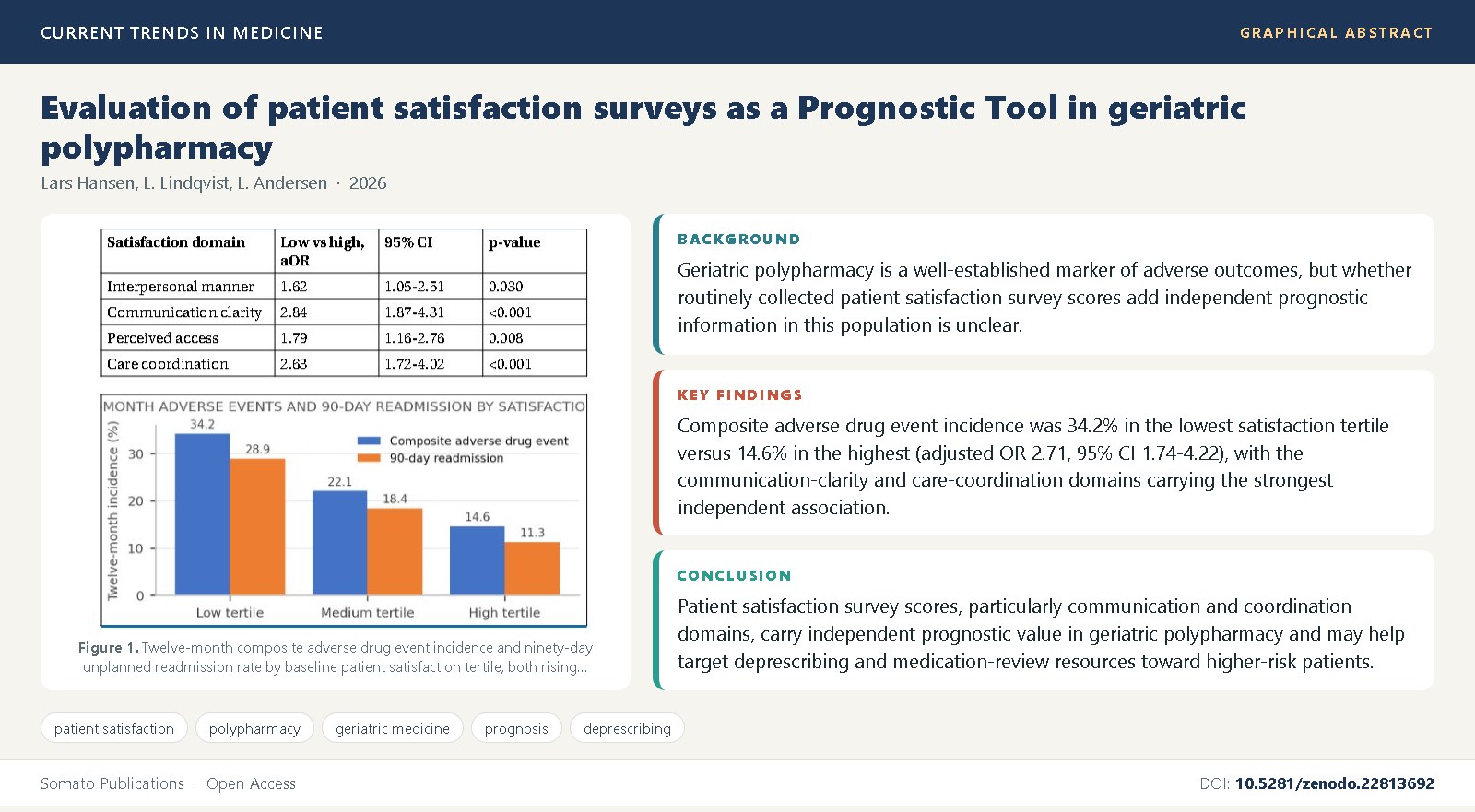
Results: Composite adverse drug event incidence was 34.2% in the lowest satisfaction tertile versus 14.6% in the highest (adjusted OR 2.71, 95% CI 1.74-4.22), with the communication-clarity and care-coordination domains carrying the strongest independent association, and adding satisfaction score improved outcome discrimination beyond comorbidity and medication-count models alone [28,24].
Conclusions: Patient satisfaction survey scores, particularly communication and coordination domains, carry independent prognostic value in geriatric polypharmacy and may help target deprescribing and medication-review resources toward higher-risk patients [12,13].
References
Masnoon N, Shakib S, Kalisch-Ellett L, Caughey GE (2017) What is polypharmacy? A systematic review of definitions. BMC Geriatrics, 17: 230. DOI: 10.1186/s12877-017-0621-2 as
Barnett K, Mercer SW, Norbury M, Watt G, Wyke S, Guthrie B (2012) Epidemiology of multimorbidity and implications for health care, research, and medical education: a cross-sectional study. Lancet, 380(9836): 37-43. DOI: 10.1016/S0140-6736(12)60240-2
Wallace E, Salisbury C, Guthrie B, Lewis C, Fahey T, Smith SM (2015) Managing patients with multimorbidity in primary care. BMJ, 350: h176. DOI: 10.1136/bmj.h176
Fried TR, O'Leary J, Towle V, Goldstein MK, Trentalange M, Martin DK (2014) Health outcomes associated with polypharmacy in community-dwelling older adults: a systematic review. Journal of the American Geriatrics Society, 62(12): 2261-2272. DOI: 10.1111/jgs.13153
Maher RL, Hanlon JT, Hajjar ER (2014) Clinical consequences of polypharmacy in elderly. Expert Opinion on Drug Safety, 13(1): 57-65. DOI: 10.1517/14740338.2013.827660
Jyrkka J, Enlund H, Korhonen MJ, Sulkava R, Hartikainen S (2009) Polypharmacy status as an indicator of mortality in an elderly population. Drugs and Aging, 26(12): 1039-1048. DOI: 10.2165/11319530-000000000-00000
Gnjidic D, Hilmer SN, Blyth FM, Naganathan V, Waite L, Seibel MJ, et al. (2012) Polypharmacy cutoff and outcomes: five or more medicines were used to identify community-dwelling older men at risk of different adverse outcomes. Journal of Clinical Epidemiology, 65(9): 989-995. DOI: 10.1016/j.jclinepi.2012.02.018
Beers MH (1997) Explicit criteria for determining potentially inappropriate medication use by the elderly. Archives of Internal Medicine, 157(14): 1531-1536.
Gallagher P, Ryan C, Byrne S, Kennedy J, O'Mahony D (2008) STOPP (Screening Tool of Older Person's Prescriptions) and START (Screening Tool to Alert doctors to Right Treatment). International Journal of Clinical Pharmacology and Therapeutics, 46(2): 72-83. DOI: 10.5414/CPP46072
O'Mahony D, O'Sullivan D, Byrne S, O'Connor MN, Ryan C, Gallagher P (2015) STOPP/START criteria for potentially inappropriate prescribing in older people: version 2. Age and Ageing, 44(2): 213-218. DOI: 10.1093/ageing/afu145
Steinman MA, Hanlon JT (2010) Managing medications in clinically complex elders: "There's got to be a happy medium". JAMA, 304(14): 1592-1601. DOI: 10.1001/jama.2010.1482
Scott IA, Hilmer SN, Reeve E, Potter K, Le Couteur D, Rigby D, et al. (2015) Reducing inappropriate polypharmacy: the process of deprescribing. JAMA Internal Medicine, 175(5): 827-834. DOI: 10.1001/jamainternmed.2015.0324
Reeve E, Gnjidic D, Long J, Hilmer S (2015) A systematic review of the emerging definition of 'deprescribing' with network analysis. British Journal of Clinical Pharmacology, 80(6): 1254-1268. DOI: 10.1111/bcp.12732
Press MJ, Rajkumar R, Conway PH (2016) Medicare's new hospital value-based purchasing program. JAMA, 315(9): 891-892. DOI: 10.1001/jama.2016.0410
Jha AK, Orav EJ, Zheng J, Epstein AM (2008) Patients' perception of hospital care in the United States. New England Journal of Medicine, 359(18): 1921-1931. DOI: 10.1056/NEJMsa0804116
Isaac T, Zaslavsky AM, Cleary PD, Landon BE (2010) The relationship between patients' perception of care and measures of hospital quality and safety. Health Services Research, 45(4): 1024-1040. DOI: 10.1111/j.1475-6773.2010.01122.x
Chang JT, Hays RD, Shekelle PG, MacLean CH, Solomon DH, Reuben DB, et al. (2006) Patients' global ratings of their health care are not associated with the technical quality of their care. Annals of Internal Medicine, 144(9): 665-672. DOI: 10.7326/0003-4819-144-9-200605020-00010
Rao M, Clarke A, Sanderson C, Hammersley R (2006) Patients' own assessments of quality of primary care compared with objective records based measures of technical quality of care: cross sectional study. BMJ, 333(7557): 19. DOI: 10.1136/bmj.38874.499167.7C
Wolf JA, Niederhauser V, Marshburn D, LaVela SL (2014) Defining patient experience. Patient Experience Journal, 1(1): 7-19. DOI: 10.35680/2372-0247.1004
Hall JA, Dornan MC (1990) Patient sociodemographic characteristics as predictors of satisfaction with medical care: a meta-analysis. Social Science and Medicine, 30(7): 811-818. DOI: 10.1016/0277-9536(90)90205-7
Peck BM (2011) Age-related differences in doctor-patient interaction and patient satisfaction. Current Gerontology and Geriatrics Research, 2011: 137492. DOI: 10.1155/2011/137492
Weiss BD (2013) Health literacy and patient safety: Help patients understand. American Medical Association Foundation Report, 2nd edition.
Al-Abri R, Al-Balushi A (2014) Patient satisfaction survey as a tool towards quality improvement. Oman Medical Journal, 29(1): 3-7. DOI: 10.5001/omj.2014.02
Glickman SW, Boulding W, Manary M, Staelin R, Roe MT, Wolosin RJ, et al. (2010) Patient satisfaction and its relationship with clinical quality and inpatient mortality in acute myocardial infarction. Circulation: Cardiovascular Quality and Outcomes, 3(2): 188-195. DOI: 10.1161/CIRCOUTCOMES.109.900597
Kennedy GD, Tevis SE, Kent KC (2014) Is there a relationship between patient satisfaction and favorable outcomes? Annals of Surgery, 260(4): 592-600. DOI: 10.1097/SLA.0000000000000932
Rhee TG, Choi YC, Ouellet GM, Ross JS (2018) National prevalence of concurrent polypharmacy and depression among community-dwelling older adults. American Journal of Preventive Medicine, 55(5): 728-731. DOI: 10.1016/j.amepre.2018.06.017
Tjia J, Velten SJ, Parsons C, Valluri S, Briesacher BA (2013) Studies to reduce unnecessary medication use in frail older adults: a systematic review. Drugs and Aging, 30(5): 285-307. DOI: 10.1007/s40266-013-0064-1
Boulding W, Glickman SW, Manary MP, Schulman KA, Staelin R (2011) Relationship between patient satisfaction with inpatient care and hospital readmission within 30 days. American Journal of Managed Care, 17(1): 41-48.
Manary MP, Boulding W, Staelin R, Glickman SW (2013) The patient experience and health outcomes. New England Journal of Medicine, 368(3): 201-203. DOI: 10.1056/NEJMp1211775
Doyle C, Lennox L, Bell D (2013) A systematic review of evidence on the links between patient experience and clinical safety and effectiveness outcomes. BMJ Open, 3(1): e001570. DOI: 10.1136/bmjopen-2012-001570
Wastesson JW, Morin L, Tan ECK, Johnell K (2018) An update on the clinical consequences of polypharmacy in older adults: a narrative review. Expert Opinion on Drug Safety, 17(12): 1185-1196. DOI: 10.1080/14740338.2018.1546841
Cadogan CA, Ryan C, Hughes CM (2016) Appropriate polypharmacy and medicine safety: when many is not too many. Drug Safety, 39(2): 109-116. DOI: 10.1007/s40264-015-0378-5
Onder G, Marengoni A (2017) Polypharmacy. JAMA, 318(17): 1728. DOI: 10.1001/jama.2017.15764
Zusman EE (2012) HCAHPS replaces Press Ganey survey as quality measure. Neurosurgery, 71(2): N21-N24. DOI: 10.1227/01.neu.0000417536.07871.ed
Hajjar ER, Cafiero AC, Hanlon JT (2007) Polypharmacy in elderly patients. American Journal of Geriatric Pharmacotherapy, 5(4): 345-351. DOI: 10.1016/j.amjopharm.2007.12.002
Fenton JJ, Jerant AF, Bertakis KD, Franks P (2012) The cost of satisfaction: a national study of patient satisfaction, health care utilization, expenditures, and mortality. Archives of Internal Medicine, 172(5): 405-411. DOI: 10.1001/archinternmed.2011.1662

Published
Issue
Section
License
Copyright (c) 2026 Lars Hansen, et al.

This work is licensed under a Creative Commons Attribution 4.0 International License.


