
electronic health record analysis in the Management of essential hypertension among elderly outpatients
DOI:
https://doi.org/10.5281/zenodo.22813636Keywords:
electronic health record, essential hypertension, elderly outpatients, blood pressure control, clinical decision supportAbstract
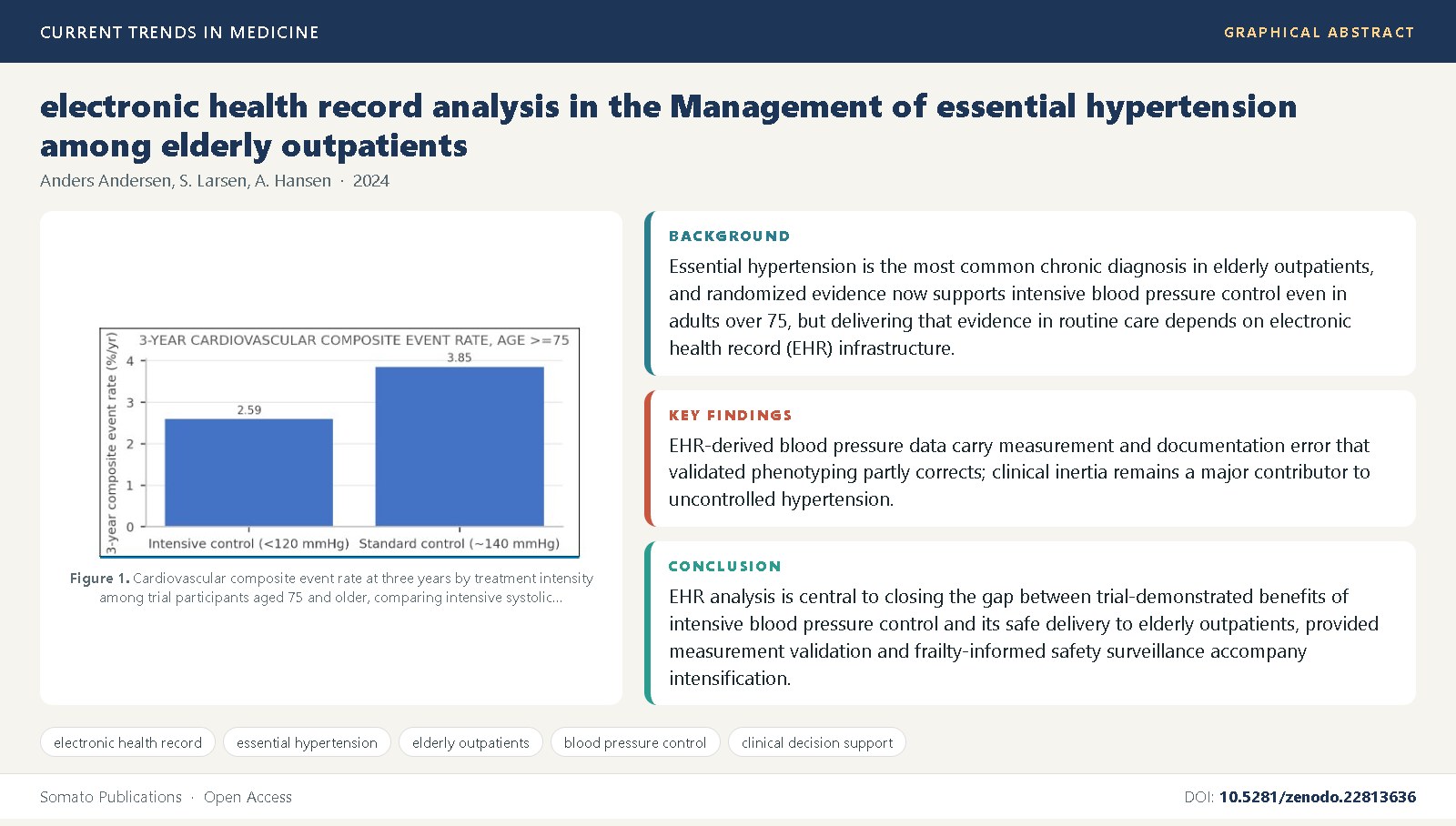
Background: Essential hypertension is the most common chronic diagnosis in elderly outpatients, and randomized evidence now supports intensive blood pressure control even in adults over 75, but delivering that evidence in routine care depends on electronic health record (EHR) infrastructure.
Objective: This review synthesizes evidence on how EHR analysis has been used to characterize and improve management of essential hypertension among elderly outpatients.
Methods: We synthesized peer-reviewed registry studies, EHR-embedded quality improvement trials, pharmacovigilance analyses, and predictive-analytics studies addressing hypertension measurement, control, and treatment in outpatients aged 65 and older.
Findings: EHR-derived blood pressure data carry measurement and documentation error that validated phenotyping partly corrects; clinical inertia remains a major contributor to uncontrolled hypertension; intensive treatment improves cardiovascular and cognitive outcomes in older patients but carries a detectable burden of falls and acute kidney injury; and EHR-embedded decision support and prediction show measurable gains in control.
Conclusions: EHR analysis is central to closing the gap between trial-demonstrated benefits of intensive blood pressure control and its safe delivery to elderly outpatients, provided measurement validation and frailty-informed safety surveillance accompany intensification.
References
SPRINT Research Group, Wright JT Jr, Williamson JD, et al. (2015) A randomized trial of intensive versus standard blood-pressure control. New England Journal of Medicine, 373(22): 2103-2116. DOI: 10.1056/NEJMoa1511939
Beckett NS, Peters R, Fletcher AE, et al. (2008) Treatment of hypertension in patients 80 years of age or older. New England Journal of Medicine, 358(18): 1887-1898. DOI: 10.1056/NEJMoa0801369
Egan BM, Zhao Y, Axon RN (2010) US trends in prevalence, awareness, treatment, and control of hypertension, 1988-2008. JAMA, 303(20): 2043-2050. DOI: 10.1001/jama.2010.650
Hsiao CJ, Hing E (2014) Use and characteristics of electronic health record systems among office-based physician practices: United States, 2001-2013. NCHS Data Brief, (143): 1-8.
Chobanian AV, Bakris GL, Black HR, et al. (2003) The seventh report of the Joint National Committee on prevention, detection, evaluation, and treatment of high blood pressure: the JNC 7 report. JAMA, 289(19): 2560-2572.
Whelton PK, Carey RM, Aronow WS, et al. (2018) 2017 ACC/A HA/AAPA/ABC/ACPM/AGS/APhA/ASH/ASPC/NMA/PCNA guideline for the prevention, detection, evaluation, and management of high blood pressure in adults. Hypertension, 71(6): e13-e115. DOI: 10.1161/HYP.0000000000000065
Williams B, Mancia G, Spiering W, et al. (2018) 2018 ESC/ESH guidelines for the management of arterial hypertension. European Heart Journal, 39(33): 3021-3104. DOI: 10.1093/eurheartj/ehy339
ACCORD Study Group, Cushman WC, Evans GW, et al. (2010) Effects of intensive blood-pressure control in type 2 diabetes mellitus. New England Journal of Medicine, 362(17): 1575-1585. DOI: 10.1056/NEJMoa1001286
Handler J, Zhao Y, Egan BM (2012) Impact of the number of blood pressure measurements on blood pressure classification in US adults: NHANES 2005-2008. American Journal of Hypertension, 25(12): 1275-1283.
Powers BJ, Olsen MK, Smith VA, Woolson RF, Bosworth HB, Oddone EZ (2011) Measuring blood pressure for decision making and quality reporting: where and how many measures? Annals of Internal Medicine, 154(12): 781-788. DOI: 10.7326/0003-4819-154-12-201106210-00005
Tu K, Campbell NR, Chen ZL, Cauch-Dudek KJ, McAlister FA (2007) Accuracy of administrative databases in identifying patients with hypertension. Open Medicine, 1(1): e18-e26.
Turchin A, Shubina M, Breydo E, Pendergrass ML, Einbinder JS (2009) Comparison of information content of structured and narrative text data sources on the example of medication intensification. Journal of the American Medical Informatics Association, 16(3): 362-370.
Lloyd-Jones DM, Evans JC, Larson MG, O'Donnell CJ, Roccella EJ, Levy D (2000) Differential control of systolic and diastolic blood pressure: factors associated with lack of blood pressure control in the community. Hypertension, 36(4): 594-599. DOI: 10.1161/01.HYP.36.4.594
Okonofua EC, Simpson KN, Jesri A, Rehman SU, Durkalski VL, Egan BM (2006) Therapeutic inertia is an impediment to achieving the Healthy People 2010 blood pressure control goals. Hypertension, 47(3): 345-351.
Phillips LS, Branch WT, Cook CB, et al. (2001) Clinical inertia. Annals of Internal Medicine, 135(9): 825-834.
Roumie CL, Elasy TA, Greevy R, et al. (2006) Improving blood pressure control through provider education, provider alerts, and patient education: a cluster randomized trial. Annals of Internal Medicine, 145(3): 165-175.
Williamson JD, Supiano MA, Applegate WB, et al. (2016) Intensive vs standard blood pressure control and cardiovascular disease outcomes in adults aged >=75 years: a randomized clinical trial. JAMA, 315(24): 2673-2682.
Bress AP, Bellows BK, King JB, et al. (2017) Cost-effectiveness of intensive versus standard blood-pressure control. New England Journal of Medicine, 377(8): 745-755. DOI: 10.1056/NEJMsa1616035
Supiano MA, Williamson JD (2019) Applying the Systolic Blood Pressure Intervention Trial results to older adults. Journal of the American Geriatrics Society, 67(1): 16-21. DOI: 10.1111/jgs.15687
Odden MC, Peralta CA, Haan MN, Covinsky KE (2012) Rethinking the association of high blood pressure with mortality in elderly adults: the impact of frailty. Archives of Internal Medicine, 172(15): 1162-1168. DOI: 10.1001/archinternmed.2012.2555
Benetos A, Rossignol P, Cherubini A, et al. (2015) Polypharmacy in the aging patient: management of hypertension in octogenarians. JAMA, 314(2): 170-180. DOI: 10.1001/jama.2015.7517
Warwick J, Falaschetti E, Rockwood K, et al. (2015) No evidence that frailty modifies the positive impact of antihypertensive treatment in very elderly people: an investigation of the impact of frailty upon treatment effect in the HYVET study. BMC Medicine, 13: 78. DOI: 10.1186/s12916-015-0328-1
Tinetti ME, Han L, Lee DS, et al. (2014) Antihypertensive medications and serious fall injuries in a nationally representative sample of older adults. JAMA Internal Medicine, 174(4): 588-595. DOI: 10.1001/jamainternmed.2013.14764
Shimbo D, Barrett Bowling C, Levitan EB, et al. (2016) Short-term risk of serious fall injuries in older adults initiating and intensifying treatment with antihypertensive medication. Circulation: Cardiovascular Quality and Outcomes, 9(3): 222-229.
Juraschek SP, Taylor AA, Wright JT Jr, et al. (2020) Orthostatic hypotension, cardiovascular outcomes, and adverse events: results from SPRINT. Hypertension, 75(3): 660-667.
Beddhu S, Rocco MV, Toto R, et al. (2017) Effects of intensive systolic blood pressure control on kidney and cardiovascular outcomes in persons without kidney disease: a secondary analysis of a randomized trial. Annals of Internal Medicine, 167(6): 375-383.
Krousel-Wood M, Islam T, Webber LS, Re RN, Morisky DE, Muntner P (2009) New medication adherence scale versus pharmacy fill rates in seniors with hypertension. American Journal of Managed Care, 15(1): 59-66.
Rodondi N, Peng T, Karter AJ, et al. (2006) Therapy modifications in response to poorly controlled hypertension, dyslipidemia, and diabetes mellitus. Annals of Internal Medicine, 144(7): 475-484.
Green BB, Cook AJ, Ralston JD, et al. (2008) Effectiveness of home blood pressure monitoring, web communication, and pharmacist care on hypertension control: a randomized controlled trial. JAMA, 299(24): 2857-2867.
Bosworth HB, Powers BJ, Olsen MK, et al. (2011) Home blood pressure management and improved blood pressure control: results from a randomized controlled trial. Archives of Internal Medicine, 171(13): 1173-1180.
Anchala R, Kannuri NK, Pant H, et al. (2014) Hypertension in India: a systematic review and meta-analysis of prevalence, awareness, and control of hypertension. Journal of Hypertension, 32(6): 1170-1177.
Ye C, Fu T, Hao S, et al. (2018) Prediction of incident hypertension within the next year: prospective study using statewide electronic health records and machine learning. Journal of Medical Internet Research, 20(1): e22. DOI: 10.2196/jmir.9268
Mancia G, Fagard R, Narkiewicz K, et al. (2013) 2013 ESH/ESC guidelines for the management of arterial hypertension. European Heart Journal, 34(28): 2159-2219. DOI: 10.1093/eurheartj/eht151
Aronow WS, Fleg JL, Pepine CJ, et al. (2011) ACCF/AHA 2011 expert consensus document on hypertension in the elderly. Journal of the American College of Cardiology, 57(20): 2037-2114.
SPRINT MIND Investigators for the SPRINT Research Group, Williamson JD, Pajewski NM, et al. (2019) Effect of intensive vs standard blood pressure control on probable dementia: a randomized clinical trial. JAMA, 321(6): 553-561.

Published
Issue
Section
License
Copyright (c) 2024 Anders Andersen, et al.

This work is licensed under a Creative Commons Attribution 4.0 International License.


