
Emerging Role of electronic health record analysis in the Diagnosis of essential hypertension
DOI:
https://doi.org/10.5281/zenodo.22813624Keywords:
electronic health records, essential hypertension, phenotyping algorithms, clinical decision support, natural language processingAbstract
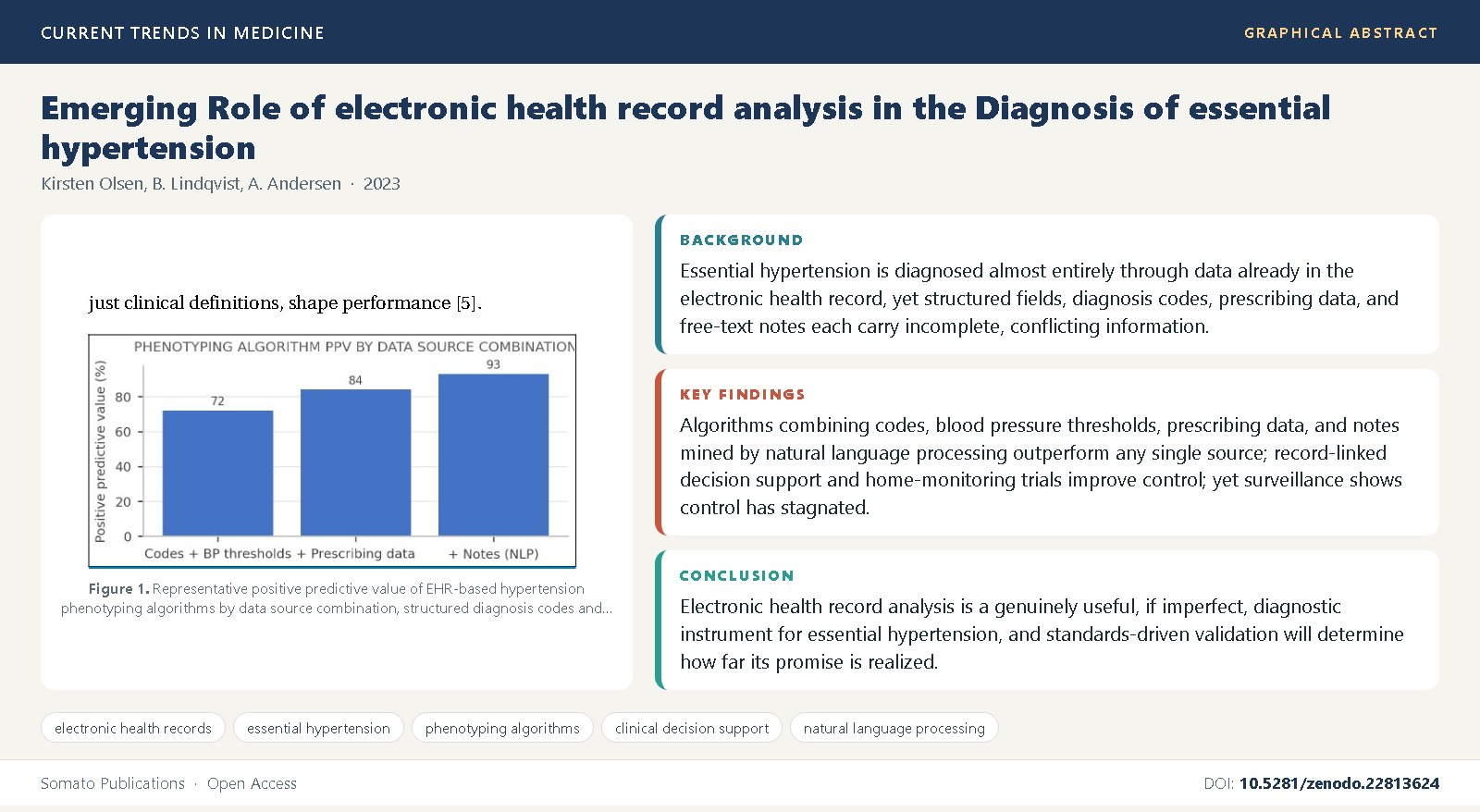
Background: Essential hypertension is diagnosed almost entirely through data already in the electronic health record, yet structured fields, diagnosis codes, prescribing data, and free-text notes each carry incomplete, conflicting information.
Objective: This review synthesizes the literature on electronic health record analysis for identifying essential hypertension: phenotyping algorithms, natural language processing and machine learning extraction, and decision support applications.
Methods: We conducted a narrative synthesis of peer-reviewed studies on electronic health record-based hypertension phenotyping, natural language processing extraction of blood pressure data, and randomized trials of record-linked decision support.
Findings: Algorithms combining codes, blood pressure thresholds, prescribing data, and notes mined by natural language processing outperform any single source; record-linked decision support and home-monitoring trials improve control; yet surveillance shows control has stagnated.
Conclusions: Electronic health record analysis is a genuinely useful, if imperfect, diagnostic instrument for essential hypertension, and standards-driven validation will determine how far its promise is realized.
References
Whelton, P.K., Carey, R.M., Aronow, W.S., et al. (2018) 2017 ACC /AHA/AAPA/ABC/ACPM/AGS/APhA/ASH/ASPC/NMA/PC NA Guideline for the Prevention, Detection, Evaluation, and Management of High Blood Pressure in Adults. Hypertension, 71(6): e13-e115. DOI: 10.1161/HYP.0000000000000065
Muntner, P., Hardy, S.T., Fine, L.J., et al. (2020) Trends in Blood Pressure Control Among US Adults With Hypertension, 1999-2000 to 2017-2018. JAMA, 324(12): 1190-1200. DOI: 10.1001/jama.2020.14545
NCD Risk Factor Collaboration (NCD-RisC) (2017) Worldwide trends in blood pressure from 1975 to 2015: a pooled analysis of 1479 population-based measurement studies with 19.1 million participants. Lancet, 389(10064): 37-55. DOI: 10.1016/S0140-6736(16)31919-5
Teixeira, P.L., Wei, W.Q., Cronin, R.M., et al. (2017) Evaluating electronic health record data sources and algorithmic approaches to identify hypertensive individuals. Journal of the American Medical Informatics Association, 24(1): 162-171. DOI: 10.1093/jamia/ocw071
Newton, K.M., Peissig, P.L., Kho, A.N., et al. (2013) Validation of electronic medical record-based phenotyping algorithms: results and lessons learned from the eMERGE network. Journal of the American Medical Informatics Association, 20(e1): e147-e154. DOI: 10.1136/amiajnl-2012-000896
Wei, W.Q., Teixeira, P.L., Mo, H., Cronin, R.M., Warner, J.L., Denny, J.C. (2016) Combining billing codes, clinical notes, and medications from electronic health records provides superior phenotyping performance. Journal of the American Medical Informatics Association, 23(e1): e20-e27. DOI: 10.1093/jamia/ocv130
Shivade, C., Raghavan, P., Fosler-Lussier, E., Embi, P.J., Elhadad, N., Johnson, S.B., Lai, A.M. (2014) A review of approaches to identifying patient phenotype cohorts using electronic health records. Journal of the American Medical Informatics Association, 21(2): 221-230. DOI: 10.1136/amiajnl-2013-001935
Turchin, A., Shubina, M., Breydo, E., Pendergrass, M.L., Einbinder, J.S. (2009) Comparison of information content of structured and narrative text data sources on the example of medication intensification. Journal of the American Medical Informatics Association, 16(3): 362-370. DOI: 10.1197/jamia.M2777
Yu, S., Liao, K.P., Shaw, S.Y., et al. (2015) Toward high-throughput phenotyping: unbiased automated feature extraction and selection from knowledge sources. Journal of the American Medical Informatics Association, 22(5): 993-1000. DOI: 10.1093/jamia/ocv034
Halpern, Y., Horng, S., Choi, Y., Sontag, D. (2016) Electronic medical record phenotyping using the anchor and learn framework. Journal of the American Medical Informatics Association, 23(4): 731-740. DOI: 10.1093/jamia/ocw011
Agarwal, V., Podchiyska, T., Banda, J.M., et al. (2016) Learning statistical models of phenotypes using noisy labeled training data. Journal of the American Medical Informatics Association, 23(6): 1166-1173. DOI: 10.1093/jamia/ocw028
Banda, J.M., Seneviratne, M., Hernandez-Boussard, T., Shah, N.H. (2018) Advances in Electronic Phenotyping: From Rule-Based Definitions to Machine Learning Models. Annual Review of Biomedical Data Science, 1: 53-68. DOI: 10.1146/annurev-biodatasci-080917-013315
Egan, B.M., Zhao, Y., Axon, R.N. (2010) US trends in prevalence, awareness, treatment, and control of hypertension, 1988-2008. JAMA, 303(20): 2043-2050. DOI: 10.1001/jama.2010.650
Wang, T.J., Vasan, R.S. (2005) Epidemiology of uncontrolled hypertension in the United States. Circulation, 112(11): 1651-1662. DOI: 10.1161/CIRCULATIONAHA.104.490599
Cohen, J.B., Lotito, M.J., Trivedi, U.K., Denker, M.G., Cohen, D.L., Townsend, R.R. (2019) Cardiovascular Events and Mortality in White Coat Hypertension: A Systematic Review and Meta-analysis. Annals of Internal Medicine, 170(12): 853-862. DOI: 10.7326/M19-0223
Kawamoto, K., Houlihan, C.A., Balas, E.A., Lobach, D.F. (2005) Improving clinical practice using clinical decision support systems: a systematic review of trials to identify features critical to success. BMJ, 330(7494): 765. DOI: 10.1136/bmj.38398.500764.8F
Bates, D.W., Kuperman, G.J., Wang, S., et al. (2003) Ten commandments for effective clinical decision support: making the practice of evidence-based medicine a reality. Journal of the American Medical Informatics Association, 10(6): 523-530. DOI: 10.1197/jamia.M1370
Bright, T.J., Wong, A., Dhurjati, R., et al. (2012) Effect of clinical decision-support systems: a systematic review. Annals of Internal Medicine, 157(1): 29-43. DOI: 10.7326/0003-4819-157-1-201207030-00450
Roumie, C.L., Elasy, T.A., Greevy, R., et al. (2006) Improving blood pressure control through provider education, provider alerts, and patient education: a cluster randomized trial. Annals of Internal Medicine, 145(3): 165-175. DOI: 10.7326/0003-4819-145-3-200608010-00004
Green, B.B., Cook, A.J., Ralston, J.D., et al. (2008) Effectiveness of home blood pressure monitoring, Web communication, and pharmacist care on hypertension control: a randomized controlled trial. JAMA, 299(24): 2857-2867. DOI: 10.1001/jama.299.24.2857
Margolis, K.L., Asche, S.E., Bergdall, A.R., et al. (2013) Effect of home blood pressure telemonitoring and pharmacist management on blood pressure control: a cluster randomized clinical trial. JAMA, 310(1): 46-56. DOI: 10.1001/jama.2013.6549
McManus, R.J., Mant, J., Haque, M.S., et al. (2014) Effect of self-monitoring and medication self-titration on systolic blood pressure in hypertensive patients at high risk of cardiovascular disease: the TASMIN-SR randomized clinical trial. JAMA, 312(8): 799-808. DOI: 10.1001/jama.2014.10057
Tang, P.C., Ralston, M., Arrigotti, M.F., Qureshi, L., Graham, J. (2007) Comparison of methodologies for calculating quality measures based on administrative data versus clinical data from an electronic health record system: implications for performance measures. Journal of the American Medical Informatics Association, 14(1): 10-15. DOI: 10.1197/jamia.M2198
Persell, S.D., Dolan, N.C., Friesema, E.M., Thompson, J.A., Kaiser, D., Baker, D.W. (2010) Frequency of inappropriate medical exceptions to quality measures. Annals of Internal Medicine, 152(4): 225-231. 10.7326/0003-4819-152-4-201002160-00007
Persell, S.D., Kaiser, D., Dolan, N.C., et al. (2011) Changes in performance after implementation of a multifaceted electronic-health-record-based quality improvement system. Medical Care, 49(2): 117-125. 10.1097/MLR.0b013e318202913d
Muntner, P., Shimbo, D., Carey, R.M., et al. (2019) Measurement of Blood Pressure in Humans: A Scientific Statement From the American Heart Association. Hypertension, 73(5): e35-e66. 10.1161/HYP.0000000000000087
Powers, B.J., Olsen, M.K., Smith, V.A., Woolson, R.F., Bosworth, H.B., Oddone, E.Z. (2011) Measuring blood pressure for decision making and quality reporting: where and how many measures? Annals of Internal Medicine, 154(12): 781-788. 10.7326/0003-4819-154-12-201106210-00005
Rakotz, M.K., Townsend, R.R., Yang, J., et al. (2017) Medical Students and Measuring Blood Pressure: Results From the American Medical Association Blood Pressure Check Challenge. Journal of Clinical Hypertension, 19(6): 614-619. DOI: 10.1111/jch.13018
Hripcsak, G., Albers, D.J. (2013) Next-generation phenotyping of electronic health records. Journal of the American Medical Informatics Association, 20(1): 117-121. DOI: 10.1136/amiajnl-2012-001145
Goldstein, B.A., Navar, A.M., Pencina, M.J., Ioannidis, J.P.A. (2017) Opportunities and challenges in developing risk prediction models with electronic health record data: a systematic review. Journal of the American Medical Informatics Association, 24(1): 198-208. 10.1093/jamia/ocw042
Denny, J.C. (2012) Chapter 13: Mining electronic health records in the genomics era. PLoS Computational Biology, 8(12): e1002823. DOI: 10.1371/journal.pcbi.1002823 DOI: DOI: DOI: DOI: DOI:

Published
Issue
Section
License
Copyright (c) 2023 Kirsten Olsen, et al.

This work is licensed under a Creative Commons Attribution 4.0 International License.


