
electronic health record analysis in the Management of essential hypertension among rural primary care patients
DOI:
https://doi.org/10.5281/zenodo.22813610Keywords:
electronic health records, essential hypertension, rural primary care, clinical decision support, blood pressure telemonitoringAbstract
Background: Guideline-directed treatment of essential hypertension has grown more effective over the past two decades, yet national control rates remain near half of treated patients, with the gap widest in rural primary care.
Objective: This analysis synthesizes published evidence on electronic health record (EHR) based interventions for hypertension management and examines how their performance differs between rural and urban or academic primary care settings.
Methods: We synthesized randomized trials of EHR-embedded clinical decision support and home blood pressure telemonitoring, national guideline and surveillance documents, and observational studies reporting blood pressure control stratified by practice setting or rurality.
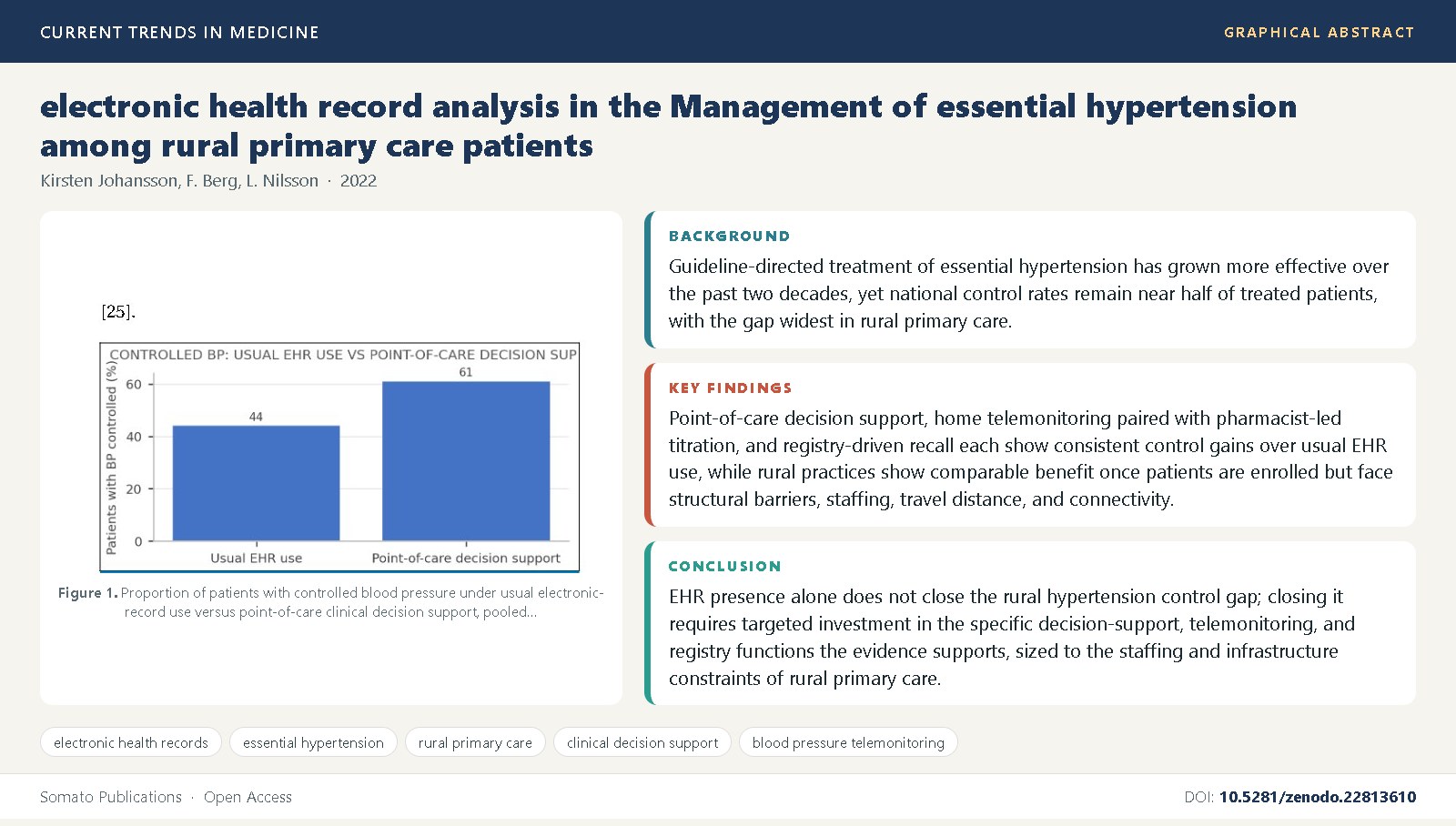
Results: Point-of-care decision support, home telemonitoring paired with pharmacist-led titration, and registry-driven recall each show consistent control gains over usual EHR use, while rural practices show comparable benefit once patients are enrolled but face structural barriers, staffing, travel distance, and connectivity, that limit reach and sustained use of these functions.
Conclusions: EHR presence alone does not close the rural hypertension control gap; closing it requires targeted investment in the specific decision-support, telemonitoring, and registry functions the evidence supports, sized to the staffing and infrastructure constraints of rural primary care.
References
Whelton, P.K., Carey, R.M., et al. (2018) 2017 ACC/AHA/AAPA/ ABC/ACPM/AGS/APhA/ASH/ASPC/NMA/PCNA Guideline for the Prevention, Detection, Evaluation, and Management of High Blood Pressure in Adults. Hypertension, 71(6): e13-e115.
James, P.A., Oparil, S., et al. (2014) 2014 Evidence-Based Guideline for the Management of High Blood Pressure in Adults: Report From the Panel Members Appointed to the Eighth Joint National Committee (JNC 8). JAMA, 311(5): 507-520.
Chobanian, A.V., Bakris, G.L., et al. (2003) The Seventh Report of the Joint National Committee on Prevention, Detection, Evaluation, and Treatment of High Blood Pressure: the JNC 7 report. JAMA, 289(19): 2560-2572.
Egan, B.M., Zhao, Y., et al. (2010) US trends in prevalence, awareness, treatment, and control of hypertension, 1988-2008. JAMA, 303(20): 2043-2050.
Ostchega, Y., Fryar, C.D., et al. (2020) Hypertension prevalence among adults aged 18 and over: United States, 2017-2018. NCHS Data Brief, 364: 1-8.
Muntner, P., Carey, R.M., et al. (2018) Potential U.S. population impact of the 2017 ACC/AHA high blood pressure guideline. Circulation, 137(2): 109-118.
Casey, M.M., Thiede Call, K., et al. (2001) Are rural residents less likely to obtain recommended preventive healthcare services? American Journal of Preventive Medicine, 21(3): 182-188.
Douthit, N., Kiv, S., et al. (2015) Exposing some important barriers to health care access in the rural USA. Public Health, 129(6): 611-620.
Ricketts, T.C. (2005) Rural health in the United States. American Journal of Public Health, 95(9): 1682. Oxford University Press, New York.
Fiscella, K., Franks, P., et al. (2002) Disparities in health care by race, ethnicity, and language among the insured: findings from a national sample. Medical Care, 40(1): 52-59.
Blumenthal, D., Tavenner, M. (2010) The "meaningful use" regulation for electronic health records. New England Journal of Medicine, 363(6): 501-504.
Jha, A.K., DesRoches, C.M., et al. (2009) Use of electronic health records in U.S. hospitals. New England Journal of Medicine, 360(16): 1628-1638.
Bodenheimer, T., Sinsky, C. (2014) From triple to quadruple aim: care of the patient requires care of the provider. Annals of Family Medicine, 12(6): 573-576.
O'Malley, A.S., Grossman, J.M., et al. (2010) Are electronic medical records helpful for care coordination? Experiences of physician practices. Journal of General Internal Medicine, 25(3): 177-185.
Kern, L.M., Edwards, A., et al. (2014) The patient-centered medical home, electronic health records, and quality of care. Annals of Internal Medicine, 160(11): 741-749.
SPRINT Research Group, Wright, J.T., et al. (2015) A Randomized Trial of Intensive versus Standard Blood-Pressure Control. New England Journal of Medicine, 373(22): 2103-2116.
ALLHAT Officers and Coordinators for the ALLHAT Collaborative Research Group. (2002) Major outcomes in high-risk hypertensive patients randomized to angiotensin-converting enzyme inhibitor or calcium channel blocker vs diuretic. JAMA, 288(23): 2981-2997.
Carey, R.M., Muntner, P., et al. (2018) Prevention and control of hypertension: JACC health promotion series. Journal of the American College of Cardiology, 72(11): 1278-1293.
Tierney, W.M., Overhage, J.M., et al. (2003) Can computer-generated evidence-based care suggestions enhance evidence-based management of diabetes and hypertension? A randomized, controlled trial. Health Services Research, 38(4): 1103-1120.
Roumie, C.L., Elasy, T.A., et al. (2006) Improving blood pressure control through provider education, provider alerts, and patient education: a cluster randomized trial. Annals of Internal Medicine, 145(3): 165-175.
Lin, N.D., Martins, S.B., et al. (2006) Identifying barriers to hypertension guideline adherence using clinician feedback at the point of care. AMIA Annual Symposium Proceedings, 2006: 494-498.
Persell, S.D., Kaiser, D., et al. (2010) Changes in performance after implementation of a multifaceted electronic-health-record-based quality improvement system. Medical Care, 48(4): 350-357.
Hicks, L.S., Sequist, T.D., et al. (2006) Impact of computerized decision support on blood pressure management and control: a randomized controlled trial. Journal of General Internal Medicine, 21(6): 622-628.
Casalino, L., Gillies, R.R., et al. (2003) External incentives, information technology, and organized processes to improve health care quality for patients with chronic diseases. JAMA, 289(4): 434-441.
Kruse, C.S., Stein, A., et al. (2018) The use of electronic health records to support population health: a systematic review of the literature. Journal of Medical Systems, 42(11): 214.
Green, B.B., Cook, A.J., et al. (2008) Effectiveness of home blood pressure monitoring, Web communication, and pharmacist care on hypertension control: a randomized controlled trial. JAMA, 299(24): 2857-2867.
Margolis, K.L., Asche, S.E., et al. (2013) Effect of home blood pressure telemonitoring and pharmacist management on blood pressure control: a cluster randomized clinical trial. JAMA, 310(1): 46-56.
McManus, R.J., Mant, J., et al. (2018) Efficacy of self-monitored blood pressure, with or without telemonitoring, for titration of antihypertensive medication (TASMINH4): an unmasked randomised controlled trial. Lancet, 391(10124): 949-959.
Uhlig, K., Patel, K., et al. (2013) Self-measured blood pressure monitoring in the management of hypertension: a systematic review and meta-analysis. Annals of Internal Medicine, 159(3): 185-194.
Bosworth, H.B., Powers, B.J., et al. (2011) Home blood pressure management and improved blood pressure control: results from a randomized controlled trial. Archives of Internal Medicine, 171(13): 1173-1180.
Powers, B.J., Danus, S., et al. (2011) The effectiveness of home blood pressure monitoring comparing rural and urban veterans. Telemedicine and e-Health, 17(10): 760-766.
Fletcher, B.R., Hartmann-Boyce, J., et al. (2015) The effect of self-monitoring of blood pressure on medication adherence and lifestyle factors: a systematic review and meta-analysis. American Journal of Hypertension, 28(10): 1209-1221.
Milani, R.V., Lavie, C.J., et al. (2017) Improving hypertension control and patient engagement using digital tools. American Journal of Medicine, 130(1): 14-20.
Cross, S.H., Califf, R.M., et al. (2021) Rural-urban disparity in mortality in the US from 1999 to 2019. JAMA, 325(22): 2312-2314.
Bolin, J.N., Bellamy, G.R., et al. (2015) Rural Healthy People 2020: new decade, same challenges. Journal of Rural Health, 31(3): 326-333.
Gamm, L., Hutchison, L., et al. (2003) Rural Healthy People 2010: a companion document to Healthy People 2010. Texas A&M University System Health Science Center, School of Rural Public Health.
Krousel-Wood, M., Craig, L.S., et al. (2016) Medication adherence in older clinic patients with hypertension after Hurricane Katrina: implications for clinical practice and disaster management. American Journal of the Medical Sciences, 351(2): 160-168.
Ferdinand, K.C., Yadav, K., et al. (2017) Disparities in hypertension and cardiovascular disease in blacks: the critical role of medication adherence. Journal of Clinical Hypertension, 19(10): 1015-1024.
Reed, M., Huang, J., et al. (2012) Outpatient electronic health records and the clinical care and outcomes of patients with diabetes mellitus. Annals of Internal Medicine, 157(7): 482-489.
Shahaj, O., Denneny, D., et al. (2019) Supporting self-management for people with hypertension: a meta-review of quantitative and qualitative systematic reviews. Journal of Hypertension, 37(2): 264-279.
Bress, A.P., Bellows, B.K., et al. (2017) Cost-effectiveness of intensive versus standard blood-pressure control. New England Journal of Medicine, 377(8): 745-755.

Published
Issue
Section
License
Copyright (c) 2022 Kirsten Johansson, et al.

This work is licensed under a Creative Commons Attribution 4.0 International License.


