
Hydroxychloroquine for Pre-Exposure Prophylaxis for Sars-Cov-2
Keywords:
Hydroxychloroquine, Pre-exposure prophylaxis, COVID-19, SARS-CoV-2Abstract
SARS-CoV-2 infection has a high transmission level. At the present time there is not a specific treatment approved but it is
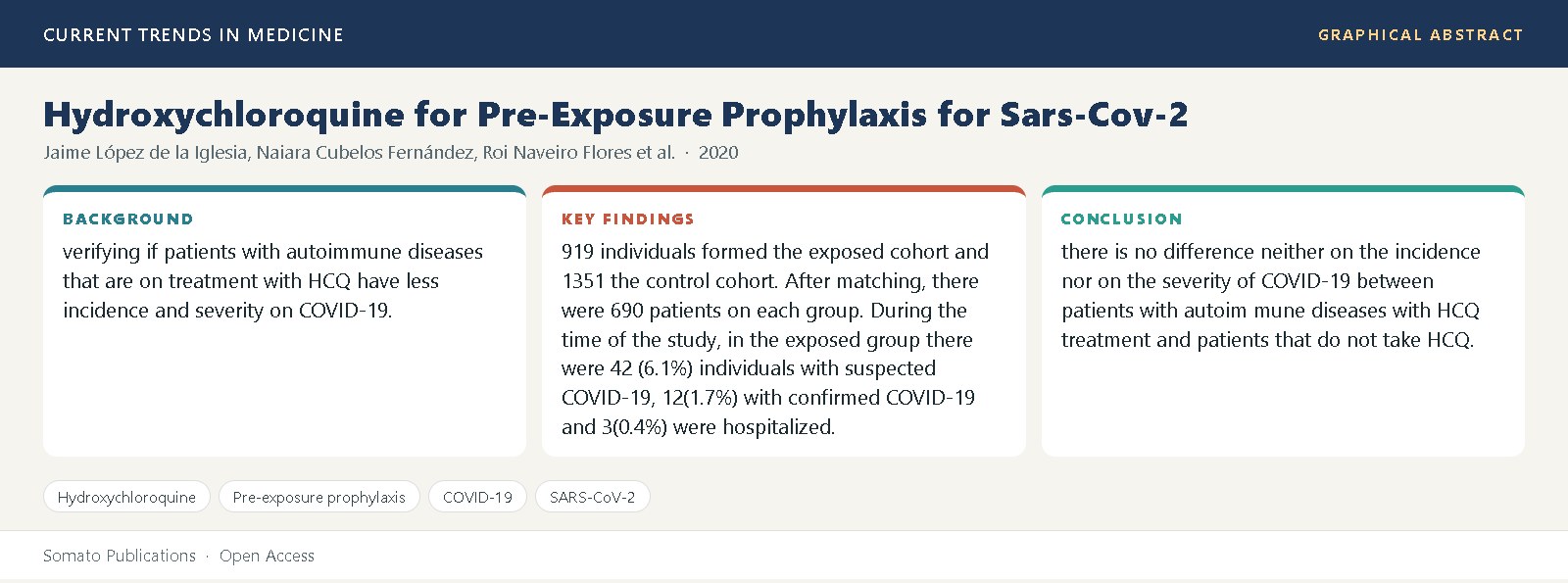
known that, in vitro, chloroquine and hydroxychloroquine can inhibit the coronavirus. Objective: verifying if patients with autoimmune diseases that are on treatment with HCQ have less incidence and severity on COVID-19. Material and methods: this is a retrospective cohort study. The exposed cohort was formed by individuals with autoimmune diseases with HCQ treatment. The control cohort was randomly selected using the Health Card database. To deal with confound ing variables and evaluate the effect of HCQ on the incidence and severity of SARS-CoV-2 infection, propensity score matching was used. Risk difference and paired percentage difference between exposed and non-exposed groups was estimated.Results: 919 individuals formed the exposed cohort and 1351 the control cohort. After matching, there were 690 patients on each group. During the time of the study, in the exposed group there were 42 (6.1%) individuals with suspected COVID-19, 12(1.7%) with confirmed COVID-19 and 3(0.4%) were hospitalized. In the control group there were 30(4.3%) individuals with suspected COVID-19, 13(1.9%) with confirmed COVID-19 and 2(0.3%) were hospitalized. The risk difference between each co hort was: 0.017(-0.05-0.04) for suspected COVID-19; -0.014(-0.015-0.012) for confirmed COVID-19 and 0.001(-0.007-0.007) for hospitalized patients. There were not significant differences. Conclusion: there is no difference neither on the incidence nor on the severity of COVID-19 between patients with autoim mune diseases with HCQ treatment and patients that do not take HCQ. Strengths and limitations of this study Strenghts: Ii provides evidence on pre-exposure prophylaxis of HCQ against COVID-19 for which there is still no evidence in clinical trials. The study on the pre-exposure prophylaxis of HCQ was carried out during the period of maximum circulation of SARS-COV-2 in Spain. Therefore, both cohorts had a high probability of exposure to the virus, which increases the power of the study. The dose of HCQ taken by most of the study subjects (400 mg per day) is similar to that used in several clinical trials that are underway as pre- and post-exposure prophylaxis of COVID-19. Limitations: The population of the exposed group suffers entirely from rheumatic diseases. This condition could act as a con founding factor, making it difficult to generalize the results to the entire population. Propensity score matching resulted in a reduction in sample size. Of the 900 initial couples, only 690 survive. Given the shortage of diagnostic tests during the study period, many of the possible COVID-19s were left unconfirmed, limiting the power of the study.
References
Savarino, A., Boelaert, JR., Cassone, A., Majori, G., and Cauda R. (2003) Effects of chloroquine on viral infections: an old drug against today's diseases?.Lancet Infect Dis, 3(11): 722-727.
Biot, C., Daher, W., Chavain, N., Chavain, N., Fandeur, T., Khalife, J., et al. (2006) Design and synthesis of hydroxyferroquine derivatives with antimalarial and antiviral activities. J Med Chem, 99(9): 2845-2849.
Yao, X., Ye, F., Zhang, M., Cui, C., Huang, B., Niu, P., et al. (2020) In vitro antiviral activity and projection of optimized dosing design of hydroxychloroquine for the treatment of severe acute respiratory syndrome main point: hydroxychloroquine was found to be more potent than chloroquine at inhibiting SARS- CoV-2 in vit. Clin Infect Dis, 71(15): 732-739.
Al-Kofaji, M., Jabobson, P., Boulware, DR., Matas, A., Kandaswamy, R., Jaber, M., et al. (2020) Finding the Dos for Hydroxychloroquine Prophylaxis for COVID-19: The Desperate Search for Effectiveness. Clin Pharmacol Ther, 108(4): 766-769.
Zhaowei, C., Jijia, H., Zhang, Z., Shan, J., Shoumeng, H., Dandan, Y., et al. (2020) Efficacy of hydroxychloroquine in patients with COVID-19: results of a randomized clinical trial. BMJ Yale, Version: 3.
Gautret, P., Lagier, JC., Parola, P., Hoang, VT., Meddeb, L., Mailhe, M., et al. (2020) Hydroxychloroquine and azithromycin as a treatment of COVID-19: results of an open-label non-randomized clinical trial. Int J Antimicrob Agents, 56(1):105949.
Million, M., Lagier, JC., Gautret, P., Colson, P., Fournier, P., Amrane, S., et al. (2020) Early treatment of COVID-19 patients with hydroxychloroquine and azithromycin: A retrospective analysis of 1061 cases in Marseille, France. Travel Med Infect Dis, 35: 101738.
Tang, W., Cao, Z., Han, M., Wang, Z., Chen, J., Sun, W., et al. (2019) Hydroxychloroquine in patients with mainly mild to moderate coronavirus disease 2019: open label, randomised controlled trial. BMJ, 14(369): m1849.
Mahévas, M., Tran, VT., Roumier, M., Chabrol, A., Paule, R., Guillaud, C., et al. (2020) Clinical efficacy of hydroxychloroquine in patients with COVID-19 pneumonia who require oxygen: observational comparative study using routine care data. BMJ 14(369): m1844.
Rosenberg, ES., Dufort, EM., Udo, T., Wilberschied, LA., Kumar, J., Tesoriero, J., et al. (2020) Association of Treatment With Hydroxychloroquine or Azithromycin With In-Hospital Mortality in Patients With COVID-19 in New York State. JAMA, 323(24):2493-2502.
Lee, S., Son, H., Ran, Peck K. (2020) Can post-exposure prophylaxis for COVID-19 be considered as an outbreak response strategy in long-term care hospitals?. Int J Antimicrob Agents, 55(6): 105988.
Chen, Z., Hu, J., Zhang, Z., Jiang, S., Han, S., Yan, D., et al. (2020) Efficacy of hydroxychloroquine in patients with COVID-19: results of a randomized clinical trial. BMJ yale.
Joob, B., Wiwanitkit, V. (2020) SLE, hydroxychloroquine and no SLE patients with COVID-19: a comment. Ann Rheum Dis, 79(6): e61.
James, S. Brady Press Briefing Room. Remarks by President Trump, Vice President Pence, and Members of the Coronavirus Task Force in Press Briefing.
Mathian, A., Mahevas, M., Rohmer, J., Roumier, M., Cohen-Aubart, F., Amador-Borrego, B., et al. (2020) Clinical course of coronavirus disease 2019 (COVID-19) in a series of 17 patients with systemic lupus erythematosus under long-term treatment with hydroxychloroquine. Ann Rheum Dis, 79 (6): 837-839.
Konig, MF., Kim, AH., Scheetz, MH., Graef, ER., Liew, JW., Simard, J., et al. (2020) Baseline use of hydroxychloroquine in systemic lupus erythematosus does not preclude SARS-CoV-2 infection and severe COVID-19. Annals of the Rheumatic Diseases, 79(10): 1386-1388.
Rosenbaum, P. R., Rubin, D. B. (1983) The central role of the propensity score in observational studies for causal effects. Biometrika, 70(1), 41-55.
Buuren, S. V., Groothuis-Oudshoorn, K. (2010) Mice: Multivariate imputation by chained equations in R. Journal of statistical software, 45(3): 1-68.
Emmi, G., Bettiol, A., Mattioli, I., Silvestri, E., Di-Scala, G., Urban, ML., et al. (2020) SARS-CoV-2 infection among patients with systemic autoimmune diseases. Autoimmun Rev, 19(7): 102575.
Becker, S., Ichino, A. (2002) Estimation of average treatment effects based on propensity scores. The Stata journal, 2(4): 358-77.
Buuren, S. V., Groothuis-Oudshoorn, K. (2010) Mice: Multivariate imputation by chained equations in R. Journal of statistical software, 45(3): 1-68.
Sekhon, JS. (2008) Multivariate and propensity score matching software with automated balance optimization: the matching package for R. Journal of Statistical Software, 42(7).
Villa, A., Mandell, BF. (2011) Trastornos cardiovasculares y enfermedad reumatica. Rev EspCardiol, 64 (9): 809-817.
Mehra MR, Desai SS, kuy S, henry TD, Patel TD. Cardiovascular Disease, Drug Therapy, and Mortality in COVID-19. N Engl J Med, 382: e102.
Cummings, MJ., Baldwin, MR., Abrams, D., Jacobson, SD., Meyer, BJ., Blough, EM., et al. (2020) Epidemiology, clinical course, and outcomes of critically ill adults with COV- ID-19 in New York City: a prospective cohort study. Lancet, 6736(20) : 31189-31192.
Zhou, F., Yu, T., Du, R., Fan, G., Liu, Y., Liu, Z., et al. (2020) Clinical course and risk factors for mortality of adult In patients with COVID-19 in Wuhan, China: a retrospective cohort study. Lancet, 395(10229): 1054-1062.
Pablos, JL., Abasolo-Alcázar, L., Álvaro-Gracia, JM., Blanco, FJ., Balnco, R., Castrejon, I., et al. (2020) Prevalence of hospital PCR confirmed COVID-19 cases in patients with chronic inflammatory and autoimmune rheumatic diseases. Ann Rheum Dis, 79(9): 1170-1173.
D'Silva, KM., Serling-Boyd, N., Wallwork, R., et al. (2020) Clinical characteristics and outcomes of patients with coronavirus disease 2019 (COVID-19) and rheumatic disease: a comparative cohort study from a US 'hot spot'. Ann Rheum Dis, 79(9): 1156-1162.
Gianfrancesco, M., Hyrich, KL., Al-Adely, S., Carmona, L., Danila, MI., Gossec, L., et al. (2020) Characteristics associated with hospitalisation for COVID-19 in people with rheumatic disease: data from the COVID 19 Global Rheumatology Alliance physician-reported registry [published online ahead of print, 2020 May 29]. Ann Rheum Dis, 79(7): 859-866.
Pablos, JL., Galindo, M., Carmona, L., Retuerto, M., Lledó, A., Blanco, R., et al. (2020) Clinical Outcomes of Patients with COVID-19 and Chronic Inflammatory and Autoimmune Rheumatic Diseases: A Multicentric Matched-Cohort Study. Ann Rheum Dis, 79(12): 1544-1549.
Shah, S., Das, S., Jain, A., Misra, DP., Negi, VS. (2020) A systematic review of the prophylactic role of chloroquine and hydroxychloroquine in coronavirus disease-19 (COV- ID-19). Int J Rheum Dis, 23(5): 613-619.




