
Prevalence and Risk Factors of postoperative wound infection in obese surgical candidates
DOI:
https://doi.org/10.5281/zenodo.22813509Keywords:
surgical site infection, obesity, risk factors, wound infection, general surgeryAbstract
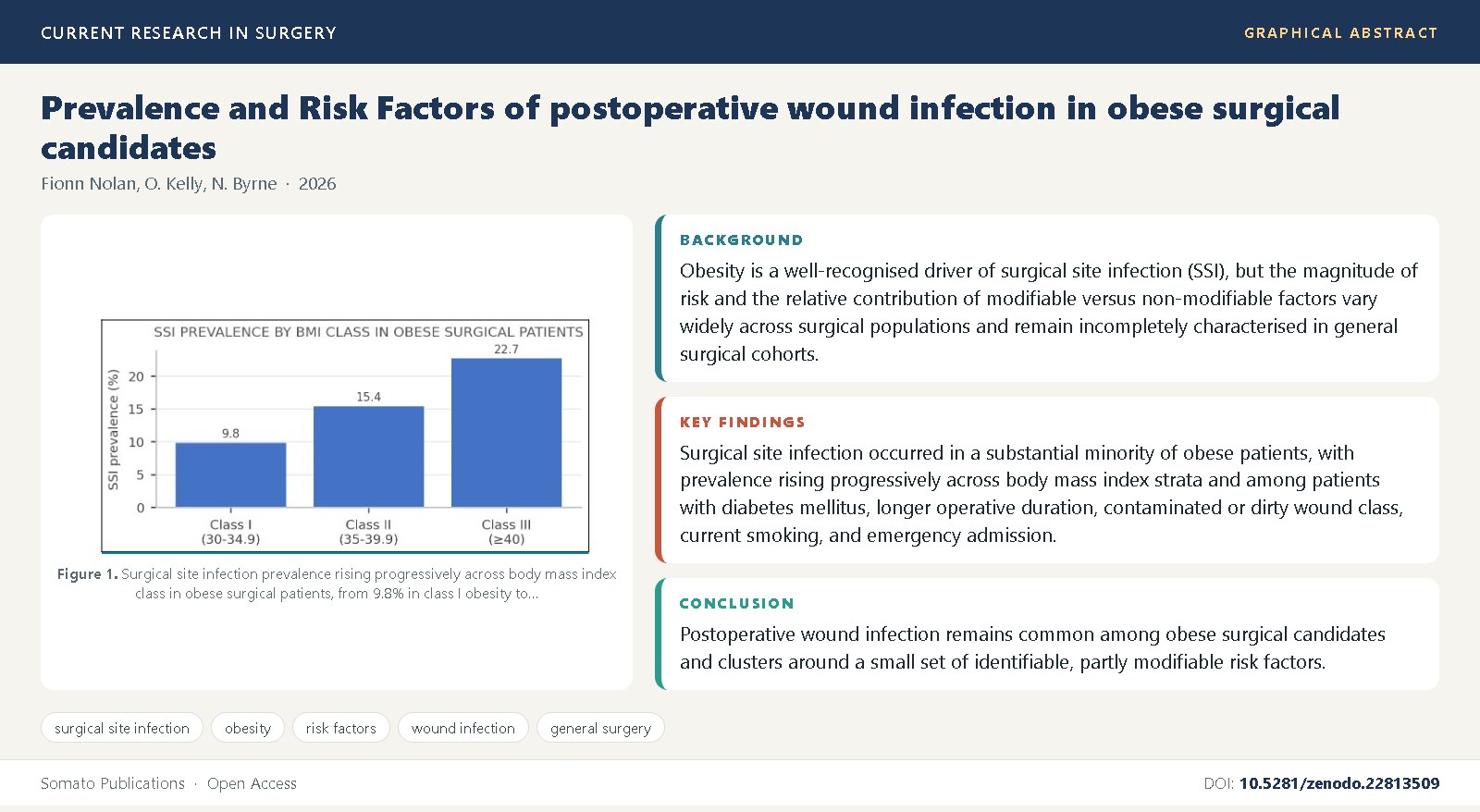
Background: Obesity is a well-recognised driver of surgical site infection (SSI), but the magnitude of risk and the relative contribution of modifiable versus non-modifiable factors vary widely across surgical populations and remain incompletely characterised in general surgical cohorts.
Objective: To determine the prevalence of postoperative wound infection among obese patients undergoing elective and emergency general surgery and to identify independent risk factors for SSI in this population.
Methods: A prospective observational cohort of adult patients with a body mass index of 30 kg/m2 or higher undergoing general surgical procedures was followed from admission through 30 days postoperatively. Wound status was assessed using Centers for Disease Control and Prevention surveillance criteria, and candidate predictors were evaluated by multivariable logistic regression.
Results: Surgical site infection occurred in a substantial minority of obese patients, with prevalence rising progressively across body mass index strata and among patients with diabetes mellitus, longer operative duration, contaminated or dirty wound class, current smoking, and emergency admission. Multivariable analysis identified body mass index of 35 kg/m2 or higher, diabetes mellitus, operative time exceeding two hours, and wound class III-IV as independent predictors of infection.
Conclusion: Postoperative wound infection remains common among obese surgical candidates and clusters around a small set of identifiable, partly modifiable risk factors. Targeted perioperative optimisation of glycaemic control, tissue oxygenation, antibiotic prophylaxis timing, and operative efficiency in higher-risk obese subgroups may reduce this burden.
References
Mangram, A.J., Horan, T.C., Pearson, M.L., Silver, L.C., Jarvis, W.R. (1999) Guideline for prevention of surgical site infection, 1999. Infection Control and Hospital Epidemiology, 20(4): 250-278.
Dindo, D., Muller, M.K., Weber, M., Clavien, P.A. (2003) Obesity in general elective surgery. Lancet, 361(9374): 2032-2035.
Falagas, M.E., Kompoti, M. (2006) Obesity and infection. Lancet Infectious Diseases, 6(7): 438-446.
Thelwall, S., Harrington, P., Sheridan, E., Lamagni, T. (2015) Impact of obesity on the risk of wound infection following surgery: results from a nationwide prospective multicentre cohort study in England. Clinical Microbiology and Infection, 21(11): 1008.e1-1008.e8.
Waisbren, E., Rosen, H., Bader, A.M., Lipsitz, S.R., Rogers, S.O., Eberlin, K.R. (2010) Percent body fat and prediction of surgical site infection. Journal of the American College of Surgeons, 210(4): 381-389.
Pierpont, Y.N., Dinh, T.P., Salas, R.E., Johnson, E.L., Wright, T.G., Robson, M.C., et al. (2014) Obesity and surgical wound healing: a current review. ISRN Obesity, 2014: 638936.
Gurunathan, U., Myles, P.S. (2016) Limitations of body mass index as an obesity measure of perioperative risk. British Journal of Anaesthesia, 116(3): 319-321.
Winfield, R.D., Reese, S., Bochicchio, K., Mazuski, J.E., Bochicchio, G.V. (2016) Obesity and the risk for surgical site infection in abdominal surgery. The American Surgeon, 82(4): 331-336.
Choban, P.S., Heckler, R., Burge, J.C., Flancbaum, L. (1995) Increased incidence of nosocomial infections in obese surgical patients. The American Surgeon, 61(11): 1001-1005.
Cheadle, W.G. (2006) Risk factors for surgical site infection. Surgical Infections, 7(Suppl 1): S7-S11.
Anderson, D.J., Podgorny, K., Berrios-Torres, S.I., Bratzler, D.W., Dellinger, E.P., Greene, L., et al. (2014) Strategies to prevent surgical site infections in acute care hospitals: 2014 update. Infection Control and Hospital Epidemiology, 35(6): 605-627.
Berrios-Torres, S.I., Umscheid, C.A., Bratzler, D.W., Leas, B., Stone, E.C., Kelz, R.R., et al. (2017) Centers for Disease Control and Prevention guideline for the prevention of surgical site infection, 2017. JAMA Surgery, 152(8): 784-791.
Bratzler, D.W., Dellinger, E.P., Olsen, K.M., Perl, T.M., Auwaerter, P.G., Bolon, M.K., et al. (2013) Clinical practice guidelines for antimicrobial prophylaxis in surgery. American Journal of Health-System Pharmacy, 70(3): 195-283.
Ban, K.A., Minei, J.P., Laronga, C., Harbrecht, B.G., Jensen, E.H., Fry, D.E., et al. (2017) American College of Surgeons and Surgical Infection Society: surgical site infection guidelines, 2016 update. Journal of the American College of Surgeons, 224(1): 59-74.
Neumayer, L., Hosokawa, P., Itani, K., El-Tamer, M., Henderson, W.G., Khuri, S.F. (2007) Multivariable predictors of postoperative surgical site infection after general and vascular surgery: results from the patient safety in surgery study. Journal of the American College of Surgeons, 204(6): 1178-1187.
Meijs, A.P., Koek, M.B.G., Vos, M.C., Geerlings, S.E., Vogely, H.C., de Greeff, S.C. (2019) The effect of body mass index on the risk of surgical site infection. Infection Control and Hospital Epidemiology, 40(9): 991-996.
Dronge, A.S., Perkal, M.F., Kancir, S., Concato, J., Aslan, M., Rosenthal, R.A. (2006) Long-term glycemic control and postoperative infectious complications. Archives of Surgery, 141(4): 375-380.
Davenport, D.L., Bowe, E.A., Henderson, W.G., Khuri, S.F., Mentzer, R.M. (2006) National Surgical Quality Improvement Program (NSQIP) risk factors can be used to validate American Society of Anesthesiologists Physical Status Classification (ASA PS) levels. Annals of Surgery, 243(5): 636-641.
Malone, D.L., Genuit, T., Tracy, J.K., Gannon, C., Napolitano, L.M. (2002) Surgical site infections: reanalysis of risk factors. Journal of Surgical Research, 103(1): 89-95.
Haridas, M., Malangoni, M.A. (2008) Predictive factors for surgical site infection in general surgery. Surgery, 144(4): 496-501.
Wick, E.C., Hirose, K., Shore, A.D., Clark, J.M., Gearhart, S.L., Efron, J., et al. (2011) Surgical site infections and cost in obese patients undergoing colorectal surgery. Archives of Surgery, 146(9): 1068-1072.
Kaye, K.S., Schmit, K., Pieper, C., Sloan, R., Caughlan, K.F., Sexton, D.J., et al. (2005) The effect of increasing age on the risk of surgical site infection. Journal of Infectious Diseases, 191(7): 1056-1062.
Bamgbade, O.A., Rutter, T.W., Nafiu, O.O., Dorje, P. (2007) Postoperative complications in obese and nonobese patients. World Journal of Surgery, 31(3): 556-560.
Olsen, M.A., Nepple, J.J., Riew, K.D., Lenke, L.G., Bridwell, K.H., Mayfield, J., et al. (2008) Risk factors for surgical site infection following orthopaedic spinal operations. Journal of Bone and Joint Surgery (American), 90(1): 62-69.
Olsen, M.A., Butler, A.M., Willers, D.M., Devkota, P., Gross, G.A., Fraser, V.J. (2008) Risk factors for surgical site infection after low transverse cesarean section. Infection Control and Hospital Epidemiology, 29(6): 477-484.
Moulton, L.J., Munoz, J.L., Lachiewicz, M., Liu, X., Goje, O. (2018) Surgical site infection after cesarean delivery: incidence and risk factors at a US academic institution. Journal of Maternal-Fetal and Neonatal Medicine, 31(14): 1873-1880.
Lake, A.G., McPencow, A.M., Dick-Biascoechea, M.A., Martin, D.K., Erekson, E.A. (2013) Surgical site infection after hysterectomy. American Journal of Obstetrics and Gynecology, 209(5): 490.e1-490.e9.
Chalya, P.L., Mabula, J.B., Chandika, A.B., Giiti, G., Mbelenge, N., Ngayomela, I.H., et al. (2012) Surgical site infections after gastrointestinal surgery in a tertiary hospital: a prospective study. Tanzania Journal of Health Research, 14(2): 133-140.
Serra-Aracil, X., Garcia-Domingo, M.I., Pares, D., Espin-Basany, E., Biondo, S., Guirao, X., et al. (2011) Surgical site infection in elective operations for colorectal cancer after the application of preventive measures. Archives of Surgery, 146(5): 606-612.
Delgado-Rodriguez, M., Medina-Cuadros, M., Martinez-Gallego, G., Sillero-Arenas, M. (1997) Total cholesterol, HDL-cholesterol, and risk of nosocomial infection: a prospective study in surgical patients. Infection Control and Hospital Epidemiology, 18(1): 9-18.
Vilar-Compte, D., Mohar, A., Sandoval, S., de la Rosa, M., Gordillo, P., Volkow, P. (2000) Surgical site infections at the National Cancer Institute in Mexico: a case-control study. American Journal of Infection Control, 28(1): 14-20.
Yuan, K., Chen, H.L. (2013) Obesity and surgical site infections risk in orthopedics: a meta-analysis. International Journal of Surgery, 11(5): 383-388.
Chopra, T., Zhao, J.J., Alangaden, G., Wood, M.H., Kaye, K.S. (2010) Preventing surgical site infections after bariatric surgery: value of perioperative antibiotic regimens. Expert Review of Pharmacoeconomics and Outcomes Research, 10(3): 317-328.
Fields, A.C., Pradarelli, J.C., Itani, K.M.F. (2020) Preventing surgical site infections: looking beyond the current guidelines. JAMA Surgery, 155(1): 1-2.

Published
Issue
Section
License
Copyright (c) 2026 Fionn Nolan, et al.

This work is licensed under a Creative Commons Attribution 4.0 International License.


