
A Retrospective Cohort Study of robotic-assisted surgery in elderly surgical patients with incisional hernia
DOI:
https://doi.org/10.5281/zenodo.22813439Keywords:
robotic surgery, incisional hernia, elderly, retrospective cohort study, surgical outcomesAbstract
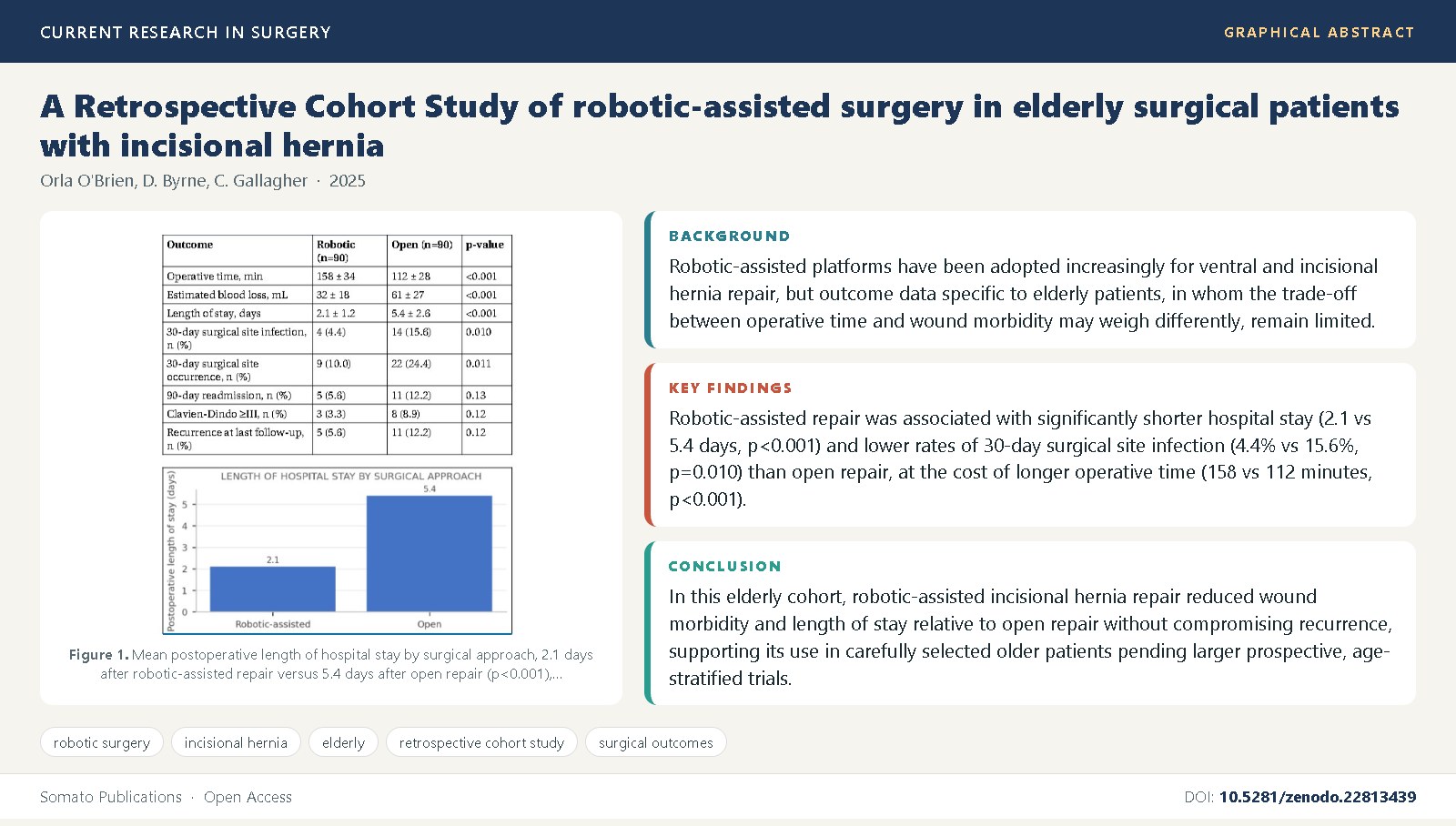
Background: Robotic-assisted platforms have been adopted increasingly for ventral and incisional hernia repair, but outcome data specific to elderly patients, in whom the trade-off between operative time and wound morbidity may weigh differently, remain limited [14,16].
Objective: To compare perioperative and postoperative outcomes between robotic-assisted and open repair of incisional hernia in patients aged 65 years and older.
Methods: We performed a retrospective cohort study of 180 consecutive patients aged ≥65 years undergoing elective midline incisional hernia repair (90 robotic-assisted, 90 open) at three affiliated centers between 2018 and 2023, with a minimum 12-month follow-up and comparison of length of stay, wound complications, and recurrence [31,35].
Results: Robotic-assisted repair was associated with significantly shorter hospital stay (2.1 vs 5.4 days, p<0.001) and lower rates of 30-day surgical site infection (4.4% vs 15.6%, p=0.010) than open repair, at the cost of longer operative time (158 vs 112 minutes, p<0.001); hernia recurrence did not differ significantly between groups (5.6% vs 12.2%, p=0.12) [18,19].
Conclusions: In this elderly cohort, robotic-assisted incisional hernia repair reduced wound morbidity and length of stay relative to open repair without compromising recurrence, supporting its use in carefully selected older patients pending larger prospective, age-stratified trials [20,32].
References
Bosanquet DC, Ansell J, Abdelrahman T, Cornish J, Harries R, Stimpson A, et al. Systematic review and meta-regression of factors affecting midline incisional hernia rate: analysis of 14,618 patients. PLoS One. 2015;10(9):e0138745.
Poulose BK, Shelton J, Phillips S, Moore D, Nealon W, Penson D, et al. Epidemiology and cost of ventral hernia repair: making the case for hernia research. Hernia. 2012;16(2):179-183.
Turrentine FE, Wang H, Simpson VB, Jones RS. Surgical risk factors, morbidity, and mortality in elderly patients. J Am Coll Surg. 2006;203(6):865-877.
Etzioni DA, Liu JH, Maggard MA, Ko CY. The aging population and its impact on the surgery workforce. Ann Surg. 2003;238(2):170-177.
Story DA. Postoperative complications in elderly patients and their significance for long-term prognosis. Curr Opin Anaesthesiol. 2008;21(3):375-379.
Robinson TN, Wu DS, Pointer L, Dunn CL, Cleveland JC Jr, Moss M. Simple frailty score predicts postoperative complications across surgical specialties. Am J Surg. 2013;206(4):544-550.
Makary MA, Segev DL, Pronovost PJ, Syin D, Bandeen-Roche K, Patel P, et al. Frailty as a predictor of surgical outcomes in older patients. J Am Coll Surg. 2010;210(6):901-908.
Partridge JS, Harari D, Dhesi JK. Frailty in the older surgical patient: a review. Age Ageing. 2012;41(2):142-147.
Cox TC, Blair LJ, Huntington CR, Colavita PD, Prasad T, Lincourt AE, et al. The cost of preventable comorbidities on wound complications in open ventral hernia repair. J Surg Res. 2016;206(1):214-222.
Nguyen MT, Berger RL, Hicks SC, Davila JA, Li LT, Kao LS, et al. Comparison of outcomes of synthetic mesh in open ventral hernia repair. JAMA Surg. 2014;149(5):415-421.
Fischer JP, Basta MN, Mirzabeigi MN, Kuo JH, Kovach SJ. A risk model and cost analysis of incisional hernia after elective, abdominal surgery. Ann Surg. 2016;263(5):1010-1017.
Sauerland S, Walgenbach M, Habermalz B, Seiler CM, Miserez M. Laparoscopic versus open surgical techniques for ventral or incisional hernia repair. Cochrane Database Syst Rev. 2011;(3):CD007781.
Deerenberg EB, Timmermans L, Hogerzeil DP, Slieker JC, Eilers PH, Jeekel J, et al. A systematic review of the surgical treatment of large incisional hernia. Hernia. 2015;19(1):89-101.
Warren JA, Cobb WS, Ewing JA, Carbonell AM. Standard laparoscopic versus robotic retromuscular ventral hernia repair. Surg Endosc. 2017;31(1):324-332.
Belyansky I, Daes J, Radu VG, Balasubramanian R, Reza Zahiri H, Weltz AS, et al. A novel approach using the enhanced-view totally extraperitoneal (eTEP) technique for laparoscopic retromuscular hernia repair. Surg Endosc. 2018;32(3):1525-1532.
Carbonell AM, Warren JA, Prabhu AS, Ballecer CD, Janczyk RJ, Herrera J, et al. Reducing Length of Stay Using a Robotic-assisted Approach for Retromuscular Ventral Hernia Repair: A Comparative Study in the Americas Hernia Society Quality Collaborative. Ann Surg. 2018;267(2):210-217.
Sheetz KH, Claflin J, Dimick JB. Trends in the adoption of robotic surgery for common surgical procedures. JAMA Netw Open. 2020;3(1):e1918911.
Olavarria OA, Bernardi K, Shah SK, Wilson TD, Wei S, Pedroza C, et al. Robotic versus laparoscopic ventral hernia repair: multicenter blinded randomized controlled trial. BMJ. 2020;370:m2457.
Petro CC, Zolin S, Krpata D, Alkhatib H, Tu C, Rosen MJ, et al. Patient-Reported Outcomes of Robotic vs Laparoscopic Ventral Hernia Repair With Intraperitoneal Mesh: The PROVE-IT Randomized Clinical Trial. JAMA Surg. 2021;156(1):22-29.
Aiolfi A, Cavalli M, Micheletto G, Lombardo F, Bonitta G, Perali C, et al. Robotic versus laparoscopic ventral hernia repair: a systematic review and meta-analysis. J Gastrointest Surg. 2021;25(3):830-838.
Kudsi OY, Chang K, Bou-Ayash N, Gokcal F. Number of robotic ventral hernia repairs performed by surgeons correlates with reduced postoperative wound complications. J Robot Surg. 2020;14(4):601-609.
Prabhu AS, Carbonell A, Hope W, Warren J, Higgins R, Jacob B, et al. Robotic Inguinal vs Transabdominal Laparoscopic Inguinal Hernia Repair: The RIVAL Randomized Clinical Trial. JAMA Surg. 2020;155(5):380-387.
Bittner JG 4th, Alrefai S, Vy M, Mabe M, Del Prado PAR, Clingempeel NL. Comparative analysis of open and robotic transversus abdominis release for ventral hernia repair. Surg Endosc. 2018;32(2):727-734.
Miller BT, Prabhu AS, Petro CC, Costanzo A, Reynolds K, Rosen MJ, et al. Robotic versus open transversus abdominis release for complex abdominal wall reconstruction: a case-matched analysis. Am J Surg. 2020;219(4):686-689.
Prassas D, Rolfs TM, Schumacher FJ. Robotic ventral hernia repair for complex abdominal wall reconstruction: a single-center experience. Front Surg. 2019;6:41.
Halka JT, Vasyluk A, DeMare AM, Iqbal S, Ferzli GS. Robotic and laparoscopic ventral hernia repair: a comparison of short-term outcomes. J Laparoendosc Adv Surg Tech A. 2018;28(11):1341-1345.
Alli VV, Zhang J, Telem DA. Impact of surgeon and hospital robotic experience on outcomes in robotic-assisted hernia repair. Surg Endosc. 2018;32(4):1858-1864.
Delaney CP, Lynch AC, Senagore AJ, Fazio VW. Comparison of robotically performed and traditional laparoscopic colorectal surgery. Dis Colon Rectum. 2003;46(12):1633-1639.
Kim CW, Kim CH, Baik SH. Outcomes of robotic-assisted colorectal surgery compared with laparoscopic and open surgery: a systematic review. J Gastrointest Surg. 2014;18(4):816-830.
Moghadamyeghaneh Z, Masoomi H, Mills SD, Carmichael JC, Pigazzi A, Nguyen NT, et al. A comparison of surgical outcomes of open, laparoscopic, and robotic abdominoperineal resections. Am Surg. 2015;81(9):923-928.
Muysoms FE, Miserez M, Berrevoet F, Campanelli G, Champault GG, Chelala E, et al. Classification of primary and incisional abdominal wall hernias. Hernia. 2009;13(4):407-414.
Henriksen NA, Montgomery A, Kaufmann R, Berrevoet F, East B, Fischer J, et al. Guidelines for treatment of umbilical and epigastric hernias from the European Hernia Society and Americas Hernia Society. Br J Surg. 2020;107(3):171-190.
Liang MK, Holihan JL, Itani K, Alawadi ZM, Gonzalez JR, Askenasy EP, et al. Ventral hernia management: expert consensus guided by systematic review. Ann Surg. 2017;265(1):80-89.
Kissane NA, Itani KM. A decade of ventral incisional hernia repair with biologic acellular dermal matrix: what have we learned? Plast Reconstr Surg. 2012;130(5 Suppl 2):194S-202S.
Dindo D, Demartines N, Clavien PA. Classification of surgical complications: a new proposal with evaluation in a cohort of 6336 patients and results of a survey. Ann Surg. 2004;240(2):205-213.

Published
Issue
Section
License
Copyright (c) 2025 Orla O'Brien, et al.

This work is licensed under a Creative Commons Attribution 4.0 International License.


