
Prevalence and Risk Factors of postoperative wound infection in elderly surgical patients
DOI:
https://doi.org/10.5281/zenodo.22813425Keywords:
surgical site infection, wound infection, elderly, risk factors, surgical outcomesAbstract
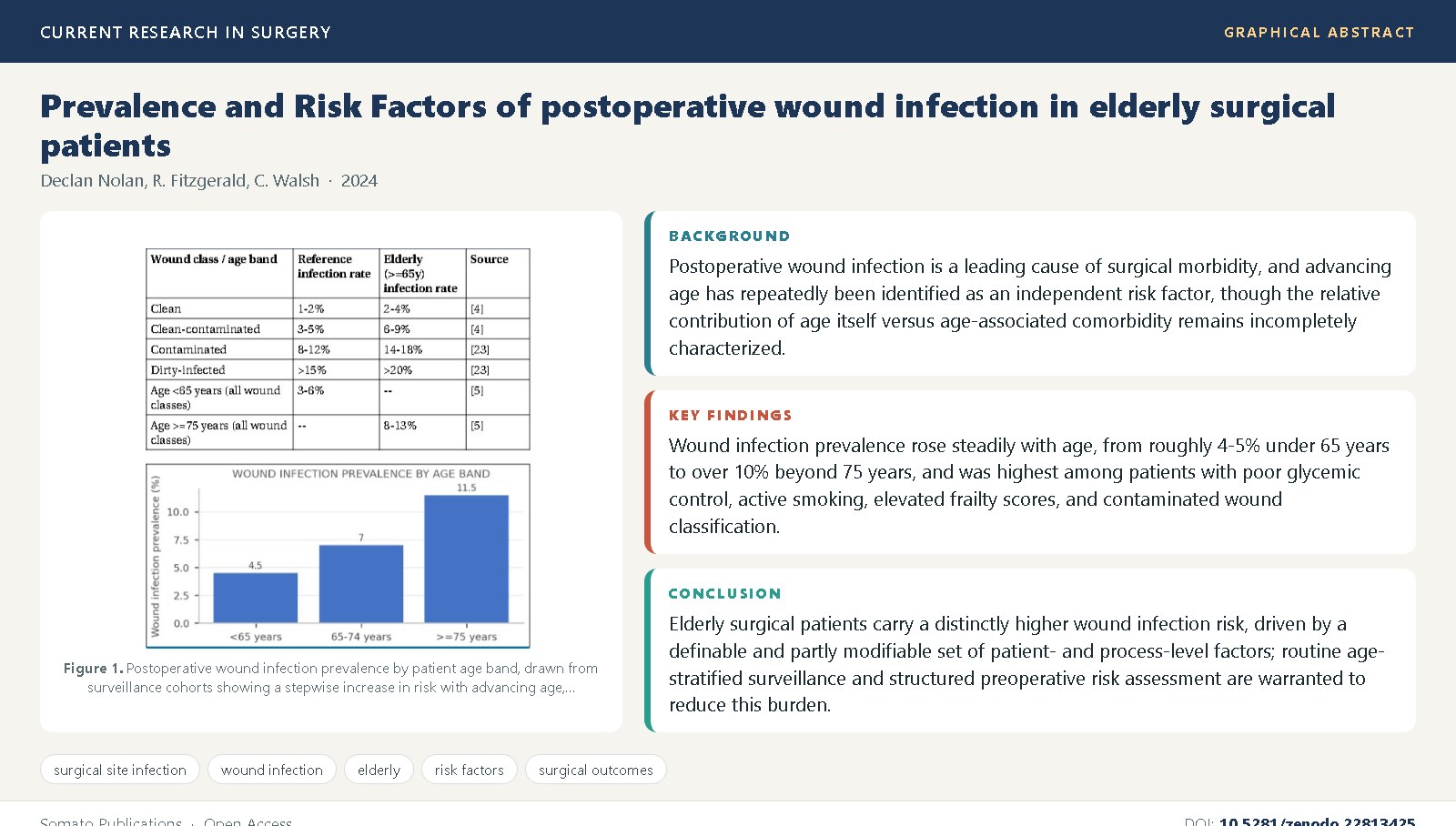
Background: Postoperative wound infection is a leading cause of surgical morbidity, and advancing age has repeatedly been identified as an independent risk factor, though the relative contribution of age itself versus age-associated comorbidity remains incompletely characterized [5,6].
Objective: This study examines the prevalence of postoperative wound infection among elderly surgical patients and identifies the preoperative, intraoperative, and postoperative factors most consistently associated with infection in this population.
Methods: We synthesized surveillance and cohort data on wound infection in patients aged 65 years and older, using CDC/NHSN case definitions and wound classification, and examined patient-, procedure-, and process-related risk factor domains reported across multicenter cohorts and trials [3,4].
Results: Wound infection prevalence rose steadily with age, from roughly 4-5% under 65 years to over 10% beyond 75 years, and was highest among patients with poor glycemic control, active smoking, elevated frailty scores, and contaminated wound classification [4,18,15]. Guideline-concordant antisepsis and prophylaxis timing were associated with lower infection rates across the reviewed cohorts [25,24].
Conclusions: Elderly surgical patients carry a distinctly higher wound infection risk, driven by a definable and partly modifiable set of patient- and process-level factors; routine age-stratified surveillance and structured preoperative risk assessment are warranted to reduce this burden [20,21].
References
Mangram, A.J., Horan, T.C., Pearson, M.L., Silver, L.C., Jarvis, W.R. (1999) Guideline for prevention of surgical site infection, 1999. Infection Control and Hospital Epidemiology, 20(4): 250-278. DOI: 10.1086/501620
Owens, C.D., Stoessel, K. (2008) Surgical site infections: epidemiology, microbiology and prevention. Journal of Hospital Infection, 70(Suppl 2): 3-10. DOI: 10.1016/S0195-6701(08)60017-1
Horan, T.C., Andrus, M., Dudeck, M.A. (2008) CDC/NHSN surveillance definition of health care-associated infection and criteria for specific types of infections in the acute care setting. American Journal of Infection Control, 36(5): 309-332. DOI: 10.1016/j.ajic.2008.03.002
Culver, D.H., Horan, T.C., Gaynes, R.P., Martone, W.J., Jarvis, W.R., Emori, T.G., et al. (1991) Surgical wound infection rates by wound class, operative procedure, and patient risk index. American Journal of Medicine, 91(3B): 152S-157S. DOI: 10.1016/0002-9343(91)90361-Z
Kaye, K.S., Schmit, K., Pieper, C., Sloane, R., Caughlan, K.F., Sexton, D.J., et al. (2005) The effect of increasing age on the risk of surgical site infection. Journal of Infectious Diseases, 191(7): 1056-1062. DOI: 10.1086/428626
Kaye, K.S., Sloane, R., Sexton, D.J., Schmader, K.A. (2006) Risk factors for surgical site infections in older people. Journal of the American Geriatrics Society, 54(3): 391-396. DOI: 10.1111/j.1532-5415.2005.00651.x
Partridge, J.S., Harari, D., Dhesi, J.K. (2012) Frailty in the older surgical patient: a review. Age and Ageing, 41(2): 142-147. DOI: 10.1093/ageing/afr182
Makary, M.A., Segev, D.L., Pronovost, P.J., Syin, D., Bandeen-Roche, K., Patel, P., et al. (2010) Frailty as a predictor of surgical outcomes in older patients. Journal of the American College of Surgeons, 210(6): 901-908. DOI: 10.1016/j.jamcollsurg.2010.01.028
Latham, R., Lancaster, A.D., Covington, J.F., Pirolo, J.S., Thomas, C.S. (2001) The association of diabetes and glucose control with surgical-site infections among cardiothoracic surgery patients. Infection Control and Hospital Epidemiology, 22(10): 607-612. DOI: 10.1086/501830
Dronge, A.S., Perkal, M.F., Kancir, S., Concato, J., Aslan, M., Rosenthal, R.A. (2006) Long-term glycemic control and postoperative infectious complications. Archives of Surgery, 141(4): 375-380. DOI: 10.1001/archsurg.141.4.375
Ata, A., Lee, J., Bestle, S.L., Desemone, J., Stain, S.C. (2010) Postoperative hyperglycemia and surgical site infection in general surgery patients. Archives of Surgery, 145(9): 858-864. DOI: 10.1001/archsurg.2010.179
Al-Niaimi, A.N., Ahmed, M., Burish, N., Chackmakchy, S.A., Seo, S., Rose, S., et al. (2015) Intensive postoperative glucose control reduces the surgical site infection rates in gynecologic oncology patients. Gynecologic Oncology, 136(1): 71-76. DOI: 10.1016/j.ygyno.2014.09.013
Kwon, S., Thompson, R., Dellinger, P., Yanez, D., Farrohki, E., Flum, D. (2013) Importance of perioperative glycemic control in general surgery: a report from the Surgical Care and Outcomes Assessment Program. Annals of Surgery, 257(1): 8-14. DOI: 10.1097/SLA.0b013e31827b6bbc
Thelwall, S., Harrington, P., Sheridan, E., Lamagni, T. (2015) Impact of obesity on the risk of wound infection following surgery: results from a nationwide prospective multicentre cohort study in England. Clinical Microbiology and Infection, 21(11): 1008.e1-1008.e8. DOI: 10.1016/j.cmi.2015.07.003
Sorensen, L.T. (2012) Wound healing and infection in surgery: the clinical impact of smoking and smoking cessation: a systematic review and meta-analysis. Archives of Surgery, 147(4): 373-383. DOI: 10.1001/archsurg.2012.5
Waltz, P.K., Zuckerbraun, B.S. (2017) Surgical site infections and associated operative characteristics. Surgical Infections, 18(4): 447-450. DOI: 10.1089/sur.2017.062
Charlson, M.E., Pompei, P., Ales, K.L., MacKenzie, C.R. (1987) A new method of classifying prognostic comorbidity in longitudinal studies: development and validation. Journal of Chronic Diseases, 40(5): 373-383. DOI: 10.1016/0021-9681(87)90171-8
Robinson, T.N., Wu, D.S., Pointer, L., Dunn, C.L., Cleveland, J.C. Jr., Moss, M. (2013) Simple frailty score predicts postoperative complications across surgical specialties. American Journal of Surgery, 206(4): 544-550. DOI: 10.1016/j.amjsurg.2013.03.012
Turrentine, F.E., Wang, H., Simpson, V.B., Jones, R.S. (2006) Surgical risk factors, morbidity, and mortality in elderly patients. Journal of the American College of Surgeons, 203(6): 865-877. DOI: 10.1016/j.jamcollsurg.2006.08.026
Chow, W.B., Rosenthal, R.A., Merkow, R.P., Ko, C.Y., Esnaola, N.F. (2012) Optimal preoperative assessment of the geriatric surgical patient: a best practices guideline. Journal of the American College of Surgeons, 215(4): 453-466. DOI: 10.1016/j.jamcollsurg.2012.06.017
Anderson, D.J., Podgorny, K., Berrios-Torres, S.I., Bratzler, D.W., Dellinger, E.P., Greene, L., et al. (2014) Strategies to prevent surgical site infections in acute care hospitals: 2014 update. Infection Control and Hospital Epidemiology, 35(6): 605-627. DOI: 10.1086/676022
Berrios-Torres, S.I., Umscheid, C.A., Bratzler, D.W., Leas, B., Stone, E.C., Kelz, R.R., et al. (2017) Centers for Disease Control and Prevention guideline for the prevention of surgical site infection, 2017. JAMA Surgery, 152(8): 784-791. DOI: 10.1001/jamasurg.2017.0904
Cruse, P.J., Foord, R. (1980) The epidemiology of wound infection: a 10-year prospective study of 62,939 wounds. Surgical Clinics of North America, 60(1): 27-40.
Bratzler, D.W., Dellinger, E.P., Olsen, K.M., Perl, T.M., Auwaerter, P.G., Bolon, M.K., et al. (2013) Clinical practice guidelines for antimicrobial prophylaxis in surgery. American Journal of Health-System Pharmacy, 70(3): 195-283. DOI: 10.2146/ajhp120568
Darouiche, R.O., Wall, M.J. Jr., Itani, K.M., Otterson, M.F., Webb, A.L., Carrick, M.M., et al. (2010) Chlorhexidine-alcohol versus povidone-iodine for surgical-site antisepsis. New England Journal of Medicine, 362(1): 18-26. DOI: 10.1056/NEJMoa0810988
Tanner, J., Norrie, P., Melen, K. (2011) Preoperative hair removal to reduce surgical site infection. Cochrane Database of Systematic Reviews, (11): CD004122. DOI: 10.1002/14651858.CD004122.pub4
Qadan, M., Akca, O., Mahid, S.S., Hornung, C.A., Polk, H.C. Jr. (2009) Perioperative supplemental oxygen therapy and surgical site infection: a meta-analysis of randomized controlled trials. Archives of Surgery, 144(4): 359-366. DOI: 10.1001/archsurg.2009.1
Neumayer, L., Hosokawa, P., Itani, K., El-Tamer, M., Henderson, W.G., Khuri, S.F. (2007) Multivariable predictors of postoperative surgical site infection after general and vascular surgery: results from the patient safety in surgery study. Journal of the American College of Surgeons, 204(6): 1178-1187. DOI: 10.1016/j.jamcollsurg.2007.03.022
Malone, D.L., Genuit, T., Tracy, J.K., Gannon, C., Napolitano, L.M. (2002) Surgical site infections: reanalysis of risk factors. Journal of Surgical Research, 103(1): 89-95. DOI: 10.1006/jsre.2001.6343
Kirkland, K.B., Briggs, J.P., Trivette, S.L., Wilkinson, W.E., Sexton, D.J. (1999) The impact of surgical-site infections in the 1990s: attributable mortality, excess length of hospitalization, and extra costs. Infection Control and Hospital Epidemiology, 20(11): 725-730. DOI: 10.1086/501572
de Lissovoy, G., Fraeman, K., Hutchins, V., Murphy, D., Song, D., Vaughn, B.B. (2009) Surgical site infection: incidence and impact on hospital utilization and treatment costs. American Journal of Infection Control, 37(5): 387-397. DOI: 10.1016/j.ajic.2008.12.010
Fry, D.E. (2008) Surgical site infections and the surgical care improvement project (SCIP): evolution of national quality measures. Surgical Infections, 9(6): 579-584. 10.1089/sur.2008.9951
Lipsky, B.A., Weigelt, J.A., Gupta, V., Killian, A., Peng, M.M. (2007) Skin, soft tissue, bone, and joint infections in hospitalized patients: epidemiology and microbiological, clinical, and economic outcomes. Infection Control and Hospital Epidemiology, 28(11): 1290-1298. 10.1086/520743
Gustafsson, U.O., Scott, M.J., Hubner, M., Nygren, J., Demartines, N., Francis, N., et al. (2019) Guidelines for perioperative care in elective colorectal surgery: Enhanced Recovery After Surgery (ERAS) Society recommendations. World Journal of Surgery, 43(3): 659-695. 10.1007/s00268-018-4844-y
Turina, M., Fry, D.E., Polk, H.C. Jr. (2005) Acute hyperglycemia and the innate immune system: clinical implications. Critical Care Medicine, 33(7): 1624-1633. DOI: 10.1097/01.CCM.0000170106.61978.D8
Wick, E.C., Vogel, J.D., Church, J.M., Remzi, F., Fazio, V.W. (2009) Surgical site infections in a "high outlier" institution: are colorectal surgeons to blame? Diseases of the Colon and Rectum, 52(3): 374-379. 10.1007/DCR.0b013e31819a5e45
Blumetti, J., Luu, M., Sarosi, G., Hartless, K., McFarlin, J., Parker, B., et al. (2007) Surgical site infections after colorectal surgery: do risk factors vary depending on the type of infection considered? Surgery, 142(5): 704-711. DOI: 10.1016/j.surg.2007.05.012 DOI: DOI: DOI: DOI:

Published
Issue
Section
License
Copyright (c) 2024 Declan Nolan, et al.

This work is licensed under a Creative Commons Attribution 4.0 International License.


