
Evaluation of surgical site infection surveillance as a Prognostic Tool in incisional hernia
DOI:
https://doi.org/10.5281/zenodo.22813401Keywords:
surgical site infection, incisional hernia, surveillance, hernia recurrence, meshAbstract
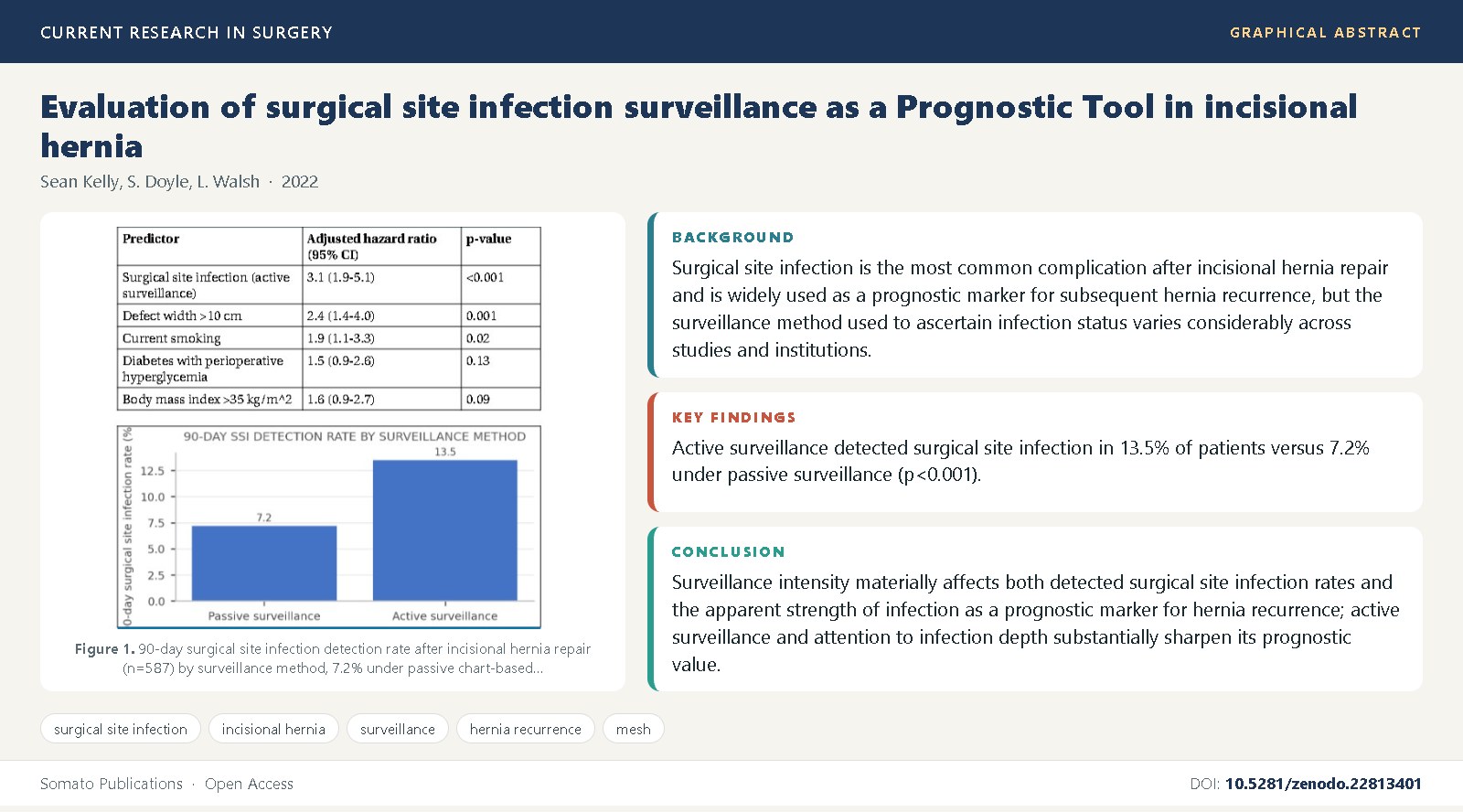
Background: Surgical site infection is the most common complication after incisional hernia repair and is widely used as a prognostic marker for subsequent hernia recurrence, but the surveillance method used to ascertain infection status varies considerably across studies and institutions.
Objective: To evaluate whether surveillance methodology changes both the detected 90-day surgical site infection rate and the strength of the association between infection status and hernia recurrence after incisional hernia repair.
Methods: In a retrospective cohort of 587 adults undergoing elective open incisional hernia repair with mesh, surgical site infection was ascertained in parallel by passive, chart-based surveillance and by active, structured surveillance combining telephone follow-up and outside-encounter linkage. Cox proportional hazards regression assessed the infection-recurrence association under each method.
Results: Active surveillance detected surgical site infection in 13.5% of patients versus 7.2% under passive surveillance (p<0.001). The adjusted hazard ratio for recurrence associated with infection was 3.1 using active surveillance versus 2.1 using passive surveillance, and deep or organ/space infection carried a markedly higher recurrence hazard than superficial infection.
Conclusions: Surveillance intensity materially affects both detected surgical site infection rates and the apparent strength of infection as a prognostic marker for hernia recurrence; active surveillance and attention to infection depth substantially sharpen its prognostic value.
References
Mangram AJ, Horan TC, Pearson ML, Silver LC, Jarvis WR. Guideline for prevention of surgical site infection, 1999. Infection Control and Hospital Epidemiology, 20(4): 247-278.
Horan TC, Andrus M, Dudeck MA. CDC/NHSN surveillance definition of health care-associated infection and criteria for specific types of infections in the acute care setting. American Journal of Infection Control, 36(5): 309-332.
National Healthcare Safety Network. Surgical Site Infection (SSI) Event. Centers for Disease Control and Prevention, Atlanta, 2017.
Breuing K, Butler CE, Ferzoco S, Franz M, Hultman CS, Kilbridge JF, et al. Incisional ventral hernias: review of the literature and recommendations regarding the grading and technique of repair. Surgery, 148(3): 544-558.
Slater NJ, Montgomery A, Berrevoet F, Carbonell AM, Chang A, Franklin M, et al. Criteria for definition of a complex abdominal wall hernia. Hernia, 18(1): 7-17.
Le Huu Nho R, Mege D, Ouaissi M, Sielezneff I, Sastre B. Incidence and prevention of ventral incisional hernia. Journal of Visceral Surgery, 149(5 Suppl): e3-e14.
Bosanquet DC, Ansell J, Abdelrahman T, Cornish J, Harries R, Stimpson A, et al. Systematic review and meta-regression of factors affecting midline incisional hernia rates: analysis of 14,618 patients. PLoS One, 10(9): e0138745.
Petersen S, Henke G, Freitag M, Faulhaber A, Ludwig K. Deep prosthesis infection in incisional hernia repair: predictive factors and clinical outcome. European Journal of Surgery, 167(6): 453-457.
Sanchez VM, Abi-Haidar YE, Itani KM. Mesh infection in ventral incisional hernia repair: incidence, contributing factors, and treatment. Surgical Infections, 12(3): 205-210.
Hawn MT, Gray SH, Snyder CW, Graham LA, Finan KR, Vick CC. Predictors of mesh explantation after incisional hernia repair. American Journal of Surgery, 202(1): 28-33.
Anthony T, Bergen PC, Kim LT, Henderson M, Fahey T, Rege RV, et al. Factors affecting recurrence following incisional herniorrhaphy. World Journal of Surgery, 24(1): 95-101.
Culver DH, Horan TC, Gaynes RP, Martone WJ, Jarvis WR, Emori TG, et al. Surgical wound infection rates by wound class, operative procedure, and patient risk index. American Journal of Medicine, 91(3B): 152S-157S.
Astagneau P, L'Heriteau F, Daniel F, Parneix P, Venier AG, Malavaud S, et al. Reducing surgical site infection incidence through a network: results from the French ISO-RAISIN surveillance system. Journal of Hospital Infection, 72(2): 127-134.
National Nosocomial Infections Surveillance (NNIS) System Report, data summary from January 1992 through June 2004. American Journal of Infection Control, 32(8): 470-485.
Itani KM, Hur K, Kim LT, Anthony T, Berger DH, Reda D, et al. Comparison of laparoscopic and open repair with mesh for the treatment of ventral incisional hernia: a randomized trial. Archives of Surgery, 145(4): 322-328.
Gastmeier P, Sohr D, Brandt C, Eckmanns T, Behnke M, Ruden H. Reduction of orthopaedic wound infections in 21 hospitals. Archives of Orthopaedic and Trauma Surgery, 125(8): 526-530.
Dindo D, Demartines N, Clavien PA. Classification of surgical complications: a new proposal with evaluation in a cohort of 6336 patients and results of a survey. Annals of Surgery, 240(2): 205-213.
Berger RL, Li LT, Hicks SC, Davila JA, Kao LS, Liang MK. Development and validation of a risk-stratification score for surgical site occurrence in patients undergoing ventral hernia repair. Journal of the American College of Surgeons, 217(6): 974-982.
Fischer JP, Wink JD, Nelson JA, Kovach SJ. Wound risk assessment in ventral hernia repair: generation and internal validation of a risk stratification system using the ACS-NSQIP. Hernia, 19(1): 103-111.
Pessaux P, Msika S, Atalla D, Hay JM, Flamant Y. Risk factors for postoperative infectious complications in noncolorectal abdominal surgery: a multivariate analysis of the French Association for Surgical Research. Archives of Surgery, 138(3): 314-324.
Ata A, Lee J, Bestle SL, Desemone J, Stain SC. Postoperative hyperglycemia and surgical site infection in general surgery patients. Archives of Surgery, 145(9): 858-864.
Cohen ME, Liu Y, Ko CY, Hall BL. Improved surgical outcomes for ACS NSQIP hospitals over time: evaluation of hospital cohorts with up to 8 years of participation. Annals of Surgery, 263(2): 267-273.
Cima R, Dankbar E, Lovely J, Pendlimari R, Aronhalt K, Nehring S, et al. Colorectal surgery surgical site infection reduction program: a national surgical quality improvement program-driven multidisciplinary single-institution experience. Journal of the American College of Surgeons, 216(1): 23-33.
Kaoutzanis C, Leichtle SW, Mouawad NJ, Welch KB, Lampman RM, Wahl WL, et al. Risk factors for postoperative wound infections and prolonged hospitalization after ventral/incisional hernia repair. Hernia, 19(1): 113-123.
Sorensen LT. Wound healing and infection in surgery: the pathophysiological impact of smoking, smoking cessation, and nicotine replacement therapy: a systematic review. Annals of Surgery, 255(6): 1069-1079.
Ban KA, Minei JP, Laronga C, Harbrecht BG, Jensen EH, Fry DE, et al. American College of Surgeons and Surgical Infection Society: Surgical site infection guidelines, 2016 update. Journal of the American College of Surgeons, 224(1): 59-74.
Falagas ME, Kasiakou SK. Mesh-related infections after hernia repair surgery. Clinical Microbiology and Infection, 11(1): 3-8.
Blatnik J, Jin J, Rosen M. Abdominal hernia repair with bridging acellular dermal matrix--an expensive hernia sac. American Journal of Surgery, 196(1): 47-50.
Rosen MJ, Krpata DM, Ermlich B, Blatnik JA. A 5-year clinical experience with single-staged repairs of infected and contaminated abdominal wall defects utilizing biologic mesh. Annals of Surgery, 257(6): 991-996.
Merkow RP, Ju MH, Chung JW, Hall BL, Cohen ME, Williams MV, et al. Underlying reasons associated with hospital readmission following surgery in the United States. JAMA, 313(5): 483-495.
Fink C, Baumann P, Wente MN, Knebel P, Bruckner T, Ulrich A, et al. Incisional hernia rate 3 years after midline laparotomy. British Journal of Surgery, 101(2): 51-54.
Diener MK, Voss S, Jensen K, Buchler MW, Seiler CM. Elective midline laparotomy closure: the INLINE systematic review and meta-analysis. Annals of Surgery, 251(5): 843-856.
Israelsson LA, Millbourn D. Prevention of incisional hernias: how to close a midline incision. Surgical Clinics of North America, 93(5): 1027-1040.

Published
Issue
Section
License
Copyright (c) 2022 Sean Kelly, et al.

This work is licensed under a Creative Commons Attribution 4.0 International License.


