
Comparative Analysis of enhanced recovery after surgery protocols versus Standard Care in incisional hernia
DOI:
https://doi.org/10.5281/zenodo.22813373Keywords:
Enhanced recovery after surgery, Incisional hernia, Perioperative care, Surgical site infection, Length of stayAbstract
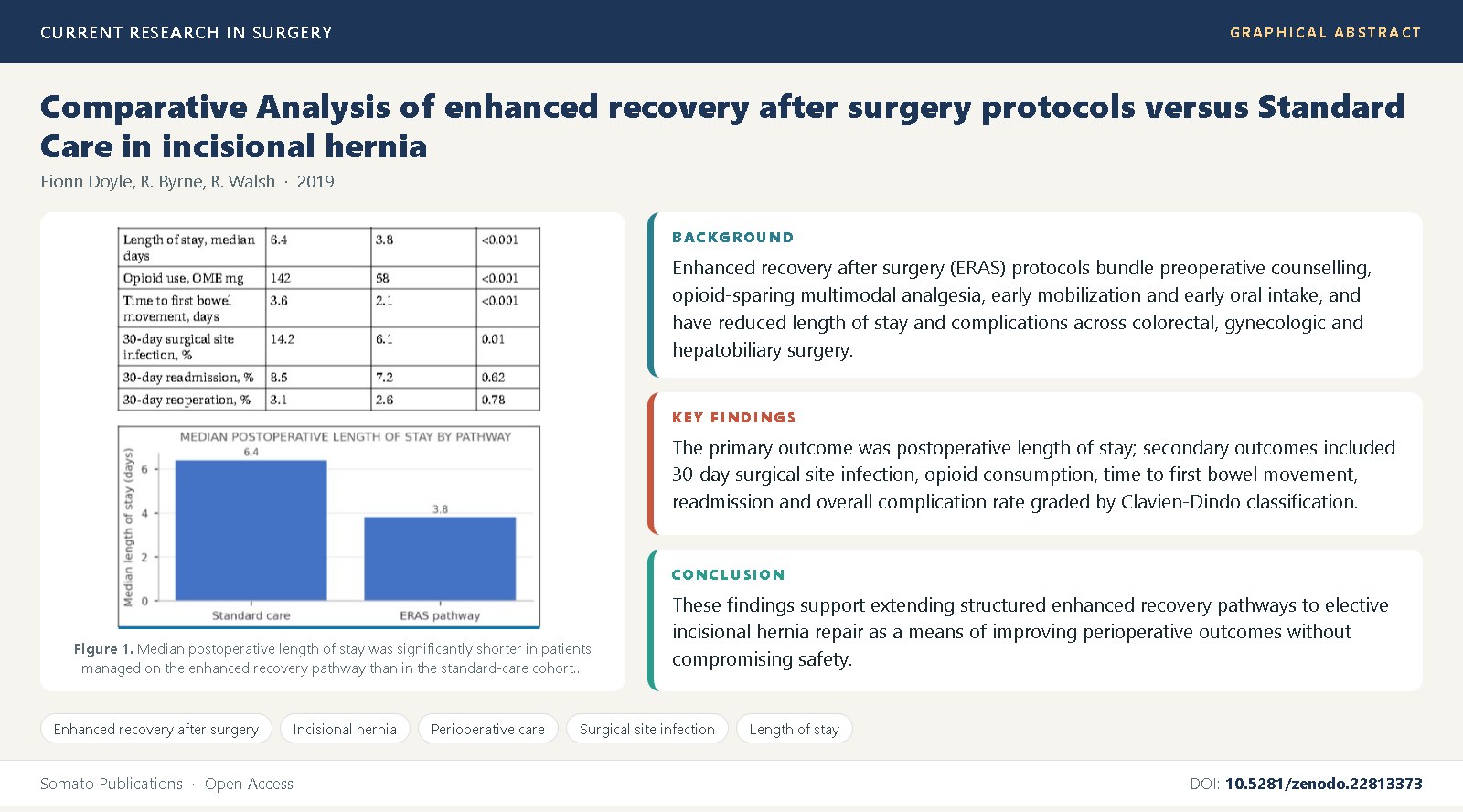
Enhanced recovery after surgery (ERAS) protocols bundle preoperative counselling, opioid-sparing multimodal analgesia, early mobilization and early oral intake, and have reduced length of stay and complications across colorectal, gynecologic and hepatobiliary surgery, but their value in elective incisional hernia repair, a population with high rates of obesity, prior wound infection and abdominal wall laxity, remains comparatively under-studied. This retrospective comparative cohort analysis evaluated consecutive adult patients undergoing elective open or laparoscopic mesh repair of incisional hernia, comparing those managed on a structured ERAS pathway against a historical standard-care cohort at the same institution. The primary outcome was postoperative length of stay; secondary outcomes included 30-day surgical site infection, opioid consumption, time to first bowel movement, readmission and overall complication rate graded by Clavien-Dindo classification. The ERAS cohort had a significantly shorter median length of stay, lower opioid consumption, earlier return of bowel function and a lower surgical site infection rate than the standard-care cohort, with no significant difference in 30-day readmission or reoperation. These findings support extending structured enhanced recovery pathways to elective incisional hernia repair as a means of improving perioperative outcomes without compromising safety.
References
Bosanquet DC, Ansell J, Abdelrahman T, Cornish J, Harries R, Stimpson A, et al. (2015) Systematic Review and Meta-Regression of Factors Affecting Midline Incisional Hernia Rates: Analysis of 14,618 Patients. PLoS One, 10(9): e0138745. DOI: 10.1371/journal.pone.0138745
Poulose BK, Shelton J, Phillips S, Moore D, Nealon W, Penson D, et al. (2012) Epidemiology and cost of ventral hernia repair: making the case for hernia research. Hernia, 16(2): 179-183. DOI: 10.1007/s10029-011-0879-9
Luijendijk RW, Hop WC, van den Tol MP, de Lange DC, Braaksma MM, IJzermans JN, et al. (2000) A comparison of suture repair with mesh repair for incisional hernia. New England Journal of Medicine, 343(6): 392-398. DOI: 10.1056/NEJM200008103430603
Burger JW, Luijendijk RW, Hop WC, Halm JA, Verdaasdonk EG, Jeekel J. (2004) Long-term follow-up of a randomized controlled trial of suture versus mesh repair of incisional hernia. Annals of Surgery, 240(4): 578-583. DOI: 10.1097/01.sla.0000141193.08524.e7
Kingsnorth A, LeBlanc K. (2003) Hernias: inguinal and incisional. Lancet, 362(9395): 1561-1571. DOI: 10.1016/S0140-6736(03)14746-0
Sorensen LT. (2012) Wound healing and infection in surgery: the pathophysiological impact of smoking, smoking cessation, and nicotine replacement therapy. Annals of Surgery, 255(6): 1069-1079. DOI: 10.1097/SLA.0b013e31824f632d
Pierpont YN, Dinh TP, Salas RE, Johnson EL, Wright TG, Robson MC, et al. (2014) Obesity and surgical wound healing: a current review. ISRN Obesity, 2014: 638936. DOI: 10.1155/2014/638936
Fischer JP, Wink JD, Tuggle CT, Nelson JA, Kovach SJ. (2015) Wound risk assessment in ventral hernia repair: generation and internal validation of a risk stratification system. Hernia, 19(1): 103-111. DOI: 10.1007/s10029-014-1318-5
den Hartog D, Dur AH, Tuinebreijer WE, Kreis RW. (2008) Open surgical procedures for incisional hernias. Cochrane Database of Systematic Reviews, 3: CD006438. DOI:
1002/14651858.CD006438.pub2 10. Sauerland S, Walgenbach M, Habermalz B, Seiler CM, Miserez M. (2011) Laparoscopic versus open surgical techniques for ventral or incisional hernia repair. Cochrane Database of Systematic Reviews, 3: CD007781. DOI: 10.1002/14651858.CD007781.pub2
Kehlet H. (1997) Multimodal approach to control postoperative pathophysiology and rehabilitation. British Journal of Anaesthesia, 78(5): 606-617. DOI: 10.1093/bja/78.5.606
Fearon KC, Ljungqvist O, Von Meyenfeldt M, Revhaug A, Dejong CH, Lassen K, et al. (2005) Enhanced recovery after surgery: a consensus review of clinical care for patients undergoing colonic resection. Clinical Nutrition, 24(3): 466-477. DOI: 10.1016/j.clnu.2005.02.002
Kehlet H, Wilmore DW. (2002) Multimodal strategies to improve surgical outcome. American Journal of Surgery, 183(6): 630-641. DOI: 10.1016/S0002-9610(02)00866-8
Varadhan KK, Neal KR, Dejong CH, Fearon KC, Ljungqvist O, Lobo DN. (2010) The enhanced recovery after surgery (ERAS) pathway for patients undergoing major elective open colorectal surgery: a meta-analysis of randomized controlled trials. Clinical Nutrition, 29(4): 434-440. DOI: 10.1016/j.clnu.2010.01.004
Spanjersberg WR, Reurings J, Keus F, van Laarhoven CJ. (2011) Fast track surgery versus conventional recovery strategies for colorectal surgery. Cochrane Database of Systematic Reviews, 2: CD007635. DOI: 10.1002/14651858.CD007635.pub2
Gustafsson UO, Scott MJ, Hubner M, Nygren J, Demartines N, Francis N, et al. (2019) Guidelines for Perioperative Care in Elective Colorectal Surgery: Enhanced Recovery After Surgery (ERAS) Society Recommendations: 2018. World Journal of Surgery, 43(3): 659-695. DOI: 10.1007/s00268-018-4844-y
Mortensen K, Nilsson M, Slim K, Schafer M, Mariette C, Braga M, et al. (2014) Consensus guidelines for enhanced recovery after gastrectomy: Enhanced Recovery After Surgery (ERAS) Society recommendations. British Journal of Surgery, 101(10): 1209-1229. DOI: 10.1002/bjs.9582
Nelson G, Altman AD, Nick A, Meyer LA, Ramirez PT, Achtari C, et al. (2016) Guidelines for postoperative care in gynecologic/oncology surgery: Enhanced Recovery After Surgery (ERAS) Society recommendations. Gynecologic Oncology, 140(2): 313-322. DOI: 10.1016/j.ygyno.2015.11.015
Ljungqvist O, Scott M, Fearon KC. (2017) Enhanced Recovery After Surgery: A Review. JAMA Surgery, 152(3): 292-298. DOI: 10.1001/jamasurg.2016.4952
Joshi GP, Kehlet H. (2019) Enhanced Recovery Pathways: Looking Into the Future. Anesthesia and Analgesia, 128(1): 5-7. DOI: 10.1213/ANE.0000000000003746
Majumder A, Winder JS, Wen Y, Pauli EM, Belyansky I, Novitsky YW. (2016) Benefits of a Multidisciplinary Approach to Abdominal Wall Reconstruction. Journal of the American College of Surgeons, 222(4): 787-793. DOI: 10.1016/j.jamcollsurg.2016.01.056
Breuing K, Butler CE, Ferzoco S, Franz M, Hultman CS, Kilbridge JF, et al. (2010) Incisional ventral hernias: review of the literature and recommendations regarding the grading and technique of repair. Surgery, 148(3): 544-558. DOI: 10.1016/j.surg.2010.01.008
Ramirez OM, Ruas E, Dellon AL. (1990) "Components separation" method for closure of abdominal-wall defects: an anatomic and clinical study. Plastic and Reconstructive Surgery, 86(3): 519-526.
White PF, Kehlet H. (2010) Improving postoperative pain management: what are the unresolved issues? Anesthesiology, 112(1): 220-225. DOI: 10.1097/ALN.0b013e3181c6316e
Kehlet H, Dahl JB. (1993) The value of "multimodal" or "balanced analgesia" in postoperative pain treatment. Anesthesia and Analgesia, 77(5): 1048-1056. DOI: 10.1213/00000539-199311000-00030
Bratzler DW, Dellinger EP, Olsen KM, Perl TM, Auwaerter PG, Bolon MK, et al. (2013) Clinical practice guidelines for antimicrobial prophylaxis in surgery. American Journal of Health-System Pharmacy, 70(3): 195-283. DOI: 10.2146/ajhp120568
Berrios-Torres SI, Umscheid CA, Bratzler DW, Leas B, Stone EC, Kelz RR, et al. (2017) Centers for Disease Control and Prevention Guideline for the Prevention of Surgical Site Infection, 2017. JAMA Surgery, 152(8): 784-791. DOI: 10.1001/jamasurg.2017.0904
Ban KA, Minei JP, Laronga C, Harbrecht BG, Jensen EH, Fry DE, et al. (2017) American College of Surgeons and Surgical Infection Society: Surgical Site Infection Guidelines, 2016 Update. Journal of the American College of Surgeons, 224(1): 59-74. DOI: 10.1016/j.jamcollsurg.2016.10.029
Carli F, Zavorsky GS. (2005) Optimizing functional exercise capacity in the elderly surgical population. Current Opinion in Clinical Nutrition and Metabolic Care, 8(1): 23-32. DOI: 10.1097/00075197-200501000-00005
Weimann A, Braga M, Carli F, Higashiguchi T, Hubner M, Klek S, et al. (2017) ESPEN guideline: Clinical nutrition in surgery. Clinical Nutrition, 36(3): 623-650. DOI: 10.1016/j.clnu.2017.02.013
Lemanu DP, Singh PP, Stowers MD, Hill AG. (2014) A systematic review to assess cost effectiveness of enhanced recovery after surgery programmes. Colorectal Disease, 16(5): 338-346. DOI: 10.1111/codi.12505
Sanders DL, Kingsnorth AN. (2012) The modern management of incisional hernias. BMJ, 344: e2843. DOI: 10.1136/bmj.e2843
Awaiz A, Rahman F, Hossain MB, Yunus RM, Khan S, Memon B, et al. (2015) Meta-analysis and systematic review of laparoscopic versus open mesh repair for elective incisional hernia. Hernia, 19(3): 449-463. DOI: 10.1007/s10029-015-1351-z

Published
Issue
Section
License
Copyright (c) 2019 Fionn Doyle, et al.

This work is licensed under a Creative Commons Attribution 4.0 International License.


