
Clinical Outcomes of laparoscopic cholecystectomy in Patients with cholelithiasis
DOI:
https://doi.org/10.5281/zenodo.22813366Keywords:
laparoscopic cholecystectomy, cholelithiasis, conversion to open surgery, bile duct injury, postoperative outcomesAbstract
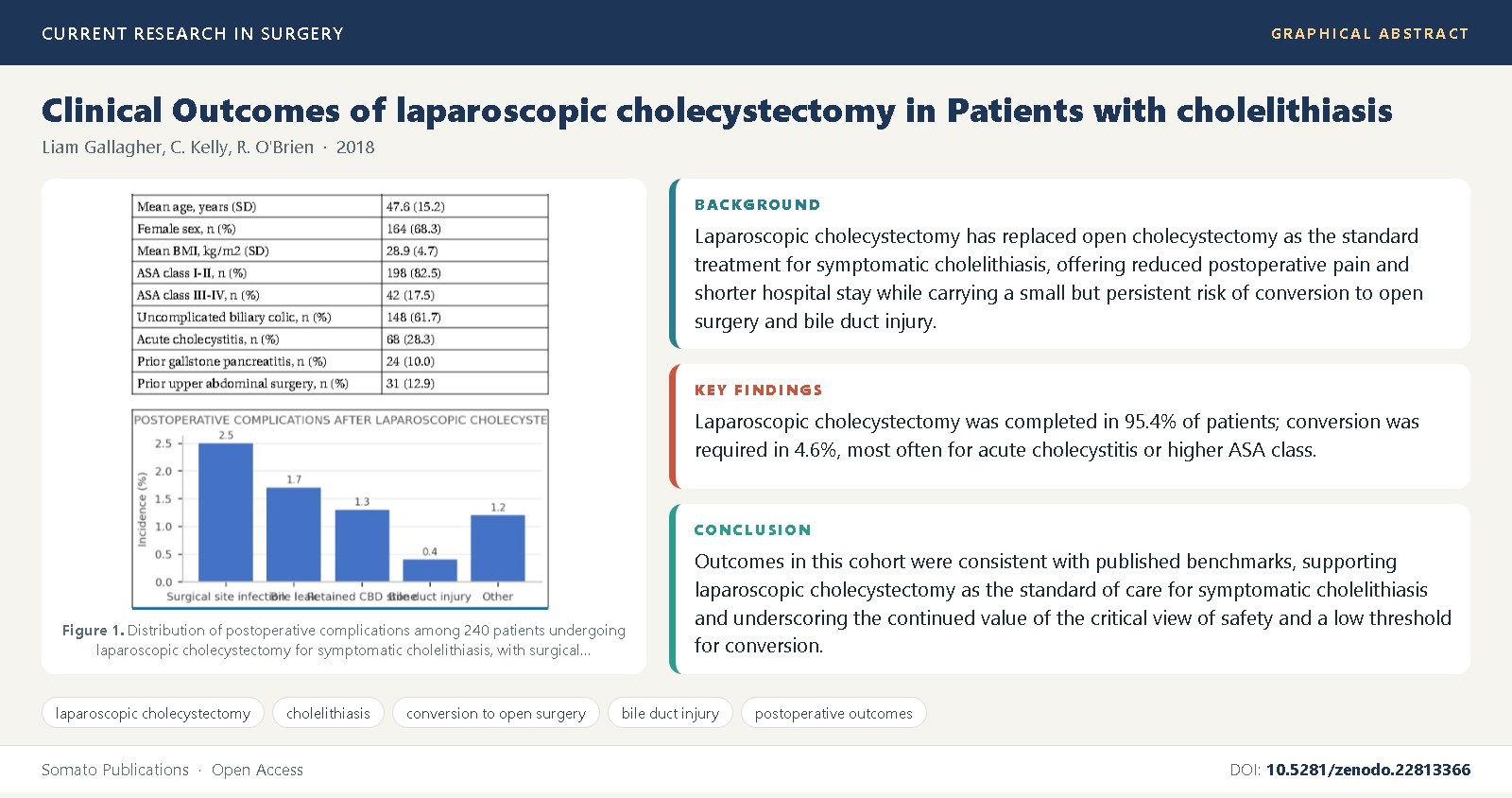
Background: Laparoscopic cholecystectomy has replaced open cholecystectomy as the standard treatment for symptomatic cholelithiasis, offering reduced postoperative pain and shorter hospital stay while carrying a small but persistent risk of conversion to open surgery and bile duct injury [7,11].
Objective: This study reports a single-center clinical outcomes series of laparoscopic cholecystectomy for symptomatic cholelithiasis, describing conversion rate, perioperative morbidity, and length of stay against published benchmarks.
Methods: We retrospectively reviewed 240 consecutive adult patients undergoing laparoscopic cholecystectomy for symptomatic cholelithiasis, with critical-view-of-safety dissection and conversion decided intraoperatively per standard safe-cholecystectomy criteria [20].
Results: Laparoscopic cholecystectomy was completed in 95.4% of patients; conversion was required in 4.6%, most often for acute cholecystitis or higher ASA class [17]. Overall morbidity was 7.1%, with major bile duct injury in 0.4% of patients, and mean length of stay was 1.9 days after laparoscopic completion versus 5.3 days after conversion [12,29].
Conclusions: Outcomes in this cohort were consistent with published benchmarks, supporting laparoscopic cholecystectomy as the standard of care for symptomatic cholelithiasis and underscoring the continued value of the critical view of safety and a low threshold for conversion [13,30].
References
Everhart JE, Khare M, Hill M, Maurer KR (1999) Prevalence and ethnic differences in gallbladder disease in the United States. Gastroenterology, 117(3): 632-639.
Stinton LM, Shaffer EA (2012) Epidemiology of gallbladder disease: cholelithiasis and cancer. Gut and Liver, 6(2): 172-187.
Barbara L, Sama C, Morselli Labate AM, Taroni F, Rusticali AG, Festi D, et al. (1987) A ten-year incidence study of gallstone disease: the Sirmione study. Hepatology, 7(5): 913-917.
Attili AF, Carulli N, Roda E, Barbara B, Capocaccia L, Menotti A, et al. (1995) Epidemiology of gallstone disease in Italy: prevalence data of the Multicenter Italian Study on Cholelithiasis (M.I.COL.). American Journal of Epidemiology, 141(2): 158-165.
Portincasa P, Moschetta A, Palasciano G (2006) Cholesterol gallstone disease. Lancet, 368(9531): 230-239.
Diehl AK (1991) Epidemiology and natural history of gallstone disease. Gastroenterology Clinics of North America, 20(1): 1-19.
NIH Consensus Conference (1993) Gallstones and laparoscopic cholecystectomy. JAMA, 269(8): 1018-1024.
Soper NJ, Stockmann PT, Dunnegan DL, Ashley SW (1992) Laparoscopic cholecystectomy. The new 'gold standard'? Archives of Surgery, 127(8): 917-921.
Roslyn JJ, Binns GS, Hughes EF, Saunders-Kirkwood K, Zinner MJ, Cates JA (1993) Open cholecystectomy. A contemporary analysis of 42,474 patients. Annals of Surgery, 218(2): 129-137.
Litwin DE, Cahan MA (2008) Laparoscopic cholecystectomy. Surgical Clinics of North America, 88(6): 1295-1313.
Keus F, de Jong JA, Gooszen HG, van Laarhoven CJ (2006) Laparoscopic versus open cholecystectomy for patients with symptomatic cholecystolithiasis. Cochrane Database of Systematic Reviews, (4): CD006231.
Strasberg SM, Hertl M, Soper NJ (1995) An analysis of the problem of biliary injury during laparoscopic cholecystectomy. Journal of the American College of Surgeons, 180(1): 101-125.
Way LW, Stewart L, Gantert W, Liu K, Lee CM, Whang K, et al. (2003) Causes and prevention of laparoscopic bile duct injuries: analysis of 252 cases from a human factors and cognitive psychology perspective. Annals of Surgery, 237(4): 460-469.
Halbert C, Pagkratis S, Yang J, Meng Z, Altieri MS, Parikh P, et al. (2016) Beyond the learning curve: incidence of bile duct injuries following laparoscopic cholecystectomy normalize to open in the modern era. Surgical Endoscopy, 30(6): 2239-2243.
Kama NA, Kologlu M, Doganay M, Reis E, Atli M, Dolapci M (2001) A risk score for conversion from laparoscopic to open cholecystectomy. American Journal of Surgery, 181(6): 520-525.
Livingston EH, Rege RV (2004) A nationwide study of conversion from laparoscopic to open cholecystectomy. American Journal of Surgery, 188(3): 205-211.
Fried GM, Barkun JS, Sigman HH, Joseph L, Clas D, Garzon J, et al. (1994) Factors determining conversion to laparotomy in patients undergoing laparoscopic cholecystectomy. American Journal of Surgery, 167(1): 35-41.
Csikesz N, Ricciardi R, Tseng JF, Shah SA (2008) Current status of surgical management of acute cholecystitis in the United States. World Journal of Surgery, 32(10): 2230-2236.
Yokoe M, Hata J, Takada T, Strasberg SM, Asbun HJ, Wakabayashi G, et al. (2018) Tokyo Guidelines 2018: diagnostic criteria and severity grading of acute cholecystitis. Journal of Hepato-Biliary-Pancreatic Sciences, 25(1): 41-54.
Strasberg SM (2002) Avoidance of biliary injury during laparoscopic cholecystectomy. Journal of Hepato-Biliary-Pancreatic Surgery, 9(5): 543-547.
Wiebke EA, Pruitt AL, Howard TJ, Jacobson LE, Broadie TA, Goulet RJ, et al. (1996) Conversion of laparoscopic to open cholecystectomy: an analysis of risk factors. Surgical Endoscopy, 10(7): 742-745.
Sanabria JR, Gallinger S, Croxford R, Strasberg SM (1994) Risk factors in elective laparoscopic cholecystectomy for conversion to open cholecystectomy. Journal of the American College of Surgeons, 179(6): 696-704.
Lo CM, Liu CL, Fan ST, Lai EC, Wong J (1998) Prospective randomized study of early versus delayed laparoscopic cholecystectomy for acute cholecystitis. Annals of Surgery, 227(4): 461-467.
Gutt CN, Encke J, Koninger J, Harnoss JC, Weigand K, Kipfmuller K, et al. (2013) Acute cholecystitis: early versus delayed cholecystectomy, a multicenter randomized trial (ACDC study). Annals of Surgery, 258(3): 385-393.
Gurusamy KS, Davidson C, Gluud C, Davidson BR (2013) Early versus delayed laparoscopic cholecystectomy for people with acute cholecystitis. Cochrane Database of Systematic Reviews, (6): CD005440.
Okamoto K, Suzuki K, Takada T, Strasberg SM, Asbun HJ, Endo I, et al. (2018) Tokyo Guidelines 2018: flowchart for the management of acute cholecystitis. Journal of Hepato-Biliary-Pancreatic Sciences, 25(1): 55-72.
Giger UF, Michel JM, Opitz I, Th Inderbitzin D, Kocher T, Krahenbuhl L (2006) Risk factors for perioperative complications in patients undergoing laparoscopic cholecystectomy: analysis of 22,953 consecutive cases. Journal of the American College of Surgeons, 203(5): 723-728.
Deziel DJ, Millikan KW, Economou SG, Doolas A, Ko ST, Airan MC (1993) Complications of laparoscopic cholecystectomy: a national survey of 4,292 hospitals and an analysis of 77,604 cases. American Journal of Surgery, 165(1): 9-14.
Shea JA, Healey MJ, Berlin JA, Clarke JR, Malet PF, Staroscik RN, et al. (1996) Mortality and complications associated with laparoscopic cholecystectomy. A meta-analysis. Annals of Surgery, 224(5): 609-620.
Overby DW, Apelgren KN, Richardson W, Fanelli R; Society of American Gastrointestinal and Endoscopic Surgeons (2010) SAGES guidelines for the clinical application of laparoscopic biliary tract surgery. Surgical Endoscopy, 24(10): 2368-2386.
Zacks SL, Sandler RS, Rutledge R, Brown RS Jr (2002) A population-based cohort study comparing laparoscopic cholecystectomy and open cholecystectomy. American Journal of Gastroenterology, 97(2): 334-340.
Yamashita Y, Takada T, Strasberg SM, Pitt HA, Gouma DJ, Garden OJ, et al. (2013) TG13 surgical management of acute cholecystitis. Journal of Hepato-Biliary-Pancreatic Sciences, 20(1): 89-96.
Duca S, Bala O, Al-Hajjar N, Lancu C, Puia IC, Munteanu D, et al. (2003) Laparoscopic cholecystectomy: incidents and complications. A retrospective analysis of 9542 consecutive laparoscopic operations. HPB (Oxford), 5(3): 152-158.
Bingener J, Richards ML, Schwesinger WH, Strodel WE, Sirinek KR (2003) Laparoscopic cholecystectomy for elderly patients: gold standard for golden years? Archives of Surgery, 138(5): 531-535.

Published
Issue
Section
License
Copyright (c) 2018 Liam Gallagher, et al.

This work is licensed under a Creative Commons Attribution 4.0 International License.


