
Histological Study in Linea Alba of Herniated Patients
Keywords:
Hernia, Linea Alba, Histological structureAbstract
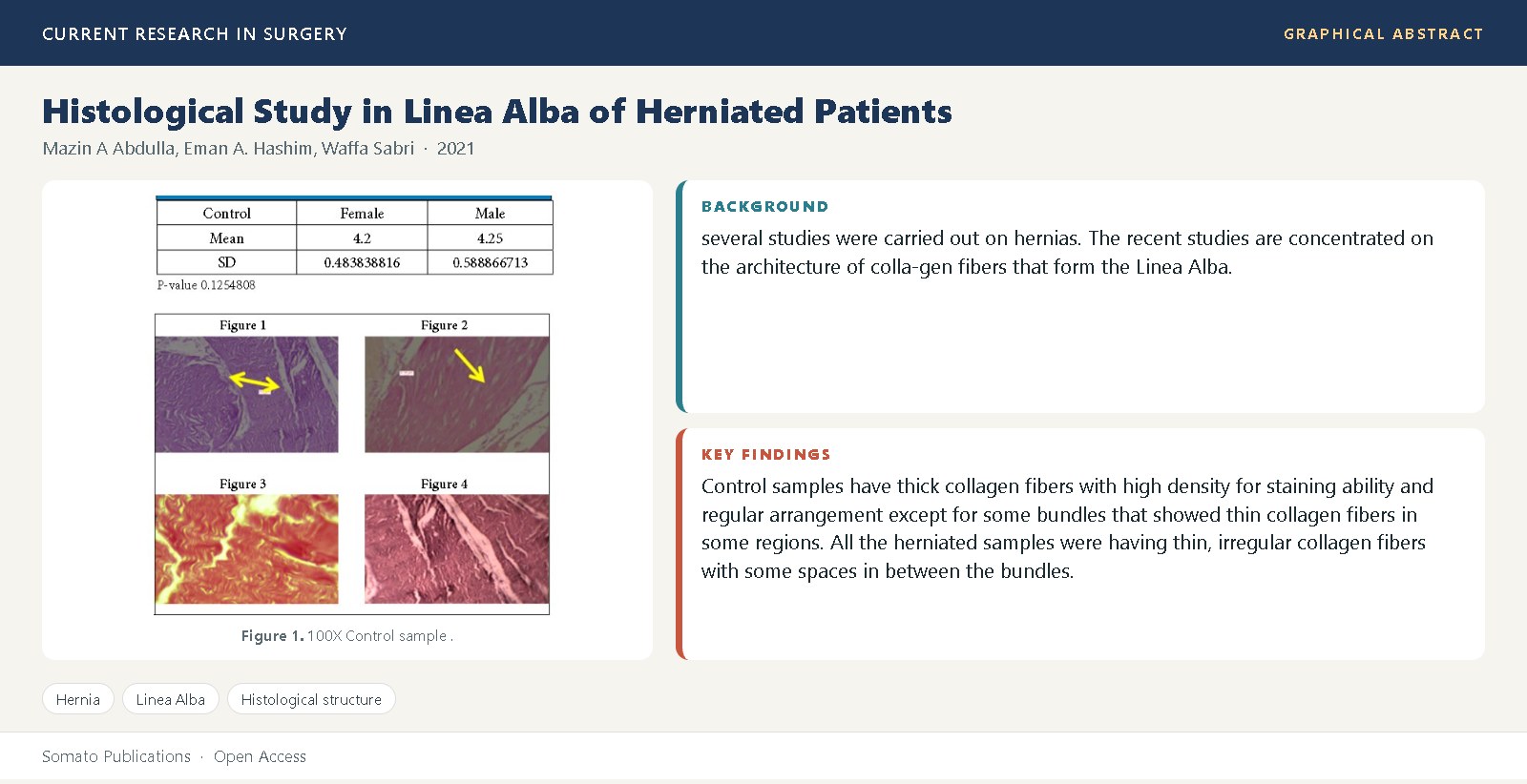
Background: several studies were carried out on hernias. The recent studies are concentrated on the architecture of colla-
gen fibers that form the Linea Alba. Objective: To identify the histological structures and the thickness of collagen fibers in Linea Alba of herniated and non- herniated cases. Methods: 14 samples from the herniated patients, 10 samples as control. Histological preparation of slides from both sam- ples was stained by Hematoxylin and Eosin (H&E)and Van Gieson stains. Collagen fibers thickness was estimated by digital microscope with camera. According to length and weight, body mass index (BMI) is measured to identify obese patients. Statistical analysis was done by computer SPSS. Results: Control samples have thick collagen fibers with high density for staining ability and regular arrangement except for some bundles that showed thin collagen fibers in some regions. All the herniated samples were having thin, irregular collagen fibers with some spaces in between the bundles. More de- structive features were seen in herniated samples especially in obese & smoker patients. They had more irregularity in fibers with low staining ability; identified spread of adipose tissue; newly developed blood vessels and some of them were dilated and engorged with blood cells
References
Pulei, AN., Odula, PO., Abdel-Malek, AK., Ogeng'o, JA. (2015) Distribution of elastic fibers in the human abdominal linea Alba. Anatomy Journal of Africa, 4(1): 476-480.
Levillain, A., Orhant, M., Turquter, F., Hoc, T. (2016) Contribution of collagen and elastin fibers to the mechanical behavior of abdominal connective tissue. J Mech Behav Biomed Mater, 61: 308-317.
Woo, SL., et al. (2005) Structure and function of ligaments and tendons, in Basic orthopedic Biomechanics and Mechano- Biology, V.C.Mow and R.Huiskes, p. 301-342.
Zendejas, B., Hernandez-Irizarry, R., Ramirez, T., Lohse, CM., Grossardt, BR., Farley, DR. (2014) Relationship between Body Mass Index and the Incidence of Inguinal Hernia Repairs: A Population-Based Study in Olmsted County, MN. Hernia, 18(2): 283-288.
Fachinelli, A., Trindade, MR., Fachinelli, FA. (2011) Elastic fibers in the anterior abdominal wall. Hernia, 15(4): 409- 415.
Ozdogan, M., Yildiz, F., Gurer, A., Orhun, S., Kulacoglu, H., Aydin, R. (2006) Changes in collagen and elastic fiber contents of the skin, rectus sheath, transveralis fascia, and peritoneum in primary inguinal hernia patients. Bratisl lek Listy, 107(6-7): 235-238.
Pans, A., Pierard, GE., Albert, A. (1999) Immunohistochemical study of the rectus sheath and transveralis fascia in adult groin hernias. Hernia, 3(2): 45-51.
Szczesny, W., Bodnar, M., Dabrowiecki, S., Szmykowski, J., Marszatek, A. (2013) Histological and immunohistochemical studies of rectus sheath in obese patients. J Surg Res, 180(2): 260-265.
Xing, L., Culbertson, EJ., Wen, Y., Robson, MC., Franz, MG. (2011) Impaired laparotomy wound healing in obese rats. Obes Surg, 21(12): 1937-1946.
Modena, SF., Caldeira, EJ., Peres, MAO., Andreollo, NA. (2016) Influence of tobacco, alcohol, and diabetes on the collagen of cremaster muscle in patients with inguinal hernias. Arq Bras Cir Dig, 29(4): 218-222.
Sørensen, LT., Hemmingsen, UB., Kirkeby, LT., Kallehave, F., Jørgensen, LN. (2005) Smoking Is a Risk Factor for Incisional Hernia. Arch Surg, 140(2): 119-123.
Hegazy, R., Hegazy, A. (2015) Hegazy’ simplified method of tissue processing (consuming less time and chemicals). Ann Int Med Dent Res, 1(2): 57-61.
Friedman, DW., Boyd, CD., Norton, P., Greco, RS., Boyarsky, AH., Mackenzie, JW., et al. (1993) Increases in type III collagen gene expression and protein synthesis in patients with inguinal hernias. Ann Surg, 218(6): 754-760.
Read, RC. (2006) Introduction. Hernia, 10: 454-455.
Korenkov, M., Beckers, A., Koebke, J., Lefering, R., Tiling, T., Troidl, H. (2001) Biomechanical and morphological types of the linea alba and its possible role in the pathogenesis of midline incisional hernia. Eur J Surg, 167(12): 909-914.
Franchi, M., Trirè, A., Quaranta, M., Orsini, E., Ottani, V. (2007) Collagen structure of tendon relates to function. ScientificWorldJournal, 7: 404-420.
Sharma, P., Maffulli, N. (2006) Biology of tendon injury: healing, modeling, and remodeling. J Musculoskelet Neuronal Interact, 6(2): 181-190.
Andersson, G., Backman, LJ., Scott, A., Lorentzon, R., Forsgren, S., Danielson, P. (2011) Substance P accelerates hypercellularity and angiogenesis in tendon tissue and enhances paratendinitis in response to Achilles tendon overuse in a tendinopathy model. Br J Sports Med, 45(13): 1017-1022.
Aström, M., Rausing, A. (1995) Chronic Achilles tendinopathy. A survey of surgical and histopathologic findings. Clin Orthop Relat Res, (316): 151-164.
Heinemeier, KM., Schjerling, P., Heinemeier, J., Magnusson, SP., Kjaer, M. (2013) Lack of tissue renewal in human adult Achilles tendon is revealed by nuclear bomb (14)C. FASEB J, 27(5): 2074-2079.
Harvey, J., Sugerman. (2001) Increased risk of recurrent incisional hernia following repair in obese patients. Hernia and Obesity, Abdominal wall Hernias pp 672-674.
Grossi, JVM., Nicola, FF., Zepeda, IA., Becker, M., Trindade, EN., Diemen, VV., et al. (2016) LINEA ALBA COLLAGEN ASSESSMENT IN MORBIDLY OBESE PATIENTS. Arq Bras Cir Dig, 29(Suppl 1): 8-11.
Axer, H., von Keyserlingk, DG., Prescher, A. (2001) Collagen fibers in Linea Alba and rectus sheaths. J Surg Res, 96(2): 239-245.




