
A Retrospective Cohort Study of neoadjuvant chemotherapy in elderly oncology patients with colorectal cancer
DOI:
https://doi.org/10.5281/zenodo.22813193Keywords:
colorectal cancer, neoadjuvant chemotherapy, elderly, geriatric oncology, retrospective cohort studyAbstract
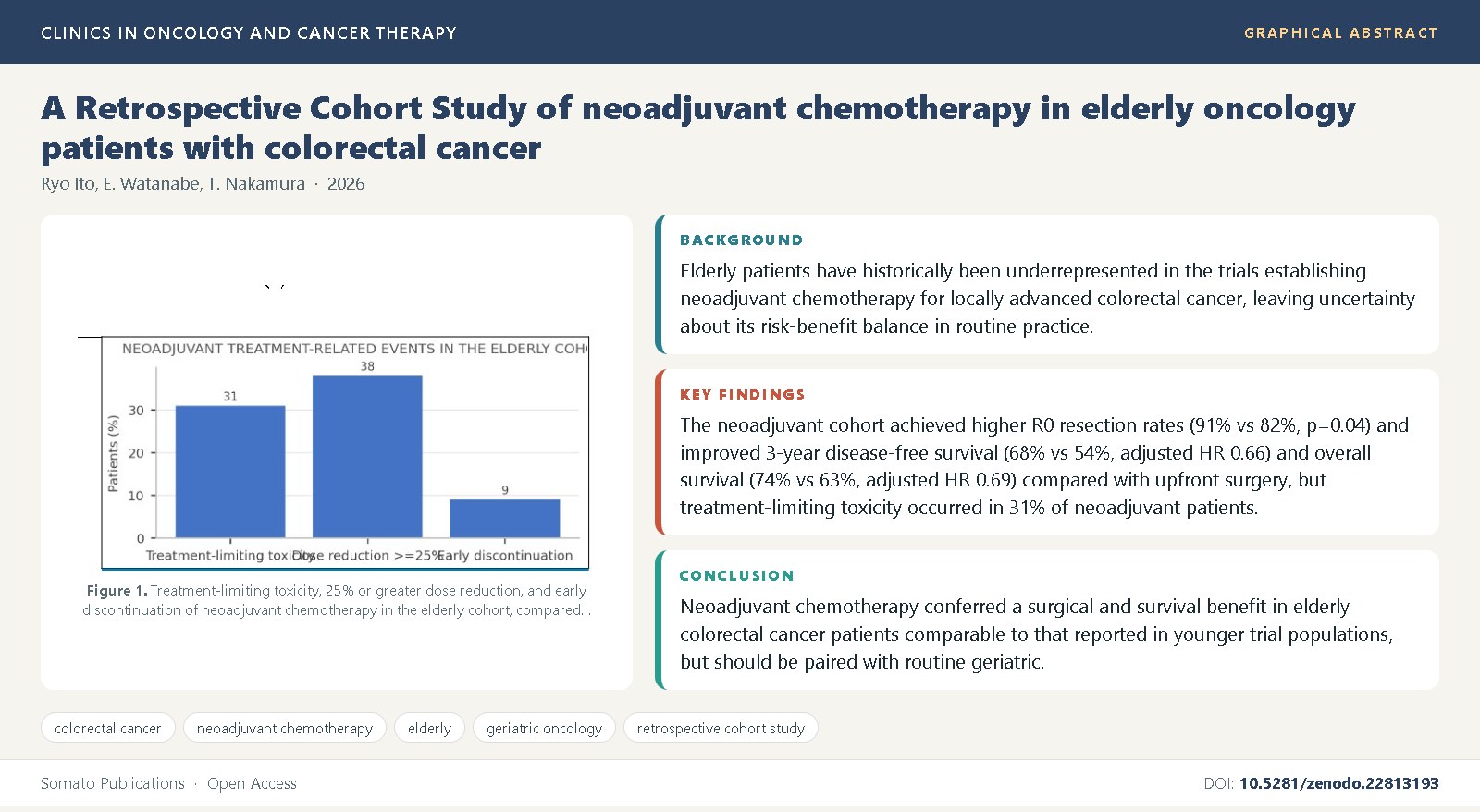
Background: Elderly patients have historically been underrepresented in the trials establishing neoadjuvant chemotherapy for locally advanced colorectal cancer [1,2], leaving uncertainty about its risk-benefit balance in routine practice.
Objective: To compare surgical, toxicity, and survival outcomes of neoadjuvant chemotherapy versus upfront surgery in elderly colorectal cancer patients.
Methods: We retrospectively identified 248 patients aged 70 or older with locally advanced colon or rectal cancer at three centers (2013-2021), forming 124 propensity-matched pairs receiving neoadjuvant chemotherapy or upfront surgery.
Results: The neoadjuvant cohort achieved higher R0 resection rates (91% vs 82%, p=0.04) and improved 3-year disease-free survival (68% vs 54%, adjusted HR 0.66) and overall survival (74% vs 63%, adjusted HR 0.69) compared with upfront surgery, but treatment-limiting toxicity occurred in 31% of neoadjuvant patients, most strongly predicted by baseline frailty rather than age alone [29,12].
Conclusions: Neoadjuvant chemotherapy conferred a surgical and survival benefit in elderly colorectal cancer patients comparable to that reported in younger trial populations, but should be paired with routine geriatric and frailty assessment to individualize regimen intensity in this undertreated population [13,30].
References
Hutchins, L.F., Unger, J.M., Crowley, J.J., Coltman, C.A., Albain, K.S. (1999) Underrepresentation of patients 65 years of age or older in cancer-treatment trials. New England Journal of Medicine, 341(27): 2061-2067.
Sauer, R., Becker, H., Hohenberger, W., Rodel, C., Wittekind, C., Fietkau, R., et al. (2004) Preoperative versus postoperative chemoradiotherapy for rectal cancer. New England Journal of Medicine, 351(17): 1731-1740.
Bosset, J.F., Collette, L., Calais, G., Mineur, L., Maingon, P., Radosevic-Jelic, L., et al. (2006) Chemotherapy with preoperative radiotherapy in rectal cancer. New England Journal of Medicine, 355(11): 1114-1123.
Gerard, J.P., Conroy, T., Bonnetain, F., Bouche, O., Chapet, O., Closon-Dejardin, M.T., et al. (2006) Preoperative radiotherapy with or without concurrent fluorouracil and leucovorin in T3-4 rectal cancers: results of FFCD 9203. Journal of Clinical Oncology, 24(28): 4620-4625.
Roh, M.S., Colangelo, L.H., O'Connell, M.J., Yothers, G., Deutsch, M., Allegra, C.J., et al. (2009) Preoperative multimodality therapy improves disease-free survival in patients with carcinoma of the rectum: NSABP R-03. Journal of Clinical Oncology, 27(31): 5124-5130.
Bujko, K., Nowacki, M.P., Nasierowska-Guttmejer, A., Michalski, W., Bebenek, M., Kryj, M. (2006) Long-term results of a randomized trial comparing preoperative short-course radiotherapy with preoperative conventionally fractionated chemoradiation for rectal cancer. British Journal of Surgery, 93(10): 1215-1223.
Ngan, S.Y., Burmeister, B., Fisher, R.J., Solomon, M., Goldstein, D., Joseph, D., et al. (2012) Randomized trial of short-course radiotherapy versus long-course chemoradiation comparing rates of local recurrence in patients with T3 rectal cancer: Trans-Tasman Radiation Oncology Group trial 01.04. Journal of Clinical Oncology, 30(31): 3827-3833.
Hofheinz, R.D., Wenz, F., Post, S., Matzdorff, A., Laechelt, S., Hartmann, J.T., et al. (2012) Chemoradiotherapy with capecitabine versus fluorouracil for locally advanced rectal cancer: a randomised, multicentre, non-inferiority, phase 3 trial. Lancet Oncology, 13(6): 579-588.
Rodel, C., Graeven, U., Fietkau, R., Hohenberger, W., Hothorn, T., Arnold, D., et al. (2015) Oxaliplatin added to fluorouracil-based preoperative chemoradiotherapy and postoperative chemotherapy of locally advanced rectal cancer: final results of the German CAO/ARO/AIO-04 randomised phase 3 trial. Lancet Oncology, 16(8): 979-989.
Bahadoer, R.R., Dijkstra, E.A., van Etten, B., Marijnen, C.A.M., Putter, H., Kranenbarg, E.M., et al. (2021) Short-course radiotherapy followed by chemotherapy before total mesorectal excision (TME) versus preoperative chemoradiotherapy, TME, and optional adjuvant chemotherapy in locally advanced rectal cancer (RAPIDO): a randomised, open-label, phase 3 trial. Lancet Oncology, 22(1): 29-42.
Conroy, T., Bosset, J.F., Etienne, P.L., Rio, E., Francois, E., Mesgouez-Nebout, N., et al. (2021) Neoadjuvant chemotherapy with FOLFIRINOX and preoperative chemoradiotherapy for patients with locally advanced rectal cancer (UNICANCER-PRODIGE 23): a multicentre, randomised, open-label, phase 3 trial. Lancet Oncology, 22(5): 702-715.
Wildiers, H., Heeren, P., Puts, M., Topinkova, E., Janssen-Heijnen, M.L., Extermann, M., et al. (2014) International Society of Geriatric Oncology consensus on geriatric assessment in older patients with cancer. Journal of Clinical Oncology, 32(24): 2595-2603.
Papamichael, D., Audisio, R.A., Glimelius, B., de Gramont, A., Glynne-Jones, R., Haller, D., et al. (2015) Treatment of colorectal cancer in older patients: International Society of Geriatric Oncology (SIOG) consensus recommendations 2013. Annals of Oncology, 26(3): 463-476.
Foxtrot Collaborative Group (2012) Feasibility of preoperative chemotherapy for locally advanced, operable colon cancer: the pilot phase of a randomised controlled trial. Lancet Oncology, 13(11): 1152-1160.
Seymour, M.T., Morton, D., FOxTROT Collaborative Group (2023) FOxTROT: Neoadjuvant chemotherapy for the treatment of patients with locally advanced colon cancer. Journal of Clinical Oncology, 41(supplement 4): LBA3504.
Aparicio, T., Navazesh, A., Boutron, I., Devaud, H., Manfredi, S., Chianea, T., et al. (2009) Half of elderly patients routinely treated for colorectal cancer receive a sub-standard treatment. Critical Reviews in Oncology/Hematology, 71(3): 249-257.
Schrag, D., Cramer, L.D., Bach, P.B., Begg, C.B. (2001) Age and adjuvant chemotherapy use after surgery for stage III colon cancer. Journal of the National Cancer Institute, 93(11): 850-857.
de Vries, H., van Erning, F.N., Lemmens, V.E., de Vries, S., Rutten, H.J., Creemers, G.J., et al. (2013) Outcomes of colon cancer treatment in elderly patients: a population-based study. European Journal of Surgical Oncology, 39(12): 1339-1346.
Folprecht, G., Seymour, M.T., Saltz, L., Douillard, J.Y., Hecker, H., Stephens, R.J., et al. (2004) Irinotecan/fluorouracil combination in first-line therapy of older and younger patients with metastatic colorectal cancer: combined analysis of 2,691 patients in randomized controlled trials. Journal of Clinical Oncology, 22(7): 1443-1451.
Sargent, D.J., Goldberg, R.M., Jacobson, S.D., Macdonald, J.S., Labianca, R., Haller, D.G., et al. (2001) A pooled analysis of adjuvant chemotherapy for resected colon cancer in elderly patients. New England Journal of Medicine, 345(15): 1091-1097.
Andre, T., Boni, C., Mounedji-Boudiaf, L., Navarro, M., Tabernero, J., Hickish, T., et al. (2004) Oxaliplatin, fluorouracil, and leucovorin as adjuvant treatment for colon cancer. New England Journal of Medicine, 350(23): 2343-2351.
Andre, T., de Gramont, A., Vernerey, D., Chibaudel, B., Bonnetain, F., Tijeras-Raballand, A., et al. (2015) Adjuvant fluorouracil, leucovorin, and oxaliplatin in stage II to III colon cancer: updated 10-year survival and outcomes according to BRAF mutation and mismatch repair status of the MOSAIC study. Journal of Clinical Oncology, 33(35): 4176-4187.
Yothers, G., O'Connell, M.J., Allegra, C.J., Kuebler, J.P., Colangelo, L.H., Petrelli, N.J., et al. (2011) Oxaliplatin as adjuvant therapy for colon cancer: updated results of NSABP C-07 trial, including survival and subset analyses. Journal of Clinical Oncology, 29(28): 3768-3774.
McCleary, N.J., Meyerhardt, J.A., Green, E., Yothers, G., de Gramont, A., Van Cutsem, E., et al. (2013) Impact of age on the efficacy of newer adjuvant therapies in patients with stage II/III colon cancer: findings from the ACCENT database. Journal of Clinical Oncology, 31(20): 2600-2606.
van Erning, F.N., Janssen-Heijnen, M.L., Wouters, M.W., Lemmens, V.E. (2016) Excess of early postoperative deaths in elderly patients with colorectal cancer undergoing elective surgery. Lancet Oncology, 17(3): 269-270.
Rutten, H.J., den Dulk, M., Lemmens, V.E., van de Velde, C.J., Marijnen, C.A. (2008) Controversies of total mesorectal excision for rectal cancer in elderly patients. Lancet Oncology, 9(5): 494-501.
Fried, L.P., Tangen, C.M., Walston, J., Newman, A.B., Hirsch, C., Gottdiener, J., et al. (2001) Frailty in older adults: evidence for a phenotype. Journals of Gerontology Series A: Biological Sciences and Medical Sciences, 56(3): M146-M156.
Decoster, L., Van Puyvelde, K., Mohile, S., Wedding, U., Basso, U., Colloca, G., et al. (2015) Screening tools for multidimensional health problems warranting a geriatric assessment in older cancer patients: an update on SIOG recommendations. Annals of Oncology, 26(2): 288-300.
Extermann, M., Boler, I., Reich, R.R., Lyman, G.H., Brown, R.H., DeFelice, J., et al. (2012) Predicting the risk of chemotherapy toxicity in older patients: the Chemotherapy Risk Assessment Scale for High-Age Patients (CRASH) score. Cancer, 118(13): 3377-3386.
Hurria, A., Togawa, K., Mohile, S.G., Owusu, C., Klepin, H.D., Gross, C.P., et al. (2011) Predicting chemotherapy toxicity in older adults with cancer: a prospective multicenter study. Journal of Clinical Oncology, 29(25): 3457-3465.
Garcia-Aguilar, J., Chow, O.S., Smith, D.D., Marcet, J.E., Cataldo, P.A., Varma, M.G., et al. (2015) Effect of adding mFOLFOX6 after neoadjuvant chemoradiation in locally advanced rectal cancer: a multicentre, phase 2 trial. Lancet Oncology, 16(8): 957-966.
Maas, M., Beets-Tan, R.G., Lambregts, D.M., Lammering, G., Nelemans, P.J., Engelen, S.M., et al. (2010) Wait-and-see policy for clinical complete responders after chemoradiation for rectal cancer. Journal of Clinical Oncology, 29(35): 4633-4640.

Published
Issue
Section
License
Copyright (c) 2026 Ryo Ito, et al.

This work is licensed under a Creative Commons Attribution 4.0 International License.


