
Comparative Analysis of targeted molecular therapy versus Standard Care in breast cancer
DOI:
https://doi.org/10.5281/zenodo.22813206Keywords:
breast cancer, targeted therapy, HER2, CDK4/6 inhibitor, standard careAbstract
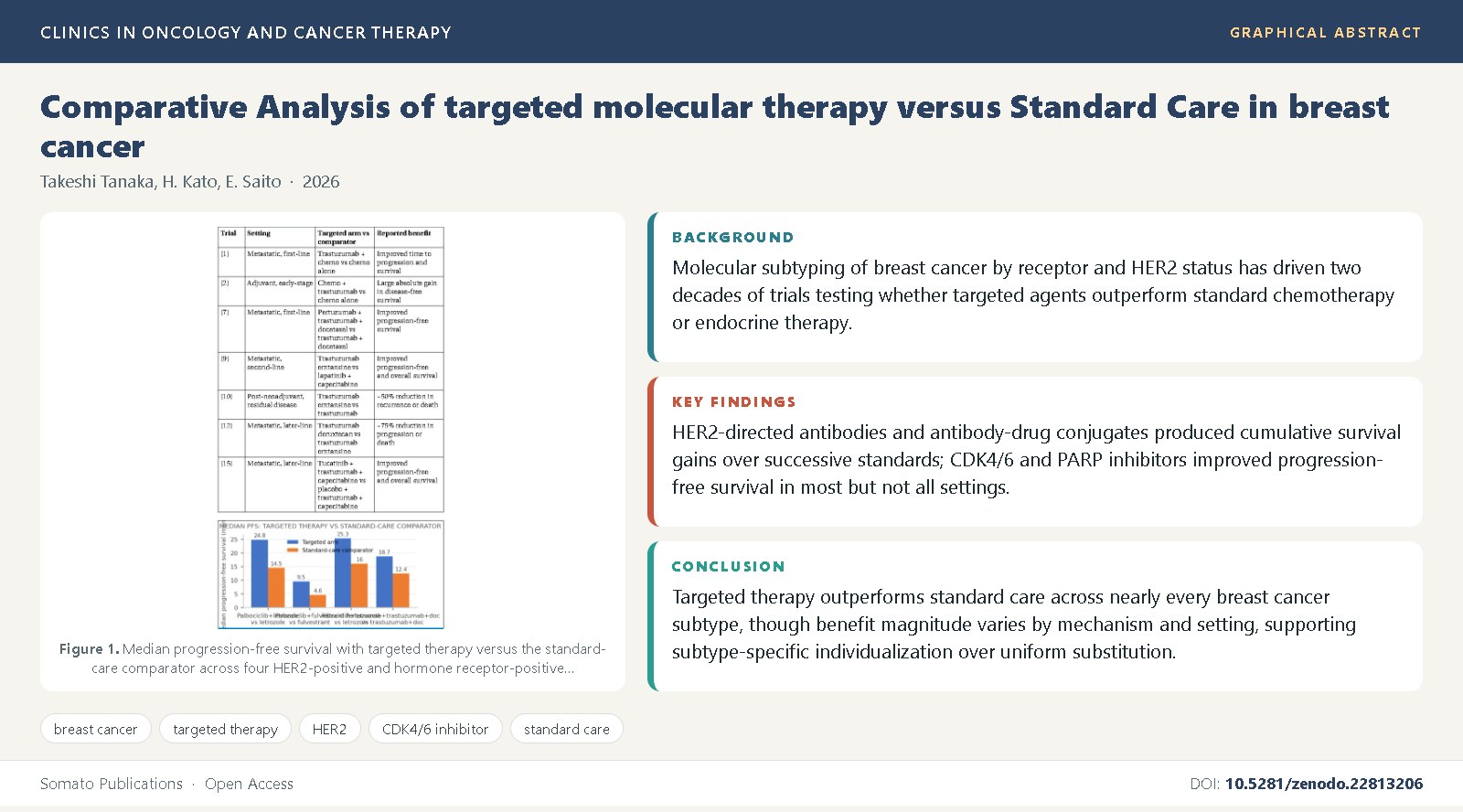
Background: Molecular subtyping of breast cancer by receptor and HER2 status has driven two decades of trials testing whether targeted agents outperform standard chemotherapy or endocrine therapy.
Objective: This analysis synthesizes randomized evidence across HER2-positive, hormone receptor-positive, BRCA-mutated, and triple-negative breast cancer to characterize how consistently targeted therapy outperforms standard care.
Methods: We compared reported progression-free survival, overall survival, disease-free survival, and pathological complete response from randomized trials of targeted agents added to or substituted for standard-care regimens.
Results: HER2-directed antibodies and antibody-drug conjugates produced cumulative survival gains over successive standards; CDK4/6 and PARP inhibitors improved progression-free survival in most but not all settings; and immunotherapy and antibody-drug conjugates improved outcomes in triple-negative disease, while genomic assays identified subsets in whom chemotherapy could be safely omitted.
Conclusions: Targeted therapy outperforms standard care across nearly every breast cancer subtype, though benefit magnitude varies by mechanism and setting, supporting subtype-specific individualization over uniform substitution.
References
Slamon, D.J., Leyland-Jones, B., Shak, S., Fuchs, H., Paton, V., Bajamonde, A., et al. (2001) Use of chemotherapy plus a monoclonal antibody against HER2 for metastatic breast cancer that overexpresses HER2. New England Journal of Medicine, 344(11): 783-792.
Romond, E.H., Perez, E.A., Bryant, J., Suman, V.J., Geyer, C.E., Davidson, N.E., et al. (2005) Trastuzumab plus adjuvant chemotherapy for operable HER2-positive breast cancer. New England Journal of Medicine, 353(16): 1673-1684.
Piccart-Gebhart, M.J., Procter, M., Leyland-Jones, B., Goldhirsch, A., Untch, M., Smith, I., et al. (2005) Trastuzumab after adjuvant chemotherapy in HER2-positive breast cancer. New England Journal of Medicine, 353(16): 1659-1672.
Cameron, D., Piccart-Gebhart, M.J., Gelber, R.D., Procter, M., Goldhirsch, A., de Azambuja, E., et al. (2017) 11 years' follow-up of trastuzumab after adjuvant chemotherapy in HER2-positive early breast cancer: final analysis of the HERceptin Adjuvant (HERA) trial. Lancet, 389(10075): 1195-1205.
Perez, E.A., Romond, E.H., Suman, V.J., Jeong, J.H., Sledge, G., Geyer, C.E., et al. (2014) Trastuzumab plus adjuvant chemotherapy for human epidermal growth factor receptor 2-positive breast cancer: planned joint analysis of overall survival from NSABP B-31 and NCCTG N9831. Journal of Clinical Oncology, 32(33): 3744-3752.
Early Breast Cancer Trialists' Collaborative Group (EBCTCG) (2021) Trastuzumab for early-stage, HER2-positive breast cancer: a meta-analysis of 13,864 women in seven randomised trials. Lancet Oncology, 22(8): 1139-1150.
Baselga, J., Cortes, J., Kim, S.B., Im, S.A., Hegg, R., Im, Y.H., et al. (2012) Pertuzumab plus trastuzumab plus docetaxel for metastatic breast cancer. New England Journal of Medicine, 366(2): 109-119.
Swain, S.M., Baselga, J., Kim, S.B., Ro, J., Semiglazov, V., Campone, M., et al. (2015) Pertuzumab, trastuzumab, and docetaxel in HER2-positive metastatic breast cancer. New England Journal of Medicine, 372(8): 724-734.
Verma, S., Miles, D., Gianni, L., Krop, I.E., Welslau, M., Baselga, J., et al. (2012) Trastuzumab emtansine for HER2-positive advanced breast cancer. New England Journal of Medicine, 367(19): 1783-1791.
von Minckwitz, G., Huang, C.S., Mano, M.S., Loibl, S., Mamounas, E.P., Untch, M., et al. (2019) Trastuzumab emtansine for residual invasive HER2-positive breast cancer. New England Journal of Medicine, 380(7): 617-628.
Modi, S., Saura, C., Yamashita, T., Park, Y.H., Kim, S.B., Tamura, K., et al. (2020) Trastuzumab deruxtecan in previously treated HER2-positive breast cancer. New England Journal of Medicine, 382(7): 610-621.
Cortes, J., Kim, S.B., Chung, W.P., Im, S.A., Park, Y.H., Hegg, R., et al. (2022) Trastuzumab deruxtecan versus trastuzumab emtansine for breast cancer. New England Journal of Medicine, 386(12): 1143-1154.
Geyer, C.E., Forster, J., Lindquist, D., Chan, S., Romieu, C.G., Pienkowski, T., et al. (2006) Lapatinib plus capecitabine for HER2-positive advanced breast cancer. New England Journal of Medicine, 355(26): 2733-2743.
Blackwell, K.L., Burstein, H.J., Storniolo, A.M., Rugo, H.S., Sledge, G., Aktan, G., et al. (2012) Overall survival benefit with lapatinib in combination with trastuzumab for patients with human epidermal growth factor receptor 2-positive metastatic breast cancer. Journal of Clinical Oncology, 30(21): 2585-2592.
Murthy, R.K., Loi, S., Okines, A., Paplomata, E., Hamilton, E., Hurvitz, S.A., et al. (2020) Tucatinib, trastuzumab, and capecitabine for HER2-positive metastatic breast cancer. New England Journal of Medicine, 382(7): 597-609.
Finn, R.S., Martin, M., Rugo, H.S., Jones, S., Im, S.A., Gelmon, K., et al. (2016) Palbociclib and letrozole in advanced breast cancer. New England Journal of Medicine, 375(20): 1925-1936.
Turner, N.C., Ro, J., Andre, F., Loi, S., Verma, S., Iwata, H., et al. (2015) Palbociclib in hormone-receptor-positive advanced breast cancer. New England Journal of Medicine, 373(3): 209-219.
Hortobagyi, G.N., Stemmer, S.M., Burris, H.A., Yap, Y.S., Sonke, G.S., Paluch-Shimon, S., et al. (2016) Ribociclib as first-line therapy for HR-positive, advanced breast cancer. New England Journal of Medicine, 375(18): 1738-1748.
Sledge, G.W., Toi, M., Neven, P., Sohn, J., Inoue, K., Pivot, X., et al. (2017) MONARCH 2: Abemaciclib in combination with fulvestrant in women with HR+/HER2- advanced breast cancer who had progressed while receiving endocrine therapy. Journal of Clinical Oncology, 35(25): 2875-2884.
Goetz, M.P., Toi, M., Campone, M., Sohn, J., Paluch-Shimon, S., Huober, J., et al. (2017) MONARCH 3: Abemaciclib as initial therapy for advanced breast cancer. Journal of Clinical Oncology, 35(32): 3638-3646.
Johnston, S.R.D., Harbeck, N., Hegg, R., Toi, M., Martin, M., Shao, Z.M., et al. (2020) Abemaciclib combined with endocrine therapy for the adjuvant treatment of HR+, HER2-, node-positive, high-risk, early breast cancer. Journal of Clinical Oncology, 38(34): 3987-3998.
Mayer, E.L., Dueck, A.C., Martin, M., Rubovszky, G., Burstein, H.J., Bellet-Ezquerra, M., et al. (2021) Palbociclib with adjuvant endocrine therapy in early breast cancer (PALLAS). Lancet Oncology, 22(2): 212-222.
Baselga, J., Campone, M., Piccart, M., Burris, H.A., Rugo, H.S., Sahmoud, T., et al. (2012) Everolimus in postmenopausal hormone-receptor-positive advanced breast cancer. New England Journal of Medicine, 366(6): 520-529.
Andre, F., Ciruelos, E., Rubovszky, G., Campone, M., Loibl, S., Rugo, H.S., et al. (2019) Alpelisib for PIK3CA-mutated, hormone receptor-positive advanced breast cancer. New England Journal of Medicine, 380(20): 1929-1940.
Sparano, J.A., Gray, R.J., Makower, D.F., Pritchard, K.I., Albain, K.S., Hayes, D.F., et al. (2018) Adjuvant chemotherapy guided by a 21-gene expression assay in breast cancer. New England Journal of Medicine, 379(2): 111-121.
Cardoso, F., van't Veer, L.J., Bogaerts, J., Slaets, L., Viale, G., Delaloge, S., et al. (2016) 70-gene signature as an aid to treatment decisions in early-stage breast cancer. New England Journal of Medicine, 375(8): 717-729.
Robson, M., Im, S.A., Senkus, E., Xu, B., Domchek, S.M., Masuda, N., et al. (2017) Olaparib for metastatic breast cancer in patients with a germline BRCA mutation. New England Journal of Medicine, 377(6): 523-533.
Litton, J.K., Rugo, H.S., Ettl, J., Hurvitz, S.A., Goncalves, A., Lee, K.H., et al. (2018) Talazoparib in patients with advanced breast cancer and a germline BRCA mutation. New England Journal of Medicine, 379(8): 753-763.
Schmid, P., Adams, S., Rugo, H.S., Schneeweiss, A., Barrios, C.H., Iwata, H., et al. (2018) Atezolizumab and nab-paclitaxel in advanced triple-negative breast cancer. New England Journal of Medicine, 379(22): 2108-2121.
Schmid, P., Cortes, J., Pusztai, L., McArthur, H., Kummel, S., Bergh, J., et al. (2020) Pembrolizumab for early triple-negative breast cancer. New England Journal of Medicine, 382(9): 810-821.
Cortazar, P., Zhang, L., Untch, M., Mehta, K., Costantino, J.P., Wolmark, N., et al. (2014) Pathological complete response and long-term clinical benefit in breast cancer after neoadjuvant chemotherapy. Lancet, 384(9938): 164-172.
Bardia, A., Hurvitz, S.A., Tolaney, S.M., Loirat, D., Punie, K., Oliveira, M., et al. (2021) Sacituzumab govitecan in metastatic triple-negative breast cancer. New England Journal of Medicine, 384(16): 1529-1541.
Rugo, H.S., Bardia, A., Marme, F., Cortes, J., Schmid, P., Loirat, D., et al. (2022) Sacituzumab govitecan in hormone receptor-positive/HER2-negative metastatic breast cancer. Journal of Clinical Oncology, 40(29): 3365-3376.
Early Breast Cancer Trialists' Collaborative Group (EBCTCG) (2011) Relevance of breast cancer hormone receptors and other factors to the efficacy of adjuvant tamoxifen: patient-level meta-analysis of randomised trials. Lancet, 378(9793): 771-784.

Published
Issue
Section
License
Copyright (c) 2026 Takeshi Tanaka, et al.

This work is licensed under a Creative Commons Attribution 4.0 International License.


