
Clinical Outcomes of liposomal encapsulation in Patients with drug degradation instability
DOI:
https://doi.org/10.5281/zenodo.22813178Keywords:
liposomal encapsulation, drug degradation instability, pharmacokinetics, clinical outcomes, nanomedicineAbstract
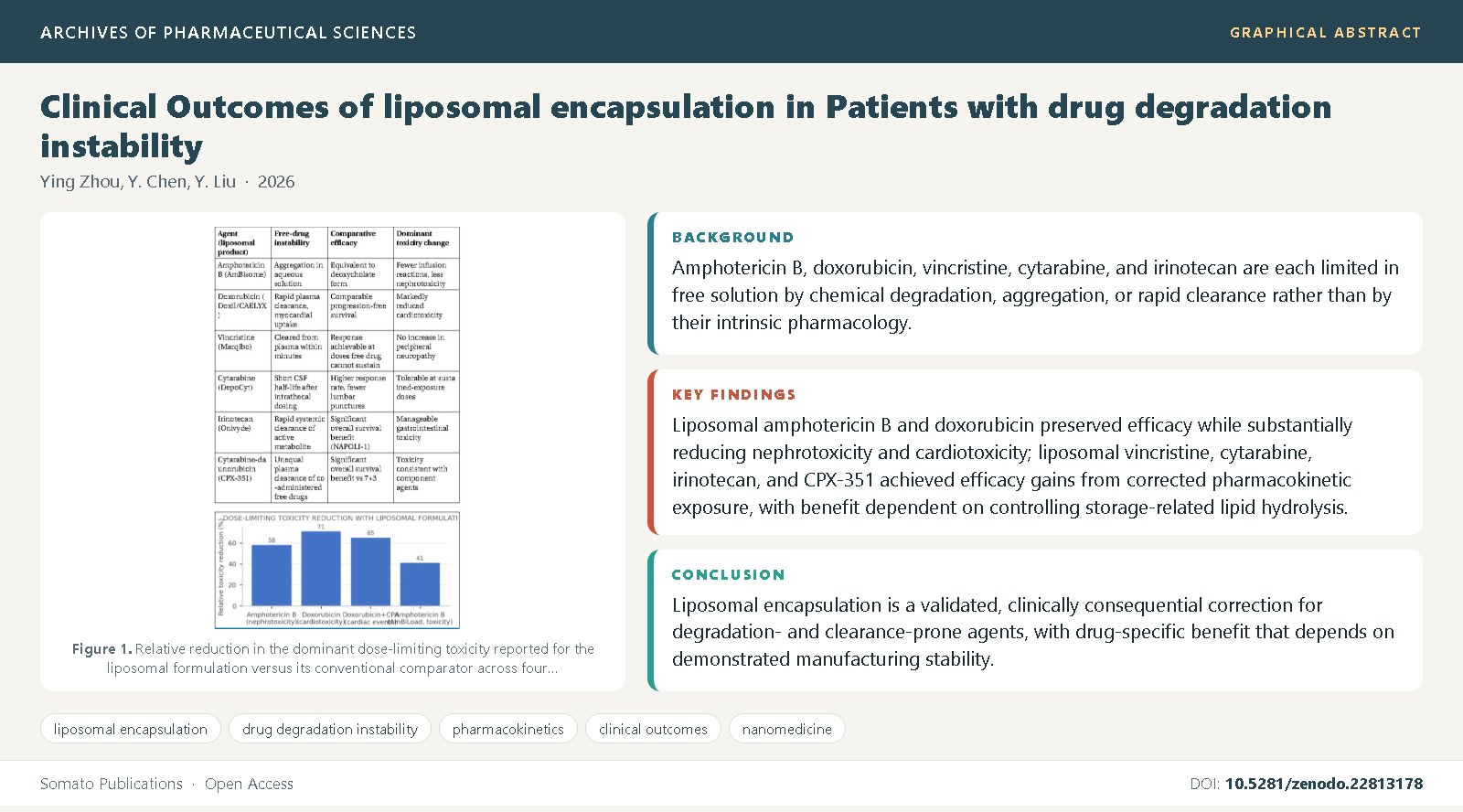
Background: Amphotericin B, doxorubicin, vincristine, cytarabine, and irinotecan are each limited in free solution by chemical degradation, aggregation, or rapid clearance rather than by their intrinsic pharmacology.
Objective: To synthesize comparative clinical trial outcomes for liposomal encapsulation of drugs with documented degradation or clearance instability, and the formulation-stability evidence underlying those outcomes.
Methods: Structured narrative synthesis of randomized and controlled trials of liposomal versus conventional formulations for six agents, alongside pharmaceutical literature on phospholipid hydrolysis and oxidation.
Findings: Liposomal amphotericin B and doxorubicin preserved efficacy while substantially reducing nephrotoxicity and cardiotoxicity; liposomal vincristine, cytarabine, irinotecan, and CPX-351 achieved efficacy gains from corrected pharmacokinetic exposure, with benefit dependent on controlling storage-related lipid hydrolysis and oxidation.
Conclusions: Liposomal encapsulation is a validated, clinically consequential correction for degradation- and clearance-prone agents, with drug-specific benefit that depends on demonstrated manufacturing stability.
References
Barenholz, Y. (2012) Doxil - the first FDA-approved nano-drug: lessons learned. Journal of Controlled Release, 160(2): 117-134.
Gabizon, A., Shmeeda, H., Barenholz, Y. (2003) Pharmacokinetics of pegylated liposomal doxorubicin: review of animal and human studies. Clinical Pharmacokinetics, 42(5): 419-436.
Silverman, J.A., Deitcher, S.R. (2013) Marqibo (vincristine sulfate liposome injection) improves the pharmacokinetics and pharmacodynamics of vincristine. Cancer Chemotherapy and Pharmacology, 71(3): 555-564.
Gabizon, A., Papahadjopoulos, D. (1988) Liposome formulations with prolonged circulation time in blood and enhanced uptake by tumors. Proceedings of the National Academy of Sciences USA, 85(18): 6949-6953.
Allen, T.M., Cullis, P.R. (2013) Liposomal drug delivery systems: from concept to clinical applications. Advanced Drug Delivery Reviews, 65(1): 36-48.
Adler-Moore, J., Proffitt, R.T. (2002) AmBisome: liposomal formulation, structure, mechanism of action and pre-clinical experience. Journal of Antimicrobial Chemotherapy, 49(Suppl 1): 21-30.
Barenholz, Y. (2001) Liposome application: problems and prospects. Current Opinion in Colloid and Interface Science, 6(1): 66-77.
Glantz, M.J., LaFollette, S., Jaeckle, K.A., Shapiro, W., Swinnen, L., Rozental, J.R., et al. (1999) Randomized trial of a slow-release version of cytarabine for the intrathecal treatment of lymphomatous meningitis. Journal of Clinical Oncology, 17(10): 3110-3116.
Kim, E.S. (2015) Liposomal irinotecan: first global approval. Drugs, 75(14): 1663-1669.
Lancet, J.E., Uy, G.L., Cortes, J.E., Newell, L.F., Lin, T.L., Ritchie, E.K., et al. (2018) CPX-351 (cytarabine and daunorubicin) liposome for injection versus conventional cytarabine plus daunorubicin in older patients with newly diagnosed secondary acute myeloid leukemia. Journal of Clinical Oncology, 36(26): 2684-2692.
Grit, M., Crommelin, D.J.A. (1993) Chemical stability of liposomes: implications for their physical stability. Chemistry and Physics of Lipids, 64(1-3): 3-18.
Crommelin, D.J.A. (1984) Influence of lipid composition and ionic strength on the physical stability of liposomes. Journal of Pharmaceutical Sciences, 73(11): 1559-1563.
Zuidam, N.J., Crommelin, D.J.A. (1995) Chemical hydrolysis of phospholipids. Journal of Pharmaceutical Sciences, 84(9): 1113-1119.
Grit, M., de Smidt, J.H., Struijke, A., Crommelin, D.J.A. (1989) Hydrolysis of phosphatidylcholine in aqueous liposome dispersions. International Journal of Pharmaceutics, 50(1): 1-6.
Walsh, T.J., Finberg, R.W., Arndt, C., Hiemenz, J., Schwartz, C., Bodensteiner, D., et al. (1999) Liposomal amphotericin B for empirical therapy in patients with persistent fever and neutropenia. New England Journal of Medicine, 340(10): 764-771.
Wingard, J.R., White, M.H., Anaissie, E., Raffalli, J., Goodman, J., Arrieta, A. (2000) A randomized, double-blind comparative trial evaluating the safety of liposomal amphotericin B versus amphotericin B lipid complex in the empirical treatment of febrile neutropenia. Clinical Infectious Diseases, 31(5): 1155-1163.
Cornely, O.A., Maertens, J., Bresnik, M., Ebrahimi, R., Ullmann, A.J., Bouza, E., et al. (2007) Liposomal amphotericin B as initial therapy for invasive mold infection: a randomized trial comparing a high-loading dose regimen with standard dosing (AmBiLoad trial). Clinical Infectious Diseases, 44(10): 1289-1297.
O'Brien, M.E.R., Wigler, N., Inbar, M., Rosso, R., Grischke, E., Santoro, A., et al. (2004) Reduced cardiotoxicity and comparable efficacy in a phase III trial of pegylated liposomal doxorubicin HCl (CAELYX/Doxil) versus conventional doxorubicin for first-line treatment of metastatic breast cancer. Annals of Oncology, 15(3): 440-449.
Batist, G., Ramakrishnan, G., Rao, C.S., Chandrasekharan, A., Gutheil, J., Guthrie, T., et al. (2001) Reduced cardiotoxicity and preserved antitumor efficacy of liposome-encapsulated doxorubicin and cyclophosphamide compared with conventional doxorubicin and cyclophosphamide in a randomized, multicenter trial of metastatic breast cancer. Journal of Clinical Oncology, 19(5): 1444-1454.
Harris, L., Batist, G., Belt, R., Rovira, D., Navari, R., Azarnia, N., et al. (2002) Liposome-encapsulated doxorubicin compared with conventional doxorubicin in a randomized multicenter trial as first-line therapy of metastatic breast carcinoma. Cancer, 94(1): 25-36.
Rivera, E., Valero, V., Arun, B., Royce, M., Adinin, R., Hoelzer, K., et al. (2002) Phase II study of pegylated liposomal doxorubicin in the treatment of advanced breast cancer. The Oncologist, 7(4): 358-361.
Krishna, R., Webb, M.S., St Onge, G., Mayer, L.D. (2001) Liposomal and nonliposomal drug pharmacokinetics after intravenous administration and pharmacodynamics of liposomal doxorubicin in tumor-bearing mice. Journal of Pharmacology and Experimental Therapeutics, 298(3): 1206-1212.
O'Brien, S., Schiller, G., Lister, J., Damon, L., Goldberg, S., Aulitzky, W., et al. (2013) High-dose vincristine sulfate liposome injection for advanced, relapsed, and refractory adult Philadelphia chromosome-negative acute lymphoblastic leukemia. Journal of Clinical Oncology, 31(6): 676-683.
Bomgaars, L., Geyer, J.R., Franklin, J., Dahl, G., Park, J., Winick, N.J., et al. (2004) Phase I trial of intrathecal liposomal cytarabine in children with neoplastic meningitis. Journal of Clinical Oncology, 22(19): 3916-3921.
Wang-Gillam, A., Li, C.P., Bodoky, G., Dean, A., Shan, Y.S., Jameson, G., et al. (2016) Nanoliposomal irinotecan with fluorouracil and folinic acid in metastatic pancreatic cancer after previous gemcitabine-based therapy (NAPOLI-1): a global, randomised, open-label, phase 3 trial. Lancet, 387(10018): 545-557.
Mayer, L.D., Tai, L.C., Bally, M.B., Mitilenes, G.N., Ginsberg, R.S., Cullis, P.R. (1989) Characterization of liposomal systems containing doxorubicin entrapped in response to pH gradients. Biochimica et Biophysica Acta, 978(2): 246-256.
Amselem, S., Gabizon, A., Barenholz, Y. (1990) A large-scale method for the preparation of sterile and non-pyrogenic liposomal formulations of defined size distributions. Journal of Pharmaceutical Sciences, 79(11): 1045-1052.
Working, P.K., Dayan, A.D. (1996) Pharmacological-toxicological expert report: CAELYX (Stealth liposomal doxorubicin HCl). Human and Experimental Toxicology, 15(9): 751-785.
Sercombe, L., Veerati, T., Moheimani, F., Wu, S.Y., Sood, A.K., Hua, S. (2015) Advances and challenges of liposome assisted drug delivery. Frontiers in Pharmacology, 6: 286.
Immordino, M.L., Dosio, F., Cattel, L. (2006) Stealth liposomes: review of the basic science, rationale, and clinical applications, existing and potential. International Journal of Nanomedicine, 1(3): 297-315.
Bulbake, U., Doppalapudi, S., Kommineni, N., Khan, W. (2017) Liposomal formulations in clinical use: an updated review. Pharmaceutics, 9(2): 12.
Chang, H.I., Yeh, M.K. (2012) Clinical development of liposome-based drugs: formulation, characterization, and therapeutic efficacy. International Journal of Nanomedicine, 7: 49-60.
Yingchoncharoen, P., Kalinowski, D.S., Richardson, D.R. (2016) Lipid-based drug delivery systems in cancer therapy: what is available and what is yet to come. Pharmacological Reviews, 68(3): 701-787.
Crommelin, D.J.A., van Hoogevest, P., Storm, G. (2020) The role of liposomes in clinical nanomedicine development. What now? Now what? Journal of Controlled Release, 318: 256-263.
Cattel, L., Ceruti, M., Dosio, F. (2003) From conventional to stealth liposomes: a new frontier in cancer chemotherapy. Tumori, 89(3): 237-249.
Drummond, D.C., Meyer, O., Hong, K., Kirpotin, D.B., Papahadjopoulos, D. (1999) Optimizing liposomes for delivery of chemotherapeutic agents to solid tumors. Pharmacological Reviews, 51(4): 691-743.

Published
Issue
Section
License
Copyright (c) 2026 Ying Zhou, et al.

This work is licensed under a Creative Commons Attribution 4.0 International License.


