
Predictors of drug bioavailability in chronic disease patients with targeted delivery limitations
DOI:
https://doi.org/10.5281/zenodo.22813144Keywords:
bioavailability, chronic disease, targeted drug delivery, pharmacokinetics, nanocarrierAbstract
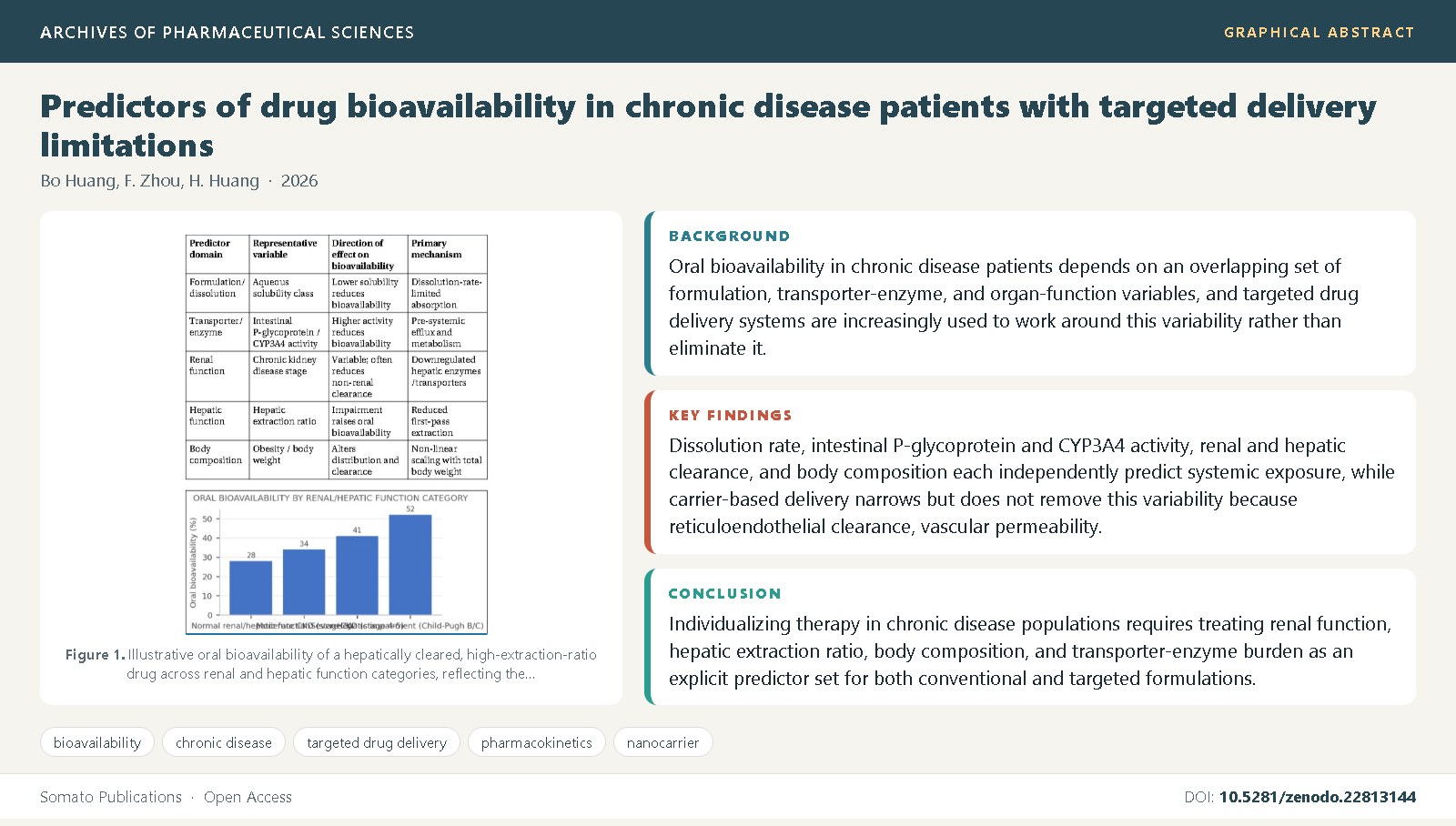
Oral bioavailability in chronic disease patients depends on an overlapping set of formulation, transporter-enzyme, and organ-function variables, and targeted drug delivery systems are increasingly used to work around this variability rather than eliminate it. This paper synthesizes the biopharmaceutics, pharmacokinetics, and nanomedicine literature to identify the predictors of variable bioavailability in chronic kidney disease, hepatic dysfunction, and obesity, and to characterize where liposomal, polymeric, and lipid-nanoparticle carrier systems reach their own disease-dependent limitations. Dissolution rate, intestinal P-glycoprotein and CYP3A4 activity, renal and hepatic clearance, and body composition each independently predict systemic exposure, while carrier-based delivery narrows but does not remove this variability because reticuloendothelial clearance, vascular permeability, and receptor expression are themselves altered by chronic disease. Individualizing therapy in chronic disease populations requires treating renal function, hepatic extraction ratio, body composition, and transporter-enzyme burden as an explicit predictor set for both conventional and targeted formulations, rather than assuming carrier-based delivery is immune to the physiology it was designed to work around.
References
Amidon, G.L., Lennernäs, H., Shah, V.P., Crouch, V.E. (1995) A theoretical basis for a biopharmaceutic drug classification: the correlation of in vitro drug product dissolution and in vivo bioavailability. Pharmaceutical Research, 12(3): 413-420. DOI: 10.1023/A:1016212804288
Yu, L.X. (1999) An integrated model for determining causes of poor oral drug absorption and bioavailability. Pharmaceutical Research, 16(12): 1883-1887. DOI: 10.1023/A:1018911728161
Lipinski, C.A., Lombardo, F., Dominy, B.W., Feeney, P.J. (2001) Experimental and computational approaches to estimate solubility and permeability in drug discovery and development settings. Advanced Drug Delivery Reviews, 46(1-3): 3-26. DOI: 10.1016/S0169-409X(00)00129-0
Wilkinson, G.R. (2005) Drug metabolism and variability among patients in drug response. New England Journal of Medicine, 352(21): 2211-2221. DOI: 10.1056/NEJMra032424
Verbeeck, R.K. (2008) Pharmacokinetics and dosage adjustment in patients with hepatic dysfunction. European Journal of Clinical Pharmacology, 64(12): 1147-1161. DOI: 10.1007/s00228-008-0553-z
Matzke, G.R., Aronoff, G.R., Atkinson, A.J., Bennett, W.M., Decker, B.S., Eckardt, K.U., et al. (2011) Drug dosing consideration in patients with acute and chronic kidney disease-a clinical update from Kidney Disease: Improving Global Outcomes (KDIGO). Kidney International, 80(11): 1122-1137. DOI: 10.1038/ki.2011.322
Torchilin, V.P. (2005) Recent advances with liposomes as pharmaceutical carriers. Nature Reviews Drug Discovery, 4(2): 145-160. DOI: 10.1038/nrd1632
Allen, T.M., Cullis, P.R. (2013) Liposomal drug delivery systems: from concept to clinical applications. Advanced Drug Delivery Reviews, 65(1): 36-48. DOI: 10.1016/j.addr.2012.09.037
Peer, D., Karp, J.M., Hong, S., Farokhzad, O.C., Margalit, R., Langer, R. (2007) Nanocarriers as an emerging platform for cancer therapy. Nature Nanotechnology, 2(12): 751-760. DOI: 10.1038/nnano.2007.387
Blanco, E., Shen, H., Ferrari, M. (2015) Principles of nanoparticle design for overcoming biological barriers to drug delivery. Nature Biotechnology, 33(9): 941-951. DOI: 10.1038/nbt.3330
Bertrand, N., Wu, J., Xu, X., Kamaly, N., Farokhzad, O.C. (2014) Cancer nanotechnology: the impact of passive and active targeting in the era of modern cancer biology. Advanced Drug Delivery Reviews, 66: 2-25. DOI: 10.1016/j.addr.2013.11.009
Griffin, B.T., Guo, J., Presas, E., Donovan, M.D., Alonso, M.J., O'Driscoll, C.M. (2016) Pharmacokinetic, pharmacodynamic and biodistribution following oral administration of nanocarriers containing peptide and protein drugs. Advanced Drug Delivery Reviews, 106(Pt B): 367-380. DOI: 10.1016/j.addr.2016.06.006
Lam, Y.W., Banerji, S., Hatfield, C., Talbert, R.L. (1997) Principles of drug administration in renal insufficiency. Clinical Pharmacokinetics, 32(1): 30-57. DOI: 10.2165/00003088-199732010-00002
Hanley, M.J., Abernethy, D.R., Greenblatt, D.J. (2010) Effect of obesity on the pharmacokinetics of drugs in humans. Clinical Pharmacokinetics, 49(2): 71-87. DOI: 10.2165/11318100-000000000-00000
Danhier, F., Ansorena, E., Silva, J.M., Coco, R., Le Breton, A., Préat, V. (2012) PLGA-based nanoparticles: an overview of biomedical applications. Journal of Controlled Release, 161(2): 505-522. DOI: 10.1016/j.jconrel.2012.01.043
Kalepu, S., Nekkanti, V. (2015) Insoluble drug delivery strategies: review of recent advances and business prospects. Acta Pharmaceutica Sinica B, 5(5): 442-453. DOI: 10.1016/j.apsb.2015.07.003
Kesisoglou, F., Panmai, S., Wu, Y. (2007) Nanosizing--oral formulation development and biopharmaceutical evaluation. Advanced Drug Delivery Reviews, 59(7): 631-644. DOI: 10.1016/j.addr.2007.05.003
Porter, C.J., Trevaskis, N.L., Charman, W.N. (2007) Lipids and lipid-based formulations: optimizing the oral delivery of lipophilic drugs. Nature Reviews Drug Discovery, 6(3): 231-248. DOI: 10.1038/nrd2197
Sosnik, A., Seremeta, K.P. (2015) Advantages and challenges of the spray-drying technology for the production of pure drug particles and drug-loaded polymeric carriers. Advances in Colloid and Interface Science, 223: 40-54. DOI: 10.1016/j.cis.2015.05.003
Chen, M.L. (2008) Lipid excipients and delivery systems for pharmaceutical development: a regulatory perspective. Advanced Drug Delivery Reviews, 60(6): 768-777. DOI: 10.1016/j.addr.2007.09.010
Lin, J.H., Yamazaki, M. (2003) Role of P-glycoprotein in pharmacokinetics: clinical implications. Clinical Pharmacokinetics, 42(1): 59-98. DOI: 10.2165/00003088-200342010-00003
Varma, M.V., Ashokraj, Y., Dey, C.S., Panchagnula, R. (2003) P-glycoprotein inhibitors and their screening: a perspective from bioavailability enhancement. Pharmacological Research, 48(4): 347-359. DOI: 10.1016/S1043-6618(03)00158-0
Benet, L.Z., Cummins, C.L. (2001) The drug efflux-metabolism alliance: biochemical aspects. Advanced Drug Delivery Reviews, 50(Suppl 1): S3-S11. DOI: 10.1016/S0169-409X(01)00178-8
Custodio, J.M., Wu, C.Y., Benet, L.Z. (2008) Predicting drug disposition, absorption/elimination/transporter interplay and the role of food on drug absorption. Advanced Drug Delivery Reviews, 60(6): 717-733. DOI: 10.1016/j.addr.2007.11.014
Pang, K.S., Rowland, M. (1977) Hepatic clearance of drugs. I. Theoretical considerations of a "well-stirred" model and a "parallel tube" model. Journal of Pharmacokinetics and Biopharmaceutics, 5(6): 625-653. DOI: 10.1007/BF01059688
Duncan, R. (2006) Polymer conjugates as anticancer nanomedicines. Nature Reviews Cancer, 6(9): 688-701. DOI: 10.1038/nrc1958
Beloqui, A., Solinís, M.Á., Rodríguez-Gascón, A., Almeida, A.J., Préat, V. (2016) Nanostructured lipid carriers: promising drug delivery systems for future clinics. Nanomedicine, 12(1): 143-161. DOI: 10.1016/j.nano.2015.09.004
Müller, R.H., Keck, C.M. (2004) Challenges and solutions for the delivery of biotech drugs--a review of drug nanocrystal technology and lipid nanoparticles. Journal of Biotechnology, 113(1-3): 151-170. DOI: 10.1016/j.jbiotec.2004.06.007
des Rieux, A., Fievez, V., Garinot, M., Schneider, Y.J., Préat, V. (2006) Nanoparticles as potential oral delivery systems of proteins and vaccines: a mechanistic approach. Journal of Controlled Release, 116(1): 1-27. DOI: 10.1016/j.jconrel.2006.08.013
Homayun, B., Lin, X., Choi, H.J. (2019) Challenges and recent progress in oral drug delivery systems for biopharmaceuticals. Pharmaceutics, 11(3): 129. DOI: 10.3390/pharmaceutics11030129
Alqahtani, M.S., Kazi, M., Alsenaidy, M.A., Ahmad, M.Z. (2021) Advances in oral drug delivery. Frontiers in Pharmacology, 12: 618411. DOI: 10.3389/fphar.2021.618411
Feng, S.S., Chien, S. (2003) Chemotherapeutic engineering: application and further development of chemical engineering principles for chemotherapy of cancer and other diseases. Chemical Engineering Science, 58(18): 4087-4114. DOI: 10.1016/S0009-2509(03)00234-5
Bosselmann, S., Williams, R.O. (2012) Has nanotechnology led to improved therapeutic outcomes? Drug Development and Industrial Pharmacy, 38(2): 158-170. DOI: 10.3109/03639045.2011.597764

Published
Issue
Section
License
Copyright (c) 2026 Bo Huang, et al.

This work is licensed under a Creative Commons Attribution 4.0 International License.


