
Prevalence and Risk Factors of poor oral bioavailability in preclinical pharmacokinetic models
DOI:
https://doi.org/10.5281/zenodo.22813136Keywords:
oral bioavailability, preclinical pharmacokinetics, biopharmaceutics classification, first-pass metabolism, P-glycoproteinAbstract
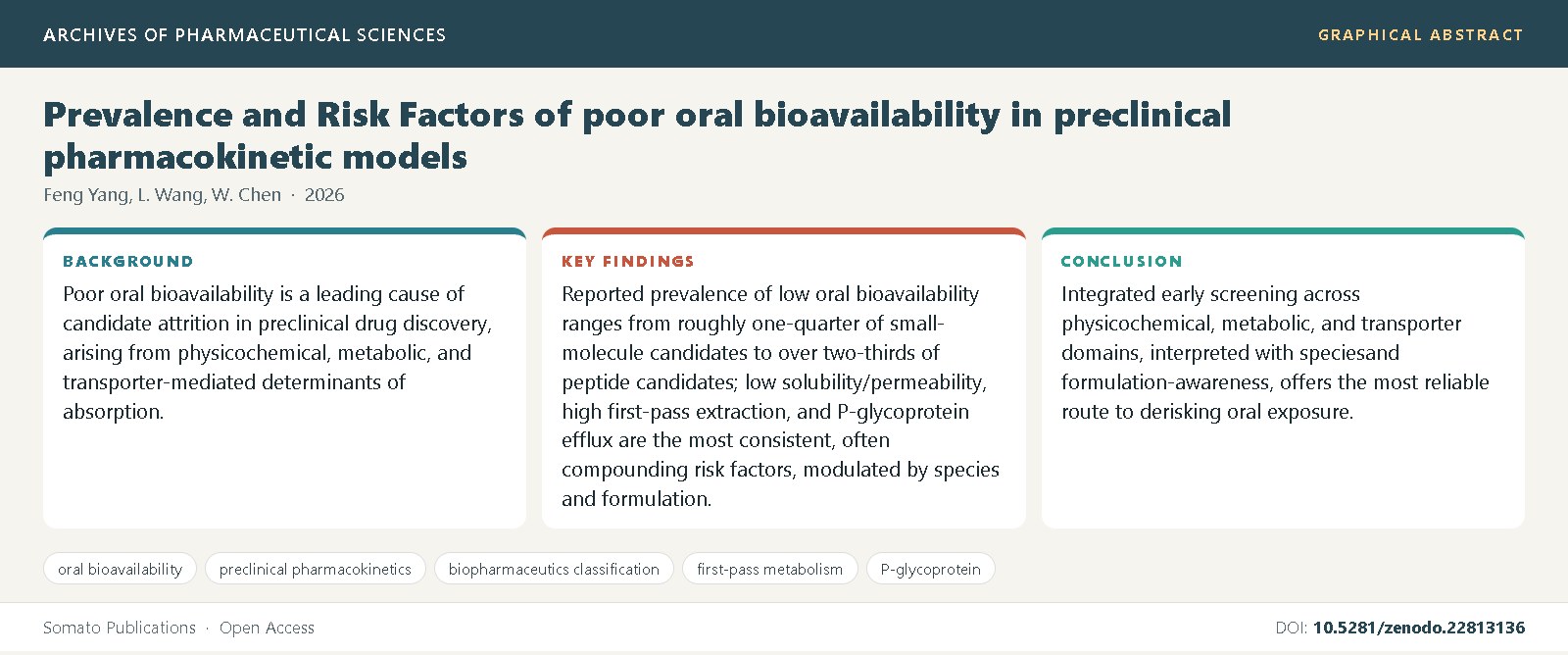
Background: Poor oral bioavailability is a leading cause of candidate attrition in preclinical drug discovery, arising from physicochemical, metabolic, and transporter-mediated determinants of absorption [3,9].
Objective: This review synthesizes the preclinical pharmacokinetic literature on the prevalence of poor oral bioavailability across compound classes and its principal risk factors.
Methods: We reviewed peer-reviewed preclinical pharmacokinetic studies and industry-wide attrition analyses reporting oral bioavailability alongside physicochemical or biopharmaceutic descriptors, drawn from rodent, canine, and primate screening cascades.
Findings: Reported prevalence of low oral bioavailability ranges from roughly one-quarter of small-molecule candidates to over two-thirds of peptide candidates [10,12]; low solubility/permeability [3], high first-pass extraction [24], and P-glycoprotein efflux [27] are the most consistent, often compounding risk factors, modulated by species and formulation [5,31].
Conclusions: Integrated early screening across physicochemical, metabolic, and transporter domains, interpreted with speciesand formulation-awareness, offers the most reliable route to derisking oral exposure [24,27].
References
Lipinski CA, Lombardo F, Dominy BW, Feeney PJ (2001) Experimental and computational approaches to estimate solubility and permeability in drug discovery and development settings. Adv Drug Deliv Rev 46(1-3):3-26. DOI: 10.1016/S0169-409X(00)00129-0
Lin JH, Lu AY (1997) Role of pharmacokinetics and metabolism in drug discovery and development. Pharmacol Rev 49(4):403-449.
Amidon GL, Lennernas H, Shah VP, Crison JR (1995) A theoretical basis for a biopharmaceutic drug classification: the correlation of in vitro drug product dissolution and in vivo bioavailability. Pharm Res 12(3):413-420. DOI: 10.1023/A:1016212804288
Martinez MN, Amidon GL (2002) A mechanistic approach to understanding the factors affecting drug absorption: a review of fundamentals. J Clin Pharmacol 42(6):620-643.
Chiou WL, Barve A (1998) Linear correlation of the fraction of oral dose absorbed of 64 drugs between humans and rats. Pharm Res 15(11):1792-1795. DOI: 10.1023/A:1011981317451
Musther H, Olivares-Morales A, Hatley OJ, Liu B, Rostami Hodjegan A (2014) Animal versus human oral drug bioavailability: do they correlate? Eur J Pharm Sci 57:280-291. DOI: 10.1016/j.ejps.2013.08.018
van de Waterbeemd H, Smith DA, Beaumont K, Walker DK (2001) Property-based design: optimization of drug absorption and pharmacokinetics. J Med Chem 44(9):1313-1333. DOI: 10.1021/jm000407e
Kerns EH, Di L (2008) Drug-like Properties: Concepts, Structure Design and Methods: from ADME to Toxicity Optimization. Academic Press, Burlington.
Kola I, Landis J (2004) Can the pharmaceutical industry reduce attrition rates? Nat Rev Drug Discov 3(8):711-715. DOI: 10.1038/nrd1470
Waring MJ, Arrowsmith J, Leach AR, et al (2015) An analysis of the attrition of drug candidates from four major pharmaceutical companies. Nat Rev Drug Discov 14(7):475-486. DOI: 10.1038/nrd4609
Veber DF, Johnson SR, Cheng HY, Smith BR, Ward KW, Kopple KD (2002) Molecular properties that influence the oral bioavailability of drug candidates. J Med Chem 45(12):2615-2623. DOI: 10.1021/jm020017n
Doak BC, Over B, Giordanetto F, Kihlberg J (2014) Oral druggable space beyond the rule of 5: insights from drugs and clinical candidates. Chem Biol 21(9):1115-1142. DOI: 10.1016/j.chembiol.2014.08.013
Leeson PD, Springthorpe B (2007) The influence of drug-like concepts on decision-making in medicinal chemistry. Nat Rev Drug Discov 6(11):881-890. DOI: 10.1038/nrd2445
Avdeef A (2003) Absorption and Drug Development: Solubility, Permeability, and Charge State. Wiley-Interscience, Hoboken.
Artursson P, Karlsson J (1991) Correlation between oral drug absorption in humans and apparent drug permeability coefficients in human intestinal epithelial (Caco-2) cells. Biochem Biophys Res Commun 175(3):880-885. DOI: 10.1016/0006-291X(91)91647-U
Wu CY, Benet LZ (2005) Predicting drug disposition via application of BCS: transport/absorption/elimination interplay and development of a biopharmaceutics drug disposition classification system. Pharm Res 22(1):11-23. DOI: 10.1007/s11095-004-9004-4
Benet LZ (2013) The role of BCS (biopharmaceutics classification system) and BDDCS (biopharmaceutics drug disposition classification system) in drug development. J Pharm Sci 102(1):34-42. DOI: 10.1002/jps.23359
Egan WJ, Merz KM, Baldwin JJ (2000) Prediction of drug absorption using multivariate statistics. J Med Chem 43(21):3867-3877. DOI: 10.1021/jm000292e
Hou T, Wang J, Zhang W, Xu X (2007) ADME evaluation in drug discovery. 7. Prediction of oral bioavailability in humans based on molecular properties and structural fingerprints. Mol Pharm 4(5):782-793. DOI: 10.1021/mp700086h
Dahan A, Miller JM, Amidon GL (2009) Prediction of solubility and permeability class membership: provisional BCS classification of the world's top oral drugs. AAPS J 11(4):740-746. DOI: 10.1208/s12248-009-9144-x
Caldwell GW, Ritchie DM, Masucci JA, Hageman W, Yan Z (2001) The new pre-preclinical paradigm: compound optimization in early and late phase drug discovery. Curr Top Med Chem 1(5):353-366. DOI: 10.2174/1568026013395100
Hurst S, Loi CM, Brodfuehrer J, El-Kattan A (2007) Impact of physiological, physicochemical and biopharmaceutical factors in absorption and metabolism mechanisms on the drug oral bioavailability of rats and humans. Expert Opin Drug Metab Toxicol 3(4):469-489. DOI: 10.1517/17425255.3.4.469
Smith DA, Beaumont K, Maurer TS, Di L (2014) Relevance of lipophilicity for molecular design. Mol Pharm 11(7):2098-2105. DOI: 10.1021/mp500055q
Obach RS (1999) Prediction of human clearance of twenty-nine drugs from hepatic microsomal intrinsic clearance data: an examination of in vitro half-life approach and nonspecific binding to microsomes. Drug Metab Dispos 27(11):1350-1359.
Riley RJ, McGinnity DF, Austin RP (2005) A unified model for predicting human hepatic, metabolic clearance from in vitro intrinsic clearance data in hepatocytes and microsomes. Drug Metab Dispos 33(9):1304-1311. DOI: 10.1124/dmd.105.004259
Paine MF, Hart HL, Ludington SS, Haining RL, Rettie AE, Zeldin DC (2006) The human intestinal cytochrome P450 "pie". Drug Metab Dispos 34(5):880-886. DOI: 10.1124/dmd.105.008672
Varma MV, Feng B, Obach RS, et al (2010) Physicochemical determinants of human renal clearance. J Med Chem 52(15):4844-4852. DOI: 10.1021/jm900403j
Lin JH, Yamazaki M (2003) Role of P-glycoprotein in pharmacokinetics: clinical implications. Clin Pharmacokinet 42(1):59-98. DOI: 10.2165/00003088-200342010-00003
Benet LZ, Cummins CL, Wu CY (2004) Unmasking the dynamic interplay between efflux transporters and metabolic enzymes. Int J Pharm 277(1-2):3-9. DOI: 10.1016/j.ijpharm.2002.12.002
Charman WN, Porter CJ, Mithani S, Dressman JB (1997) Physicochemical and physiological mechanisms for the effects of food on drug absorption: the role of lipids and pH. J Pharm Sci 86(3):269-282. DOI: 10.1021/js960085v
Porter CJ, Trevaskis NL, Charman WN (2007) Lipids and lipid-based formulations: optimizing the oral delivery of lipophilic drugs. Nat Rev Drug Discov 6(3):231-248. DOI: 10.1038/nrd2197
Kawabata Y, Wada K, Nakatani M, Yamada S, Onoue S (2011) Formulation design for poorly water-soluble drugs based on biopharmaceutics classification system: basic approaches and practical applications. Int J Pharm 420(1):1-10. DOI: 10.1016/j.ijpharm.2011.08.032

Published
Issue
Section
License
Copyright (c) 2026 Feng Yang, et al.

This work is licensed under a Creative Commons Attribution 4.0 International License.


