
Impact of liposomal encapsulation on Quality of Life in Patients with drug degradation instability
DOI:
https://doi.org/10.5281/zenodo.22813157Keywords:
liposomal encapsulation, drug degradation instability, quality of life, pharmaceutical stability, controlled drug releaseAbstract
Background: Many drugs degrade in solution through hydrolysis, oxidation, or photolysis fast enough to compromise potency, translating clinically into unstable symptom control and a heavier adverse-effect burden.
Objective: This review synthesizes evidence on how liposomal encapsulation stabilizes drugs with degradation instability and how the resulting pharmacokinetic and safety changes translate into quality-of-life outcomes.
Methods: We synthesized liposome formulation and stability studies alongside randomized and pharmacokinetic trials comparing liposomal and conventional formulations of anthracycline, antifungal, and vinca alkaloid drugs with documented instability.
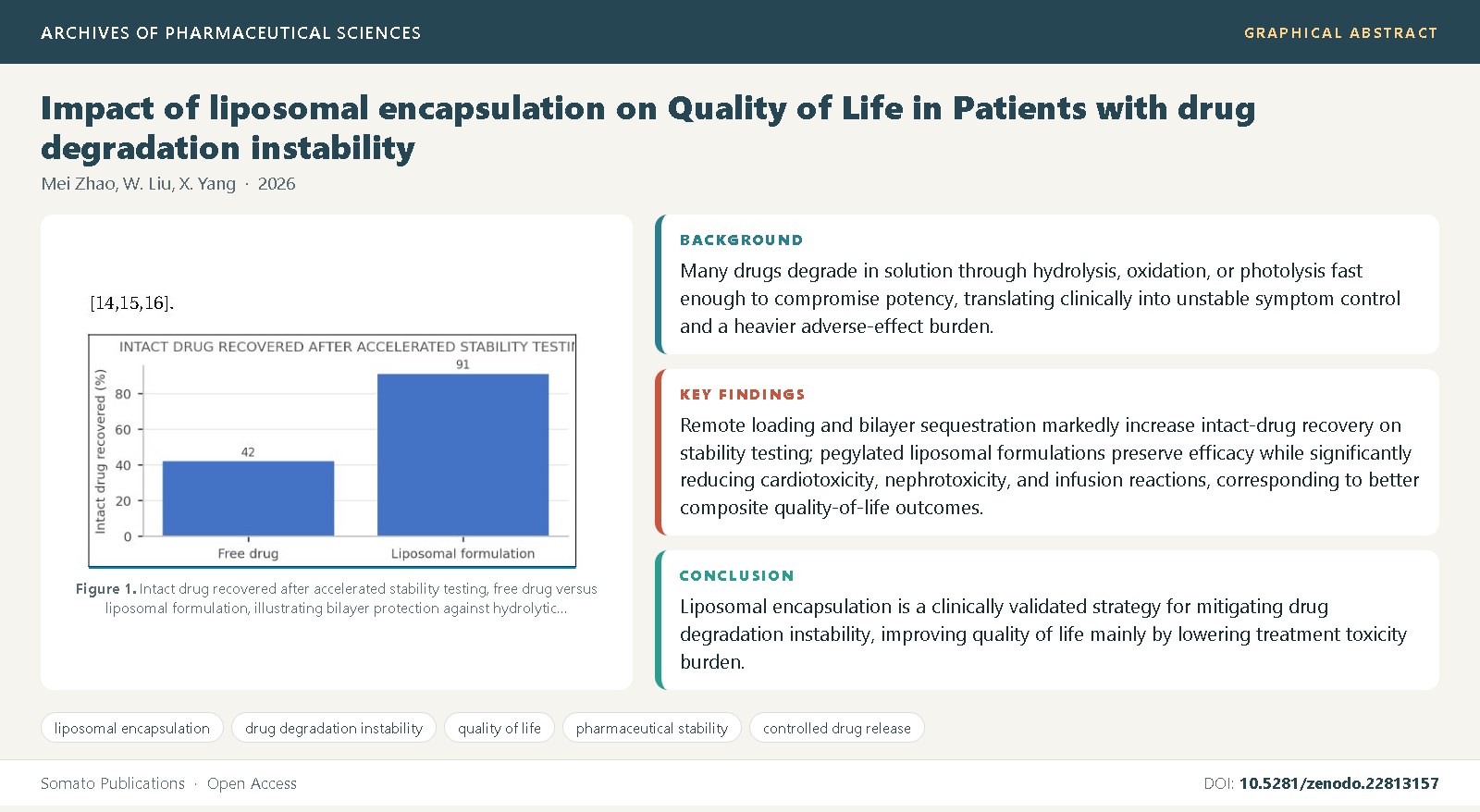
Findings: Remote loading and bilayer sequestration markedly increase intact-drug recovery on stability testing; pegylated liposomal formulations preserve efficacy while significantly reducing cardiotoxicity, nephrotoxicity, and infusion reactions, corresponding to better composite quality-of-life outcomes.
Conclusions: Liposomal encapsulation is a clinically validated strategy for mitigating drug degradation instability, improving quality of life mainly by lowering treatment toxicity burden.
References
Waterman, K.C., Adami, R.C. (2005) Accelerated aging: prediction of chemical stability of pharmaceuticals. International Journal of Pharmaceutics, 293(1-2): 101-125. DOI: 10.1016/j.ijpharm.2004.12.013
Blessy, M., Patel, R.D., Prajapati, P.N., Agrawal, Y.K. (2014) Development of forced degradation and stability indicating studies of drugs - A review. Journal of Pharmaceutical Analysis, 4(3): 159-165. DOI: 10.1016/j.jpha.2013.09.003
Torchilin, V.P. (2005) Recent advances with liposomes as pharmaceutical carriers. Nature Reviews Drug Discovery, 4(2): 145-160. DOI: 10.1038/nrd1632
Allen, T.M., Cullis, P.R. (2013) Liposomal drug delivery systems: from concept to clinical applications. Advanced of Drug Delivery Reviews, 65(1): 36-48. DOI: 10.1016/j.addr.2012.09.037
Bulbake, U., Doppalapudi, S., Kommineni, N., Khan, W. (2017) Liposomal formulations in clinical use: an updated review. Pharmaceutics, 9(2): 12. DOI: 10.3390/pharmaceutics9020012
Gregoriadis, G. (1995) Engineering liposomes for drug delivery: progress and problems. Trends in Biotechnology, 13(12): 527-537. DOI: 10.1016/S0167-7799(00)89017-4
Lasic, D.D. (1998) Novel applications of liposomes. Trends in Biotechnology, 16(7): 307-321. DOI: 10.1016/S0167-7799(98)01220-7
Drummond, D.C., Meyer, O., Hong, K., Kirpotin, D.B., Papahadjopoulos, D. (1999) Optimizing liposomes for delivery of chemotherapeutic agents to solid tumors. Pharmacological Reviews, 51(4): 691-743.
Grit, M., Crommelin, D.J.A. (1993) Chemical stability of liposomes: implications for their physical stability. Chemistry and Physics of Lipids, 64(1-3): 3-18. DOI:
1016/0009-3084(93)90053-6 10. Zuidam, N.J., Crommelin, D.J.A. (1995) Chemical hydrolysis of phospholipids. Journal of Pharmaceutical Sciences, 84(9): 1113-1119. DOI: 10.1002/jps.2600840917
Cullis, P.R., Hope, M.J., Bally, M.B., Madden, T.D., Mayer, L.D., Fenske, D.B. (1997) Influence of pH gradients on the transbilayer transport of drugs, lipophilic agents and membrane potential-sensitive dyes. Biochimica et Biophysica Acta, 1331(2): 187-211. DOI: 10.1016/S0304-4157(97)00006-3
Fritze, A., Hens, F., Kimpfler, A., Schubert, R., Peschka-Suss, R. (2006) Remote loading of doxorubicin into liposomes driven by a transmembrane phosphate gradient. Biochimica et Biophysica Acta, 1758(10): 1633-1640. DOI: 10.1016/j.bbamem.2006.05.028
Chen, C., Han, D., Cai, C., Tang, X. (2010) An overview of liposome lyophilization and its future potential. Journal of Controlled Release, 142(3): 299-311. DOI: 10.1016/j.jconrel.2009.10.024
Ong, S.G.M., Chitneni, M., Lee, K.S., Ming, L.C., Yuen, K.H. (2016) Evaluation of extrusion technique for nanosizing liposomes. Pharmaceutics, 8(4): 36. DOI: 10.3390/pharmaceutics8040036
Maherani, B., Arab-Tehrany, E., Mozafari, M.R., Gaiani, C., Linder, M. (2011) Liposomes: a review of manufacturing techniques and targeting strategies. Current Nanoscience, 7(3): 436-452. DOI: 10.2174/157341311795542453
Akbarzadeh, A., Rezaei-Sadabady, R., Davaran, S., Joo, S.W., Zarghami, N., Hanifehpour, Y., et al. (2013) Liposome: classification, preparation, and applications. Nanoscale Research Letters, 8(1): 102. DOI: 10.1186/1556-276X-8-102
Gabizon, A., Shmeeda, H., Barenholz, Y. (2003) Pharmacokinetics of pegylated liposomal doxorubicin: review of animal and human studies. Clinical Pharmacokinetics, 42(5): 419-436. DOI: 10.2165/00003088-200342050-00002
Immordino, M.L., Dosio, F., Cattel, L. (2006) Stealth liposomes: review of the basic science, rationale, and clinical applications, existing and potential. International Journal of Nanomedicine, 1(3): 297-315.
Barenholz, Y. (2012) Doxil - the first FDA-approved nano-drug: lessons learned. Journal of Controlled Release, 160(2): 117-134. DOI: 10.1016/j.jconrel.2012.03.020
O'Brien, M.E.R., Wigler, N., Inbar, M., Rosso, R., Grischke, E., Santoro, A., et al. (2004) Reduced cardiotoxicity and comparable efficacy in a phase III trial of pegylated liposomal doxorubicin HCl (CAELYX/Doxil) versus conventional doxorubicin for first-line treatment of metastatic breast cancer. Annals of Oncology, 15(3): 440-449. DOI: 10.1093/annonc/mdh097
Batist, G., Ramakrishnan, G., Rao, C.S., Chandrasekharan, A., Gutheil, J., Guthrie, T., et al. (2001) Reduced cardiotoxicity and preserved antitumor efficacy of liposome-encapsulated doxorubicin and cyclophosphamide compared with conventional doxorubicin and cyclophosphamide in a randomized, multicenter trial of metastatic breast cancer. Journal of Clinical Oncology, 19(5): 1444-1454. DOI: 10.1200/JCO.2001.19.5.1444
Adler-Moore, J., Proffitt, R.T. (2002) AmBisome: liposomal formulation, structure, mechanism of action and pre-clinical experience. Journal of Antimicrobial Chemotherapy, 49(Suppl 1): 21-30. DOI: 10.1093/jac/49.suppl_1.21
Walsh, T.J., Finberg, R.W., Arndt, C., Hiemenz, J., Schwartz, C., Bodensteiner, D., et al. (1999) Liposomal amphotericin B for empirical therapy in patients with persistent fever and neutropenia. New England Journal of Medicine, 340(10): 764-771. DOI: 10.1056/NEJM199903113401004
Aaronson, N.K., Ahmedzai, S., Bergman, B., Bullinger, M., Cull, A., Duez, N.J., et al. (1993) The European Organization for Research and Treatment of Cancer QLQ-C30: a quality-of-life instrument for use in international clinical trials in oncology. Journal of the National Cancer Institute, 85(5): 365-376. DOI: 10.1093/jnci/85.5.365
Petersen, G.H., Alzghari, S.K., Chee, W., Sankari, S.S., La-Beck, N.M. (2016) Meta-analysis of clinical and preclinical studies comparing the anticancer efficacy of liposomal versus conventional non-liposomal doxorubicin. Journal of Controlled Release, 232: 255-264. DOI: 10.1016/j.jconrel.2016.04.028
Muggia, F.M., Hainsworth, J.D., Jeffers, S., Miller, P., Groshen, S., Tan, M., et al. (1997) Phase II study of liposomal doxorubicin in refractory ovarian cancer: antitumor activity and toxicity modification by liposomal encapsulation. Journal of Clinical Oncology, 15(3): 987-993. DOI: 10.1200/JCO.1997.15.3.987
Gordon, A.N., Fleagle, J.T., Guthrie, D., Parkin, D.E., Gore, M.E., Lacave, A.J. (2001) Recurrent epithelial ovarian carcinoma: a randomized phase III study of pegylated liposomal doxorubicin versus topotecan. Journal of Clinical Oncology, 19(14): 3312-3322. DOI: 10.1200/JCO.2001.19.14.3312
Northfelt, D.W., Dezube, B.J., Thommes, J.A., Miller, B.J., Fischl, M.A., Friedman-Kien, A., et al. (1998) Pegylated-liposomal doxorubicin versus doxorubicin, bleomycin, and vincristine in the treatment of AIDS-related Kaposi's sarcoma: results of a randomized phase III clinical trial. Journal of Clinical Oncology, 16(7): 2445-2451. DOI: 10.1200/JCO.1998.16.7.2445
Chang, H.I., Yeh, M.K. (2012) Clinical development of liposome-based drugs: formulation, characterization, and therapeutic efficacy. International Journal of Nanomedicine, 7: 49-60. DOI: 10.2147/IJN.S26766
Slingerland, M., Guchelaar, H.J., Gelderblom, H. (2012) Liposomal drug formulations in cancer therapy: 15 years along the road. Drug Discovery Today, 17(3-4): 160-166. DOI: 10.1016/j.drudis.2011.09.015
Fan, Y., Zhang, Q. (2013) Development of liposomal formulations: from concept to clinical investigations. Asian Journal of Pharmaceutical Sciences, 8(2): 81-87. DOI: 10.1016/j.ajps.2013.07.010
Sercombe, L., Veerati, T., Moheimani, F., Wu, S.Y., Sood, A.K., Hua, S. (2015) Advances and challenges of liposome assisted drug delivery. Frontiers in Pharmacology, 6: 286. DOI: 10.3389/fphar.2015.00286
Crommelin, D.J.A., van Hoogevest, P., Storm, G. (2020) The role of liposomes in clinical nanomedicine development. What now? Now what? Journal of Controlled Release, 318: 256-263. DOI: 10.1016/j.jconrel.2019.12.023
Beltran-Gracia, E., Lopez-Camacho, A., Higuera-Ciapara, I., Velazquez-Fernandez, J.B., Vallejo-Cardona, A.A. (2019) Nanomedicine review: clinical developments in liposomal applications for cancer therapy. Cancer Nanotechnology, 10: 11. DOI: 10.1186/s12645-019-0055-y

Published
Issue
Section
License
Copyright (c) 2026 Mei Zhao, et al.

This work is licensed under a Creative Commons Attribution 4.0 International License.


