
Impact of controlled-release tablet design on Quality of Life in Patients with drug degradation instability
DOI:
https://doi.org/10.5281/zenodo.22813168Keywords:
controlled-release tablet, drug stability, quality of life, medication adherence, formulation designAbstract
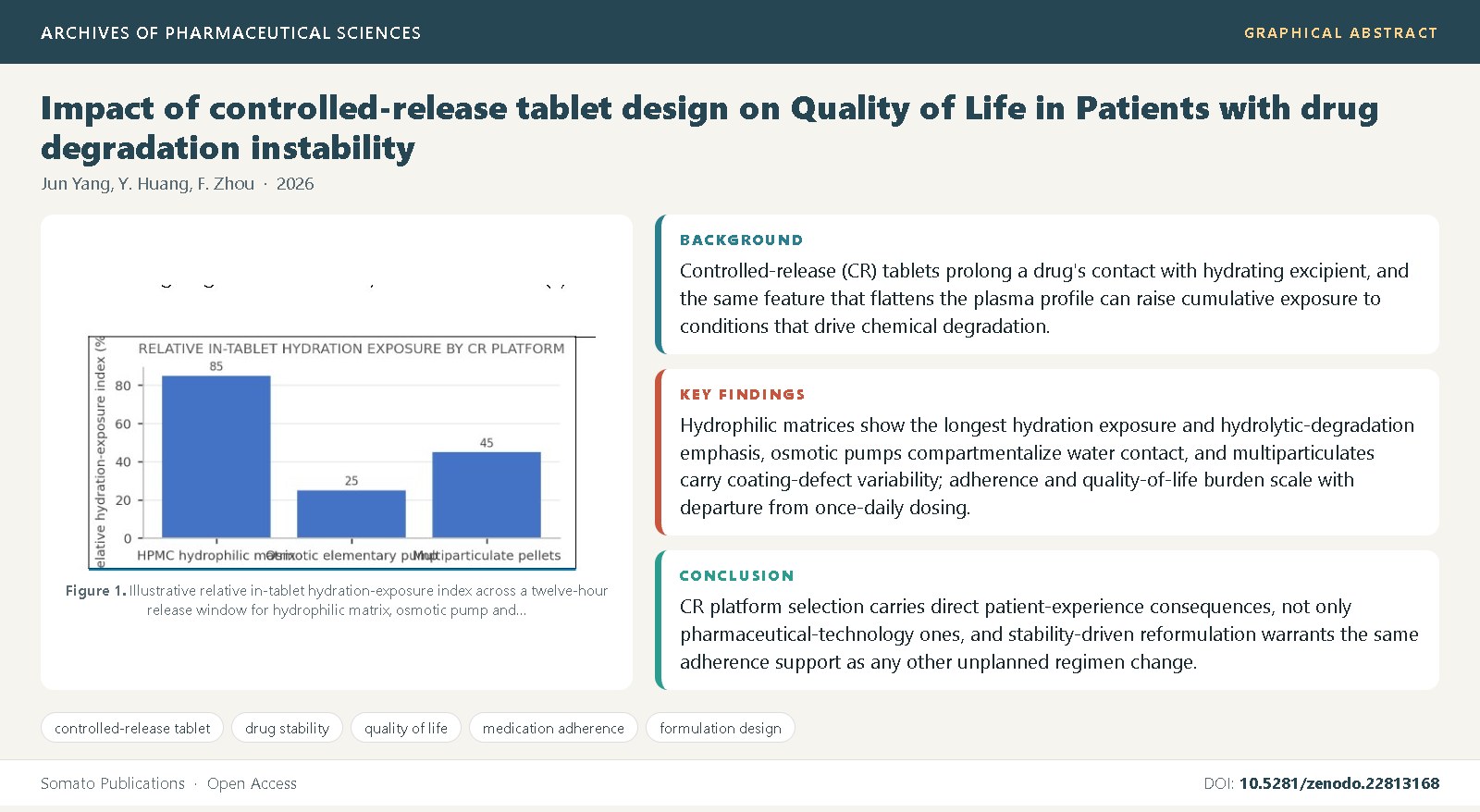
Background: Controlled-release (CR) tablets prolong a drug's contact with hydrating excipient, and the same feature that flattens the plasma profile can raise cumulative exposure to conditions that drive chemical degradation.
Objective: We examine how the choice among hydrophilic matrix, osmotic pump and multiparticulate CR platforms affects degradation-related instability risk, and how the resulting regimen disruption affects patient quality of life and adherence.
Methods: We synthesized formulation-mechanism, forced-degradation, accelerated-stability, and adherence/quality-of-life literature into an illustrative comparative framework across three representative CR platforms.
Results: Hydrophilic matrices show the longest hydration exposure and hydrolytic-degradation emphasis, osmotic pumps compartmentalize water contact, and multiparticulates carry coating-defect variability; adherence and quality-of-life burden scale with departure from once-daily dosing.
Conclusions: CR platform selection carries direct patient-experience consequences, not only pharmaceutical-technology ones, and stability-driven reformulation warrants the same adherence support as any other unplanned regimen change.
References
Higuchi, T. (1963) Mechanism of sustained-action medication: theoretical analysis of rate of release of solid drugs dispersed in solid matrices. Journal of Pharmaceutical Sciences, 52(12): 1145-1149. DOI: 10.1002/jps.2600521210
Korsmeyer, R.W., Gurny, R., Doelker, E., Buri, P., Peppas, N.A. (1983) Mechanisms of solute release from porous hydrophilic polymers. International Journal of Pharmaceutics, 15(1): 25-35. DOI: 10.1016/0378-5173(83)90064-9
Ritger, P.L., Peppas, N.A. (1987) A simple equation for description of solute release I. Fickian and non-Fickian release from non-swellable devices. Journal of Controlled Release, 5(1): 23-36. DOI: 10.1016/0168-3659(87)90034-4
Peppas, N.A. (1985) Analysis of Fickian and non-Fickian drug release from polymers. Pharmaceutica Acta Helvetiae, 60(4): 110-111.
Siepmann, J., Peppas, N.A. (2001) Modeling of drug release from delivery systems based on hydroxypropyl methylcellulose (HPMC). Advanced Drug Delivery Reviews, 48(2-3): 139-157. DOI: 10.1016/S0169-409X(01)00112-0
Siepmann, J., Siepmann, F. (2008) Mathematical modeling of drug delivery. International Journal of Pharmaceutics, 364(2): 328-343. DOI: 10.1016/j.ijpharm.2008.09.004
Gao, P., Skoug, J.W., Nixon, P.R., Ju, T.R., Stemm, N.L., Sung, K.C. (2013) Swelling of hydroxypropyl methylcellulose matrix tablets: 1. Characterization of swelling using a novel optical imaging method. Journal of Pharmaceutical Sciences, 102(9): 3184-3192. DOI: 10.1002/jps.23623
Theeuwes, F. (1975) Elementary osmotic pump. Journal of Pharmaceutical Sciences, 64(12): 1987-1991. DOI: 10.1002/jps.2600641218
Verma, R.K., Krishna, D.M., Garg, S. (2002) Formulation aspects in the development of osmotically controlled oral drug delivery systems. Journal of Controlled Release, 79(1-3): 7-27. DOI: 10.1016/S0168-3659(01)00550-8
Waterman, K.C., Adami, R.C., Alsante, K.M., Hong, J., Landis, M.S., Lombardo, F., Roberts, C.J. (2002) Stabilization of pharmaceuticals to oxidative degradation. Pharmaceutical Development and Technology, 7(1): 1-32. DOI: 10.1081/PDT-120002237
Byrn, S.R., Xu, W., Newman, A.W. (2001) Chemical reactivity in solid-state pharmaceuticals: formulation implications. Advanced Drug Delivery Reviews, 48(1): 115-136. DOI: 10.1016/S0169-409X(01)00102-8
International Conference on Harmonisation (2003) ICH Harmonised Tripartite Guideline Q1A(R2): Stability Testing of New Drug Substances and Products. ICH, Geneva.
Blessy, M., Patel, R.D., Prajapati, P.N., Agrawal, Y.K. (2014) Development of forced degradation and stability indicating studies of drugs-a review. Journal of Pharmaceutical Analysis, 4(3): 159-165. DOI: 10.1016/j.jpha.2013.09.003
Singh, S., Bakshi, M. (2000) Guidance on conduct of stress tests to determine inherent stability of drugs. Pharmaceutical Technology, 24(4): 1-14.
Waterman, K.C., Carella, A.J., Gumkowski, M.J., Lukulay, P., MacDonald, B.C., Roy, M.C., Shamblin, S.L. (2007) Improved protocol and data analysis for accelerated shelf-life estimation of solid dosage forms. Pharmaceutical Research, 24(4): 780-790. DOI: 10.1007/s11095-006-9201-4
Claxton, A.J., Cramer, J., Pierce, C. (2001) A systematic review of the associations between dose regimens and medication compliance. Clinical Therapeutics, 23(8): 1296-1310. DOI: 10.1016/S0149-2918(01)80109-0
Saini, S.D., Schoenfeld, P., Kaulback, K., Dubinsky, M.C. (2009) Effect of medication dosing frequency on adherence in chronic diseases. American Journal of Managed Care, 15(6): e22-e33.
Ingersoll, K.S., Cohen, J. (2008) The impact of medication regimen factors on adherence to chronic treatment: a review of literature. Journal of Behavioral Medicine, 31(3): 213-224. DOI: 10.1007/s10865-007-9147-y
Vrijens, B., De Geest, S., Hughes, D.A., Przemyslaw, K., Demonceau, J., Ruppar, T., Dobbels, F., Fargher, E., Morrison, V., Lewek, P., Matyjaszczyk, M., Mshelia, C., Clyne, W., Aronson, J.K., Urquhart, J. (2012) A new taxonomy for describing and defining adherence to medications. British Journal of Clinical Pharmacology, 73(5): 691-705. DOI: 10.1111/j.1365-2125.2012.04167.x
Ware, J.E., Sherbourne, C.D. (1992) The MOS 36-item short-form health survey (SF-36): I. Conceptual framework and item selection. Medical Care, 30(6): 473-483.
WHOQOL Group (1998) Development of the World Health Organization WHOQOL-BREF quality of life assessment. Psychological Medicine, 28(3): 551-558. DOI: 10.1017/S0033291798006667
Testa, M.A., Simonson, D.C. (1996) Assessment of quality-of-life outcomes. New England Journal of Medicine, 334(13): 835-840. DOI: 10.1056/NEJM199603283341306
Marinker, M., Shaw, J. (2003) Not to be taken as directed. BMJ, 326(7385): 348-349. DOI: 10.1136/bmj.326.7385.348
Costa, P., Sousa Lobo, J.M. (2001) Modeling and comparison of dissolution profiles. European Journal of Pharmaceutical Sciences, 13(2): 123-133. DOI: 10.1016/S0928-0987(01)00095-1
Colombo, P., Bettini, R., Santi, P., Peppas, N.A. (2000) Swellable matrices for controlled drug delivery: gel-layer behaviour, mechanisms and optimal performance. Pharmaceutical Science and Technology Today, 3(6): 198-204. DOI: 10.1016/S1461-5347(00)00269-8
Maderuelo, C., Zarzuelo, A., Lanao, J.M. (2011) Critical factors in the release of drugs from sustained release hydrophilic matrices. Journal of Controlled Release, 154(1): 2-19. DOI: 10.1016/j.jconrel.2011.04.002
Carstensen, J.T., Rhodes, C.T. (2000) Drug Stability: Principles and Practices, 3rd edition. Marcel Dekker, New York.
Osterberg, L., Blaschke, T. (2005) Adherence to medication. New England Journal of Medicine, 353(5): 487-497. DOI: 10.1056/NEJMra050100
Cramer, J.A. (1998) Enhancing patient compliance in the elderly: role of packaging aids and monitoring. Drugs & Aging, 12(1): 7-15. DOI: 10.2165/00002512-199812010-00002
Rowe, R.C., Sheskey, P.J., Quinn, M.E. (eds.) (2009) Handbook of Pharmaceutical Excipients, 6th edition. Pharmaceutical Press, London.

Published
Issue
Section
License
Copyright (c) 2026 Jun Yang, et al.

This work is licensed under a Creative Commons Attribution 4.0 International License.


