
Predictors of visual acuity improvement in diabetic patients with retinal disease with corneal ulcer
DOI:
https://doi.org/10.5281/zenodo.22812190Keywords:
diabetic retinopathy, corneal ulcer, visual acuity, diabetic keratopathy, macular edemaAbstract
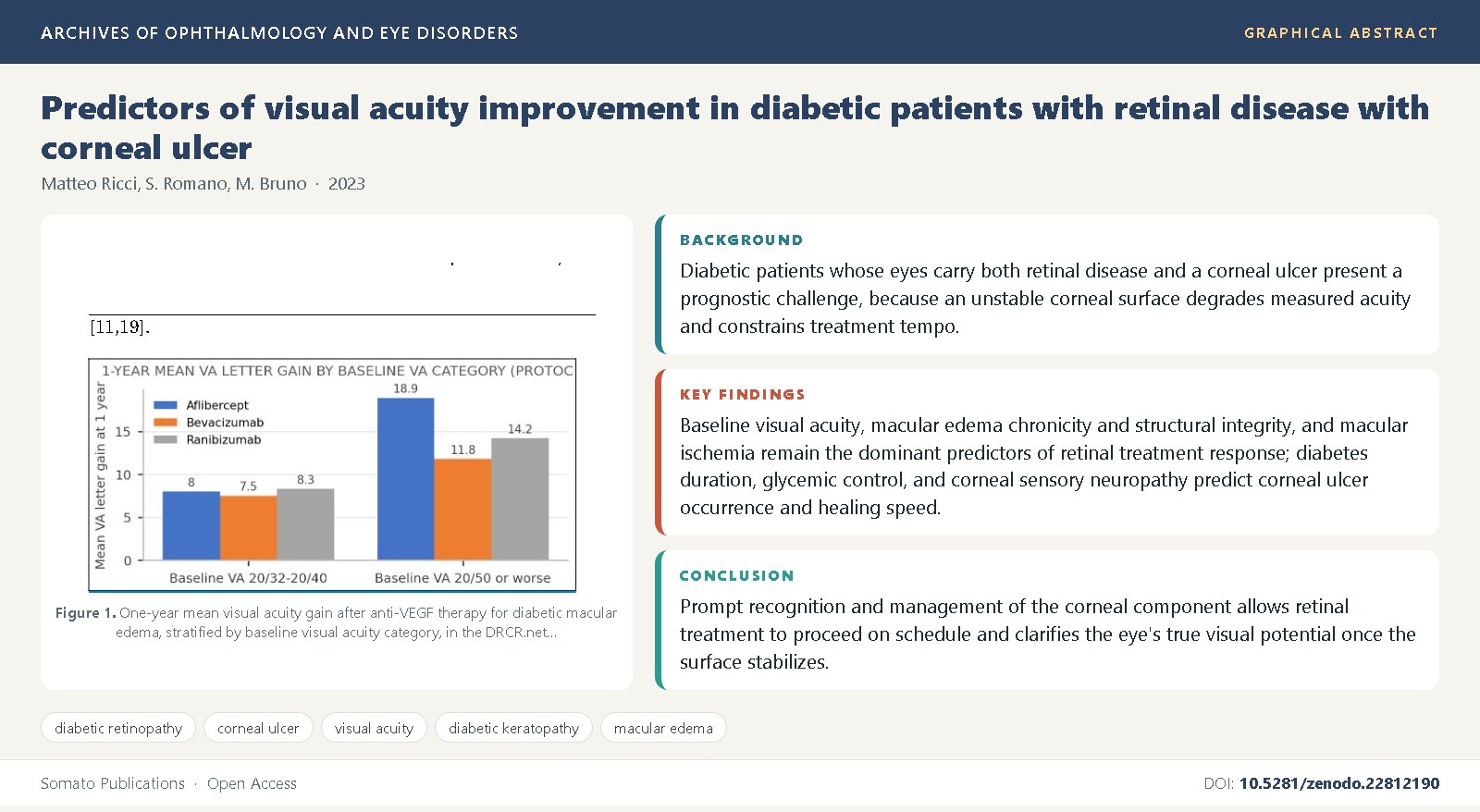
Background: Diabetic patients whose eyes carry both retinal disease and a corneal ulcer present a prognostic challenge, because an unstable corneal surface degrades measured acuity and constrains treatment tempo, while the systemic factors that predict poor corneal healing also predict a blunted retinal treatment response.
Objective: This review synthesizes evidence on predictors of visual acuity improvement in diabetic patients with retinal disease complicated by corneal ulcer, drawing on the retinal treatment-response literature and the corneal healing literature together.
Methods: We reviewed randomized trials and cohort studies of anti-VEGF and laser therapy for diabetic macular edema and proliferative diabetic retinopathy, alongside clinical and mechanistic studies of corneal ulcer risk and healing in diabetes, synthesizing the two literatures given the scarcity of studies enrolling patients with both diagnoses concurrently.
Findings: Baseline visual acuity, macular edema chronicity and structural integrity, and macular ischemia remain the dominant predictors of retinal treatment response; diabetes duration, glycemic control, and corneal sensory neuropathy predict corneal ulcer occurrence and healing speed; and an active ulcer functions as a modifier that transiently degrades measured acuity, delays retinal treatment scheduling, and marks a patient whose overall disease severity already limits the retinal treatment ceiling.
Conclusions: Prompt recognition and management of the corneal component allows retinal treatment to proceed on schedule and clarifies the eye's true visual potential once the surface stabilizes; routine ocular surface screening is warranted in diabetic patients with long disease duration, poor glycemic control, and advanced retinopathy.
References
Priyadarsini, S., Whelchel, A., Nicholas, S., Sharif, R., Riaz, K., Karamichos, D. (2020) Diabetic keratopathy: Insights and challenges. Survey of Ophthalmology, 65(5): 513-529. DOI: 10.1016/j.survophthal.2020.02.005
Ljubimov, A.V. (2017) Diabetic complications in the cornea. Vision Research, 139: 138-152. DOI: 10.1016/j.visres.2017.03.002
Hyndiuk, R.A., Kazarian, E.L., Schultz, R.O., Seideman, S. (1977) Neurotrophic corneal ulcers in diabetes mellitus. Archives of Ophthalmology, 95(12): 2193-2196. DOI: 10.1001/archopht.1977.04450120099013
Schultz, R.O., Van Horn, D.L., Peters, M.A., Klewin, K.M., Schutten, W.H. (1981) Diabetic keratopathy. Transactions of the American Ophthalmological Society, 79: 180-199.
Bikbova, G., Oshitari, T., Tawada, A., Yamamoto, S. (2012) Corneal changes in diabetes mellitus. Current Diabetes Reviews, 8(4): 294-302. DOI: 10.2174/157339912800840479
Yoon, K.C., Im, S.K., Seo, M.S. (2004) Changes of tear film and ocular surface in diabetes mellitus. Korean Journal of Ophthalmology, 18(2): 168-174. DOI: 10.3341/kjo.2004.18.2.168
Wells, J.A., Glassman, A.R., Ayala, A.R., Jampol, L.M., Aiello, L.P., Antoszyk, A.N., et al. (2015) Aflibercept, bevacizumab, or ranibizumab for diabetic macular edema. New England Journal of Medicine, 372(13): 1193-1203. DOI: 10.1056/NEJMoa1414264
Elman, M.J., Aiello, L.P., Beck, R.W., Bressler, N.M., Bressler, S.B., Edwards, A.R., et al. (2010) Randomized trial evaluating ranibizumab plus prompt or deferred laser or triamcinolone plus prompt laser for diabetic macular edema. Ophthalmology, 117(6): 1064-1077. DOI: 10.1016/j.ophtha.2010.02.031
Bressler, S.B., Odia, I., Maguire, M.G., Dhoot, D.S., Glassman, A.R., Jampol, L.M., et al. (2018) Factors associated with visual acuity outcomes after vascular endothelial growth factor inhibitor therapy for diabetic macular edema: Diabetic Retinopathy Clinical Research Network. Retina, 38(9): 1904-1913. DOI: 10.1097/IAE.0000000000002032
Chikama, T., Wakuta, M., Liu, Y., Nishida, T. (2007) Deviated mechanism of wound healing in diabetic corneas. Cornea, 26(9 Suppl 1): S75-81. DOI: 10.1097/ICO.0b013e31812f6d18
Kaji, Y., Usui, T., Oshika, T., Matsubara, M., Yamashita, H., Araie, M., et al. (2000) Advanced glycation end products in diabetic corneas. Investigative Ophthalmology & Visual Science, 41(2): 362-368.
Yau, J.W., Rogers, S.L., Kawasaki, R., Lamoureux, E.L., Kowalski, J.W., Bek, T., et al. (2012) Global prevalence and major risk factors of diabetic retinopathy. Diabetes Care, 35(3): 556-564. DOI: 10.2337/dc11-1909
Sabanayagam, C., Banu, R., Chee, M.L., Lee, R., Wang, Y.X., Tan, G., et al. (2019) Incidence and progression of diabetic retinopathy: a systematic review. The Lancet Diabetes & Endocrinology, 7(2): 140-149. DOI: 10.1016/S2213-8587(18)30128-1
Klein, R., Klein, B.E., Moss, S.E., Davis, M.D., DeMets, D.L. (1984) The Wisconsin Epidemiologic Study of Diabetic Retinopathy II: prevalence and risk of diabetic retinopathy when age at diagnosis is less than 30 years. Archives of Ophthalmology, 102(4): 520-526. DOI: 10.1001/archopht.1984.01040030398010
Wong, T.Y., Sabanayagam, C. (2020) Strategies to tackle the global burden of diabetic retinopathy: from epidemiology to artificial intelligence. Ophthalmologica, 243(1): 9-20. DOI: 10.1159/000502387
Shih, K.C., Lam, K.S., Tong, L. (2017) A systematic review on the impact of diabetes mellitus on the ocular surface. Nutrition & Diabetes, 7(3): e251. DOI: 10.1038/nutd.2017.4
Han, S.B., Yang, H.K., Hyon, J.Y. (2019) Influence of diabetes mellitus on anterior segment of the eye. Clinical Interventions in Aging, 14: 53-63. DOI: 10.2147/CIA.S190713
Saito, J., Enoki, M., Hara, M., Morishige, N., Chikama, T., Nishida, T. (2003) Correlation of corneal sensation, but not of basal or reflex tear secretion, with the stage of diabetic retinopathy. Cornea, 22(1): 15-18. DOI: 10.1097/00003226-200301000-00004
Rehany, U., Ishii, Y., Lahav, M., Rumelt, S. (2000) Ultrastructural changes in corneas of diabetic patients: an electron-microscopy study. Cornea, 19(4): 534-538. DOI: 10.1097/00003226-200007000-00026
Zhang, X., Zhao, L., Deng, S., Sun, X., Wang, N. (2016) Dry eye syndrome in patients with diabetes mellitus: prevalence, etiology, and clinical characteristics. Journal of Ophthalmology, 2016: 8201053. DOI: 10.1155/2016/8201053
Vieira-Potter, V.J., Karamichos, D., Lee, D.J. (2016) Ocular complications of diabetes and therapeutic approaches. BioMed Research International, 2016: 3801570. DOI: 10.1155/2016/3801570
Nguyen, Q.D., Brown, D.M., Marcus, D.M., Boyer, D.S., Patel, S., Feiner, L., et al. (2012) Ranibizumab for diabetic macular edema: results from 2 phase III randomized trials, RISE and RIDE. Ophthalmology, 119(4): 789-801. DOI: 10.1016/j.ophtha.2011.12.039
Ciulla, T.A., Amador, A.G., Zinman, B. (2003) Diabetic retinopathy and diabetic macular edema: pathophysiology, screening, and novel therapies. Diabetes Care, 26(9): 2653-2664. DOI: 10.2337/diacare.26.9.2653
Bhagat, N., Grigorian, R.A., Tutela, A., Zarbin, M.A. (2009) Diabetic macular edema: pathogenesis and treatment. Survey of Ophthalmology, 54(1): 1-32. DOI: 10.1016/j.survophthal.2008.10.001
Fuerst, N., Illig, J., Bermejo, J.L., Kobuch, K., Lang, S., Framme, C. (2014) Anatomical and functional outcomes of intravitreal ranibizumab for diabetic macular edema over 2 years. Retina, 34(7): 1367-1375. DOI: 10.1097/IAE.0000000000000078
Gross, J.G., Glassman, A.R., Jampol, L.M., Inusah, S., Aiello, L.P., Antoszyk, A.N., et al. (2015) Panretinal photocoagulation vs intravitreous ranibizumab for proliferative diabetic retinopathy. JAMA, 314(20): 2137-2146. DOI: 10.1001/jama.2015.15217
Early Treatment Diabetic Retinopathy Study Research Group (1985) Photocoagulation for diabetic macular edema: ETDRS report number 1. Archives of Ophthalmology, 103(12): 1796-1806. DOI: 10.1001/archopht.1985.01050120030015
Early Treatment Diabetic Retinopathy Study Research Group (1991) Early photocoagulation for diabetic retinopathy: ETDRS report number 9. Ophthalmology, 98(5 Suppl): 766-785. DOI: 10.1016/S0161-6420(13)38011-7
Diabetic Retinopathy Study Research Group (1981) Photocoagulation treatment of proliferative diabetic retinopathy: DRS report number 8. Ophthalmology, 88(7): 583-600.
Sun, J.K., Jampol, L.M. (2019) The Diabetic Retinopathy Clinical Research Network (DRCR.net) and its contributions to the treatment of diabetic retinopathy. Ophthalmic Research, 62(4): 225-230. DOI: 10.1159/000502779
Diabetic Retinopathy Clinical Research Network (2016) Aflibercept, bevacizumab, or ranibizumab for diabetic macular edema: two-year results from a comparative effectiveness randomized clinical trial. Ophthalmology, 123(6): 1351-1359. DOI: 10.1016/j.ophtha.2016.02.022
Bourcier, T., Thomas, F., Borderie, V., Chaumeil, C., Laroche, L. (2003) Bacterial keratitis: predisposing factors, clinical and microbiological review of 300 cases. British Journal of Ophthalmology, 87(7): 834-838. DOI: 10.1136/bjo.87.7.834
Green, M., Apel, A., Stapleton, F. (2008) Risk factors and causative organisms in microbial keratitis. Cornea, 27(1): 22-27. DOI: 10.1097/ICO.0b013e318156caf2
Wilhelmus, K.R. (2000) Review of clinical experience with microbial keratitis associated with contact lenses. The CLAO Journal, 26(4): 218-224.
Inoue, K., Kato, S., Ohara, C., Numaga, J., Amano, S., Oshika, T. (2001) Ocular and systemic factors relevant to diabetic keratoepitheliopathy. Cornea, 20(8): 798-801. DOI: 10.1097/00003226-200111000-00011
Sanchez-Thorin, J.C. (1998) The cornea in diabetes mellitus. International Ophthalmology Clinics, 38(2): 19-36. DOI: 10.1097/00004397-199803820-00004
Zagon, I.S., Sassani, J.W., Immonen, J.A., McLaughlin, P.J. (2014) Ocular surface abnormalities related to type 2 diabetes are reversed by the opioid antagonist naltrexone. Clinical & Experimental Ophthalmology, 42(2): 159-165. DOI: 10.1111/ceo.12136
Diaz-Valle, D., Benitez del Castillo Sanchez, J.M., Castillo, A., Sayagues, O., Moriche, M. (2001) Endothelial damage with cataract surgery techniques. Journal of Cataract & Refractive Surgery, 27(6): 951-955. DOI: 10.1016/S0886-3350(00)00693-3
Cheung, N., Mitchell, P., Wong, T.Y. (2010) Diabetic retinopathy. The Lancet, 376(9735): 124-136. DOI: 10.1016/S0140-6736(09)62124-3

Published
Issue
Section
License
Copyright (c) 2023 Matteo Ricci, et al.

This work is licensed under a Creative Commons Attribution 4.0 International License.