
A Retrospective Cohort Study of nanorobotic drug delivery in preclinical animal models with neurodegenerative disease
DOI:
https://doi.org/10.5281/zenodo.22812094Keywords:
nanorobotic drug delivery, blood-brain barrier, neurodegenerative disease, nanoparticle targeting, preclinical animal modelsAbstract
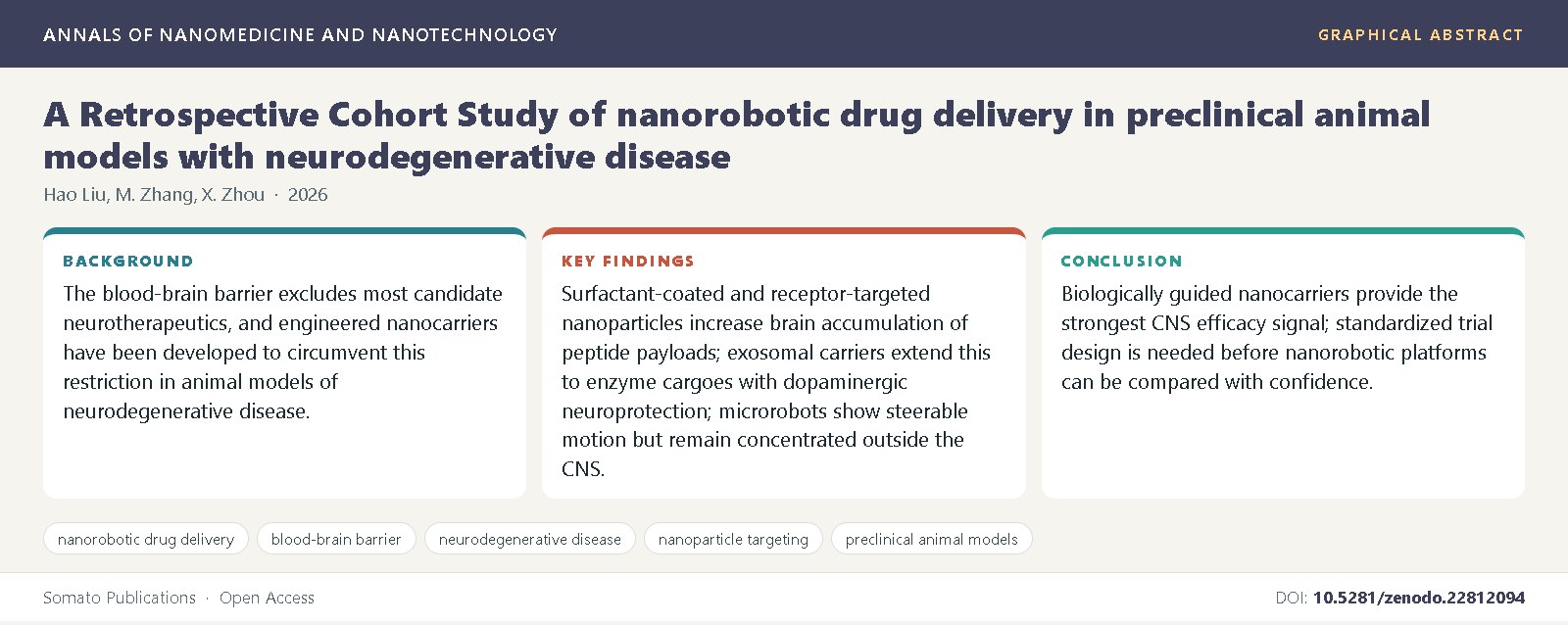
Background: The blood-brain barrier excludes most candidate neurotherapeutics, and engineered nanocarriers have been developed to circumvent this restriction in animal models of neurodegenerative disease.
Objective: This retrospective cohort synthesis evaluates preclinical nanoparticle and nanorobotic delivery platforms in rodent models of Alzheimer's and Parkinson's disease.
Methods: Twenty-five preclinical cohorts were characterized by carrier chemistry, disease model, and reported brain accumulation or behavioral outcome, without meta-analytic pooling given study heterogeneity.
Findings: Surfactant-coated and receptor-targeted nanoparticles increase brain accumulation of peptide payloads; exosomal carriers extend this to enzyme cargoes with dopaminergic neuroprotection; microrobots show steerable motion but remain concentrated outside the CNS.
Conclusions: Biologically guided nanocarriers provide the strongest CNS efficacy signal; standardized trial design is needed before nanorobotic platforms can be compared with confidence.
References
Kreuter, J., Petrov, V.E., Kharkevich, D.A., Alyautdin, R.N. (1997) Influence of the type of surfactant on the analgesic effects induced by the peptide dalargin after its delivery across the blood-brain barrier using surfactant-coated nanoparticles. Journal of Controlled Release, 49(1): 81-87. DOI: 10.1016/s0168-3659(97)00061-8
Schroder, U., Sabel, B.A. (1996) Nanoparticles, a drug carrier system to pass the blood-brain barrier, permit central analgesic effects of i.v. dalargin injections. Brain Research, 710(1-2): 121-124. DOI: 10.1016/0006-8993(95)01375-x
Kreuter, J. (2002) Transport of drugs across the blood-brain barrier by nanoparticles. Current Medicinal Chemistry - Central Nervous System Agents, 2(4): 241-249. DOI: 10.2174/1568015023357950
Saraiva, C., Praca, C., Ferreira, R., Santos, T., Ferreira, L., Bernardino, L. (2016) Nanoparticle-mediated brain drug delivery: overcoming blood-brain barrier to treat neurodegenerative diseases. Journal of Controlled Release, 235: 34-47. DOI: 10.1016/j.jconrel.2016.05.044
Pardridge, W.M. (2007) Blood-brain barrier delivery. Drug Discovery Today, 12(1-2): 54-61.
Nazem, A., Mansoori, G.A. (2008) Nanotechnology solutions for Alzheimer's disease: advances in research tools, diagnostic methods and therapeutic agents. Journal of Alzheimer's Disease, 13(2): 199-223.
Alyautdin, R.N., Petrov, V.E., Langer, K., et al. (1997) Delivery of loperamide across the blood-brain barrier with polysorbate 80-coated polybutylcyanoacrylate nanoparticles. Pharmaceutical Research, 14(3): 325-328.
Wilson, B., Samanta, M.K., Santhi, K., et al. (2008) Targeted delivery of tacrine into the brain with polysorbate 80-coated poly(n-butylcyanoacrylate) nanoparticles. European Journal of Pharmaceutics and Biopharmaceutics, 70(1): 75-84. DOI: 10.1016/j.ejpb.2008.03.009
Zensi, A., Begley, D., Pontikis, C., et al. (2009) Albumin nanoparticles targeted with Apo E enter the CNS by transcytosis and are delivered to neurones. Journal of Controlled Release, 137(1): 78-86.
Kim, H.R., Andrieux, K., Gil, S., et al. (2007) Translocation of poly(ethylene glycol-co-hexadecyl)cyanoacrylate nanoparticles into rat brain endothelial cells. Biomacromolecules, 8(3): 793-799.
Gao, X., Tao, W., Lu, W., et al. (2006) Lectin-conjugated PEG-PLA nanoparticles: preparation and brain delivery after intranasal administration. Biomaterials, 27(18): 3482-3490. DOI: 10.1016/j.biomaterials.2006.01.038
Liu, Z., Jiang, M., Kang, T., et al. (2013) Lactoferrin-modified PEG-co-PCL nanoparticles for enhanced brain delivery of NAP peptide following intranasal administration. Biomaterials, 34(15): 3870-3881. DOI: 10.1016/j.biomaterials.2013.02.003
Hu, K., Li, J., Shen, Y., et al. (2009) Lactoferrin-conjugated PEG-PLA nanoparticles as a novel drug carrier for brain delivery. Journal of Controlled Release, 134(1): 55-61.
Re, F., Cambianica, I., Zona, C., et al. (2011) Functionalization of liposomes with ApoE recombinant protein compensates for low receptor-targeted molecule numbers and enables the delivery of neuropeptides to the brain. Nanomedicine: Nanotechnology, Biology and Medicine, 7(5): 551-559.
Ordonez-Gutierrez, L., Re, F., Bereczki, E., et al. (2015) Repeated intraperitoneal administration of liposome-encapsulated curcumin decreases the acumulation of N-terminal truncated Abeta species in an Alzheimer's disease transgenic mouse model. Nanomedicine: Nanotechnology, Biology and Medicine, 11(2): 421-430.
Cheng, K.K., Chan, P.S., Fan, S., et al. (2015) Curcumin-conjugated magnetic nanoparticles for detecting amyloid plaques in Alzheimer's disease mice using magnetic resonance imaging (MRI). Biomaterials, 44: 155-172.
Song, Q., Huang, M., Yao, L., et al. (2014) Lipoprotein-based nanoparticles rescue the memory loss of mice with Alzheimer's disease by accelerating the clearance of amyloid-beta. ACS Nano, 8(3): 2345-2359.
Servant, A., Qiu, F., Mazza, M., et al. (2015) Controlled in vivo swimming of a swarm of bacteria-like microrobotic flagella. Advanced Materials, 27(19): 2981-2988.
de Avila, B.E., Angsantikul, P., Li, J., et al. (2017) Micromotor-enabled active drug delivery for in vivo treatment of stomach infection. Nature Communications, 8: 272.
Yan, X., Zhou, Q., Vincent, M., et al. (2017) Multifunctional biohybrid magnetite microrobots for imaging-guided therapy. Science Robotics, 2(12): eaaq1155.
Wang, B., Kostarelos, K., Nelson, B.J., Zhang, L. (2021) Trends in micro-/nanorobotics: materials development, actuation, localization, and functionality for biomedical applications. Advanced Materials, 33(4): e2002047.
Haney, M.J., Klyachko, N.L., Zhao, Y., et al. (2015) Exosomes as drug delivery vehicles for Parkinson's disease therapy. Journal of Controlled Release, 207: 18-30.
Zhao, Y., Haney, M.J., Fallon, J.K., et al. (2011) Using PLGA-PEG nanoparticles and macrophage carriers for brain delivery of catalase to protect dopaminergic neurons in a Parkinson's disease model. Journal of Nanomedicine & Nanotechnology, S4: 003.
Kuo, Y.C., Chen, H.H. (2011) Effect of nanoparticulate polybutylcyanoacrylate and methylmethacrylate-sulfopropylmethacrylate on the permeability of tacrine across the blood-brain barrier. International Journal of Pharmaceutics, 405(1-2): 218-227.
Sonvico, F., Clementino, A., Buttini, F., et al. (2018) Surface-modified nanocarriers for nose-to-brain delivery: from bioadhesion to targeting. Pharmaceutics, 10(1): 34.

Published
Issue
Section
License
Copyright (c) 2026 Hao Liu, et al.

This work is licensed under a Creative Commons Attribution 4.0 International License.


