
Evaluation of nanotoxicological assessment as a Prognostic Tool in solid tumors
DOI:
https://doi.org/10.5281/zenodo.22812104Keywords:
nanotoxicology, solid tumors, nanoparticle biodistribution, EPR effect, prognostic biomarkerAbstract
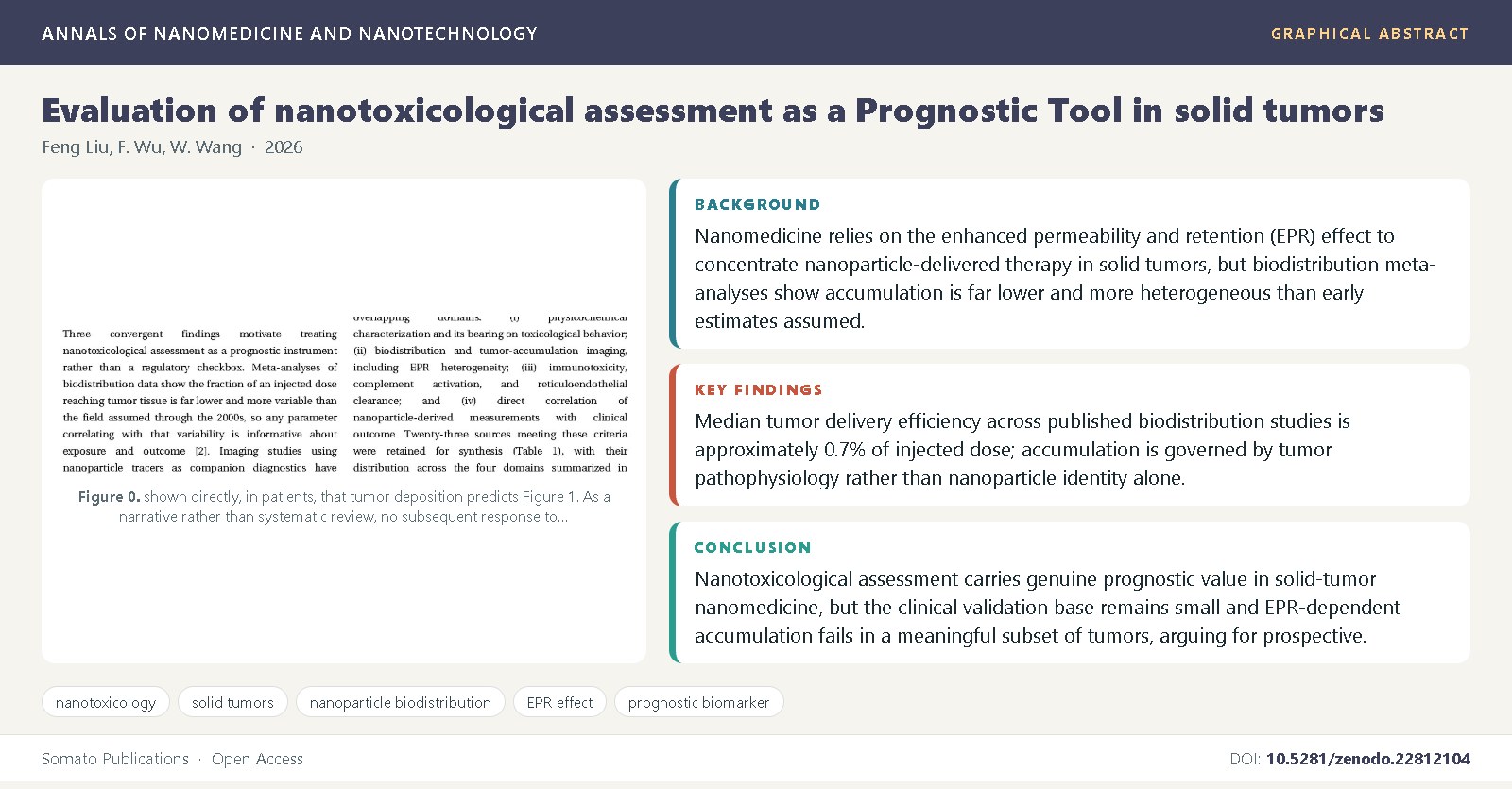
Background: Nanomedicine relies on the enhanced permeability and retention (EPR) effect to concentrate nanoparticle-delivered therapy in solid tumors, but biodistribution meta-analyses show accumulation is far lower and more heterogeneous than early estimates assumed [2].
Objective: This review synthesizes evidence on whether assays developed for nanotoxicological safety assessment, biodistribution imaging, immunotoxicity and clearance profiling, also function as prognostic tools for solid-tumor patients.
Methods: We conducted a narrative synthesis of 23 peer-reviewed sources spanning physicochemical characterization, biodistribution and EPR imaging, immunotoxicity and clearance, and clinical accumulation-outcome correlation in solid-tumor oncology.
Findings: Median tumor delivery efficiency across published biodistribution studies is approximately 0.7% of injected dose [2]; accumulation is governed by tumor pathophysiology rather than nanoparticle identity alone [5,6]; and companion-imaging trials using ferumoxytol and 64Cu-MM-302 tracers show pretreatment accumulation predicts treatment response [3,4].
Conclusions: Nanotoxicological assessment carries genuine prognostic value in solid-tumor nanomedicine, but the clinical validation base remains small and EPR-dependent accumulation fails in a meaningful subset of tumors, arguing for prospective, longitudinal use of these assays rather than one-time safety clearance [13,10].
References
Prabhakar, U., Maeda, H., Jain, R.K., Sevick-Muraca, E.M., Zamboni, W., Farokhzad, O.C., et al. (2013) Challenges and Key Considerations of the Enhanced Permeability and Retention Effect for Nanomedicine Drug Delivery in Oncology. Cancer Research, 73(8): 2412-2417. DOI: 10.1158/0008-5472.CAN-12-4561
Wilhelm, S., Tavares, A.J., Dai, Q., Ohta, S., Audet, J., Dvorak, H.F., Chan, W.C.W. (2016) Analysis of nanoparticle delivery to tumours. Nature Reviews Materials, 1: 16014. DOI: 10.1038/natrevmats.2016.14
Miller, M.A., Zheng, Y.R., Gadde, S., Pfirschke, C., Zope, H., Engblom, C., et al. (2016) Predicting therapeutic nanomedicine efficacy using a companion magnetic resonance imaging iron oxide nanoparticle. Science Translational Medicine, 8(340): 340ra73.
Lee, H., Shields, A.F., Siegel, B.A., Miller, K.D., Krop, I., Ma, C.X., et al. (2017) 64Cu-MM-302 Positron Emission Tomography Quantifies Variability of Enhanced Permeability and Retention of Nanoparticles in Relation to Treatment Response in Patients with Metastatic Breast Cancer. Clinical Cancer Research, 23(15): 4190-4202. DOI: 10.1158/1078-0432.CCR-16-3193
Sykes, E.A., Dai, Q., Sarsons, C.D., Chen, J., Rocheleau, J.V., Hwang, D.M., et al. (2016) Tailoring nanoparticle designs to target cancer based on tumor pathophysiology. Proceedings of the National Academy of Sciences, 113(9): E1142-E1151. DOI: 10.1073/pnas.1521265113
Sindhwani, S., Syed, A.M., Ngai, J., Kingston, B.R., Maiorino, L., Rothschild, J., et al. (2020) The entry of nanoparticles into solid tumours. Nature Materials, 19(5): 566-575. DOI: 10.1038/s41563-019-0566-2
Nel, A., Xia, T., Madler, L., Li, N. (2006) Toxic potential of materials at the nanolevel. Science, 311(5761): 622-627. DOI: 10.1126/science.1114397
Oberdorster, G., Oberdorster, E., Oberdorster, J. (2005) Nanotoxicology: an emerging discipline evolving from studies of ultrafine particles. Environmental Health Perspectives, 113(7): 823-839. DOI: 10.1289/ehp.7339
Dobrovolskaia, M.A., McNeil, S.E. (2007) Immunological properties of engineered nanomaterials. Nature Nanotechnology, 2(8): 469-478. DOI:
1038/nnano.2007.223 10. Fadeel, B., Fornara, A., Toprak, M.S., Bhattacharya, K. (2015) Keeping it real: The importance of material characterization in nanotoxicology. Biochemical and Biophysical Research Communications, 468(3): 498-503. DOI: 10.1016/j.bbrc.2015.06.143
Maeda, H. (2015) Toward a full understanding of the EPR effect in primary and metastatic tumors as well as issues related to its heterogeneity. Advanced Drug Delivery Reviews, 91: 3-6. DOI: 10.1016/j.addr.2015.01.002
Golombek, S.K., May, J.N., Theek, B., Appold, L., Drude, N., Kiessling, F., et al. (2018) Tumor targeting via EPR: Strategies to enhance patient responses. Advanced Drug Delivery Reviews, 130: 17-38. DOI: 10.1016/j.addr.2018.07.007
Danhier, F. (2016) To exploit the tumor microenvironment: Since the EPR effect fails in the clinic, what is the future of nanomedicine? Journal of Controlled Release, 244(Pt A): 108-121. DOI: 10.1016/j.jconrel.2016.11.015
Moghimi, S.M., Hunter, A.C., Andresen, T.L. (2012) Factors controlling nanoparticle pharmacokinetics: an integrated analysis and perspective. Annual Review of Pharmacology and Toxicology, 52: 481-503. DOI: 10.1146/annurev-pharmtox-010611-134623
Oberdorster, G. (2010) Safety assessment for nanotechnology and nanomedicine: concepts of nanotoxicology. Journal of Internal Medicine, 267(1): 89-105. DOI: 10.1111/j.1365-2796.2009.02187.x
Barenholz, Y. (2012) Doxil - the first FDA-approved nano-drug: lessons learned. Journal of Controlled Release, 160(2): 117-134. DOI: 10.1016/j.jconrel.2012.03.020
Gabizon, A., Shmeeda, H., Barenholz, Y. (2003) Pharmacokinetics of pegylated liposomal doxorubicin: review of animal and human studies. Clinical Pharmacokinetics, 42(5): 419-436. DOI: 10.2165/00003088-200342050-00002
Cabral, H., Matsumoto, Y., Mizuno, K., Chen, Q., Murakami, M., Kimura, M., et al. (2011) Accumulation of sub-100 nm polymeric micelles in poorly permeable tumours depends on size. Nature Nanotechnology, 6(12): 815-823. DOI: 10.1038/nnano.2011.166
Kunjachan, S., Ehling, J., Storm, G., Kiessling, F., Lammers, T. (2015) Noninvasive Imaging of Nanomedicines and Nanotheranostics: Principles, Progress, and Prospects. Chemical Reviews, 115(19): 10907-10937. DOI: 10.1021/cr500314d
Lammers, T., Kiessling, F., Hennink, W.E., Storm, G. (2012) Drug targeting to tumors: principles, pitfalls and (pre-) clinical progress. Journal of Controlled Release, 161(2): 175-187. DOI: 10.1016/j.jconrel.2011.09.063
Anselmo, A.C., Mitragotri, S. (2019) Nanoparticles in the clinic: An update. Bioengineering & Translational Medicine, 4(3): e10143. DOI: 10.1002/btm2.10143
Bertrand, N., Wu, J., Xu, X., Kamaly, N., Farokhzad, O.C. (2014) Cancer nanotechnology: The impact of passive and active targeting in the era of modern cancer biology. Advanced Drug Delivery Reviews, 66: 2-25. DOI: 10.1016/j.addr.2013.11.009
Poon, W., Kingston, B.R., Ouyang, B., et al. (2020) A framework for designing delivery systems. Nature Nanotechnology, 15(10): 819-829. DOI: 10.1038/s41565-020-0759-5

Published
Issue
Section
License
Copyright (c) 2026 Feng Liu, et al.

This work is licensed under a Creative Commons Attribution 4.0 International License.


