
Impact of nanorobotic drug delivery on Quality of Life in Patients with solid tumors
DOI:
https://doi.org/10.5281/zenodo.22812126Keywords:
nanorobotic drug delivery, quality of life, solid tumors, nanoparticle chemotherapy, cancer toxicityAbstract
Background: Conventional chemotherapy distributes throughout the body largely independent of tumor location, producing systemic toxicity that instruments such as the QLQ-C30 and FACT-G were built to quantify as patient-reported quality of life [1,2].
Objective: This review synthesizes evidence on how nanoparticle and early nanorobotic drug delivery reshape quality of life in solid tumors, from measurement instruments through biodistribution rationale to trial evidence.
Methods: We conducted a narrative synthesis of psychometric validation studies, randomized trials comparing nanoparticle formulations with conventional chemotherapy, a pooled toxicity meta-analysis, and mechanistic reviews of nanoparticle and nanorobotic delivery.
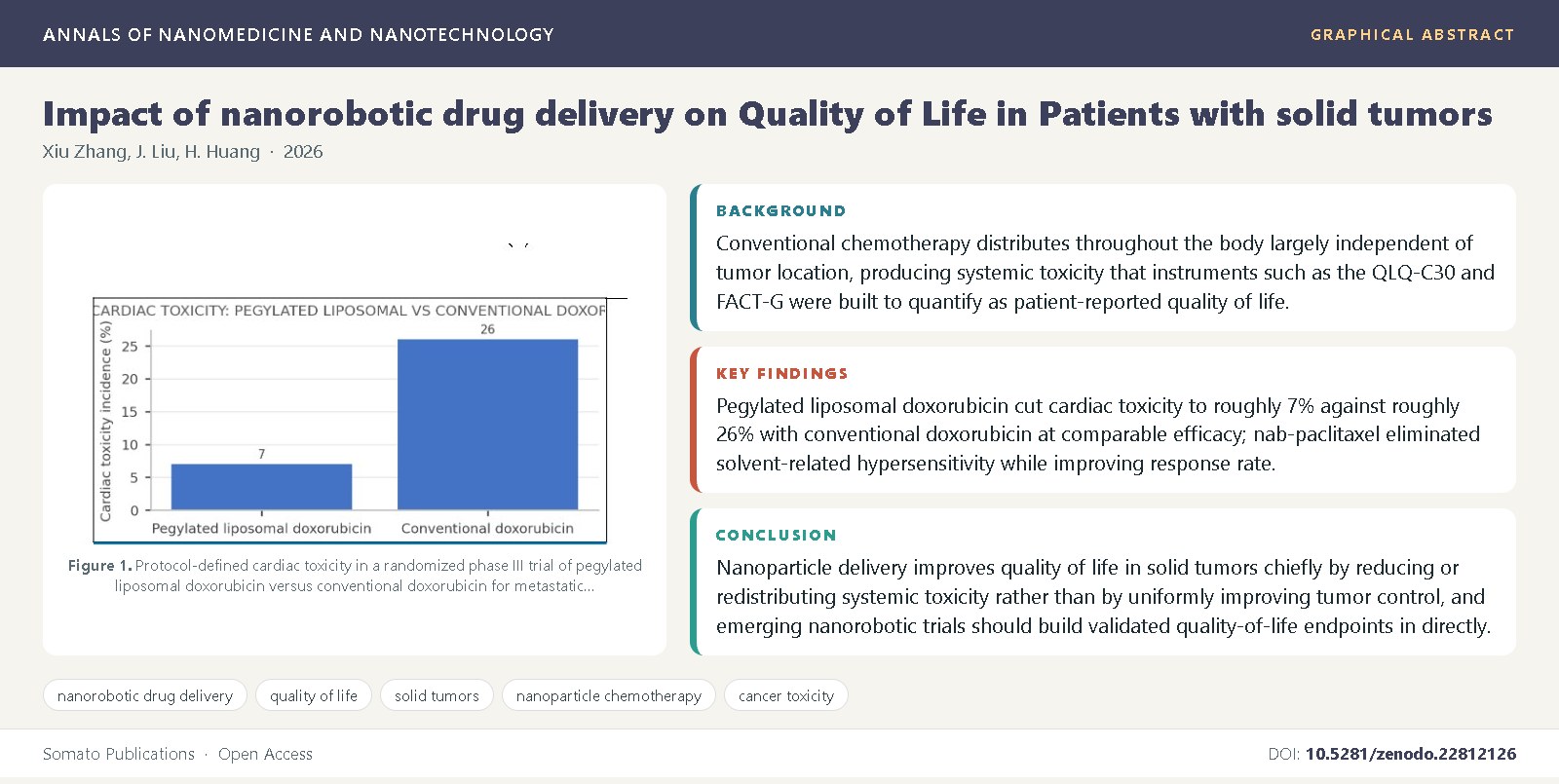
Findings: Pegylated liposomal doxorubicin cut cardiac toxicity to roughly 7% against roughly 26% with conventional doxorubicin at comparable efficacy [12]; nab-paclitaxel eliminated solvent-related hypersensitivity while improving response rate [16]; and a pooled analysis found lower grade 3 or higher hematologic toxicity and neuropathy with nanoparticle chemotherapy [20], while nanorobotic platforms remain largely preclinical [5,6].
Conclusions: Nanoparticle delivery improves quality of life in solid tumors chiefly by reducing or redistributing systemic toxicity rather than by uniformly improving tumor control, and emerging nanorobotic trials should build validated quality-of-life endpoints in directly [7,24].
References
Aaronson, N.K., Ahmedzai, S., Bergman, B., Bullinger, M., Cull, A., Duez, N.J., et al. (1993) The European Organization for Research and Treatment of Cancer QLQ-C30: a quality-of-life instrument for use in international clinical trials in oncology. Journal of the National Cancer Institute, 85(5): 365-376. DOI: 10.1093/jnci/85.5.365
Cella, D.F., Tulsky, D.S., Gray, G., Sarafian, B., Linn, E., Bonomi, A., et al. (1993) The Functional Assessment of Cancer Therapy scale: development and validation of the general measure. Journal of Clinical Oncology, 11(3): 570-579. DOI: 10.1200/JCO.1993.11.3.570
Peer, D., Karp, J.M., Hong, S., Farokhzad, O.C., Margalit, R., Langer, R. (2007) Nanocarriers as an emerging platform for cancer therapy. Nature Nanotechnology, 2(12): 751-760. DOI: 10.1038/nnano.2007.387
Golombek, S.K., May, J.N., Theek, B., Appold, L., Drude, N., Kiessling, F., et al. (2018) Tumor targeting via EPR: strategies to enhance patient responses. Advanced Drug Delivery Reviews, 130: 17-38. DOI: 10.1016/j.addr.2018.07.007
Cavalcanti, A., Freitas, R.A. (2005) Nanorobotics control design: a collective behavior approach for medicine. IEEE Transactions on NanoBioscience, 4(2): 133-140. DOI: 10.1109/tnb.2005.850469
Erkoc, P., Yasa, I.C., Ceylan, H., Yasa, O., Alapan, Y., Sitti, M. (2019) Mobile microrobots for active therapeutic delivery. Advanced Therapeutics, 2(1): 1800064. DOI: 10.1002/adtp.201800064
Herdman, M., Gudex, C., Lloyd, A., Janssen, M.F., Kind, P., Parkin, D., et al. (2011) Development and preliminary testing of the new five-level version of EQ-5D (EQ-5D-5L). Quality of Life Research, 20(10): 1727-1736. DOI: 10.1007/s11136-011-9903-x
Sindhwani, S., Syed, A.M., Ngai, J., Kingston, B.R., Maiorino, L., Rothschild, J., et al. (2020) The entry of nanoparticles into solid tumours. Nature Materials, 19(5): 566-575. DOI: 10.1038/s41563-019-0566-2
Shi, J., Kantoff, P.W., Wooster, R., Farokhzad, O.C. (2017) Cancer nanomedicine: progress, challenges and opportunities. Nature Reviews Cancer, 17(1): 20-37. DOI:
1038/nrc.2016.108 10. Wicki, A., Witzigmann, D., Balasubramanian, V., Huwyler, J. (2015) Nanomedicine in cancer therapy: challenges, opportunities, and clinical applications. Journal of Controlled Release, 200: 138-157. DOI: 10.1016/j.jconrel.2014.12.030
Barenholz, Y. (2012) Doxil - the first FDA-approved nano-drug: lessons learned. Journal of Controlled Release, 160(2): 117-134. DOI: 10.1016/j.jconrel.2012.03.020
O'Brien, M.E.R., Wigler, N., Inbar, M., Rosso, R., Grischke, E., Santoro, A., et al. (2004) Reduced cardiotoxicity and comparable efficacy in a phase III trial of pegylated liposomal doxorubicin HCl (CAELYX/Doxil) versus conventional doxorubicin for first-line treatment of metastatic breast cancer. Annals of Oncology, 15(3): 440-449. DOI: 10.1093/annonc/mdh097
Safra, T., Muggia, F., Jeffers, S., Tsao-Wei, D.D., Groshen, S., Lyass, O., et al. (2000) Pegylated liposomal doxorubicin (Doxil): reduced clinical cardiotoxicity in patients reaching or exceeding cumulative doses of 500 mg/m2. Annals of Oncology, 11(8): 1029-1033. DOI: 10.1023/a:1008365716693
Gordon, A.N., Fleagle, J.T., Guthrie, D., Parkin, D.E., Gore, M.E., Lacave, A.J. (2001) Recurrent epithelial ovarian carcinoma: a randomized phase III study of pegylated liposomal doxorubicin versus topotecan. Journal of Clinical Oncology, 19(14): 3312-3322. DOI: 10.1200/JCO.2001.19.14.3312
Krown, S.E., Northfelt, D.W., Osoba, D., Stewart, J.S. (2004) Use of liposomal anthracyclines in Kaposi's sarcoma. Seminars in Oncology, 31(6 Suppl 13): 36-52. DOI: 10.1053/j.seminoncol.2004.08.003
Gradishar, W.J., Tjulandin, S., Davidson, N., Shaw, H., Desai, N., Bhar, P., et al. (2005) Phase III trial of nanoparticle albumin-bound paclitaxel compared with polyethylated castor oil-based paclitaxel in women with breast cancer. Journal of Clinical Oncology, 23(31): 7794-7803. DOI: 10.1200/JCO.2005.04.937
Kim, T.Y., Kim, D.W., Chung, J.Y., Shin, S.G., Kim, S.C., Heo, D.S., et al. (2004) Phase I and pharmacokinetic study of Genexol-PM, a Cremophor-free, polymeric micelle-formulated paclitaxel, in patients with advanced malignancies. Clinical Cancer Research, 10(11): 3708-3716. DOI: 10.1158/1078-0432.ccr-03-0655
Von Hoff, D.D., Ervin, T., Arena, F.P., Chiorean, E.G., Infante, J., Moore, M., et al. (2013) Increased survival in pancreatic cancer with nab-paclitaxel plus gemcitabine. New England Journal of Medicine, 369(18): 1691-1703. DOI: 10.1056/NEJMoa1304369
Wang-Gillam, A., Li, C.P., Bodoky, G., Dean, A., Shan, Y.S., Jameson, G., et al. (2016) Nanoliposomal irinotecan with fluorouracil and folinic acid in metastatic pancreatic cancer after previous gemcitabine-based therapy (NAPOLI-1): a global, randomised, open-label, phase 3 trial. The Lancet, 387(10018): 545-557. DOI: 10.1016/S0140-6736(15)00986-1
Kanwar, M.M., Noor, A., Rasool, T., Anjum, H.S., Ashraf, A., Rahman, A.U., Rehman, M.U. (2025) Meta-analysis of efficacy of nanoparticle-based chemotherapy compared to conventional chemotherapy in solid tumors. Insights-Journal of Health and Rehabilitation. 10.71000/rce00f58
Bobo, D., Robinson, K.J., Islam, J., Thurecht, K.J., Corrie, S.R. (2016) Nanoparticle-based medicines: a review FDA-approved materials and clinical trials to date. Pharmaceutical Research, 33(10): 2373-2387. 10.1007/s11095-016-1958-5
Anselmo, A.C., Mitragotri, S. (2016) Nanoparticles in the clinic. Bioengineering & Translational Medicine, 1(1): 10-29. DOI: 10.1002/btm2.10003
Anselmo, A.C., Mitragotri, S. (2019) Nanoparticles in the clinic: an update. Bioengineering & Translational Medicine, 4(3): e10143. DOI: 10.1002/btm2.10143
van der Meel, R., Sulheim, E., Shi, Y., Kiessling, F., Mulder, W.J.M., Lammers, T. (2019) Smart cancer nanomedicine. Nature Nanotechnology, 14(11): 1007-1017. 10.1038/s41565-019-0567-y DOI: of DOI: DOI:

Published
Issue
Section
License
Copyright (c) 2026 Xiu Zhang, et al.

This work is licensed under a Creative Commons Attribution 4.0 International License.


