
Comparative Analysis of nanorobotic drug delivery versus Standard Care in chronic wounds
DOI:
https://doi.org/10.5281/zenodo.22811861Keywords:
nanorobotics, drug delivery, chronic wounds, wound healing, standard careAbstract
Background: Chronic wounds stall in the inflammatory phase and resist standard care, driving nanomedicine research from passive antimicrobial dressings toward actively propelled, logic-gated nanorobotic delivery.
Objective: This review compares outcome evidence for nanorobotic and nanoparticle-based drug delivery in chronic wounds against standard wound care and its passive-nanoparticle extensions.
Methods: We conducted a narrative, comparative synthesis of studies reporting quantifiable wound outcomes for nanorobotic platforms, alongside randomized trials of standard care, silver-based dressings, and growth-factor delivery.
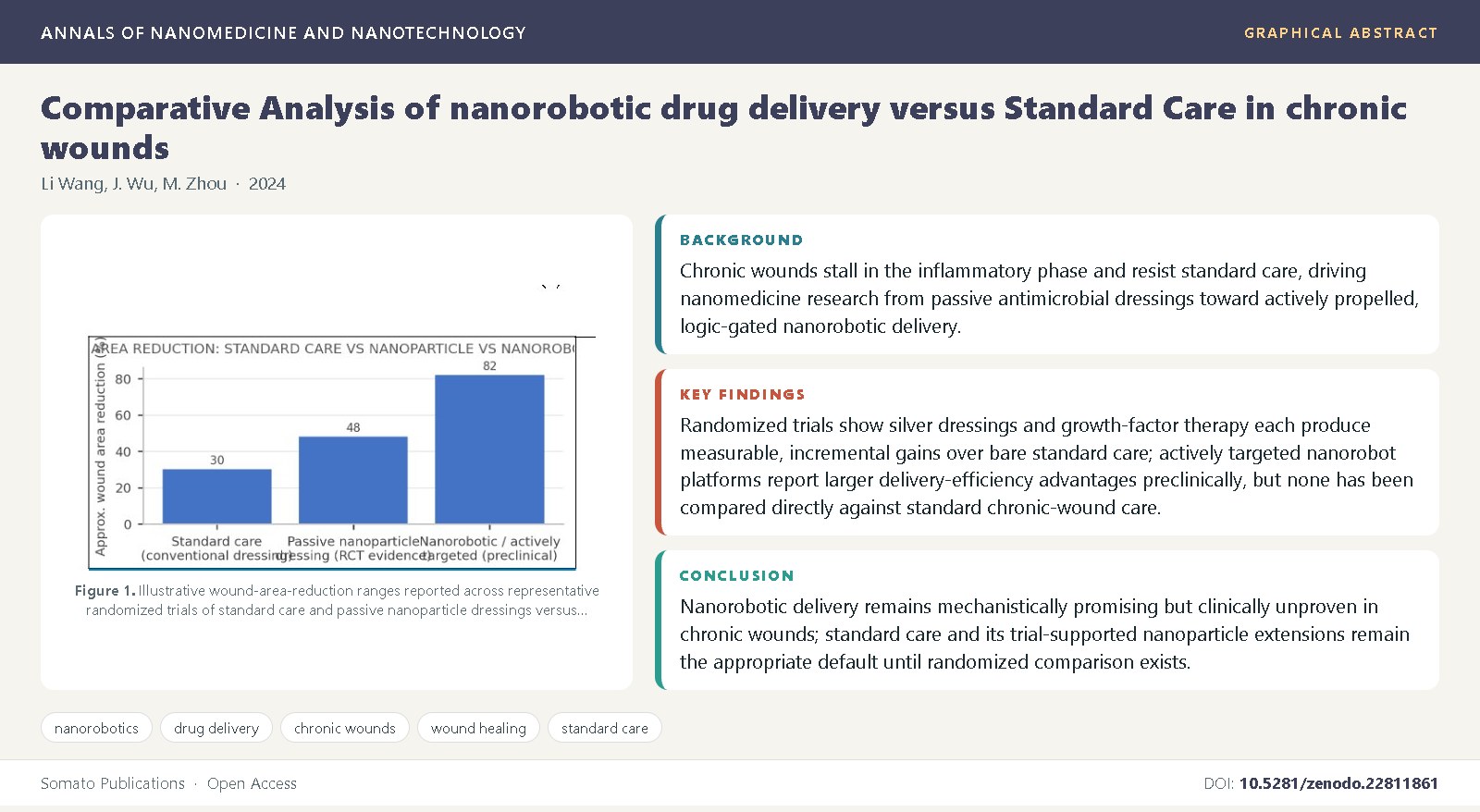
Findings: Randomized trials show silver dressings and growth-factor therapy each produce measurable, incremental gains over bare standard care; actively targeted nanorobot platforms report larger delivery-efficiency advantages preclinically, but none has been compared directly against standard chronic-wound care.
Conclusions: Nanorobotic delivery remains mechanistically promising but clinically unproven in chronic wounds; standard care and its trial-supported nanoparticle extensions remain the appropriate default until randomized comparison exists.
References
Sood, A., Granick, M.S., Tomaselli, N.L. (2014) Wound dressings and comparative effectiveness data. Advances in Wound Care, 3(8): 511-529. DOI: 10.1089/wound.2012.0401
Ruan, N., Tian, W. (2021) Recent perspectives of nanotechnology in burn wounds management: a review. Journal of Wound Care, 30(5): 350-358.
Catanzano, O., Quaglia, F., Boateng, J.S. (2021) Wound dressings as growth factor delivery platforms for chronic wound healing. Expert Opinion on Drug Delivery, 18(6): 737-759. DOI: 10.1080/17425247.2021.1867096
Laiva, A.L., O'Brien, F.J., Keogh, M.B. (2018) Innovations in gene and growth factor delivery systems for diabetic wound healing. Journal of Tissue Engineering and Regenerative Medicine, 12(1): e296-e312. DOI: 10.1002/term.2443
Nelson, B.J., Kaliakatsos, I.K., Abbott, J.J. (2010) Microrobots for minimally invasive medicine. Annual Review of Biomedical Engineering, 12: 55-85. DOI: 10.1146/annurev-bioeng-010510-103409
Abbott, J.J., Peyer, K.E., Lagomarsino, M.C., Zhang, L., Dong, L., Kaliakatsos, I.K., et al. (2009) How should microrobots swim? The International Journal of Robotics Research, 28(11-12): 1434-1447. DOI: 10.1177/0278364909341658
Qiu, F., Nelson, B.J. (2015) Magnetic helical micro- and nanorobots: toward their biomedical applications. Engineering, 1(1): 21-26. DOI: 10.15302/j-eng-2015005
Hu, M., Ge, X., Chen, X., Mao, W., Qian, X., Yuan, W.E. (2020) Micro/nanorobot: a promising targeted drug delivery system. Pharmaceutics, 12(7): 665. DOI: 10.3390/pharmaceutics12070665
Ren, L., Nama, N., McNeill, J.M., Soto, F., Yan, Z., Liu, W., et al. (2021) Ultrasound-powered micro-/nanorobots: fundamentals and biomedical applications. In: Field-Driven Micro and Nanorobots for Biology and Medicine. DOI:
1007/978-3-030-80197-7_2 10. Farokhzad, O.C., Langer, R. (2009) Impact of nanotechnology on drug delivery. ACS Nano, 3(1): 16-20. DOI: 10.1021/nn900002m
Park, K. (2013) Facing the truth about nanotechnology in drug delivery. ACS Nano, 7(9): 7442-7447. DOI: 10.1021/nn404501g
Woo, K.Y., Coutts, P.M., Sibbald, R.G. (2012) A randomized controlled trial to evaluate an antimicrobial dressing with silver alginate powder for the management of chronic wounds exhibiting signs of critical colonization. Advances in Skin & Wound Care, 25(11): 503-508. DOI: 10.1097/01.asw.0000422628.63148.4b
Muangman, P., Pundee, C., Opasanon, S., Muangman, S. (2010) A prospective, randomized trial of silver containing hydrofiber dressing versus 1% silver sulfadiazine for the treatment of partial thickness burns. International Wound Journal, 7(4): 271-276. DOI: 10.1111/j.1742-481x.2010.00690.x
Hunt, D.L. (2003) Review: debridement using hydrogel seems to be better than standard wound care for healing diabetic foot ulcer. ACP Journal Club, 139(1): 16. DOI: 10.7326/acpjc-2003-139-1-016
Armstrong, D.G., et al. (2022) Multicenter, randomized controlled clinical investigation evaluating a unique micro water jet technology device versus standard debridement in the treatment of diabetic foot ulcers. Diabetes, 71(Supplement_1): 30-LB. DOI: 10.2337/db22-30-lb
Probst, S., Saini, C., Rosset, C., Buehrer Skinner, M. (2022) Superabsorbent charcoal dressing versus silver foam dressing in wound area reduction: a randomised controlled trial. Journal of Wound Care, 31(2): 140-146. DOI: 10.12968/jowc.2022.31.2.140
Metcalf, D.G., Parsons, D., Bowler, P.G. (2016) Clinical safety and effectiveness evaluation of a new antimicrobial wound dressing designed to manage exudate, infection and biofilm. International Wound Journal, 14(1): 203-213. DOI: 10.1111/iwj.12590
Yingsakmongkol, N., Maraprygsavan, P., Sukosit, P. (2011) Effect of WF10 (immunokine) on diabetic foot ulcer therapy: a double-blind, randomized, placebo-controlled trial. The Journal of Foot and Ankle Surgery, 50(6): 635-640. DOI: 10.1053/j.jfas.2011.05.006
Yu, L., Dong, A., Guo, R., Yang, M., Deng, L., Zhang, J. (2022) Thiol-mediated rapid cytosolic uptake of tumor-targeted DNA nanorobot for siRNA delivery. Cancer Research, 82(12_Supplement): 303. DOI: 10.1158/1538-7445.am2022-303
Peyer, K.E., Zhang, L., Nelson, B.J. (2012) Bacteria-inspired microrobots. In: Microbiorobotics: Biologically Inspired Microscale Robotic Systems. DOI: 10.1016/b978-1-4557-7891-1.00007-4
Zhao, S., Sun, D., Zhang, J. (2023) Actuation and biomedical development of micro/nanorobots - a review. In: Actuators and Motion Control for Next-Generation Robotics. DOI: 10.1016/b978-0-12-822125-9.00006-3
Zhang, L., Chan, J.M., Gu, F.X., Rhee, J.W., Wang, A.Z., Radovic-Moreno, A.F., et al. (2008) Self-assembled lipid-polymer hybrid nanoparticles: a robust drug delivery platform. ACS Nano, 2(8): 1696-1702. DOI: 10.1021/nn800275r
Radovic-Moreno, A.F., Lu, T.K., Puscasu, V.A., Yoon, C.J., Langer, R., Farokhzad, O.C. (2012) Surface charge-switching polymeric nanoparticles for bacterial cell wall-targeted delivery of antibiotics. ACS Nano, 6(5): 4279-4287. DOI: 10.1021/nn3008383
Bagalkot, V., Farokhzad, O.C., Langer, R., Jon, S. (2007) An aptamer-doxorubicin physical conjugate as a novel targeted drug-delivery platform. Nanomedicine: Nanotechnology, Biology and Medicine, 3(4): 311-321. DOI: 10.1016/j.nano.2007.10.070
Farokhzad, O.C., Langer, R. (2006) Nanomedicine: developing smarter therapeutic and diagnostic modalities. Advanced Drug Delivery Reviews, 58(14): 1456-1459. DOI: 10.1016/j.addr.2006.09.011
Shi, J., Votruba, A.R., Farokhzad, O.C., Langer, R. (2010) Nanotechnology in drug delivery and tissue engineering: from discovery to applications. Nano Letters, 10(9): 3223-3230. DOI: 10.1021/nl102184c
Seidel, D., Mathes, T., Lefering, R., Storck, M., Lawall, H., Neugebauer, E.A.M. (2014) Negative pressure wound therapy versus standard wound care in chronic diabetic foot wounds: study protocol for a randomized controlled trial. Trials, 15: 334. DOI: 10.1186/1745-6215-15-334
Rothmaier, M., et al. (2026) Overcoming challenges in wound infection: biofilm and antimicrobial resistance. Advances in Wound Care. DOI: 10.1177/21621918261440437

Published
Issue
Section
License
Copyright (c) 2024 Li Wang, et al.

This work is licensed under a Creative Commons Attribution 4.0 International License.


