
Emerging Role of transmission electron microscopy in the Diagnosis of chronic wounds
DOI:
https://doi.org/10.5281/zenodo.22811849Keywords:
transmission electron microscopy, chronic wound, biofilm, extracellular vesicles, nanomaterial dressingsAbstract
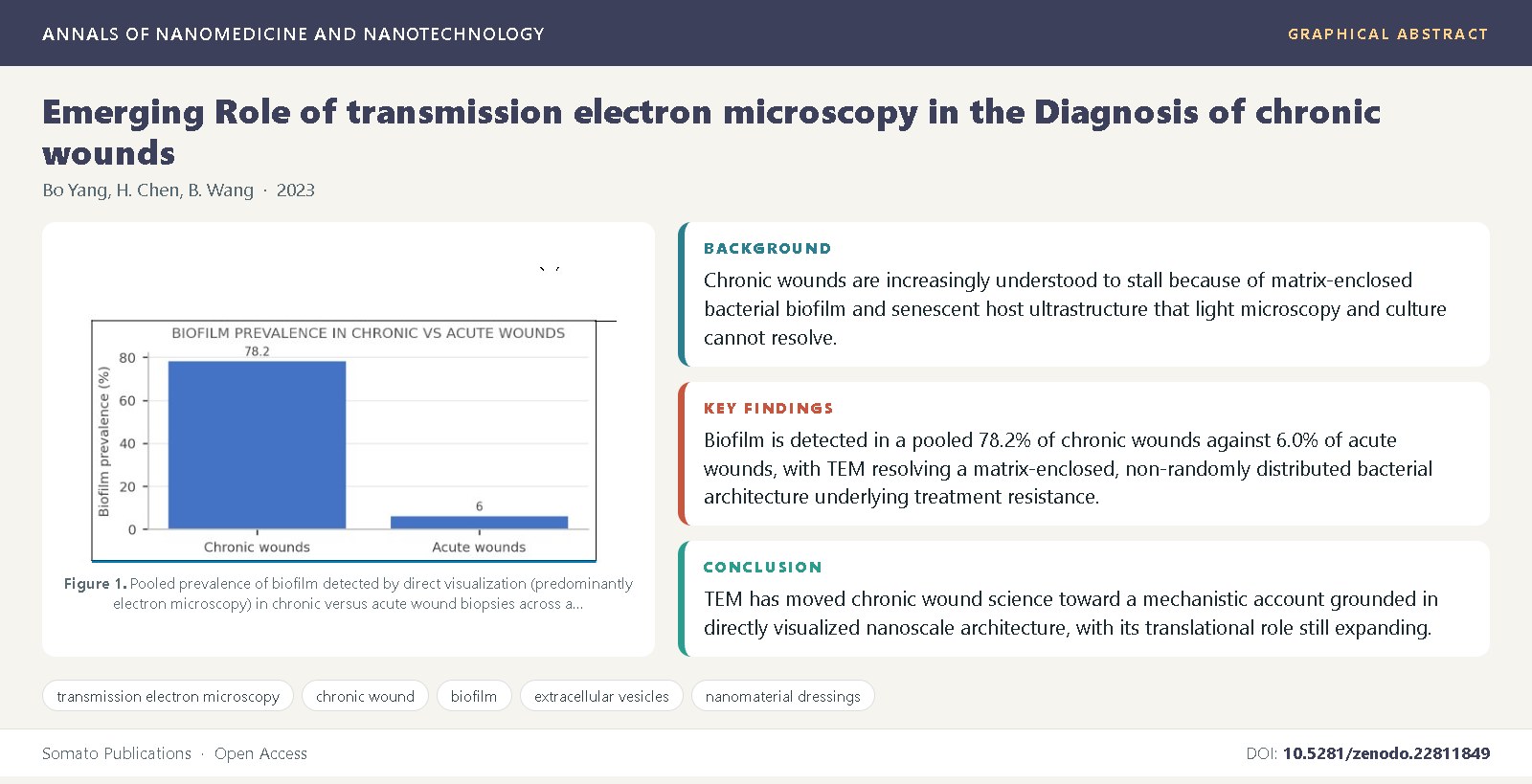
Background: Chronic wounds are increasingly understood to stall because of matrix-enclosed bacterial biofilm and senescent host ultrastructure that light microscopy and culture cannot resolve [1,7].
Objective: This review synthesizes TEM's contribution to chronic wound diagnosis across biofilm architecture, exudate extracellular vesicles, and nanomaterial dressing characterization.
Methods: We synthesized peer-reviewed literature in which TEM or a closely related method generated the tissue- or particle-level findings discussed.
Findings: Biofilm is detected in a pooled 78.2% of chronic wounds against 6.0% of acute wounds [18], with TEM resolving a matrix-enclosed, non-randomly distributed bacterial architecture underlying treatment resistance [3,10]; TEM is likewise the reference method confirming wound-exudate extracellular vesicles [24,25] and verifying nanomaterial dressing particle characteristics [28].
Conclusions: TEM has moved chronic wound science toward a mechanistic account grounded in directly visualized nanoscale architecture, with its translational role still expanding [21,23].
References
James, G.A., Swogger, E., Wolcott, R., et al. (2008) Biofilms in chronic wounds. Wound Repair and Regeneration, 16(1): 37-44. DOI: 10.1111/j.1524-475X.2007.00321.x
Bjarnsholt, T., Kirketerp-Moller, K., Jensen, P.O., et al. (2008) Why chronic wounds will not heal: a novel hypothesis. Wound Repair and Regeneration, 16(1): 2-10. DOI: 10.1111/j.1524-475x.2007.00283.x
Kirketerp-Moller, K., Jensen, P.O., Fazli, M., et al. (2008) Distribution, organization, and ecology of bacteria in chronic wounds. Journal of Clinical Microbiology, 46(8): 2717-2722. DOI: 10.1128/jcm.00501-08
Zhao, G., Hochwalt, P.C., Usui, M.L., et al. (2010) Delayed wound healing in diabetic (db/db) mice with Pseudomonas aeruginosa biofilm challenge: a model for the study of chronic wounds. Wound Repair and Regeneration, 18(5): 467-477. DOI: 10.1111/j.1524-475x.2010.00608.x
Frykberg, R.G., Banks, J. (2015) Challenges in the treatment of chronic wounds. Advances in Wound Care, 4(9): 560-582. DOI: 10.1089/wound.2015.0635
Han, G., Ceilley, R. (2017) Chronic wound healing: a review of current management and treatments. Advances in Therapy, 34(3): 599-610. DOI: 10.1007/s12325-017-0478-y
Loots, M.A., Lamme, E.N., Zeegelaar, J., Mekkes, J.R., Bos, J.D., Middelkoop, E. (1998) Differences in cellular infiltrate and extracellular matrix of chronic diabetic and venous ulcers versus acute wounds. Journal of Investigative Dermatology, 111(5): 850-857. DOI: 10.1046/j.1523-1747.1998.00381.x
Menke, N.B., Ward, K.R., Witten, T.M., Bonchev, D.G., Diegelmann, R.F. (2007) Impaired wound healing. Clinics in Dermatology, 25(1): 19-25. DOI: 10.1016/j.clindermatol.2006.12.005
Diegelmann, R.F., Evans, M.C. (2004) Wound healing: an overview of acute, fibrotic and delayed healing. Frontiers in Bioscience, 9: 283-289. DOI: 10.2741/1184
Fazli, M., Bjarnsholt, T., Kirketerp-Moller, K., et al. (2009) Nonrandom distribution of Pseudomonas aeruginosa and Staphylococcus aureus in chronic wounds. Journal of Clinical Microbiology, 47(12): 4084-4089. DOI: 10.1128/JCM.01395-09
Fazli, M., Bjarnsholt, T., Kirketerp-Moller, K., et al. (2011) Quantitative analysis of the cellular inflammatory response against biofilm bacteria in chronic wounds. Wound Repair and Regeneration, 19(4): 387-391. DOI: 10.1111/j.1524-475x.2011.00681.x
Costerton, J.W., Stewart, P.S., Greenberg, E.P. (1999) Bacterial biofilms: a common cause of persistent infections. Science, 284(5418): 1318-1322. DOI: 10.1126/science.284.5418.1318
Costerton, J.W., Cheng, K.J., Geesey, G.G., et al. (1987) Bacterial biofilms in nature and disease. Annual Review of Microbiology, 41: 435-464. DOI: 10.1146/annurev.mi.41.100187.002251
Flemming, H.C., Wingender, J. (2010) The biofilm matrix. Nature Reviews Microbiology, 8(9): 623-633. DOI: 10.1038/nrmicro2415
Gurtner, G.C., Werner, S., Barrandon, Y., Longaker, M.T. (2008) Wound repair and regeneration. Nature, 453(7193): 314-321. DOI: 10.1038/nature07039
Eming, S.A., Martin, P., Tomic-Canic, M. (2014) Wound repair and regeneration: mechanisms, signaling, and translation. Science Translational Medicine, 6(265): 265sr6. DOI: 10.1126/scitranslmed.3009337
Falanga, V. (2005) Wound healing and its impairment in the diabetic foot. Lancet, 366(9498): 1736-1743. DOI: 10.1016/S0140-6736(05)67700-8
Malone, M., Bjarnsholt, T., McBain, A.J., et al. (2017) The prevalence of biofilms in chronic wounds: a systematic review and meta-analysis of published data. Journal of Wound Care, 26(1): 20-25. DOI: 10.12968/jowc.2017.26.1.20
Metcalf, D.G., Bowler, P.G. (2013) Biofilm delays wound healing: A review of the evidence. Burns & Trauma, 1(1): 5-12. DOI: 10.4103/2321-3868.113329
Alhede, M., Kragh, K.N., Qvortrup, K., et al. (2011) Phenotypes of non-attached Pseudomonas aeruginosa aggregates resemble surface attached biofilm. PLoS ONE, 6(11): e27943. DOI: 10.1371/journal.pone.0027943
Bjarnsholt, T., Alhede, M., Alhede, M., et al. (2013) The in vivo biofilm. Trends in Microbiology, 21(9): 466-474. DOI: 10.1016/j.tim.2013.06.002
Percival, S.L., Hill, K.E., Malic, S., Thomas, D.W., Williams, D.W. (2011) Antimicrobial tolerance and the significance of persister cells in recalcitrant chronic wound biofilms. Wound Repair and Regeneration, 19(1): 1-9. DOI: 10.1111/j.1524-475x.2010.00651.x
Schierle, C.F., De la Garza, M., Mustoe, T.A., Galiano, R.D. (2009) Staphylococcal biofilms impair wound healing by delaying reepithelialization in a murine cutaneous wound model. Wound Repair and Regeneration, 17(3): 354-359. DOI: 10.1111/j.1524-475X.2009.00489.x
Raposo, G., Stoorvogel, W. (2013) Extracellular vesicles: exosomes, microvesicles, and friends. Journal of Cell Biology, 200(4): 373-383. DOI: 10.1083/jcb.201211138
Thery, C., Witwer, K.W., Aikawa, E., et al. (2018) Minimal information for studies of extracellular vesicles 2018 (MISEV2018). Journal of Extracellular Vesicles, 7(1): 1535750. DOI: 10.1080/20013078.2018.1535750
Shabbir, A., Cox, A., Rodriguez-Menocal, L., Salgado, M., Van Badiavas, E. (2015) Mesenchymal stem cell exosomes induce proliferation and migration of normal and chronic wound fibroblasts, and enhance angiogenesis in vitro. Stem Cells and Development, 24(14): 1635-1647. DOI: 10.1089/scd.2014.0316
Casado-Diaz, A., Quesada-Gomez, J.M., Dorado, G. (2020) Extracellular vesicles derived from mesenchymal stem cells (MSC) in regenerative medicine: applications in skin wound healing. Frontiers in Bioengineering and Biotechnology, 8: 146. DOI: 10.3389/fbioe.2020.00146
Mihai, M.M., Dima, M.B., Dima, B., Holban, A.M. (2019) Nanomaterials for wound healing and infection control. Materials, 12(13): 2176. DOI: 10.3390/ma12132176

Published
Issue
Section
License
Copyright (c) 2023 Bo Yang, et al.

This work is licensed under a Creative Commons Attribution 4.0 International License.


