
Emerging Role of nanotoxicological assessment in the Diagnosis of chronic wounds
DOI:
https://doi.org/10.5281/zenodo.22811810Keywords:
nanotoxicology, chronic wound diagnosis, wound biomarkers, silver nanoparticles, nanomedicineAbstract
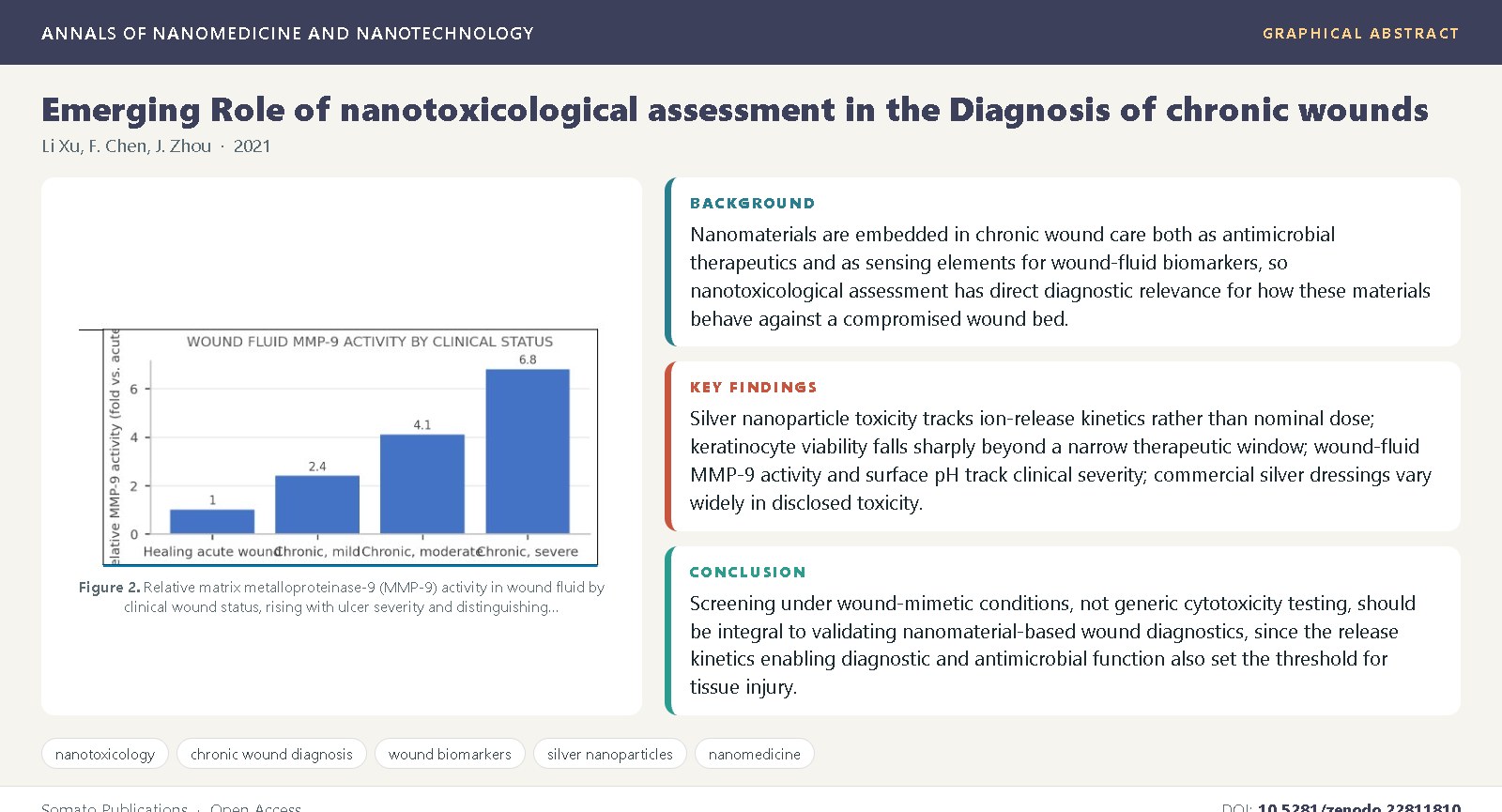
Background: Nanomaterials are embedded in chronic wound care both as antimicrobial therapeutics and as sensing elements for wound-fluid biomarkers, so nanotoxicological assessment has direct diagnostic relevance for how these materials behave against a compromised wound bed [5,6].
Objective: This review synthesizes the nanotoxicological assessment literature as it applies to chronic wound diagnosis: assay frameworks, wound-fluid biomarkers of non-healing, and diagnostic platforms combining the two.
Methods: We conducted a narrative synthesis of nanotoxicology methodology papers, wound-biology biomarker studies, and nanomedicine reports on nanomaterial-integrated wound diagnostics.
Findings: Silver nanoparticle toxicity tracks ion-release kinetics rather than nominal dose [9,10]; keratinocyte viability falls sharply beyond a narrow therapeutic window [12]; wound-fluid MMP-9 activity and surface pH track clinical severity [19,21]; commercial silver dressings vary widely in disclosed toxicity [13,14].
Conclusions: Screening under wound-mimetic conditions, not generic cytotoxicity testing, should be integral to validating nanomaterial-based wound diagnostics, since the release kinetics enabling diagnostic and antimicrobial function also set the threshold for tissue injury [17,8].
References
Frykberg, R.G., Banks, J. (2015) Challenges in the treatment of chronic wounds. Advances in Wound Care, 4(9): 560-582. DOI: 10.1089/wound.2015.0635
Rigo, C., Ferroni, L., Tocco, I., Roman, M., Munivrana, I., Gardin, C., et al. (2013) Active silver nanoparticles for wound healing. International Journal of Molecular Sciences, 14(3): 4817-4840. DOI: 10.3390/ijms14034817
Kalashnikova, I., Das, S., Seal, S. (2015) Nanomaterials for wound healing: scope and advancement. Nanomedicine, 10(16): 2593-2612. DOI: 10.2217/nnm.15.82
Boateng, J., Catanzano, O. (2015) Advanced therapeutic dressings for effective wound healing - a review. Journal of Pharmaceutical Sciences, 104(11): 3653-3680. DOI: 10.1002/jps.24610
Oberdörster, G., Oberdörster, E., Oberdörster, J. (2005) Nanotoxicology: An emerging discipline evolving from studies of ultrafine particles. Environmental Health Perspectives, 113(7): 823-839. DOI: 10.1289/ehp.7339
Nel, A., Xia, T., Mädler, L., Li, N. (2006) Toxic potential of materials at the nanolevel. Science, 311(5761): 622-627. DOI: 10.1126/science.1114397
Donaldson, K., Poland, C.A. (2013) Nanotoxicity: challenging the myth of nano-specific toxicity. Current Opinion in Biotechnology, 24(4): 724-734. DOI: 10.1016/j.copbio.2013.05.003
Krug, H.F., Wick, P. (2011) Nanotoxicology: An interdisciplinary challenge. Angewandte Chemie International Edition, 50(6): 1260-1278. DOI: 10.1002/anie.201001037
Wijnhoven, S.W.P., Peijnenburg, W.J.G.M., Herberts, C.A., Hagens, W.I., Oomen, A.G., Heugens, E.H.W., et al. (2009) Nano-silver - a review of available data and knowledge gaps in human and environmental risk assessment. Nanotoxicology, 3(2): 109-138. DOI:
1080/17435390902725914 10. Gliga, A.R., Skoglund, S., Wallinder, I.O., Fadeel, B., Karlsson, H.L. (2014) Size-dependent cytotoxicity of silver nanoparticles in human lung cells: the role of cellular uptake, agglomeration and Ag release. Particle and Fibre Toxicology, 11: 11. DOI: 10.1186/1743-8977-11-11
Chaloupka, K., Malam, Y., Seifalian, A.M. (2010) Nanosilver as a new generation of nanoproduct in biomedical applications. Trends in Biotechnology, 28(11): 580-588. DOI: 10.1016/j.tibtech.2010.07.006
Fraňková, J., Pivodová, V., Vágnerová, H., Juráňová, J., Ulrichová, J. (2016) Effects of silver nanoparticles on primary cell cultures of fibroblasts and keratinocytes in a wound-healing model. Journal of Applied Biomaterials & Functional Materials, 14(2): e137-142. DOI: 10.5301/jabfm.5000268
Sim, W., Barnard, R.T., Blaskovich, M.A.T., Ziora, Z.M. (2018) Antimicrobial silver in medicinal and consumer applications: a patent review of the past decade (2007-2017). Antibiotics, 7(4): 93. DOI: 10.3390/antibiotics7040093
Burdușel, A.C., Gherasim, O., Grumezescu, A.M., Mogoantă, L., Ficai, A., Andronescu, E. (2018) Biomedical applications of silver nanoparticles: an up-to-date overview. Nanomaterials, 8(9): 681. DOI: 10.3390/nano8090681
Fadeel, B., Garcia-Bennett, A.E. (2010) Better safe than sorry: Understanding the toxicological properties of inorganic nanoparticles manufactured for biomedical applications. Advanced Drug Delivery Reviews, 62(3): 362-374. DOI: 10.1016/j.addr.2009.11.008
Oberdörster, G. (2010) Safety assessment for nanotechnology and nanomedicine: concepts of nanotoxicology. Journal of Internal Medicine, 267(1): 89-105. DOI: 10.1111/j.1365-2796.2009.02187.x
Fadeel, B., Farcal, L., Hardy, B., Vazquez-Campos, S., Hristozov, D., Marcomini, A., et al. (2018) Advanced tools for the safety assessment of nanomaterials. Nature Nanotechnology, 13(7): 537-543. DOI: 10.1038/s41565-018-0185-0
Trengove, N.J., Stacey, M.C., MacAuley, S., Bennett, N., Gibson, J., Burslem, F., et al. (1999) Analysis of the acute and chronic wound environments: the role of proteases and their inhibitors. Wound Repair and Regeneration, 7(6): 442-452. DOI: 10.1046/j.1524-475X.1999.00442.x
Rayment, E.A., Upton, Z., Shooter, G.K. (2008) Increased matrix metalloproteinase-9 (MMP-9) activity observed in chronic wound fluid is related to the clinical severity of the ulcer. British Journal of Dermatology, 158(5): 951-961. DOI: 10.1111/j.1365-2133.2008.08462.x
McCarty, S.M., Percival, S.L. (2013) Proteases and delayed wound healing. Advances in Wound Care, 2(8): 438-447. DOI: 10.1089/wound.2012.0370
Schneider, L.A., Korber, A., Grabbe, S., Dissemond, J. (2007) Influence of pH on wound-healing: a new perspective for wound-therapy? Archives of Dermatological Research, 298(9): 413-420. DOI: 10.1007/s00403-006-0713-x
Percival, S.L., McCarty, S.M., Lipsky, B. (2015) Biofilms and wounds: an overview of the evidence. Advances in Wound Care, 4(7): 373-381. DOI: 10.1089/wound.2014.0557
Falanga, V. (2005) Wound healing and its impairment in the diabetic foot. The Lancet, 366(9498): 1736-1743. DOI: 10.1016/S0140-6736(05)67700-8
Mihai, M.M., Dima, M.B., Dima, B., Holban, A.M. (2019) Nanomaterials for wound healing and infection control. Materials, 12(13): 2176. DOI: 10.3390/ma12132176
Kalantari, K., Mostafavi, E., Afifi, A.M., Izadiyan, Z., Jahangirian, H., Rafiee-Moghaddam, R., et al. (2020) Wound dressings functionalized with silver nanoparticles: promises and pitfalls. Nanoscale, 12(4): 2268-2291. DOI: 10.1039/C9NR08234D

Published
Issue
Section
License
Copyright (c) 2021 Li Xu, et al.

This work is licensed under a Creative Commons Attribution 4.0 International License.


