
Clinical Outcomes of nanorobotic drug delivery in Patients with solid tumors
DOI:
https://doi.org/10.5281/zenodo.22811779Keywords:
nanorobotics, drug delivery, solid tumors, tumor microenvironment, nanomedicineAbstract
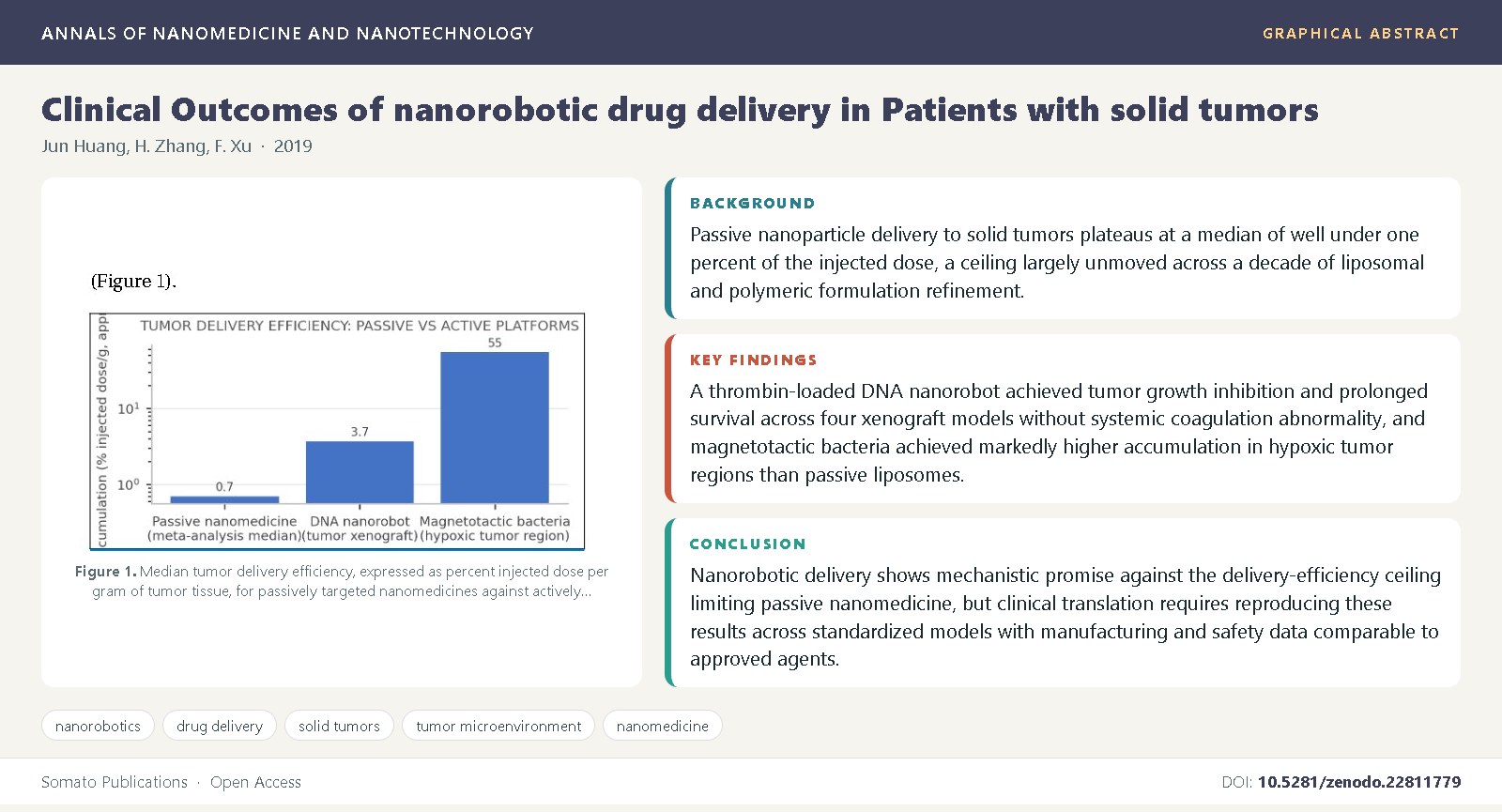
Background: Passive nanoparticle delivery to solid tumors plateaus at a median of well under one percent of the injected dose, a ceiling largely unmoved across a decade of liposomal and polymeric formulation refinement.
Objective: This review benchmarks nanorobotic drug delivery platforms, DNA-based logic-gated devices, synthetic micromotors, and biohybrid carriers, against solid tumor models and against the clinical-trial evidence for approved nanomedicines.
Methods: We conducted a narrative synthesis of primary studies reporting quantifiable in vivo outcomes for nanorobotic and micromotor platforms, supplemented by the passive-delivery and clinical-trial literature used for benchmarking.
Findings: A thrombin-loaded DNA nanorobot achieved tumor growth inhibition and prolonged survival across four xenograft models without systemic coagulation abnormality, and magnetotactic bacteria achieved markedly higher accumulation in hypoxic tumor regions than passive liposomes; both exceed the roughly 0.7% median delivery efficiency of passive nanomedicines, but evidence remains concentrated in few laboratories and no platform has entered human testing.
Conclusions: Nanorobotic delivery shows mechanistic promise against the delivery-efficiency ceiling limiting passive nanomedicine, but clinical translation requires reproducing these results across standardized models with manufacturing and safety data comparable to approved agents.
References
Peer, D., Karp, J.M., Hong, S., Farokhzad, O.C., Margalit, R., Langer, R. (2007) Nanocarriers as an emerging platform for cancer therapy. Nature Nanotechnology, 2(12): 751-760. DOI: 10.1038/nnano.2007.387
Barenholz, Y. (2012) Doxil - the first FDA-approved nano-drug: lessons learned. Journal of Controlled Release, 160(2): 117-134. DOI: 10.1016/j.jconrel.2012.03.020
Von Hoff, D.D., Ervin, T., Arena, F.P., Chiorean, E.G., Infante, J., Moore, M., et al. (2013) Increased survival in pancreatic cancer with nab-paclitaxel plus gemcitabine. New England Journal of Medicine, 369(18): 1691-1703. DOI: 10.1056/NEJMoa1304369
Wilhelm, S., Tavares, A.J., Dai, Q., Ohta, S., Audet, J., Dvorak, H.F., Chan, W.C.W. (2016) Analysis of nanoparticle delivery to tumours. Nature Reviews Materials, 1: 16014. DOI: 10.1038/natrevmats.2016.14
Douglas, S.M., Bachelet, I., Church, G.M. (2012) A logic-gated nanorobot for targeted transport of molecular payloads. Science, 335(6070): 831-834. DOI: 10.1126/science.1214081
Li, S., Jiang, Q., Liu, S., Zhang, Y., Tian, Y., Song, C., et al. (2018) A DNA nanorobot functions as a cancer therapeutic in response to a molecular trigger in vivo. Nature Biotechnology, 36(3): 258-264. DOI: 10.1038/nbt.4071
Wang, J., Gao, W. (2012) Nano/microscale motors: biomedical opportunities and challenges. ACS Nano, 6(7): 5745-5751. DOI: 10.1021/nn3028997
Li, J., de Ávila, B.E., Gao, W., Zhang, L., Wang, J. (2017) Micro/nanorobots for biomedicine: delivery, surgery, sensing, and detoxification. Science Robotics, 2(4): eaam6431. DOI: 10.1126/scirobotics.aam6431
Felfoul, O., Mohammadi, M., Taherkhani, S., de Lanauze, D., Zhong Xu, Y., Loghin, D., et al. (2016) Magneto-aerotactic bacteria deliver drug-containing nanoliposomes to tumour hypoxic regions. Nature Nanotechnology, 11(11): 941-947. DOI: 10.1038/nnano.2016.137
Servant, A., Qiu, F., Mazza, M., Kostarelos, K., Nelson, B.J. (2015) Controlled in vivo swimming of a swarm of bacteria-like microrobotic flagella. Advanced Materials, 27(19): 2981-2988. DOI: 10.1002/adma.201404444
Alapan, Y., Yasa, O., Yigit, B., Yasa, I.C., Erkoc, P., Sitti, M. (2019) Microrobotics and microorganisms: biohybrid autonomous cellular robots. Annual Review of Control, Robotics, and Autonomous Systems, 2: 205-230. DOI: 10.1146/annurev-control-060117-104856
Cheng, R., Meng, F., Deng, C., Klok, H.A., Zhong, Z. (2013) Dual and multi-stimuli responsive polymeric nanoparticles for programmed site-specific drug delivery. Biomaterials, 34(14): 3647-3657. DOI: 10.1016/j.biomaterials.2013.01.084
Hu, Q., Katti, P.S., Gu, Z. (2014) Enzyme-responsive nanomaterials for controlled drug delivery. Nanoscale, 6(21): 12273-12286. DOI: 10.1039/c4nr04249b
Erkoc, P., Yasa, I.C., Ceylan, H., Yasa, O., Alapan, Y., Sitti, M. (2019) Mobile microrobots for active therapeutic delivery. Advanced Therapeutics, 2(1): 1800064. DOI: 10.1002/adtp.201800064
Anselmo, A.C., Mitragotri, S. (2019) Nanoparticle delivery systems for cancer therapy: 15 years of progress and 15 years to go. Bioengineering & Translational Medicine, 4(3): e10143. DOI: 10.1002/btm2.10143
Nelson, B.J., Kaliakatsos, I.K., Abbott, J.J. (2010) Microrobots for minimally invasive medicine. Annual Review of Biomedical Engineering, 12: 55-85. DOI: 10.1146/annurev-bioeng-010510-103409
Sitti, M., Ceylan, H., Hu, W., Giltinan, J., Turan, M., Yim, S., Diller, E. (2015) Biomedical applications of untethered mobile milli/microrobots. Proceedings of the IEEE, 103(2): 205-224. DOI: 10.1109/JPROC.2014.2385105
Soto, F., Wang, J., Ahmed, R., Demirci, U. (2020) Medical micro/nanorobots in precision medicine. Advanced Science, 7(21): 2002203. DOI: 10.1002/advs.202002203
Peng, F., Tu, Y., Wilson, D.A. (2017) Micro/nanomotors towards in vivo application: cell, tissue and biofluid. Chemical Society Reviews, 46(17): 5289-5310. DOI: 10.1039/c6cs00885b
de Ávila, B.E., Angsantikul, P., Li, J., Angell, C., Khong, M., Chen, C., et al. (2017) Micromotor-enabled active drug delivery for in vivo treatment of stomach infection. Nature Communications, 8: 272. DOI: 10.1038/s41467-017-00309-w
Gao, W., Dong, R., Thamphiwatana, S., Li, J., Gao, W., Zhang, L., Wang, J. (2015) Artificial micromotors in the mouse's stomach: a step toward in vivo use of synthetic motors. ACS Nano, 9(1): 117-123. DOI: 10.1021/nn507097k
Kagan, D., Benchimol, M.J., Claussen, J.C., Chuluun-Erdene, E., Esener, S., Wang, J. (2012) Acoustic droplet vaporization and propulsion of perfluorocarbon-loaded microbullets for targeted tissue penetration and deployment. Angewandte Chemie International Edition, 51(30): 7519-7522. DOI: 10.1002/anie.201201902
de Lanauze, D., Felfoul, O., Turcot, J.P., Mohammadi, M., Martel, S. (2014) Three-dimensional remote aggregation and steering of magnetotactic bacteria microrobots for drug delivery applications. International Journal of Robotics Research, 33(3): 359-374.
Wu, Z., Li, T., Li, J., Gao, W., Xu, T., Christianson, C., et al. (2014) Turning erythrocytes into functional micromotors. ACS Nano, 8(12): 12041-12048. DOI: 10.1021/nn504822w
Hu, C.M., Fang, R.H., Wang, K.C., Luk, B.T., Thamphiwatana, S., Dehaini, D., et al. (2015) Nanoparticle biointerfacing by platelet membrane cloaking. Nature, 526(7571): 118-121. DOI: 10.1038/nature15373
Villa, K., Pumera, M. (2019) Fuel-free light-driven micro/nanomachines: artificial active matter mimicking nature's tactic behaviors. Chemical Society Reviews, 48(19): 4966-4978. DOI: 10.1039/c9cs00090a
Gao, C., Wang, Y., Ye, Z., Lin, Z., Ma, X., He, Q. (2021) Biomedical micro-/nanomotors: from overcoming biological barriers to in vivo imaging. Advanced Materials, 33(6): 2000512.

Published
Issue
Section
License
Copyright (c) 2019 Jun Huang, et al.

This work is licensed under a Creative Commons Attribution 4.0 International License.


