
Comparative Analysis of kidney transplantation versus Standard Care in diabetic nephropathy
DOI:
https://doi.org/10.5281/zenodo.22813053Keywords:
diabetic nephropathy, kidney transplantation, dialysis, pancreas-kidney transplantation, end-stage renal diseaseAbstract
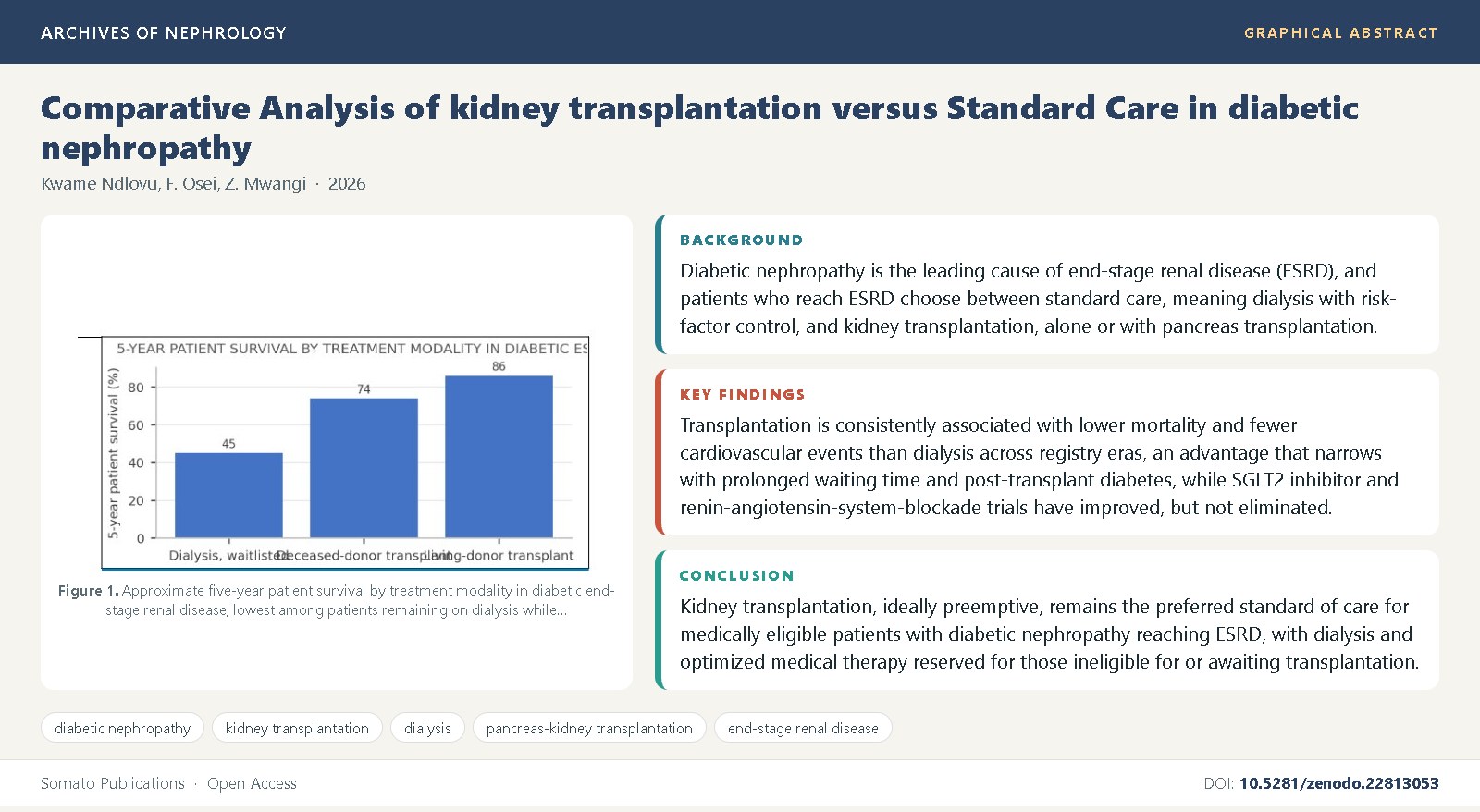
Background: Diabetic nephropathy is the leading cause of end-stage renal disease (ESRD), and patients who reach ESRD choose between standard care, meaning dialysis with risk-factor control, and kidney transplantation, alone or with pancreas transplantation [1,3].
Objective: This review compares survival, metabolic outcomes, and cardiovascular complications between kidney transplantation and standard care in diabetic nephropathy, including simultaneous pancreas-kidney (SPK) transplantation.
Methods: We synthesized registry analyses, cohort studies, and trials of standard-care pharmacotherapy addressing mortality, graft survival, and glycemic control in diabetic ESRD managed by dialysis versus kidney or pancreas-kidney transplantation.
Findings: Transplantation is consistently associated with lower mortality and fewer cardiovascular events than dialysis across registry eras [4,10], an advantage that narrows with prolonged waiting time and post-transplant diabetes [11,17], while SGLT2 inhibitor and renin-angiotensin-system-blockade trials have improved, but not eliminated, the trajectory of standard care [6,7]; SPK transplantation adds a further, conditional survival benefit over kidney-alone transplantation when pancreas graft function is sustained [27,30].
Conclusions: Kidney transplantation, ideally preemptive, remains the preferred standard of care for medically eligible patients with diabetic nephropathy reaching ESRD, with dialysis and optimized medical therapy reserved for those ineligible for or awaiting transplantation [15,16].
References
Ritz, E., Orth, S.R. (1999) Nephropathy in patients with type 2 diabetes mellitus. New England Journal of Medicine, 341(15): 1127-1133. DOI: 10.1056/NEJM199910073411506
United States Renal Data System. (2021) USRDS Annual Data Report: Epidemiology of Kidney Disease in the United States. American Journal of Kidney Diseases, 77(4)(Suppl 1): A7-A8. DOI: 10.1053/j.ajkd.2021.01.001
Kidney Disease: Improving Global Outcomes (KDIGO) Diabetes Work Group. (2020) KDIGO 2020 clinical practice guideline for diabetes management in chronic kidney disease. Kidney International, 98(4S): S1-S115. DOI: 10.1016/j.kint.2020.06.019
Wolfe, R.A., Ashby, V.B., Milford, E.L., Ojo, A.O., Ettenger, R.E., Agodoa, L.Y., et al. (1999) Comparison of mortality in all patients on dialysis, patients on dialysis awaiting transplantation, and recipients of a first cadaveric transplant. New England Journal of Medicine, 341(23): 1725-1730. DOI: 10.1056/NEJM199912023412303
Port, F.K., Wolfe, R.A., Mauger, E.A., Berling, D.P., Jiang, K. (1993) Comparison of survival probabilities for dialysis patients vs cadaveric renal transplant recipients. JAMA, 270(11): 1339-1343. DOI: 10.1001/jama.1993.03500110079036
Perkovic, V., Jardine, M.J., Neal, B., Bompoint, S., Heerspink, H.J.L., Charytan, D.M., et al. (2019) Canagliflozin and renal outcomes in type 2 diabetes and nephropathy. New England Journal of Medicine, 380(24): 2295-2306. DOI: 10.1056/NEJMoa1811744
Heerspink, H.J.L., Stefansson, B.V., Correa-Rotter, R., Chertow, G.M., Greene, T., Hou, F.F., et al. (2020) Dapagliflozin in patients with chronic kidney disease. New England Journal of Medicine, 383(15): 1436-1446. DOI: 10.1056/NEJMoa2024816
EMPA-KIDNEY Collaborative Group. (2023) Empagliflozin in patients with chronic kidney disease. New England Journal of Medicine, 388(2): 117-127. DOI: 10.1056/NEJMoa2204233
Israni, A.K., Zaun, D., Rosendale, J.D., Schaffhausen, C., Snyder, J.J., Kasiske, B.L. (2018) OPTN/SRTR annual data report: deceased organ donation. American Journal of Transplantation, 18(Suppl 1): 434-463. DOI: 10.1111/ajt.14563
Tonelli, M., Wiebe, N., Knoll, G., Bello, A., Browne, S., Jadhav, D., et al. (2011) Systematic review: kidney transplantation compared with dialysis in clinically relevant outcomes. American Journal of Transplantation, 11(10): 2093-2109. DOI: 10.1111/j.1600-6143.2011.03686.x
Meier-Kriesche, H.U., Port, F.K., Ojo, A.O., Rudich, S.M., Hanson, J.A., Cibrik, D.M., et al. (2000) Effect of waiting time on renal transplant outcome. Kidney International, 58(3): 1311-1317. DOI: 10.1046/j.1523-1755.2000.00287.x
Becker, B.N., Rush, S.H., Dykstra, D.M., Becker, Y.T., Port, F.K. (2006) Preemptive transplantation for patients with diabetes-related kidney disease. Archives of Internal Medicine, 166(1): 44-48. DOI: 10.1001/archinte.166.1.44
Schold, J.D., Meier-Kriesche, H.U. (2006) Which renal transplant candidates should accept marginal kidneys in exchange for a shorter waiting time? Clinical Journal of the American Society of Nephrology, 1(3): 532-538. DOI: 10.2215/CJN.01130905
Ojo, A.O., Port, F.K., Wolfe, R.A., Mauger, E.A., Williams, L., Berling, D.P. (1994) Comparative mortality risks of chronic dialysis and cadaveric transplantation in black end-stage renal disease patients. American Journal of Kidney Diseases, 24(1): 59-64. DOI: 10.1016/S0272-6386(12)80160-0
Coemans, M., Susal, C., Dohler, B., Anglicheau, D., Giral, M., Bestard, O., et al. (2018) Analyses of the short- and long-term graft survival after kidney transplantation in Europe between 1986 and 2015. Kidney International, 94(5): 964-973. DOI: 10.1016/j.kint.2018.05.018
Hariharan, S., Israni, A.K., Danovitch, G. (2021) Long-term survival after kidney transplantation. New England Journal of Medicine, 385(8): 729-743. DOI: 10.1056/NEJMra2014530
Kasiske, B.L., Snyder, J.J., Gilbertson, D., Matas, A.J. (2003) Diabetes mellitus after kidney transplantation in the United States. American Journal of Transplantation, 3(2): 178-185. DOI: 10.1034/j.1600-6143.2003.00010.x
Cosio, F.G., Kudva, Y., van der Velde, M., Larson, T.S., Textor, S.C., Griffin, M.D., et al. (2005) New onset hyperglycemia and diabetes are associated with increased cardiovascular risk after kidney transplantation. Kidney International, 67(6): 2415-2421. DOI: 10.1111/j.1523-1755.2005.00349.x
Rostaing, L., Malvezzi, P. (2016) Steroid-based therapy and risk of posttransplant diabetes. Clinical Journal of the American Society of Nephrology, 11(10): 1710-1712. DOI: 10.2215/CJN.08790816
Diabetes Control and Complications Trial (DCCT) Research Group. (1993) The effect of intensive treatment of diabetes on the development and progression of long-term complications in insulin-dependent diabetes mellitus. New England Journal of Medicine, 329(14): 977-986. DOI: 10.1056/NEJM199309303291401
Morath, C., Zeier, M., Dohler, B., Schmidt, J., Nawroth, P.P., Opelz, G. (2008) Metabolic control improves long-term renal allograft and patient survival in type 1 diabetes. Journal of the American Society of Nephrology, 19(8): 1557-1563. DOI: 10.1681/ASN.2007070804
Lewis, E.J., Hunsicker, L.G., Bain, R.P., Rohde, R.D. (1993) The effect of angiotensin-converting-enzyme inhibition on diabetic nephropathy. New England Journal of Medicine, 329(20): 1456-1462. DOI: 10.1056/NEJM199311113292004
Brenner, B.M., Cooper, M.E., de Zeeuw, D., Keane, W.F., Mitch, W.E., Parving, H.H., et al. (2001) Effects of losartan on renal and cardiovascular outcomes in patients with type 2 diabetes and nephropathy. New England Journal of Medicine, 345(12): 861-869. DOI: 10.1056/NEJMoa011161
Lewis, E.J., Hunsicker, L.G., Clarke, W.R., Berl, T., Pohl, M.A., Lewis, J.B., et al. (2001) Renoprotective effect of the angiotensin-receptor antagonist irbesartan in patients with nephropathy due to type 2 diabetes. New England Journal of Medicine, 345(12): 851-860. DOI: 10.1056/NEJMoa011303
Rangel, E.B., Franco, M.C., Gabriel, D.A., Uehara, M.H., Rezende, L.P. (2011) Kidney transplant in diabetic patients: modalities, indications and results. Diabetology and Metabolic Syndrome, 3: 34. DOI: 10.1186/1758-5996-3-34
Fioretto, P., Steffes, M.W., Sutherland, D.E., Goetz, F.C., Mauer, M. (1998) Reversal of lesions of diabetic nephropathy after pancreas transplantation. New England Journal of Medicine, 339(2): 69-75. DOI: 10.1056/NEJM199807093390202
Ojo, A.O., Meier-Kriesche, H.U., Hanson, J.A., Leichtman, A.B., Cibrik, D., Magee, J.C., et al. (2001) The impact of simultaneous pancreas-kidney transplantation on long-term patient survival. Transplantation, 71(1): 82-90. DOI: 10.1097/00007890-200101150-00014
Gruessner, R.W., Sutherland, D.E., Gruessner, A.C. (2004) Mortality assessment for pancreas transplants. American Journal of Transplantation, 4(12): 2018-2026. DOI: 10.1111/j.1600-6143.2004.00667.x
Sutherland, D.E., Gruessner, R.W., Dunn, D.L., Matas, A.J., Humar, A., Kandaswamy, R., et al. (2001) Lessons learned from more than 1,000 pancreas transplants at a single institution. Annals of Surgery, 233(4): 463-501. DOI: 10.1097/00000658-200104000-00003
Weiss, A.S., Smits, G., Wiseman, A.C. (2009) Twelve-month pancreas graft function significantly influences survival following simultaneous pancreas-kidney transplantation. Clinical Journal of the American Society of Nephrology, 4(5): 988-995. DOI: 10.2215/CJN.04940908
Gaynor, J.J., Ciancio, G., Guerra, G., Sageshima, J., Hanson, L., Roth, D., et al. (2016) Graft failure after simultaneous pancreas-kidney transplantation in the new millennium. Clinical Transplantation, 30(4): 424-433. DOI: 10.1111/ctr.12706

Published
Issue
Section
License
Copyright (c) 2026 Kwame Ndlovu, et al.

This work is licensed under a Creative Commons Attribution 4.0 International License.


