
Prevalence and Risk Factors of polycystic kidney disease in pediatric nephrology patients
DOI:
https://doi.org/10.5281/zenodo.22813070Keywords:
polycystic kidney disease, ADPKD, ARPKD, pediatric nephrology, hypertensionAbstract
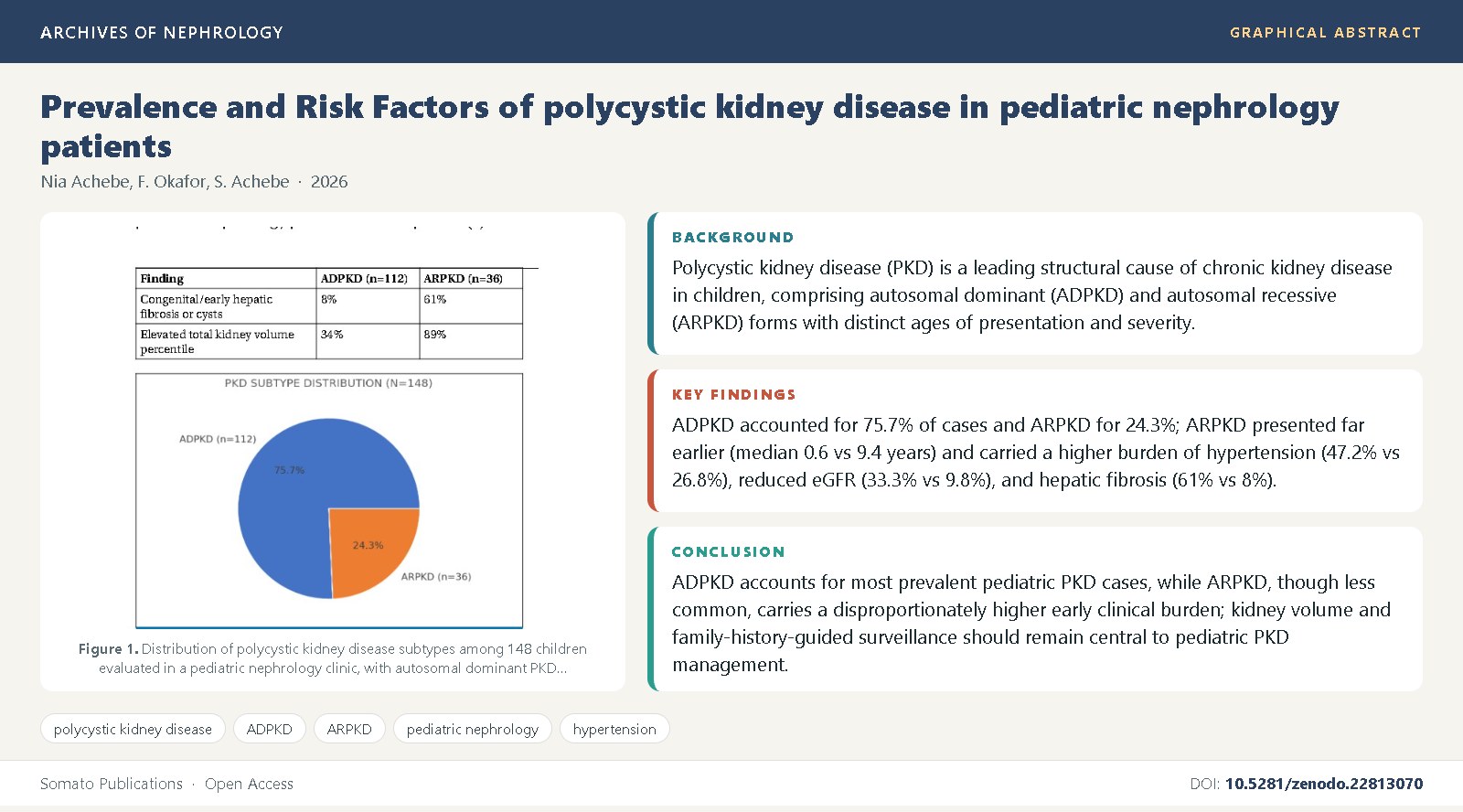
Background: Polycystic kidney disease (PKD) is a leading structural cause of chronic kidney disease in children, comprising autosomal dominant (ADPKD) and autosomal recessive (ARPKD) forms with distinct ages of presentation and severity [1,6].
Objective: This study estimated the prevalence of PKD subtypes among children evaluated in a pediatric nephrology service and identified clinical and family-history factors associated with hypertension and reduced kidney function at presentation.
Methods: We retrospectively reviewed 148 children with imaging- or genetically-confirmed PKD, extracting age, ascertainment mode, family history, blood pressure, estimated glomerular filtration rate, kidney volume, and extrarenal findings by subtype.
Results: ADPKD accounted for 75.7% of cases and ARPKD for 24.3%; ARPKD presented far earlier (median 0.6 vs 9.4 years) and carried a higher burden of hypertension (47.2% vs 26.8%), reduced eGFR (33.3% vs 9.8%), and hepatic fibrosis (61% vs 8%) [4,9].
Conclusions: ADPKD accounts for most prevalent pediatric PKD cases, while ARPKD, though less common, carries a disproportionately higher early clinical burden; kidney volume and family-history-guided surveillance should remain central to pediatric PKD management [24,10].
References
Harris, P.C., Torres, V.E. (2009) Polycystic kidney disease. Annual Review of Medicine, 60: 321-337. DOI: 10.1146/annurev.med.60.101707.125712
Bergmann, C., Guay-Woodford, L.M., Harris, P.C., Horie, S., Peters, D.J.M., Torres, V.E. (2018) Polycystic kidney disease. Nature Reviews Disease Primers, 4: 50. DOI: 10.1038/s41572-018-0047-y
Zerres, K., Rudnik-Schoneborn, S., Deget, F., Holtkamp, U., Brodehl, J., Geisert, J., et al. (1996) Autosomal recessive polycystic kidney disease in 115 children: clinical presentation, course and influence of gender. Acta Paediatrica, 85(4): 437-445. DOI: 10.1111/j.1651-2227.1996.tb14056.x
Cadnapaphornchai, M.A., McFann, K., Strain, J.D., Masoumi, A., Schrier, R.W. (2011) Prospective change in renal volume and function in children with ADPKD. Clinical Journal of the American Society of Nephrology, 6(2): 380-385. DOI: 10.2215/CJN.03210410
Fick-Brosnahan, G.M., Tran, Z.V., Johnson, A.M., Strain, J.D., Gabow, P.A. (2001) Progression of autosomal-dominant polycystic kidney disease in children. Kidney International, 59(5): 1654-1662. DOI: 10.1046/j.1523-1755.2001.0590051654.x
Guay-Woodford, L.M., Bissler, J.J., Braun, M.C., Bockenhauer, D., Cadnapaphornchai, M.A., Dell, K.M., et al. (2014) Consensus expert recommendations for the diagnosis and management of autosomal recessive polycystic kidney disease. Journal of Pediatrics, 165(3): 611-617. DOI: 10.1016/j.jpeds.2014.06.015
Bergmann, C., Senderek, J., Windelen, E., Kupper, F., Middeldorf, I., Schneider, F., et al. (2005) Clinical consequences of PKHD1 mutations in 164 patients with autosomal-recessive polycystic kidney disease. Kidney International, 67(3): 829-848. DOI: 10.1111/j.1523-1755.2005.00148.x
Willey, C.J., Blais, J.D., Hall, A.K., Krasa, H.B., Makin, A.J., Czerwiec, F.S. (2017) Prevalence of autosomal dominant polycystic kidney disease in the European Union. Nephrology Dialysis Transplantation, 32(8): 1356-1363. DOI: 10.1093/ndt/gfw240
Bergmann, C., Senderek, J., Sedlacek, B., Pegiazoglou, I., Puglia, P., Eggermann, T., et al. (2003) Spectrum of mutations in the gene for autosomal recessive polycystic kidney disease (ARPKD/PKHD1). Journal of the American Society of Nephrology, 14(1): 76-89. DOI:
1097/01.asn.0000039578.55688.d0 10. Dell, K.M. (2016) The spectrum of polycystic kidney disease in children. Advances in Chronic Kidney Disease, 18(5): 339-347. DOI: 10.1053/j.ackd.2011.04.001
Harambat, J., van Stralen, K.J., Kim, J.J., Tizard, E.J. (2012) Epidemiology of chronic kidney disease in children. Pediatric Nephrology, 27(3): 363-373. DOI: 10.1007/s00467-011-1939-1
North American Pediatric Renal Trials and Collaborative Studies (NAPRTCS) (2014) 2014 Annual Transplant Report. Boston: NAPRTCS.
Ravine, D., Gibson, R.N., Walker, R.G., Sheffield, L.J., Kincaid-Smith, P., Danks, D.M. (1994) Evaluation of ultrasonographic diagnostic criteria for autosomal dominant polycystic kidney disease 1. Lancet, 343(8901): 824-827. DOI: 10.1016/s0140-6736(94)92026-5
Pei, Y., Obaji, J., Dupuis, A., Paterson, A.D., Magistroni, R., Dicks, E., et al. (2009) Unified criteria for ultrasonographic diagnosis of ADPKD. Journal of the American Society of Nephrology, 20(1): 205-212. DOI: 10.1681/ASN.2008050507
Gimpel, C., Avni, F.E., Bergmann, C., Cetiner, M., Habbig, S., Haffner, D., et al. (2019) Perinatal diagnosis, management, and follow-up of cystic renal diseases: a clinical practice recommendation. JAMA Pediatrics, 173(1): 74-86. DOI: 10.1001/jamapediatrics.2018.3938
Sweeney, W.E., Avner, E.D. (2011) Diagnosis and management of childhood polycystic kidney disease. Pediatric Nephrology, 26(5): 675-692. DOI: 10.1007/s00467-010-1656-1
Schwartz, G.J., Munoz, A., Schneider, M.F., Mak, R.H., Kaskel, F., Warady, B.A., et al. (2009) New equations to estimate GFR in children with CKD. Journal of the American Society of Nephrology, 20(3): 629-637. DOI: 10.1681/ASN.2008030287
Flynn, J.T., Kaelber, D.C., Baker-Smith, C.M., Blowey, D., Carroll, A.E., Daniels, S.R., et al. (2017) Clinical practice guideline for screening and management of high blood pressure in children and adolescents. Pediatrics, 140(3): e20171904. DOI: 10.1542/peds.2017-1904
Massella, L., Mekahli, D., Paripovic, D., Prikhodina, L., Godefroid, N., Niemirska, A., et al. (2018) Prevalence of hypertension in children with early-stage ADPKD. Clinical Journal of the American Society of Nephrology, 13(6): 874-883. DOI: 10.2215/CJN.11360817
Hogan, M.C., Abebe, K., Torres, V.E., Chapman, A.B., Bae, K.T., Tao, C., et al. (2015) Liver involvement in early autosomal-dominant polycystic kidney disease. Clinical Gastroenterology and Hepatology, 13(1): 155-164. DOI: 10.1016/j.cgh.2014.07.051
Barua, M., Cil, O., Paterson, A.D., Wang, K., He, N., Dicks, E., et al. (2009) Family history of renal disease severity predicts the mutated gene in ADPKD. Journal of the American Society of Nephrology, 20(8): 1833-1838. DOI: 10.1681/ASN.2009020162
Rossetti, S., Consugar, M.B., Chapman, A.B., Torres, V.E., Guay-Woodford, L.M., Grantham, J.J., et al. (2007) Comprehensive molecular diagnostics in autosomal dominant polycystic kidney disease. Journal of the American Society of Nephrology, 18(7): 2143-2160. DOI: 10.1681/ASN.2006121387
Pirson, Y., Chauveau, D., Torres, V. (2002) Management of cerebral aneurysms in autosomal dominant polycystic kidney disease. Journal of the American Society of Nephrology, 13(1): 269-276. DOI: 10.1681/ASN.V131269
Grantham, J.J., Torres, V.E., Chapman, A.B., Guay-Woodford, L.M., Bae, K.T., King, B.F., et al. (2006) Volume progression in polycystic kidney disease. New England Journal of Medicine, 354(20): 2122-2130. DOI: 10.1056/NEJMoa054341
Chapman, A.B., Bost, J.E., Torres, V.E., Guay-Woodford, L., Bae, K.T., Landsittel, D., et al. (2012) Kidney volume and functional outcomes in autosomal dominant polycystic kidney disease. Clinical Journal of the American Society of Nephrology, 7(3): 479-486. DOI: 10.2215/CJN.09500911
Schrier, R.W., Abebe, K.Z., Perrone, R.D., Torres, V.E., Braun, W.E., Steinman, T.I., et al. (2014) Blood pressure in early autosomal dominant polycystic kidney disease. New England Journal of Medicine, 371(24): 2255-2266. DOI: 10.1056/NEJMoa1402685
Ecder, T., Schrier, R.W. (2009) Cardiovascular abnormalities in autosomal-dominant polycystic kidney disease. Nature Reviews Nephrology, 5(4): 221-228. DOI: 10.1038/nrneph.2009.13
Mekahli, D., Woolf, A.S. (2015) Update on the ciliopathies and cystic kidney diseases in children. Pediatric Nephrology, 31(3): 349-352. DOI: 10.1007/s00467-015-3204-9
Cornec-Le Gall, E., Audrezet, M.P., Chen, J.M., Hourmant, M., Morin, M.P., Perrichot, R., et al. (2013) Type of PKD1 mutation influences renal outcome in ADPKD. Journal of the American Society of Nephrology, 24(6): 1006-1013. DOI: 10.1681/ASN.2012070650
ESCAPE Trial Group, Wuhl, E., Trivelli, A., Picca, S., Litwin, M., Peco-Antic, A., Zurowska, A., et al. (2009) Strict blood-pressure control and progression of renal failure in children. New England Journal of Medicine, 361(17): 1639-1650. DOI: 10.1056/NEJMoa0902066
Torres, V.E., Chapman, A.B., Devuyst, O., Gansevoort, R.T., Grantham, J.J., Higashihara, E., et al. (2012) Tolvaptan in patients with autosomal dominant polycystic kidney disease. New England Journal of Medicine, 367(25): 2407-2418. DOI: 10.1056/NEJMoa1205511
Torres, V.E., Chapman, A.B., Devuyst, O., Gansevoort, R.T., Perrone, R.D., Koch, G., et al. (2017) Tolvaptan in later-stage autosomal dominant polycystic kidney disease. New England Journal of Medicine, 377(20): 1930-1942. DOI: 10.1056/NEJMoa1710030
Cadnapaphornchai, M.A. (2014) Autosomal dominant polycystic kidney disease in children. Current Opinion in Pediatrics, 27(2): 193-200. DOI: 10.1097/MOP.0000000000000195
Wong, H., Vivian, L., Weiler, G., Filler, G. (2011) Patients with autosomal dominant polycystic kidney disease hyperfiltrate early in their disease course. Pediatric Nephrology, 26(3): 469-473. DOI: 10.1007/s00467-010-1740-6
Adeva, M., El-Youssef, M., Rossetti, S., Kamath, P.S., Kubly, V., Consugar, M.B., et al. (2006) Clinical and molecular characterization of defects in polycystic kidney and hepatic disease. Medicine, 85(1): 1-21. DOI: 10.1097/01.md.0000200165.90373.9a

Published
Issue
Section
License
Copyright (c) 2026 Nia Achebe, et al.

This work is licensed under a Creative Commons Attribution 4.0 International License.


