
Predictors of dialysis adequacy in pediatric nephrology patients with nephrolithiasis
DOI:
https://doi.org/10.5281/zenodo.22813100Keywords:
dialysis adequacy, pediatric nephrology, nephrolithiasis, Kt/V, chronic kidney diseaseAbstract
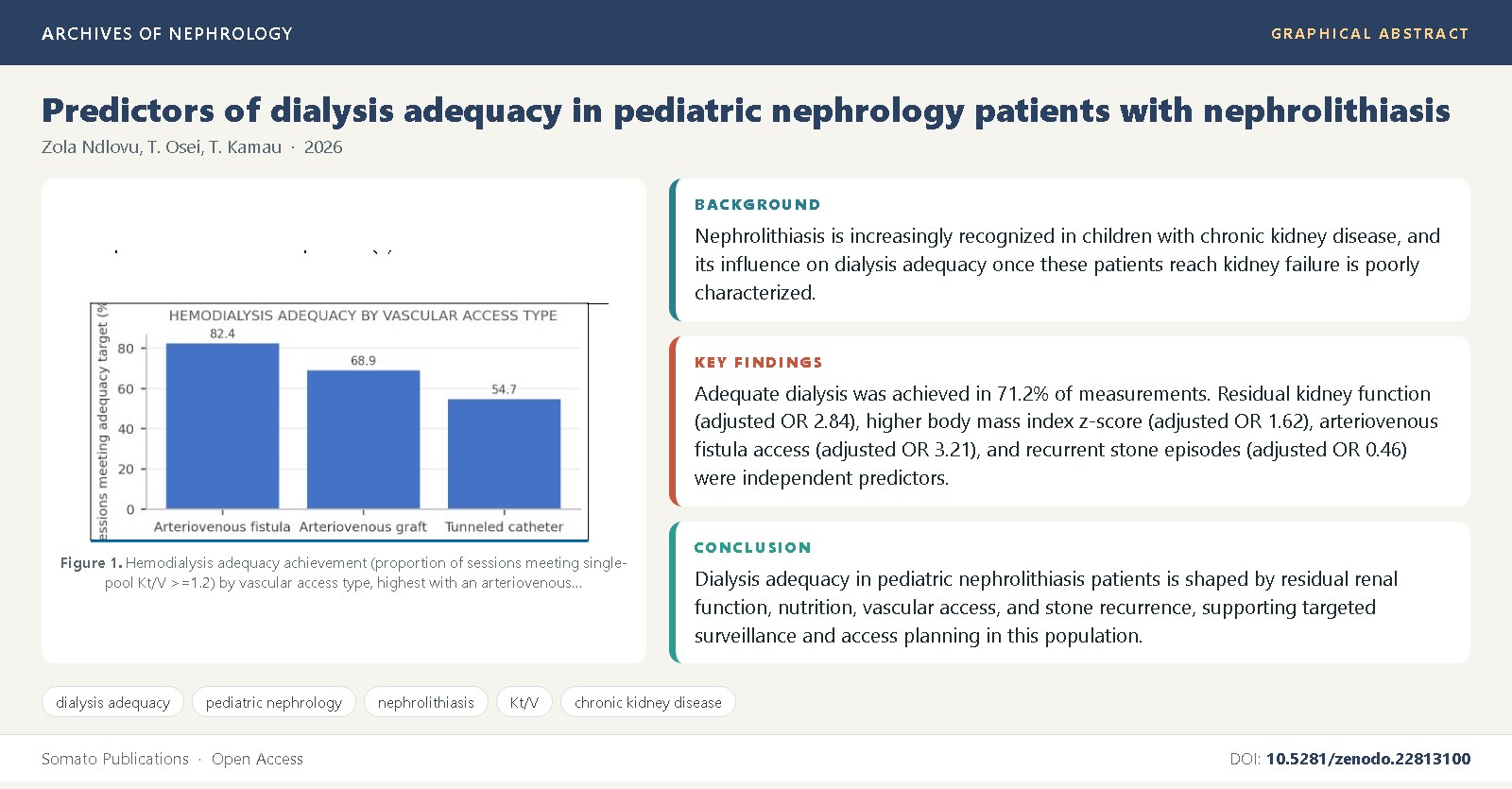
Background: Nephrolithiasis is increasingly recognized in children with chronic kidney disease, and its influence on dialysis adequacy once these patients reach kidney failure is poorly characterized.
Objective: To identify predictors of dialysis adequacy, defined by Kt/V and normalized protein catabolic rate, in pediatric patients with nephrolithiasis on chronic dialysis.
Methods: Retrospective cohort of 118 pediatric dialysis patients (74 hemodialysis, 44 peritoneal dialysis) with confirmed nephrolithiasis across three centers (2019-2025). Adequacy was assessed for 12 months; multivariable regression identified independent predictors.
Results: Adequate dialysis was achieved in 71.2% of measurements. Residual kidney function (adjusted OR 2.84), higher body mass index z-score (adjusted OR 1.62), arteriovenous fistula access (adjusted OR 3.21), and recurrent stone episodes (adjusted OR 0.46) were independent predictors. Bicarbonate and normalized protein catabolic rate correlated positively with achieved Kt/V (r=0.41, r=0.53; p<0.001).
Conclusion: Dialysis adequacy in pediatric nephrolithiasis patients is shaped by residual renal function, nutrition, vascular access, and stone recurrence, supporting targeted surveillance and access planning in this population.
References
Tasian, G.E., Ross, M.E., Song, L., Sas, D.J., Keren, R., Denburg, M.R., et al. (2016) Annual incidence of nephrolithiasis among children and adults in South Carolina from 1997 to 2012. Clinical Journal of the American Society of Nephrology, 11(3): 488-496.
Copelovitch, L., Kaplan, B.S. (2008) Urolithiasis in children: pathogenesis, presentation and management. Pediatric Nephrology, 23(11): 2119-2126.
Cochat, P., Rumsby, G. (2013) Primary hyperoxaluria. New England Journal of Medicine, 369(7): 649-658.
Halbritter, J., Baum, M., Hynes, A.M., Rice, S.J., Thwaites, D.T., Simpson, M.A., et al. (2015) Fourth-generation urine-based next-generation sequencing gene panel for hereditary kidney stone disease. Journal of the American Society of Nephrology, 26(3): 543-551.
Alexander, R.T., Hemmelgarn, B.R., Wiebe, N., Bello, A., Morgan, C., Samuel, S., et al. (2012) Kidney stones and kidney function loss: a cohort study. BMJ, 345: e5287.
VanDeVoorde, R.G. (2011) Urolithiasis in children. Pediatric Clinics of North America, 58(2): 359-372.
Gotch, F.A., Sargent, J.A. (1985) A mechanistic analysis of the National Cooperative Dialysis Study (NCDS). Kidney International, 28(3): 526-534.
North American Pediatric Renal Trials and Collaborative Studies. (2014) NAPRTCS 2014 Annual Dialysis Report. NAPRTCS, Rockville, MD.
National Kidney Foundation. (2006) KDOQI clinical practice guidelines for hemodialysis adequacy, update 2006. American Journal of Kidney Diseases, 48(Suppl 1): S2-S90.
National Kidney Foundation. (2006) KDOQI clinical practice guidelines for peritoneal dialysis adequacy, update 2006. American Journal of Kidney Diseases, 48(Suppl 1): S91-S157.
Fischbach, M., Warady, B.A. (2009) Peritoneal dialysis prescription in children: bedside principles for optimal practice. Pediatric Nephrology, 24(9): 1633-1642.
Sas, D.J. (2018) An update on the changing epidemiology and metabolic risk factors in pediatric kidney stone disease. Clinical Journal of the American Society of Nephrology, 6(8): 2062-2068.
Milliner, D.S., Murphy, M.E. (1993) Urolithiasis in pediatric patients. Mayo Clinic Proceedings, 68(3): 241-248.
Warady, B.A., Chadha, V. (2007) Chronic kidney disease in children: the global perspective. Pediatric Nephrology, 22(12): 1999-2009.
Furth, S.L., Hwang, W., Yang, C., Neu, A.M., Fivush, B.A., Powe, N.R. (2002) Growth failure, risk of hospitalization and death for children with end-stage renal disease. Pediatric Nephrology, 17(6): 450-455.
Chand, D.H., Valentini, R.P. (2008) International pediatric fistula first initiative: a call to action. American Journal of Kidney Diseases, 51(6): 1016-1024.
Schmitt, C.P., Bakkaloglu, S.A., Klaus, G., Schroder, C., Fischbach, M. (2011) Solute and fluid removal in children on chronic peritoneal dialysis. Pediatric Nephrology, 26(7): 1001-1009.
Watson, A.R., Coleman, J.E., Warady, B.A. (2012) When and how to use nutritional supplements in children on dialysis. Peritoneal Dialysis International, 32(Suppl 2): S192-S196.
Bakkaloglu, S.A., Bacchetta, J., Lalayiannis, A.D., Leonard, M.B., Shroff, R., Group, E.S.C.M.B.D.W. (2021) Bone evaluation in paediatric chronic kidney disease: clinical practice points from the European Society for Paediatric Nephrology CKD-MBD and Dialysis working groups. Pediatric Nephrology, 36(9): 2937-2949.
Chesney, R.W. (2016) The role of nutrition in growth and metabolic bone disease in children with chronic kidney disease. Pediatric Nephrology, 31(6): 891-899.
Fischbach, M., Edefonti, A., Schroder, C., Watson, A. (2005) Hemodialysis in children: general practical guidelines. Pediatric Nephrology, 20(8): 1054-1066.
Bunchman, T.E. (2001) Chronic dialysis in the infant less than 1 year of age. Pediatric Nephrology, 16(3): 289-290.
Foster, B.J., Leonard, M.B. (2004) Nutrition in children with kidney disease: pitfalls of tradition. Blood Purification, 22(1): 72-76.
National Kidney Foundation. (2009) KDOQI clinical practice guideline for nutrition in children with CKD: 2008 update. American Journal of Kidney Diseases, 53(3 Suppl 2): S1-S123.
Ledermann, S.E., Scanes, M.E., Fernando, O.N., Duffy, P.G., Madden, S.J., Trompeter, R.S. (2000) Long-term outcome of peritoneal dialysis in infants. Journal of Pediatrics, 136(1): 24-29.
Mak, R.H., Ikizler, T.A., Kovesdy, C.P., Raj, D.S., Kalantar-Zadeh, K., Kopple, J.D. (2011) Wasting in chronic kidney disease. Journal of Cachexia, Sarcopenia and Muscle, 2(1): 9-25.
Zurowska, A.M., Fischbach, M., Watson, A.R., Edefonti, A., Stefanidis, C.J. (2013) Clinical practice recommendations for the care of infants with stage 5 chronic kidney disease. Pediatric Nephrology, 28(9): 1739-1748.
Fischbach, M., Terzic, J., Menouer, S., Provot, E., Bergere, V. (2005) Hemodiafiltration in children: nutritional and metabolic effects. Pediatric Nephrology, 20(11): 1636-1638.
Tasian, G.E., Copelovitch, L. (2014) Evaluation and medical management of kidney stones in children. Journal of Urology, 192(5): 1329-1336.
Copelovitch, L. (2012) Urolithiasis in children: medical approach. Pediatric Clinics of North America, 59(4): 881-896.
Hoppe, B., Kemper, M.J. (2010) Diagnostic examination of the child with urolithiasis or nephrocalcinosis. Pediatric Nephrology, 25(3): 403-413.
Groothoff, J.W., Gruppen, M.P., Offringa, M., Hutten, J., Lilien, M.R., Van De Kar, N.J., et al. (2002) Mortality and causes of death of end-stage renal disease in children: a Dutch cohort study. Kidney International, 61(2): 621-629.
Warady, B.A., Bakkaloglu, S., Newland, J., Cantwell, M., Verrina, E., Neu, A., et al. (2012) Consensus guidelines for the prevention and treatment of catheter-related infections and peritonitis in pediatric patients receiving peritoneal dialysis: 2012 update. Peritoneal Dialysis International, 32(6): 610-624.

Published
Issue
Section
License
Copyright (c) 2026 Zola Ndlovu, et al.

This work is licensed under a Creative Commons Attribution 4.0 International License.


