
Clinical Outcomes of kidney transplantation in Patients with acute kidney injury
DOI:
https://doi.org/10.5281/zenodo.22813078Keywords:
acute kidney injury, kidney transplantation, delayed graft function, graft survival, machine perfusionAbstract
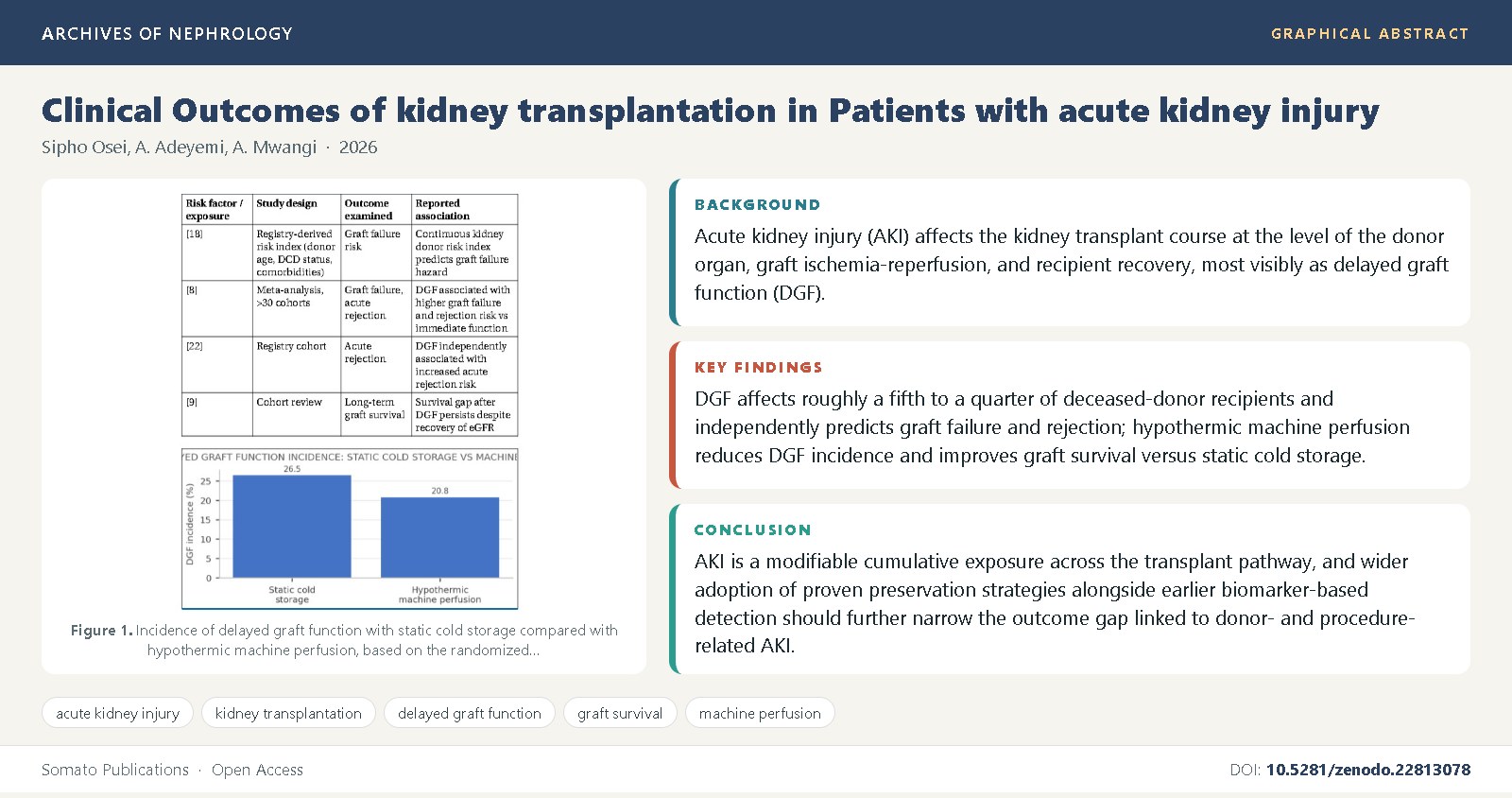
Background: Acute kidney injury (AKI) affects the kidney transplant course at the level of the donor organ, graft ischemia-reperfusion, and recipient recovery, most visibly as delayed graft function (DGF).
Objective: This review synthesizes how donor-, graft-, and recipient-level AKI shape graft and patient outcomes after kidney transplantation and what interventions modify that relationship.
Methods: We conducted a narrative synthesis of AKI definition and epidemiology studies, transplant-specific DGF literature, machine perfusion trials, and tubular injury biomarker studies.
Findings: DGF affects roughly a fifth to a quarter of deceased-donor recipients and independently predicts graft failure and rejection; hypothermic machine perfusion reduces DGF incidence and improves graft survival versus static cold storage, while transplantation still outperforms dialysis on overall survival despite the added early risk.
Conclusions: AKI is a modifiable cumulative exposure across the transplant pathway, and wider adoption of proven preservation strategies alongside earlier biomarker-based detection should further narrow the outcome gap linked to donor- and procedure-related AKI.
References
Bellomo, R., Ronco, C., Kellum, J.A., Mehta, R.L., Palevsky, P. (2004) Acute renal failure - definition, outcome measures, animal models, fluid therapy and information technology needs: the Second International Consensus Conference of the Acute Dialysis Quality Initiative (ADQI) Group. Critical Care, 8(4): R204-212. DOI: 10.1186/cc2872
Mehta, R.L., Kellum, J.A., Shah, S.V., Molitoris, B.A., Ronco, C., Warnock, D.G., Levin, A. (2007) Acute Kidney Injury Network: report of an initiative to improve outcomes in acute kidney injury. Critical Care, 11(2): R31. DOI: 10.1186/cc5713
Kidney Disease: Improving Global Outcomes (KDIGO) Acute Kidney Injury Work Group. (2012) KDIGO Clinical Practice Guideline for Acute Kidney Injury. Kidney International Supplements, 2(1): 1-138. DOI: 10.1038/kisup.2012.1
Bellomo, R., Kellum, J.A., Ronco, C. (2012) Acute kidney injury. The Lancet, 380(9843): 756-766. DOI: 10.1016/S0140-6736(11)61454-2
Perico, N., Cattaneo, D., Sayegh, M.H., Remuzzi, G. (2004) Delayed graft function in kidney transplantation. The Lancet, 364(9447): 1814-1827. DOI: 10.1016/S0140-6736(04)17406-0
Mallon, D.H., Summers, D.M., Bradley, J.A., Pettigrew, G.J. (2013) Defining delayed graft function after renal transplantation: simplifying the approach to a complex problem. Transplantation, 96(10): 885-889. DOI: 10.1097/TP.0b013e3182a19348
Ojo, A.O., Wolfe, R.A., Held, P.J., Port, F.K., Schmouder, R.L. (1997) Delayed graft function: risk factors and implications for renal allograft survival. Transplantation, 63(7): 968-974. DOI: 10.1097/00007890-199704150-00011
Yarlagadda, S.G., Coca, S.G., Formica, R.N. Jr, Poggio, E.D., Parikh, C.R. (2009) Association between delayed graft function and allograft and patient survival: a systematic review and meta-analysis. Nephrology Dialysis Transplantation, 24(3): 1039-1047. DOI: 10.1093/ndt/gfn667
Siedlecki, A., Irish, W., Brennan, D.C. (2011) Delayed graft function in the kidney transplant. American Journal of Transplantation, 11(11): 2279-2296. DOI:
1111/j.1600-6143.2011.03754.x 10. Zhao, H., Alam, A., Soo, A.P., George, A.J.T., Ma, D. (2018) Ischemia-reperfusion injury reduces long term renal graft survival: mechanism and beyond. EBioMedicine, 28: 31-42. DOI: 10.1016/j.ebiom.2018.01.025
Salvadori, M., Rosso, G., Bertoni, E. (2015) Update on ischemia-reperfusion injury in kidney transplantation: pathogenesis and treatment. World Journal of Transplantation, 5(2): 52-67. DOI: 10.5500/wjt.v5.i2.52
Chertow, G.M., Burdick, E., Honour, M., Bonventre, J.V., Bates, D.W. (2005) Acute kidney injury, mortality, length of stay, and costs in hospitalized patients. Journal of the American Society of Nephrology, 16(11): 3365-3370. DOI: 10.1681/ASN.2004090740
Coca, S.G., Singanamala, S., Parikh, C.R. (2012) Chronic kidney disease after acute kidney injury: a systematic review and meta-analysis. Kidney International, 81(5): 442-448. DOI: 10.1038/ki.2011.379
Susantitaphong, P., Cruz, D.N., Cerda, J., Abulfaraj, M., Alqahtani, F., Koulouridis, I., Jaber, B.L. (2013) World incidence of AKI: a meta-analysis. Clinical Journal of the American Society of Nephrology, 8(9): 1482-1493. DOI: 10.2215/CJN.00710113
Levey, A.S., James, M.T. (2017) Acute kidney injury. Annals of Internal Medicine, 167(9): ITC66-ITC80. DOI: 10.7326/AITC201711070
Kellum, J.A., Lameire, N. (2013) Diagnosis, evaluation, and management of acute kidney injury: a KDIGO summary (Part 1). Critical Care, 17(1): 204. DOI: 10.1186/cc11454
Moore, P.K., Hsu, R.K., Liu, K.D. (2018) Management of acute kidney injury: core curriculum 2018. American Journal of Kidney Diseases, 72(1): 136-148. DOI: 10.1053/j.ajkd.2017.11.021
Rao, P.S., Schaubel, D.E., Guidinger, M.K., Andreoni, K.A., Wolfe, R.A., Merion, R.M., Port, F.K., Sung, R.S. (2009) A comprehensive risk quantification score for deceased donor kidneys: the kidney donor risk index. Transplantation, 88(2): 231-236. DOI: 10.1097/TP.0b013e3181ac620b
Schold, J.D., Kaplan, B., Baliga, R.S., Meier-Kriesche, H.U. (2005) The broad spectrum of quality in deceased donor kidneys. American Journal of Transplantation, 5(4 Pt 1): 757-765. DOI: 10.1111/j.1600-6143.2005.00768.x
Moers, C., Smits, J.M., Maathuis, M.H., Treckmann, J., van Gelder, F., Napieralski, B.P., et al. (2009) Machine perfusion or cold storage in deceased-donor kidney transplantation. New England Journal of Medicine, 360(1): 7-19. DOI: 10.1056/NEJMoa0802289
O'Callaghan, J.M., Morgan, R.D., Knight, S.R., Morris, P.J. (2013) Systematic review and meta-analysis of hypothermic machine perfusion versus static cold storage of kidney allografts on transplant outcomes. British Journal of Surgery, 100(8): 991-1001. DOI: 10.1002/bjs.9169
Wu, W.K., Famure, O., Li, Y., Kim, S.J. (2015) Delayed graft function and the risk of acute rejection in the modern era of kidney transplantation. Kidney International, 88(4): 851-858. DOI: 10.1038/ki.2015.190
Schroppel, B., Legendre, C. (2014) Delayed kidney graft function: from mechanism to translation. Kidney International, 86(2): 251-258. DOI: 10.1038/ki.2014.18
Hosgood, S.A., Nicholson, M.L. (2011) First in man renal transplantation after ex vivo normothermic perfusion. Transplantation, 92(7): 735-738. DOI: 10.1097/TP.0b013e31822d4e04
Nicholson, M.L., Hosgood, S.A. (2013) Renal transplantation after ex vivo normothermic perfusion: the first clinical study. American Journal of Transplantation, 13(5): 1246-1252. DOI: 10.1111/ajt.12179
Kaballo, M.A., Canney, M., O'Kelly, P., Williams, Y., O'Seaghdha, C.M., Conlon, P.J. (2018) A comparative analysis of survival of patients on dialysis and after kidney transplantation. Clinical Kidney Journal, 11(3): 389-393. DOI: 10.1093/ckj/sfx117
Lodhi, S.A., Lamb, K.E., Meier-Kriesche, H.U. (2011) Solid organ allograft survival improvement in the United States: the long-term does not mirror the dramatic short-term success. American Journal of Transplantation, 11(6): 1226-1235. DOI: 10.1111/j.1600-6143.2011.03539.x
Sellares, J., de Freitas, D.G., Mengel, M., Reeve, J., Einecke, G., Sis, B., et al. (2012) Understanding the causes of kidney transplant failure: the dominant role of antibody-mediated rejection and nonadherence. American Journal of Transplantation, 12(2): 388-399. DOI: 10.1111/j.1600-6143.2011.03840.x
Halloran, P.F. (2004) Immunosuppressive drugs for kidney transplantation. New England Journal of Medicine, 351(26): 2715-2729. DOI: 10.1056/NEJMra033540
Legendre, C., Canaud, G., Martinez, F. (2014) Factors influencing long-term outcome after kidney transplantation. Transplant International, 27(1): 19-27. DOI: 10.1111/tri.12217
Devarajan, P. (2008) Neutrophil gelatinase-associated lipocalin (NGAL): a new marker of kidney disease. Scandinavian Journal of Clinical and Laboratory Investigation Supplementum, 241: 89-94. DOI: 10.1080/00365510802150158
Han, W.K., Bailly, V., Abichandani, R., Thadhani, R., Bonventre, J.V. (2002) Kidney Injury Molecule-1 (KIM-1): a novel biomarker for human renal proximal tubule injury. Kidney International, 62(1): 237-244. DOI: 10.1046/j.1523-1755.2002.00433.x
Parikh, C.R., Jani, A., Melnikov, V.Y., Faubel, S., Edelstein, C.L. (2004) Urinary interleukin-18 is a marker of human acute tubular necrosis. American Journal of Kidney Diseases, 43(3): 405-414. DOI: 10.1053/j.ajkd.2003.10.040
Nashan, B., Abbud-Filho, M., Citterio, F. (2016) Prediction, prevention, and management of delayed graft function: where are we now? Clinical Transplantation, 30(10): 1198-1208. DOI: 10.1111/ctr.12832

Published
Issue
Section
License
Copyright (c) 2026 Sipho Osei, et al.

This work is licensed under a Creative Commons Attribution 4.0 International License.


