
Long-Term Follow-Up of peritoneal dialysis for diabetic nephropathy
DOI:
https://doi.org/10.5281/zenodo.22813031Keywords:
peritoneal dialysis, diabetic nephropathy, technique survival, peritonitis, residual renal functionAbstract
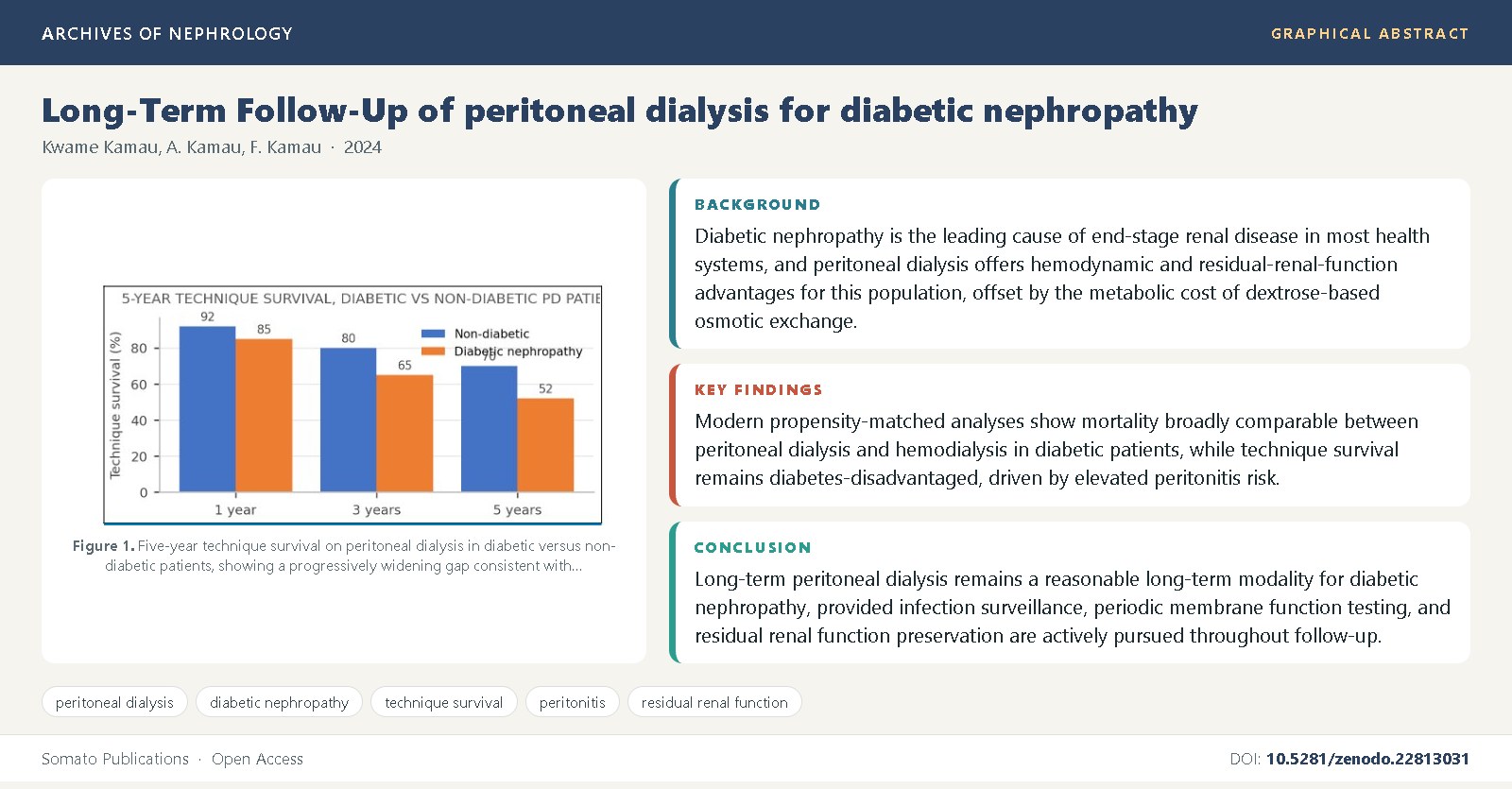
Background: Diabetic nephropathy is the leading cause of end-stage renal disease in most health systems, and peritoneal dialysis offers hemodynamic and residual-renal-function advantages for this population, offset by the metabolic cost of dextrose-based osmotic exchange.
Objective: This review synthesizes long-term follow-up evidence on peritoneal dialysis outcomes in diabetic nephropathy across patient and technique survival, peritonitis risk, metabolic and membrane change, and cardiovascular outcomes.
Methods: We synthesized cohort studies, national and multinational renal registry analyses, randomized trials of peritoneal dialysis solutions, and systematic reviews reporting diabetes-stratified peritoneal dialysis outcomes over multi-year follow-up.
Findings: Modern propensity-matched analyses show mortality broadly comparable between peritoneal dialysis and hemodialysis in diabetic patients, while technique survival remains diabetes-disadvantaged, driven by elevated peritonitis risk and progressive glucose-exposure-related peritoneal membrane change that erodes ultrafiltration capacity; glucose-sparing strategies such as icodextrin help preserve ultrafiltration over time.
Conclusions: Long-term peritoneal dialysis remains a reasonable long-term modality for diabetic nephropathy, provided infection surveillance, periodic membrane function testing, and residual renal function preservation are actively pursued throughout follow-up.
References
Gregg, E.W., Li, Y., Wang, J., Rios Burrows, N., Ali, M.K., Rolka, D., et al. (2014) Changes in diabetes-related complications in the United States, 1990-2010. New England Journal of Medicine, 370(16): 1514-1523. DOI: 10.1056/NEJMoa1310799
Afkarian, M., Zelnick, L.R., Hall, Y.N., Heagerty, P.J., Tuttle, K., Weiss, N.S., et al. (2016) Clinical manifestations of kidney disease among US adults with diabetes, 1988-2014. JAMA, 316(6): 602-610. DOI: 10.1001/jama.2016.10924
de Boer, I.H., Rue, T.C., Hall, Y.N., Heagerty, P.J., Weiss, N.S., Himmelfarb, J. (2011) Temporal trends in the prevalence of diabetic kidney disease in the United States. JAMA, 305(24): 2532-2539. DOI: 10.1001/jama.2011.861
American Diabetes Association. (2014) Diabetic kidney disease: a report from an ADA Consensus Conference. Diabetes Care, 37(10): 2864-2883. DOI: 10.2337/dc14-1296
Zoccali, C., Mallamaci, F. (2013) Diabetic nephropathy: many faces, one disease. Nephron Clinical Practice, 124(1-2): 68-72. DOI: 10.1159/000355538
Li, P.K., Chow, K.M., Van de Luijtgaarden, M.W., Johnson, D.W., Jager, K.J., Mehrotra, R., et al. (2017) Changes in the worldwide epidemiology of peritoneal dialysis. Nature Reviews Nephrology, 13(2): 90-103. DOI: 10.1038/nrneph.2016.181
Mehrotra, R., Devuyst, O., Davies, S.J., Johnson, D.W. (2016) The current state of peritoneal dialysis. Journal of the American Society of Nephrology, 27(11): 3238-3252. DOI: 10.1681/ASN.2016010112
Vonesh, E.F., Snyder, J.J., Foley, R.N., Collins, A.J. (2004) The differential impact of risk factors on mortality in hemodialysis and peritoneal dialysis. Kidney International, 66(6): 2389-2401. DOI: 10.1111/j.1523-1755.2004.00559.x
Termorshuizen, F., Korevaar, J.C., Dekker, F.W., van Manen, J.G., Boeschoten, E.W., Krediet, R.T. (2003) The relative importance of residual renal function compared with peritoneal clearance for patient survival and quality of life: an analysis of the Netherlands Cooperative Study on the Adequacy of Dialysis (NECOSAD)-2. American Journal of Kidney Diseases, 41(6): 1293-1302.
Davies, S.J., Phillips, L., Naish, P.F., Russell, G.I. (2001) Peritoneal glucose exposure and changes in membrane solute transport with time on peritoneal dialysis. Journal of the American Society of Nephrology, 12(5): 1046-1051.
Weinhandl, E.D., Foley, R.N., Gilbertson, D.T., Arneson, T.J., Snyder, J.J., Collins, A.J. (2010) Propensity-matched mortality comparison of incident hemodialysis and peritoneal dialysis patients. Journal of the American Society of Nephrology, 21(3): 499-506. DOI: 10.1681/ASN.2009090904
Mehrotra, R., Chiu, Y.W., Kalantar-Zadeh, K., Bargman, J., Vonesh, E. (2011) Similar outcomes with hemodialysis and peritoneal dialysis in patients with end-stage renal disease. Archives of Internal Medicine, 171(2): 110-118. DOI: 10.1001/archinternmed.2011.113
CANUSA Peritoneal Dialysis Study Group. (1996) Adequacy of dialysis and nutrition in continuous peritoneal dialysis: association with clinical outcomes. Journal of the American Society of Nephrology, 7(2): 198-207.
Krediet, R.T., Balafa, O. (2010) Cardiovascular risk in the peritoneal dialysis patient. Nature Reviews Nephrology, 6(8): 451-460. DOI: 10.1038/nrneph.2010.68
Rabindranath, K.S., Adams, J., Ali, T.Z., Daly, C., Vale, L., Macleod, A.M., et al. (2007) Continuous ambulatory peritoneal dialysis versus automated peritoneal dialysis for end-stage renal disease. Cochrane Database of Systematic Reviews, (2): CD006515. DOI: 10.1002/14651858.CD006515
Fenton, S.S., Schaubel, D.E., Desmeules, M., Morrison, H.I., Mao, Y., Copleston, P., et al. (1997) Hemodialysis versus peritoneal dialysis: a comparison of adjusted mortality rates. American Journal of Kidney Diseases, 30(3): 334-342.
Heaf, J.G., Løkkegaard, H., Madsen, M. (2002) Initial survival advantage in peritoneal dialysis. Nephrology Dialysis Transplantation, 17(1): 112-117.
Jaar, B.G., Coresh, J., Plantinga, L.C., Fink, N.E., Klag, M.J., Levey, A.S., et al. (2005) Comparing the risk for death with peritoneal dialysis and hemodialysis in a national cohort of patients with chronic kidney disease. Annals of Internal Medicine, 143(3): 174-183. DOI: 10.7326/0003-4819-143-3-200508020-00005
Yeates, K., Zhu, N., Vonesh, E., Trpeski, L., Blake, P., Fenton, S. (2012) Hemodialysis and peritoneal dialysis are associated with similar outcomes for end-stage renal disease treatment in Canada. Nephrology Dialysis Transplantation, 27(9): 3568-3575. DOI: 10.1093/ndt/gfr197
Fried, L., Bernardini, J., Piraino, B. (2001) Charlson comorbidity index as a predictor of outcomes in incident peritoneal dialysis patients. American Journal of Kidney Diseases, 37(2): 337-342.
Chow, K.M., Szeto, C.C., Leung, C.B., Kwan, B.C., Wang, A.Y., Li, P.K. (2005) A risk analysis of continuous ambulatory peritoneal dialysis-related peritonitis. Peritoneal Dialysis International, 25(4): 374-379.
Nessim, S.J., Bargman, J.M., Austin, P.C., Nisenbaum, R., Jassal, S.V. (2009) Predictors of peritonitis in patients on peritoneal dialysis: results of a large, prospective Canadian database. Clinical Journal of the American Society of Nephrology, 4(7): 1195-1200. DOI: 10.2215/CJN.06060809
Piraino, B., Bernardini, J., Brown, E., Figueiredo, A., Johnson, D.W., Lye, W.C., et al. (2011) ISPD position statement on reducing the risks of peritoneal dialysis-related infections. Peritoneal Dialysis International, 31(6): 614-630. DOI: 10.3747/pdi.2011.00040
Li, P.K., Szeto, C.C., Piraino, B., de Arteaga, J., Fan, S., Figueiredo, A.E., et al. (2016) ISPD peritonitis recommendations: 2016 update on prevention and treatment. Peritoneal Dialysis International, 36(5): 481-508. DOI: 10.3747/pdi.2016.00078
Szeto, C.C., Chow, K.M., Wong, T.Y., Leung, C.B., Wang, A.Y., Lui, S.F., et al. (2002) Feasibility of resuming peritoneal dialysis after severe peritonitis and Tenckhoff catheter removal. Journal of the American Society of Nephrology, 13(4): 1040-1045.
Davies, S.J., Woodrow, G., Donovan, K., Plum, J., Williams, P., Johansson, A.C., et al. (2003) Icodextrin improves the fluid status of peritoneal dialysis patients: results of a double-blind randomized controlled trial. Journal of the American Society of Nephrology, 14(9): 2338-2344. DOI: 10.1097/01.ASN.0000083904.12234.27
Wolfson, M., Piraino, B., Hamburger, R.J., Morton, A.R. (2002) A randomized controlled trial to evaluate the efficacy and safety of icodextrin in peritoneal dialysis. American Journal of Kidney Diseases, 40(5): 1055-1065.
Frampton, J.E., Plosker, G.L. (2003) Icodextrin: a review of its use in peritoneal dialysis. Drugs, 63(19): 2079-2103.
Bargman, J.M., Thorpe, K.E., Churchill, D.N. (2001) Relative contribution of residual renal function and peritoneal clearance to adequacy of dialysis: a reanalysis of the CANUSA study. Journal of the American Society of Nephrology, 12(10): 2158-2162.
Wang, A.Y., Wang, M., Woo, J., Lam, C.W., Li, P.K., Lui, S.F., et al. (2002) A novel association between residual renal function and left ventricular hypertrophy in peritoneal dialysis patients. Kidney International, 62(2): 639-647.
Van Biesen, W., Williams, J.D., Covic, A.C., Fan, S., Claes, K., Lichodziejewska-Niemierko, M., et al. (2011) Fluid status in peritoneal dialysis patients: the European Body Composition Monitoring (EuroBCM) study cohort. PLoS One, 6(2): e17148. DOI: 10.1371/journal.pone.0017148

Published
Issue
Section
License
Copyright (c) 2024 Kwame Kamau, et al.

This work is licensed under a Creative Commons Attribution 4.0 International License.


