
Long-Term Follow-Up of peritoneal dialysis for chronic kidney disease
DOI:
https://doi.org/10.5281/zenodo.22812987Keywords:
peritoneal dialysis, chronic kidney disease, technique survival, peritonitis, peritoneal membrane transportAbstract
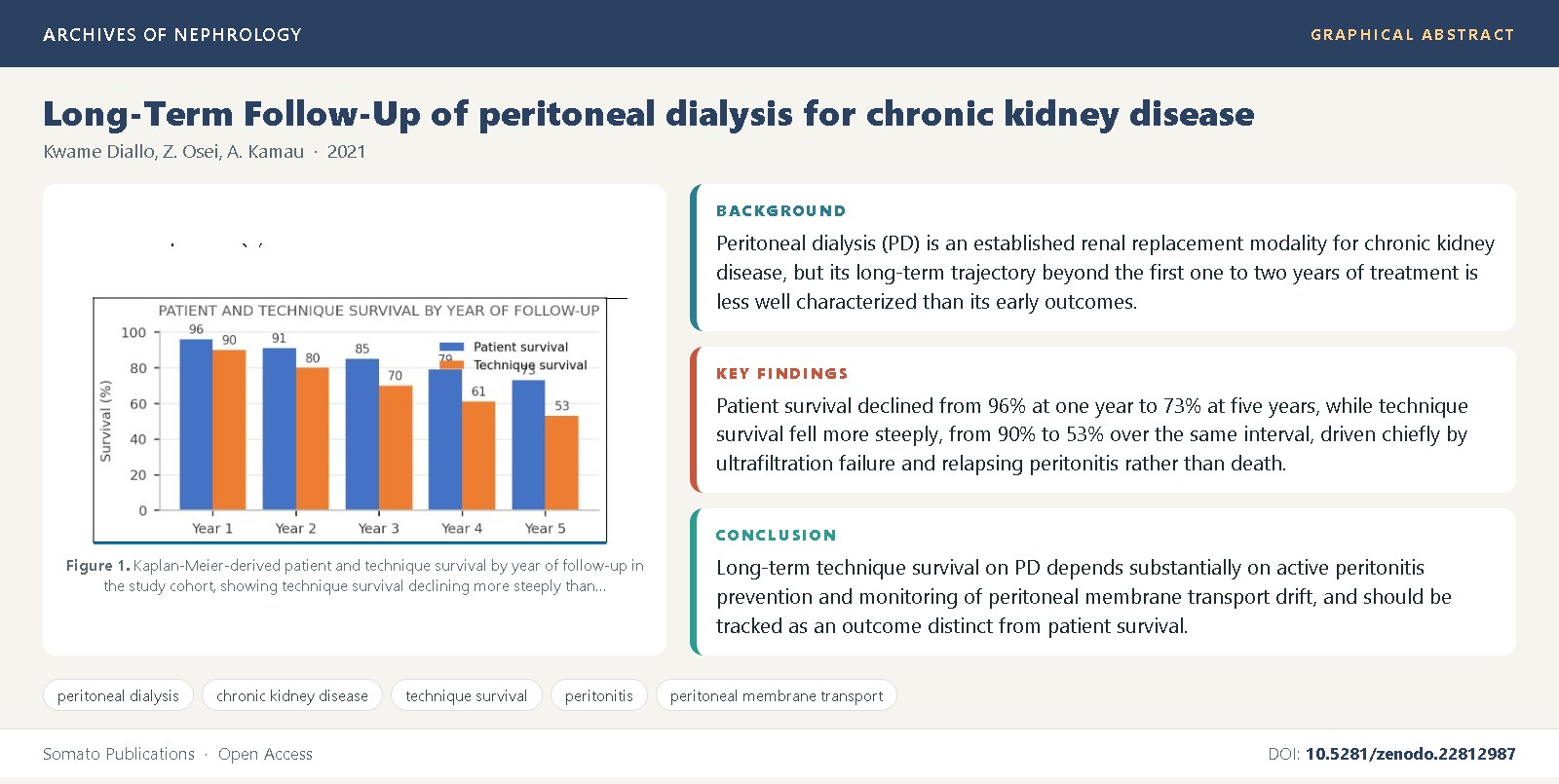
Background: Peritoneal dialysis (PD) is an established renal replacement modality for chronic kidney disease, but its long-term trajectory beyond the first one to two years of treatment is less well characterized than its early outcomes.
Objective: This study reports a long-term, single-center follow-up of adults treated with PD for chronic kidney disease, describing patient and technique survival, peritonitis incidence, and peritoneal membrane transport drift over a five-year observation window.
Methods: A retrospective cohort of 148 adults beginning continuous ambulatory or automated PD was followed for up to five years, with peritoneal transport status assessed by standardized equilibration testing and peritonitis defined and managed according to prevailing society guidance.
Results: Patient survival declined from 96% at one year to 73% at five years, while technique survival fell more steeply, from 90% to 53% over the same interval, driven chiefly by ultrafiltration failure and relapsing peritonitis rather than death. Peritonitis incidence rose from 0.32 to 0.61 episodes per patient-year, and membrane transport drifted toward higher solute transport in patients with a peritonitis history.
Conclusion: Long-term technique survival on PD depends substantially on active peritonitis prevention and monitoring of peritoneal membrane transport drift, and should be tracked as an outcome distinct from patient survival.
References
Li PK, Chow KM, Van de Luijtgaarden MW, et al. (2017) Changes in the worldwide epidemiology of peritoneal dialysis. Nature Reviews Nephrology, 13(2): 90-103.
Mehrotra R, Devuyst O, Davies SJ, Johnson DW. (2016) The current state of peritoneal dialysis. Journal of the American Society of Nephrology, 27(11): 3238-3252.
Van Biesen W, Vanholder R, Lameire N. (2000) The role of peritoneal dialysis as the first-line renal replacement modality. Peritoneal Dialysis International, 20(4): 375-383.
Chaudhary K, Sangha H, Khanna R. (2011) Peritoneal dialysis first: rationale. Clinical Journal of the American Society of Nephrology, 6(2): 447-456.
Jain AK, Blake P, Cordy P, Garg AX. (2012) Global trends in rates of peritoneal dialysis. Journal of the American Society of Nephrology, 23(3): 533-544.
Davies SJ, Phillips L, Naish PF, Russell GI. (2001) Peritoneal glucose exposure and changes in membrane solute transport with time on peritoneal dialysis. Journal of the American Society of Nephrology, 12(5): 1046-1051.
Krediet RT, Lindholm B, Rippe B. (2000) Pathophysiology of peritoneal membrane failure. Peritoneal Dialysis International, 20(Suppl 4): S22-S42.
Churchill DN, Taylor DW, Keshaviah PR. (1996) Adequacy of dialysis and nutrition in continuous peritoneal dialysis: association with clinical outcomes. Journal of the American Society of Nephrology, 7(2): 198-207.
Paniagua R, Amato D, Vonesh E, et al. (2002) Effects of increased peritoneal clearances on mortality rates in peritoneal dialysis: ADEMEX, a prospective, randomized, controlled trial. Journal of the American Society of Nephrology, 13(5): 1307-1320.
Bargman JM, Thorpe KE, Churchill DN. (2001) Relative contribution of residual renal function and peritoneal clearance to adequacy of dialysis: a reanalysis of the CANUSA study. Journal of the American Society of Nephrology, 12(10): 2158-2162.
Twardowski ZJ, Nolph KD, Khanna R, et al. (1987) Peritoneal equilibration test. Peritoneal Dialysis Bulletin, 7(3): 138-147.
Rippe B, Venturoli D, Simonsen O, de Arteaga J. (2004) Fluid and electrolyte transport across the peritoneal membrane during CAPD according to the three-pore model. Peritoneal Dialysis International, 24(1): 10-27.
Li PK, Szeto CC, Piraino B, et al. (2016) ISPD peritonitis recommendations: 2016 update on prevention and treatment. Peritoneal Dialysis International, 36(5): 481-508.
Piraino B, Bailie GR, Bernardini J, et al. (2005) Peritoneal dialysis-related infections recommendations: 2005 update. Peritoneal Dialysis International, 25(2): 107-131.
Fried LF, Bernardini J, Piraino B. (2001) Charlson comorbidity index as a predictor of outcomes in incident peritoneal dialysis patients. American Journal of Kidney Diseases, 37(2): 337-342.
Kolesnyk I, Dekker FW, Boeschoten EW, Krediet RT. (2010) Time-dependent reasons for peritoneal dialysis technique failure and mortality. Peritoneal Dialysis International, 30(2): 170-177.
Guo A, Mujais S. (2003) Patient and technique survival on peritoneal dialysis in the United States: evaluation in large incident cohorts. Kidney International Supplements, 64(88): S3-S12.
Mujais S, Story K. (2006) Peritoneal dialysis in the US: evaluation of outcomes in contemporary cohorts. Kidney International Supplements, 70(103): S21-S26.
Korevaar JC, Feith GW, Dekker FW, et al. (2003) Effect of starting with hemodialysis compared with peritoneal dialysis in patients new on dialysis treatment: a randomized controlled trial. Kidney International, 64(6): 2222-2228.
Vonesh EF, Snyder JJ, Foley RN, Collins AJ. (2004) The differential impact of risk factors on mortality in hemodialysis and peritoneal dialysis. Kidney International, 66(6): 2389-2401.
Weinhandl ED, Foley RN, Gilbertson DT, et al. (2010) Propensity-matched mortality comparison of incident hemodialysis and peritoneal dialysis patients. Journal of the American Society of Nephrology, 21(3): 499-506.
Mehrotra R, Chiu YW, Kalantar-Zadeh K, Bargman J, Vonesh E. (2011) Similar outcomes with hemodialysis and peritoneal dialysis in patients with end-stage renal disease. Archives of Internal Medicine, 171(2): 110-118.
Boudville N, Kemp A, Clayton P, et al. (2012) Recent peritonitis associates with mortality among patients treated with peritoneal dialysis. Journal of the American Society of Nephrology, 23(8): 1398-1405.
Nessim SJ, Bargman JM, Austin PC, Nisenbaum R, Jassal SV. (2009) Predictors of peritonitis in patients on peritoneal dialysis: results of a large, prospective Canadian database. Clinical Journal of the American Society of Nephrology, 4(7): 1195-1200.
Davies SJ, Phillips L, Griffiths AM, Russell LH, Naish PF, Russell GI. (1998) What really happens to people on long-term peritoneal dialysis? Kidney International, 54(6): 2207-2217.
Heimburger O, Waniewski J, Werynski A, Tranaeus A, Lindholm B. (1990) Peritoneal transport in CAPD patients with permanent loss of ultrafiltration capacity. Kidney International, 38(3): 495-506.
Cho Y, Johnson DW. (2014) Peritoneal dialysis-related peritonitis: towards improving evidence, practices, and outcomes. American Journal of Kidney Diseases, 64(2): 278-289.
Fenton SS, Schaubel DE, Desmeules M, et al. (1997) Hemodialysis versus peritoneal dialysis: a comparison of adjusted mortality rates. American Journal of Kidney Diseases, 30(3): 334-342.
Foley RN, Parfrey PS, Harnett JD, Kent GM, Murray DC, Barre PE. (1998) Mode of dialysis therapy and mortality trends in end-stage renal disease. Journal of the American Society of Nephrology, 9(2): 267-276.
Mailloux LU, Bellucci AG, Wilkes BM, et al. (1991) Mortality in dialysis patients: analysis of the causes of death. American Journal of Kidney Diseases, 18(3): 326-335.
Termorshuizen F, Korevaar JC, Dekker FW, et al. (2003) The relative importance of residual renal function compared with peritoneal clearance for patient survival and quality of life: an analysis of NECOSAD-2. American Journal of Kidney Diseases, 41(6): 1293-1302.
Jansen MA, Termorshuizen F, Korevaar JC, et al. (2005) Predictors of survival in anuric peritoneal dialysis patients. Kidney International, 68(3): 1199-1205.
Lo WK, Ho YW, Li CS, et al. (2003) Effect of Kt/V on survival and clinical outcome in CAPD patients in a randomized prospective study. Kidney International, 64(2): 649-656.
Diaz-Buxo JA, Lowrie EG, Lew NL, Zhang H, Lazarus JM. (1999) Associates of mortality among peritoneal dialysis patients with special reference to peritoneal transport rates and solute clearance. American Journal of Kidney Diseases, 33(3): 523-534.
de Fijter CW, Oe LP, Nauta JJ, et al. (1994) Clinical efficacy and morbidity associated with continuous cyclic compared with continuous ambulatory peritoneal dialysis. Annals of Internal Medicine, 120(4): 264-271.

Published
Issue
Section
License
Copyright (c) 2021 Kwame Diallo, et al.

This work is licensed under a Creative Commons Attribution 4.0 International License.


