
Clinical Outcomes of hemodialysis optimization in Patients with nephrolithiasis
DOI:
https://doi.org/10.5281/zenodo.22812972Keywords:
hemodialysis, nephrolithiasis, dialysis adequacy, mineral metabolism, residual renal functionAbstract
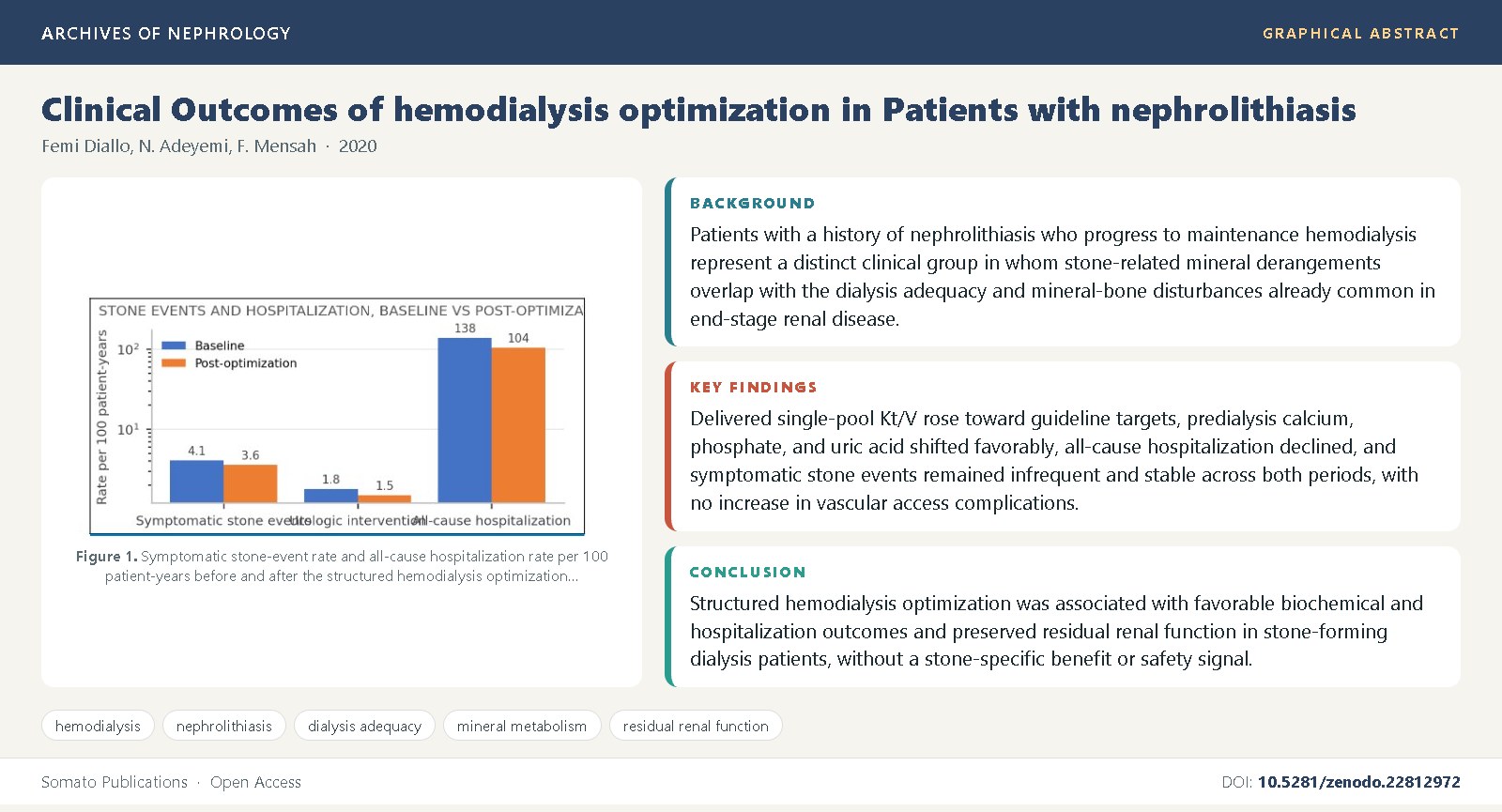
Background: Patients with a history of nephrolithiasis who progress to maintenance hemodialysis represent a distinct clinical group in whom stone-related mineral derangements overlap with the dialysis adequacy and mineral-bone disturbances already common in end-stage renal disease.
Objective: This study evaluated clinical outcomes, symptomatic stone events, biochemical stone-risk markers, residual renal function, and hospitalization, in a hemodialysis cohort with documented nephrolithiasis before and after a structured dialysis-optimization protocol.
Methods: A single-center, retrospective, pre-post cohort analysis compared a 12-month baseline period of conventional thrice-weekly hemodialysis with a 12-month period following optimization of dialysis dose, ultrafiltration rate, and dialysate calcium composition, in patients with imaging-confirmed nephrolithiasis.
Results: Delivered single-pool Kt/V rose toward guideline targets, predialysis calcium, phosphate, and uric acid shifted favorably, all-cause hospitalization declined, and symptomatic stone events remained infrequent and stable across both periods, with no increase in vascular access complications.
Conclusions: Structured hemodialysis optimization was associated with favorable biochemical and hospitalization outcomes and preserved residual renal function in stone-forming dialysis patients, without a stone-specific benefit or safety signal, supporting individualized prescribing pending larger prospective study.
References
Stamatelou KK, Francis ME, Jones CA, Nyberg LM, Curhan GC. (2003) Time trends in reported prevalence of kidney stones in the United States: 1976-1994. Kidney International, 63(5): 1817-1823.
Scales CD Jr, Smith AC, Hanley JM, Saigal CS. (2012) Prevalence of kidney stones in the United States. European Urology, 62(1): 160-165.
Rule AD, Bergstralh EJ, Melton LJ 3rd, Li X, Weaver AL, Lieske JC. (2009) Kidney stones and the risk for chronic kidney disease. Clinical Journal of the American Society of Nephrology, 4(4): 804-811.
Alexander RT, Hemmelgarn BR, Wiebe N, Bello A, Morgan C, Samuel S, et al. (2012) Kidney stones and kidney function loss: a cohort study. BMJ, 345: e5287.
El-Zoghby ZM, Lieske JC, Foley RN, Bergstralh EJ, Li X, Melton LJ 3rd, et al. (2012) Urolithiasis and the risk of ESRD. Clinical Journal of the American Society of Nephrology, 7(9): 1409-1415.
Vupputuri S, Soucie JM, Sandler DP, Scott TA. (2004) History of kidney stones as a possible risk factor for chronic kidney disease. Annals of Epidemiology, 14(3): 222-228.
Keddis MT, Rule AD. (2013) Nephrolithiasis and loss of kidney function. Current Opinion in Nephrology and Hypertension, 22(4): 390-396.
Gotch FA, Sargent JA. (1985) A mechanistic analysis of the National Cooperative Dialysis Study. Kidney International, 28(3): 526-534.
Owen WF Jr, Lew NL, Liu Y, Lowrie EG, Lazarus JM. (1993) The urea reduction ratio and serum albumin concentration as predictors of mortality in patients undergoing hemodialysis. New England Journal of Medicine, 329(14): 1001-1006.
Lowrie EG, Lew NL. (1990) Death risk in hemodialysis patients: the predictive value of commonly measured variables and an evaluation of death rate differences between facilities. American Journal of Kidney Diseases, 15(5): 458-482.
Eknoyan G, Beck GJ, Cheung AK, Daugirdas JT, Greene T, Kusek JW, et al. (2002) Effect of dialysis dose and membrane flux in maintenance hemodialysis. New England Journal of Medicine, 347(25): 2010-2019.
Cheung AK, Levin NW, Greene T, Agodoa L, Bailey J, Beck G, et al. (2003) Effects of high-flux hemodialysis on clinical outcomes: results of the HEMO study. Journal of the American Society of Nephrology, 14(12): 3251-3263.
Held PJ, Port FK, Wolfe RA, Stannard DC, Carroll CE, Daugirdas JT, et al. (1996) The dose of hemodialysis and patient mortality. Kidney International, 50(2): 550-556.
Coe FL, Evan A, Worcester E. (2005) Kidney stone disease. Journal of Clinical Investigation, 115(10): 2598-2608.
Moe OW. (2006) Kidney stones: pathophysiology and medical management. Lancet, 367(9507): 333-344.
Worcester EM, Coe FL. (2010) Clinical practice. Calcium kidney stones. New England Journal of Medicine, 363(10): 954-963.
Sakhaee K, Maalouf NM, Sinnott B. (2012) Clinical review: kidney stones 2012: pathogenesis, diagnosis, and management. Journal of Clinical Endocrinology and Metabolism, 97(6): 1847-1860.
Block GA, Klassen PS, Lazarus JM, Ofsthun N, Lowrie EG, Chertow GM. (2004) Mineral metabolism, mortality, and morbidity in maintenance hemodialysis. Journal of the American Society of Nephrology, 15(8): 2208-2218.
Schwarz S, Trivedi BK, Kalantar-Zadeh K, Kovesdy CP. (2006) Association of disorders in mineral metabolism with progression of chronic kidney disease. Clinical Journal of the American Society of Nephrology, 1(4): 825-831.
Daugirdas JT. (1993) Second generation logarithmic estimates of single-pool variable volume Kt/V: an analysis of error. Journal of the American Society of Nephrology, 4(5): 1205-1213.
National Kidney Foundation. (2006) KDOQI clinical practice guidelines and clinical practice recommendations for 2006 updates: hemodialysis adequacy. American Journal of Kidney Diseases, 48(Suppl 1): S2-S90.
Suri RS, Larive B, Sherer S, Eggers P, Gassman J, James SH, et al. (2013) Risk of vascular access complications with frequent hemodialysis. Journal of the American Society of Nephrology, 24(3): 498-505.
Lacson E Jr, Xu J, Suri RS, Nesrallah G, Lindsay R, Garg AX, et al. (2010) Survival with three-times weekly in-center nocturnal versus conventional hemodialysis. Journal of the American Society of Nephrology, 21(10): 1712-1720.
Rocco MV, Lockridge RS Jr, Beck GJ, Eggers PW, Gassman JJ, Greene T, et al. (2011) The effects of frequent nocturnal home hemodialysis: the Frequent Hemodialysis Network Nocturnal Trial. Kidney International, 80(10): 1080-1091.
FHN Trial Group, Chertow GM, Levin NW, Beck GJ, Depner TA, Eggers PW, et al. (2010) In-center hemodialysis six times per week versus three times per week. New England Journal of Medicine, 363(24): 2287-2300.
Pearle MS, Calhoun EA, Curhan GC. (2005) Urologic diseases in America project: urolithiasis. Journal of Urology, 173(3): 848-857.
United States Renal Data System. (2019) USRDS Annual Data Report: Epidemiology of Kidney Disease in the United States. National Institute of Diabetes and Digestive and Kidney Diseases, National Institutes of Health.
Daudon M, Traxer O, Conort P, Lacour B, Jungers P. (2006) Type 2 diabetes increases the risk for uric acid stones. Journal of the American Society of Nephrology, 17(7): 2026-2033.
Taylor EN, Stampfer MJ, Curhan GC. (2005) Obesity, weight gain, and the risk of kidney stones. JAMA, 293(4): 455-462.
Curhan GC, Willett WC, Rimm EB, Stampfer MJ. (1993) A prospective study of dietary calcium and other nutrients and the risk of kidney stones in men. New England Journal of Medicine, 328(12): 833-838.
Curhan GC, Willett WC, Speizer FE, Spiegelman D, Stampfer MJ. (1997) Comparison of dietary calcium with supplemental calcium and other nutrients as factors affecting the risk for kidney stones in women. Annals of Internal Medicine, 126(7): 497-504.
Foley RN, Parfrey PS, Sarnak MJ. (1998) Clinical epidemiology of cardiovascular disease in chronic renal disease. American Journal of Kidney Diseases, 32(5 Suppl 3): S112-S119.
Vanholder R, De Smet R, Glorieux G, Argiles A, Baurmeister U, Brunet P, et al. (2003) Review on uremic toxins: classification, concentration, and interindividual variability. Kidney International, 63(5): 1934-1943.
Besarab A, Bolton WK, Browne JK, Egrie JC, Nissenson AR, Okamoto DM, et al. (1998) The effects of normal as compared with low hematocrit values in patients with cardiac disease who are receiving hemodialysis and epoetin. New England Journal of Medicine, 339(9): 584-590.
Locatelli F, Martin-Malo A, Hannedouche T, Loureiro A, Papadimitriou M, Wizemann V, et al. (2009) Effect of membrane permeability on survival of hemodialysis patients. Journal of the American Society of Nephrology, 20(3): 645-654.

Published
Issue
Section
License
Copyright (c) 2020 Femi Diallo, et al.

This work is licensed under a Creative Commons Attribution 4.0 International License.


