
Clinical Outcomes of combination antimicrobial therapy in Patients with fungal pathogenesis
DOI:
https://doi.org/10.5281/zenodo.22812886Keywords:
combination antifungal therapy, cryptococcal meningitis, invasive aspergillosis, candidemia, antifungal stewardshipAbstract
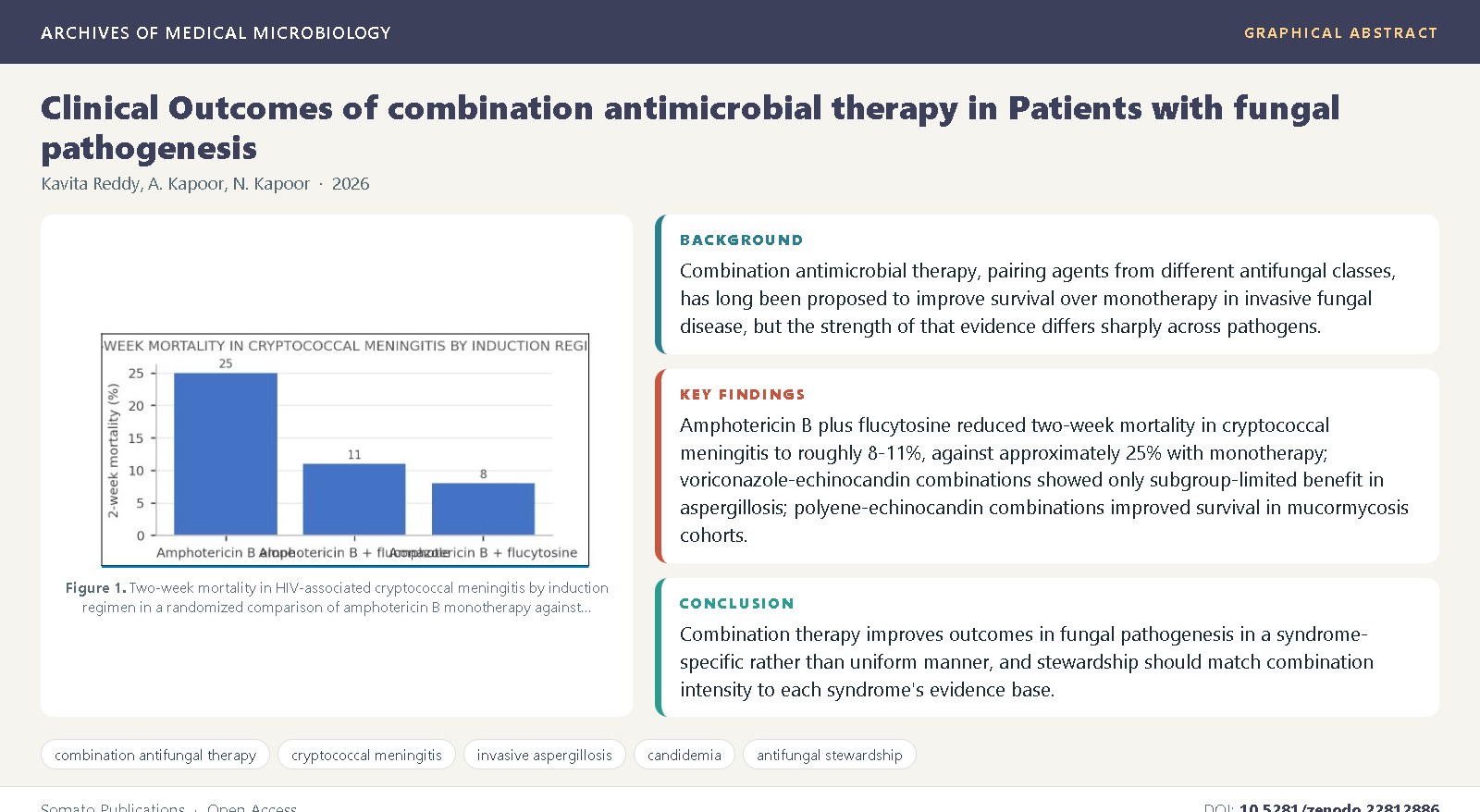
Background: Combination antimicrobial therapy, pairing agents from different antifungal classes, has long been proposed to improve survival over monotherapy in invasive fungal disease, but the strength of that evidence differs sharply across pathogens.
Objective: To synthesize published clinical-outcomes evidence on combination antifungal therapy for cryptococcal meningitis, invasive mould disease, and candidemia.
Methods: We synthesized randomized trials, prospective cohorts and society guidelines reporting mortality or mycological clearance for combination versus monotherapy antifungal regimens in adults with confirmed fungal infection.
Results: Amphotericin B plus flucytosine reduced two-week mortality in cryptococcal meningitis to roughly 8-11%, against approximately 25% with monotherapy; voriconazole-echinocandin combinations showed only subgroup-limited benefit in aspergillosis; polyene-echinocandin combinations improved survival in mucormycosis cohorts; and monotherapy performed adequately in candidemia.
Conclusions: Combination therapy improves outcomes in fungal pathogenesis in a syndrome-specific rather than uniform manner, and stewardship should match combination intensity to each syndrome's evidence base.
References
Johnson, M.D., MacDougall, C., Ostrosky-Zeichner, L., Perfect, J.R., Rex, J.H. (2004) Combination antifungal therapy. Antimicrobial Agents and Chemotherapy, 48(3): 693-715.
Denning, D.W. (2003) Echinocandin antifungal drugs. Lancet, 362(9390): 1142-1151.
Mukherjee, P.K., Sheehan, D.J., Hitchcock, C.A., Ghannoum, M.A. (2005) Combination treatment of invasive fungal infections. Clinical Microbiology Reviews, 18(1): 163-194.
Perfect, J.R. (2017) The antifungal pipeline: a reality check. Nature Reviews Drug Discovery, 16(9): 603-616.
Baddley, J.W., Pappas, P.G. (2005) Antifungal combination therapy: clinical potential. Drugs, 65(11): 1461-1480. in 6. Bennett, J.E., Dismukes, W.E., Duma, R.J., Medoff, G., Sande, M.A., Gallis, H., et al. (1979) A comparison of amphotericin B alone and combined with flucytosine in the treatment of cryptococcal meningitis. New England Journal of Medicine, 301(3): 126-131.
Perfect, J.R., Dismukes, W.E., Dromer, F., Goldman, D.L., Graybill, J.R., Hamill, R.J., et al. (2010) Clinical practice guidelines for the management of cryptococcal disease: 2010 update by the Infectious Diseases Society of America. Clinical Infectious Diseases, 50(3): 291-322.
Marr, K.A., Schlamm, H.T., Herbrecht, R., Rottinghaus, S.T., Bow, E.J., Cornely, O.A., et al. (2015) Combination antifungal therapy for invasive aspergillosis: a randomized trial. Annals of Internal Medicine, 162(2): 81-89.
Singh, N., Limaye, A.P., Forrest, G., Safdar, N., Munoz, P., Pursell, K., et al. (2006) Combination of voriconazole and caspofungin as primary therapy for invasive aspergillosis in solid organ transplant recipients: a prospective, multicenter, observational study. Transplantation, 81(3): 320-326.
Reed, C., Ibrahim, A., Edwards, J.E. Jr., Walot, I., Spellberg, B. (2008) Combination polyene-caspofungin treatment of rhino-orbital-cerebral mucormycosis. Clinical Infectious Diseases, 47(3): 364-371.
Spellberg, B., Ibrahim, A.S. (2010) Recent advances in the treatment of mucormycosis. Current Infectious Disease Reports, 12(6): 423-429.
Groll, A.H., Piscitelli, S.C., Walsh, T.J. (2001) Antifungal pharmacodynamics: concentration-effect relationships in vitro and in vivo. Pharmacotherapy, 21(8 Pt 2): 133S-148S.
Cuenca-Estrella, M. (2004) Combinations of antifungal agents in therapy--what value are they? Journal of Antimicrobial Chemotherapy, 54(6): 854-869.
Vazquez, J.A. (2008) Combination antifungal therapy for mold infections: much ado about nothing? Clinical Infectious Diseases, 46(12): 1889-1901.
Day, J.N., Chau, T.T.H., Wolbers, M., Mai, P.P., Dung, N.T., Mai, N.H., et al. (2013) Combination antifungal therapy for cryptococcal meningitis. New England Journal of Medicine, 368(14): 1291-1302.
Molloy, S.F., Kanyama, C., Heyderman, R.S., Loyse, A., Kouanfack, C., Chanda, D., et al. (2018) Antifungal combinations for treatment of cryptococcal meningitis in Africa. New England Journal of Medicine, 378(11): 1004-1017.
Larsen, R.A., Bozzette, S., Jones, B.E., Haghighat, D., Leal, M.A., Forthal, D., et al. (1994) Fluconazole combined with flucytosine for treatment of cryptococcal meningitis in patients with AIDS. Clinical Infectious Diseases, 19(4): 741-745.
Loyse, A., Wilson, D., Meintjes, G., Jarvis, J.N., Bicanic, T., Bishop, L., et al. (2012) Comparison of the early fungicidal activity of high-dose fluconazole, voriconazole, and flucytosine as second-line drugs given in combination with amphotericin B for the treatment of HIV-associated cryptococcal meningitis. Clinical Infectious Diseases, 54(1): 121-128.
Nussbaum, J.C., Jackson, A., Namarika, D., Phulusa, J., Kenala, J., Kanyemba, C., et al. (2010) Combination flucytosine and high-dose fluconazole compared with fluconazole monotherapy for the treatment of cryptococcal meningitis: a randomized trial in Malawi. Clinical Infectious Diseases, 50(3): 338-344.
Marr, K.A., Boeckh, M., Carter, R.A., Kim, H.W., Corey, L. (2004) Combination antifungal therapy for invasive aspergillosis. Clinical Infectious Diseases, 39(6): 797-802.
Kontoyiannis, D.P., Lewis, R.E. (2011) How I treat mucormycosis. Blood, 118(5): 1216-1224.
Bicanic, T., Wood, R., Meintjes, G., Rebe, K., Brouwer, A., Loyse, A., et al. (2007) Fungal burden, early fungicidal activity, and outcome in cryptococcal meningitis in antiretroviral-naive or antiretroviral-experienced patients treated with amphotericin B or fluconazole. Clinical Infectious Diseases, 45(1): 76-80.
Jarvis, J.N., Bicanic, T., Loyse, A., Namarika, D., Jackson, A., Nussbaum, J.C., et al. (2014) Determinants of mortality in a combined cohort of 501 patients with HIV-associated cryptococcal meningitis: implications for improving outcomes. Clinical Infectious Diseases, 58(5): 736-745.
Dromer, F., Bernede-Bauduin, C., Guillemot, D., Lortholary, O. (2008) Major role for amphotericin B-flucytosine combination in severe cryptococcosis. PLoS ONE, 3(8): e2870.
van der Horst, C.M., Saag, M.S., Cloud, G.A., Hamill, R.J., Graybill, J.R., Sobel, J.D., et al. (1997) Treatment of cryptococcal meningitis associated with the acquired immunodeficiency syndrome. New England Journal of Medicine, 337(1): 15-21.
Herbrecht, R., Denning, D.W., Patterson, T.F., Bennett, J.E., Greene, R.E., Oestmann, J.W., et al. (2002) Voriconazole versus amphotericin B for primary therapy of invasive aspergillosis. New England Journal of Medicine, 347(6): 408-415.
Cornely, O.A., Maertens, J., Bresnik, M., Ebrahimi, R., Ullmann, A.J., Bouza, E., et al. (2007) Liposomal amphotericin B as initial therapy for invasive mold infection: a randomized trial comparing a high-loading dose regimen with standard dosing (AmBiLoad trial). Clinical Infectious Diseases, 44(10): 1289-1297.
Walsh, T.J., Anaissie, E.J., Denning, D.W., Herbrecht, R., Kontoyiannis, D.P., Marr, K.A., et al. (2008) Treatment of aspergillosis: clinical practice guidelines of the Infectious Diseases Society of America. Clinical Infectious Diseases, 46(3): 327-360.
Patterson, T.F., Thompson, G.R. 3rd, Denning, D.W., Fishman, J.A., Hadley, S., Herbrecht, R., et al. (2016) Practice guidelines for the diagnosis and management aspergillosis: 2016 update by the Infectious Diseases Society of America. Clinical Infectious Diseases, 63(4): e1-e60.
Chamilos, G., Lewis, R.E., Kontoyiannis, D.P. (2008) Delaying amphotericin B-based frontline therapy significantly increases mortality among patients with hematologic malignancy who have zygomycosis. Clinical Infectious Diseases, 47(4): 503-509.
Rex, J.H., Bennett, J.E., Sugar, A.M., Pappas, P.G., van der Horst, C.M., Edwards, J.E., et al. (1994) A randomized trial comparing fluconazole with amphotericin B for the treatment of candidemia in patients without neutropenia. New England Journal of Medicine, 331(20): 1325-1330.
Mora-Duarte, J., Betts, R., Rotstein, C., Colombo, A.L., Thompson-Moya, L., Smietana, J., et al. (2002) Comparison of caspofungin and amphotericin B for invasive candidiasis. New England Journal of Medicine, 347(25): 2020-2029.
Kullberg, B.J., Sobel, J.D., Ruhnke, M., Pappas, P.G., Viscoli, C., Rex, J.H., et al. (2005) Voriconazole versus a regimen of amphotericin B followed by fluconazole for candidaemia in non-neutropenic patients: a randomised non-inferiority trial. Lancet, 366(9495): 1435-1442.
Reboli, A.C., Rotstein, C., Pappas, P.G., Chapman, S.W., Kett, D.H., Kumar, D., et al. (2007) Anidulafungin versus fluconazole for invasive candidiasis. New England Journal of Medicine, 356(24): 2472-2482.
Pappas, P.G., Kauffman, C.A., Andes, D.R., Clancy, C.J., Marr, K.A., Ostrosky-Zeichner, L., et al. (2016) Clinical practice guideline for the management of candidiasis: 2016 update by the Infectious Diseases Society of America. Clinical Infectious Diseases, 62(4): e1-e50. of

Published
Issue
Section
License
Copyright (c) 2026 Kavita Reddy, et al.

This work is licensed under a Creative Commons Attribution 4.0 International License.


