
Predictors of infection clearance rate in intensive care unit patients with catheter-related bloodstream infection
DOI:
https://doi.org/10.5281/zenodo.22812897Keywords:
catheter-related bloodstream infection, intensive care unit, microbiological clearance, catheter removal, predictorsAbstract
Background: Catheter-related bloodstream infection (CRBSI) is a major preventable cause of morbidity and mortality in intensive care unit (ICU) patients, and clinicians must decide rapidly whether to remove or attempt to salvage an infected catheter [6,1].
Objective: This study aimed to identify independent clinical, microbiological, and catheter-management predictors of seven-day microbiological clearance in ICU patients with CRBSI.
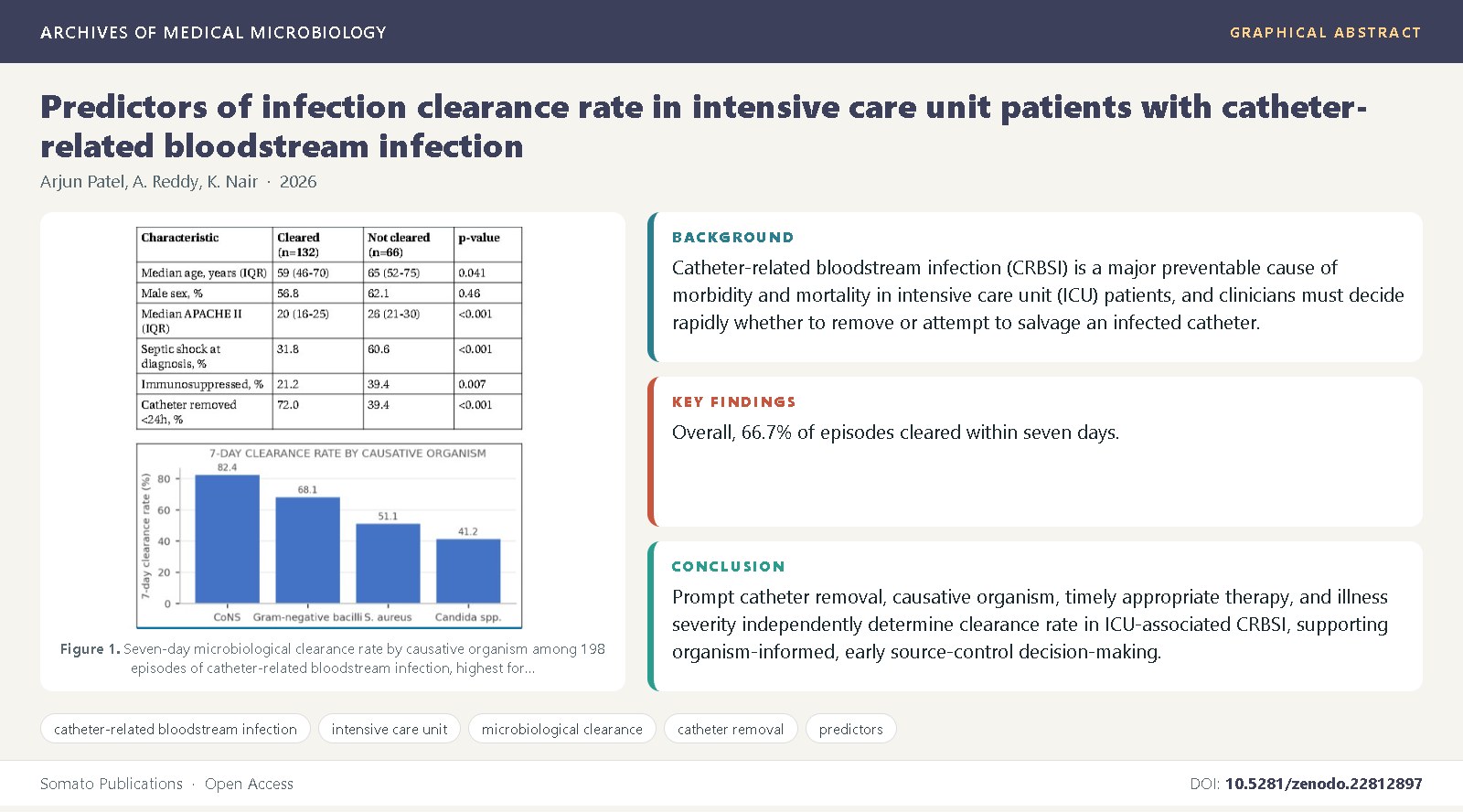
Methods: We performed a retrospective cohort study of 198 CRBSI episodes in 187 ICU patients at a tertiary referral center over five years, defining clearance as two consecutive negative blood cultures within seven days of appropriate therapy, and analyzed predictors using multivariable logistic regression.
Results: Overall, 66.7% of episodes cleared within seven days. Catheter removal within 24 hours (adjusted OR 3.42), coagulase-negative staphylococcal infection (aOR 2.61), timely appropriate empiric therapy (aOR 2.35), and absence of septic shock (aOR 2.18) independently predicted clearance, while Candida infection (aOR 0.44) and immunosuppression (aOR 0.48) independently predicted failure to clear [10,12].
Conclusions: Prompt catheter removal, causative organism, timely appropriate therapy, and illness severity independently determine clearance rate in ICU-associated CRBSI, supporting organism-informed, early source-control decision-making [13,9].
References
Pittet, D., Tarara, D., Wenzel, R.P. (1994) Nosocomial bloodstream infection in critically ill patients: excess length of stay, extra costs, and attributable mortality. JAMA, 271(20): 1598-1601. DOI: 10.1001/jama.1994.03510200084038
DiGiovine, B., Chenoweth, C., Watts, C., Higgins, M. (1999) The attributable mortality and costs of primary nosocomial bloodstream infections in the intensive care unit. American Journal of Respiratory and Critical Care Medicine, 160(3): 976-981. DOI: 10.1164/ajrccm.160.3.9808145
Wisplinghoff, H., Bischoff, T., Tallent, S.M., Seifert, H., Wenzel, R.P., Edmond, M.B. (2004) Nosocomial bloodstream infections in US hospitals: analysis of 24,179 cases from a prospective nationwide surveillance study. Clinical Infectious Diseases, 39(3): 309-317. DOI: 10.1086/421946
Vincent, J.L., Rello, J., Marshall, J., Silva, E., Anzueto, A., Martin, C.D., et al. (2009) International study of the prevalence and outcomes of infection in intensive care units. JAMA, 302(21): 2323-2329. DOI: 10.1001/jama.2009.1754
Marra, A.R., Camargo, L.F., Pignatari, A.C., Sukiennik, T., Behar, P.R., Medeiros, E.A., et al. (2010) Nosocomial bloodstream infections in Brazilian hospitals: analysis of 2,563 cases from a prospective nationwide surveillance study. Journal of Clinical Microbiology, 49(5): 1866-1871. DOI: 10.1128/JCM.00376-10
Mermel, L.A., Allon, M., Bouza, E., Craven, D.E., Flynn, P., O'Grady, N.P., et al. (2009) Clinical practice guidelines for the diagnosis and management of intravascular catheter-related infection: 2009 update by the Infectious Diseases Society of America. Clinical Infectious Diseases, 49(1): 1-45. DOI: 10.1086/599376
Raad, I., Hanna, H., Maki, D. (2007) Antibiotic lock technique for prevention and treatment of catheter-related bloodstream infections. Journal of Antimicrobial Chemotherapy, 60(2): 231-241.
Oliveira, M., Braga, M.C., Oliveira, N.M.C., Ferreira, S.M.S., Serra, N., Cardoso, T. (2018) Predictors of clinical response and death in patients with catheter-related bloodstream infections. Infectious Disease Reports, 10(2): 7442. DOI: 10.4081/idr.2018.7442
Siempos, I.I., Kopterides, P., Tsangaris, I., Dimopoulou, I., Armaganidis, A.E. (2009) Impact of catheter-related bloodstream infections on the mortality of critically ill patients: a meta-analysis. Critical Care Medicine, 37(7): 2283-2289. DOI: 10.1097/CCM.0b013e3181a02a67
Raad, I., Costerton, W., Sabharwal, U., Sacilowski, M., Anaissie, E., Bodey, G.P. (1993) Ultrastructural analysis of indwelling vascular catheters: a quantitative relationship between luminal colonization and duration of placement. Journal of Infectious Diseases, 168(2): 400-407. DOI: 10.1093/infdis/168.2.400
Safdar, N., Kluger, D.M., Maki, D.G. (2002) A review of risk factors for catheter-related bloodstream infection caused by percutaneously inserted, noncuffed central venous catheters: implications for preventive strategies. Medicine, 81(6): 466-479. DOI: 10.1097/00005792-200211000-00007
Garnacho-Montero, J., Garcia-Garmendia, J.L., Barrero-Almodovar, A., Jimenez-Jimenez, F.J., Perez-Paredes, C., Ortiz-Leyba, C. (2001) Risk factors for and prognosis of catheter-related bloodstream infection in critically ill patients. Critical Care Medicine, 29(5): 979-983. DOI: 10.1097/00003246-200105000-00019
Rijnders, B.J., Peetermans, W.E., Verwaest, C., Wilmer, A., Van Wijngaerden, E. (2004) Watchful waiting versus immediate catheter removal in ICU patients with suspected catheter-related infection: a randomized trial. Intensive Care Medicine, 30(6): 1073-1080. DOI: 10.1007/s00134-004-2212-x
Renaud, B., Brun-Buisson, C. (2001) Outcomes of primary and catheter-related bacteremia: a cohort and case-control study in critically ill patients. American Journal of Respiratory and Critical Care Medicine, 163(7): 1584-1590. DOI: 10.1164/ajrccm.163.7.9912080
Blot, S.I., Depuydt, P., Annemans, L., Benoit, D., Hoste, E., De Waele, J.J., et al. (2005) Clinical and economic outcomes in critically ill patients with nosocomial catheter-related bloodstream infections. Clinical Infectious Diseases, 41(11): 1591-1598. DOI: 10.1086/497833
Liu, C., Bayer, A., Cosgrove, S.E., Daum, R.S., Fridkin, S.K., Gorwitz, R.J., et al. (2011) Clinical practice guidelines by the Infectious Diseases Society of America for the treatment of methicillin-resistant Staphylococcus aureus infections in adults and children. Clinical Infectious Diseases, 52(3): e18-e55. DOI: 10.1093/cid/ciq146
Lorente, L., Henry, C., Martin, M.M., Jimenez, A., Mora, M.L. (2005) Central venous catheter-related infection in a prospective and observational study of 2,595 catheters. Critical Care, 9(6): R631-R635. DOI: 10.1186/cc3824
Chopra, V., O'Horo, J.C., Rogers, M.A., Maki, D.G., Safdar, N. (2013) The risk of bloodstream infection associated with peripherally inserted central catheters compared with central venous catheters in adults: a systematic review and meta-analysis. Infection Control and Hospital Epidemiology, 34(9): 908-918. DOI: 10.1086/671737
Bouza, E., Alvarado, N., Alcala, L., Perez, M.J., Rincon, C., Munoz, P. (2007) A randomized and prospective study of 3 procedures for the diagnosis of catheter-related bloodstream infection without catheter withdrawal. Clinical Infectious Diseases, 44(6): 820-826. DOI: 10.1086/511865
Pronovost, P., Needham, D., Berenholtz, S., Sinopoli, D., Chu, H., Cosgrove, S., et al. (2006) An intervention to decrease catheter-related bloodstream infections in the ICU. New England Journal of Medicine, 355(26): 2725-2732. DOI: 10.1056/NEJMoa061115
Raad, I.I., Hohn, D.C., Gilbreath, B.J., Suleiman, N., Hill, L.A., Bruso, P.A., et al. (1994) Prevention of central venous catheter-related infections by using maximal sterile barrier precautions during insertion. Infection Control and Hospital Epidemiology, 15(4 Pt 1): 231-238. DOI: 10.1086/646902
Mimoz, O., Lucet, J.C., Kerforne, T., Pascal, J., Souweine, B., Goudet, V., et al. (2015) Skin antisepsis with chlorhexidine-alcohol versus povidone iodine-alcohol, with and without skin scrubbing, for prevention of intravascular-catheter-related infection: an open-label, multicentre, randomised, controlled, two-by-two factorial trial. Lancet, 386(10008): 2069-2077. DOI: 10.1016/S0140-6736(15)00244-5
Timsit, J.F., Schwebel, C., Bouadma, L., Geffroy, A., Garrouste-Orgeas, M., Pease, S., et al. (2009) Chlorhexidine-impregnated sponges and less frequent dressing changes for prevention of catheter-related infections in critically ill adults: a randomized controlled trial. JAMA, 301(12): 1231-1241. DOI: 10.1001/jama.2009.376
Blot, F., Nitenberg, G., Chachaty, E., Raynard, B., Germann, N., Antoun, S., et al. (1999) Diagnosis of catheter-related bacteraemia: a prospective comparison of the time to positivity of hub-blood versus peripheral-blood cultures. Lancet, 354(9184): 1071-1077. DOI: 10.1016/S0140-6736(98)11134-0
Safdar, N., Maki, D.G. (2005) Use of vancomycin-containing lock or flush solutions for prevention of bloodstream infection associated with central venous access devices: a meta-analysis of prospective, randomized trials. Clinical Infectious Diseases, 40(7): 990-1000. DOI: 10.1086/428123
Ziegler, M.J., Pellegrini, D.C., Safdar, N. (2015) Attributable mortality of central line associated bloodstream infection: systematic review and meta-analysis. Infection, 43(1): 29-36. DOI: 10.1007/s15010-014-0689-y
O'Grady, N.P., Alexander, M., Burns, L.A., Dellinger, E.P., Garland, J., Heard, S.O., et al. (2011) Guidelines for the prevention of intravascular catheter-related infections. Clinical Infectious Diseases, 52(9): e162-e193. DOI: 10.1093/cid/cir257
Raad, I., Hanna, H., Maki, D. (2007) Intravascular catheter-related infections: advances in diagnosis, prevention, and management. Lancet Infectious Diseases, 7(10): 645-657. DOI: 10.1016/S1473-3099(07)70235-9
Fatkenheuer, G., Buchheidt, D., Cornely, O.A., Fuhr, H.G., Karthaus, M., Kisro, J., et al. (2003) Central venous catheter (CVC)-related infections in neutropenic patients. Annals of Hematology, 82(Suppl 2): S149-S157. DOI: 10.1007/s00277-003-0736-7
Marschall, J., Mermel, L.A., Fakih, M., Hadaway, L., Kallen, A., O'Grady, N.P., et al. (2014) Strategies to prevent central line-associated bloodstream infections in acute care hospitals: 2014 update. Infection Control and Hospital Epidemiology, 35(7): 753-771. DOI: 10.1086/676533
Timsit, J.F., Mimoz, O., Mourvillier, B., Souweine, B., Garrouste-Orgeas, M., Alfandari, S., et al. (2012) Randomized controlled trial of chlorhexidine dressing and highly adhesive dressing for preventing catheter-related infections in critically ill adults. American Journal of Respiratory and Critical Care Medicine, 186(12): 1272-1278. DOI: 10.1164/rccm.201206-1038OC

Published
Issue
Section
License
Copyright (c) 2026 Arjun Patel, et al.

This work is licensed under a Creative Commons Attribution 4.0 International License.


