
antimicrobial susceptibility testing in the Management of catheter-related bloodstream infection among immunocompromised hosts
DOI:
https://doi.org/10.5281/zenodo.22812845Keywords:
antimicrobial susceptibility testing, catheter-related bloodstream infection, immunocompromised host, multidrug resistance, central venous catheterAbstract
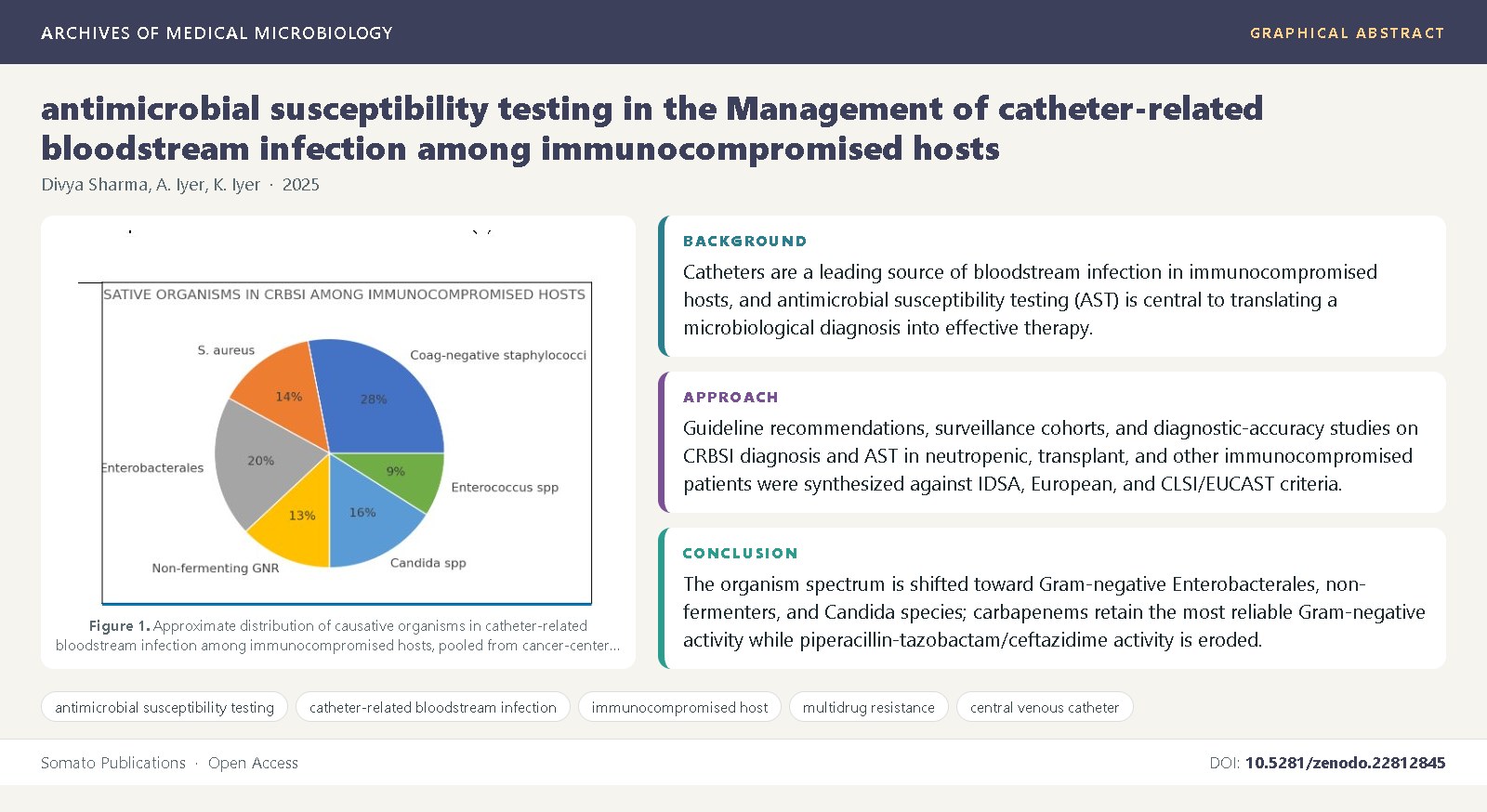
Background/Objective: Catheters are a leading source of bloodstream infection in immunocompromised hosts, and antimicrobial susceptibility testing (AST) is central to translating a microbiological diagnosis into effective therapy; this review synthesizes the diagnostic microbiology and susceptibility profile of catheter-related bloodstream infection (CRBSI) in this population.
Methods: Guideline recommendations, surveillance cohorts, and diagnostic-accuracy studies on CRBSI diagnosis and AST in neutropenic, transplant, and other immunocompromised patients were synthesized against IDSA, European, and CLSI/EUCAST criteria. Results/Conclusions: The organism spectrum is shifted toward Gram-negative Enterobacterales, non-fermenters, and Candida species; carbapenems retain the most reliable Gram-negative activity while piperacillin-tazobactam/ceftazidime activity is eroded, and inappropriate empirical therapy is associated with worse outcomes. Rapid, population-stratified AST, catheter-sparing diagnosis, and decisive catheter removal when biofilm-forming or fungal pathogens are implicated form the core of effective management.
References
Mermel, L.A., Allon, M., Bouza, E., Craven, D.E., Flynn, P., O'Grady, N.P., et al. (2009) Clinical practice guidelines for the diagnosis and management of intravascular catheter-related infection: 2009 update by the Infectious Diseases Society of America. Clinical Infectious Diseases, 49(1): 1-45. DOI: 10.1086/599376
Raad, I., Hanna, H., Maki, D. (2007) Intravascular catheter-related infections: advances in diagnosis, prevention, and management. Lancet Infectious Diseases, 7(10): 645-657. DOI: 10.1016/S1473-3099(07)70235-9
Hachem, R., Raad, I. (2002) Catheter-related infections in cancer patients. International Journal of Antimicrobial Agents, 19(6): 543-547. DOI: 10.1016/S0924-8579(02)00108-5
Marschall, J., Mermel, L.A., Fakih, M., Hadaway, L., Kallen, A., O'Grady, N.P., et al. (2014) Strategies to prevent central line-associated bloodstream infections in acute care hospitals: 2014 update. Infection Control and Hospital Epidemiology, 35(7): 753-771. DOI: 10.1086/676533
Raad, I., Costerton, W., Sabharwal, U., Sacilowski, M., Anaissie, E., Bodey, G.P. (1993) Ultrastructural analysis of indwelling vascular catheters: a quantitative relationship between luminal colonization and duration of placement. Journal of Infectious Diseases, 168(2): 400-407. DOI: 10.1093/infdis/168.2.400
Safdar, N., Maki, D.G. (2004) The pathogenesis of catheter-related bloodstream infection with noncuffed short-term central venous catheters. Intensive Care Medicine, 30(1): 62-67. DOI: 10.1007/s00134-003-2045-z
Freifeld, A.G., Bow, E.J., Sepkowitz, K.A., Boeckh, M.J., Ito, J.I., Mullen, C.A., et al. (2011) Clinical practice guideline for the use of antimicrobial agents in neutropenic patients with cancer: 2010 update by the Infectious Diseases Society of America. Clinical Infectious Diseases, 52(4): e56-e93. DOI: 10.1093/cid/cir073
Wisplinghoff, H., Bischoff, T., Tallent, S.M., Seifert, H., Wenzel, R.P., Edmond, M.B. (2004) Nosocomial bloodstream infections in US hospitals: analysis of 24,179 cases from a prospective nationwide surveillance study. Clinical Infectious Diseases, 39(3): 309-317. DOI: 10.1086/421946
Diekema, D.J., Hsueh, P.R., Mendes, R.E., Pfaller, M.A., Rolston, K.V., Sader, H.S., et al. (2019) The microbiology of bloodstream infection: 20-year trends from the SENTRY Antimicrobial Surveillance Program. Antimicrobial Agents and Chemotherapy, 63(7): e00355-19. DOI:
1128/AAC.00355-19 10. Gudiol, C., Tubau, F., Calatayud, L., Garcia-Vidal, C., Cisnal, M., Sanchez-Ortega, I., et al. (2011) Bacteraemia due to multidrug-resistant Gram-negative bacilli in cancer patients: risk factors, antibiotic therapy and outcomes. Journal of Antimicrobial Chemotherapy, 66(3): 657-663. DOI: 10.1093/jac/dkq494
Trecarichi, E.M., Tumbarello, M. (2014) Antimicrobial-resistant Gram-negative bacteria in febrile neutropenic patients with cancer: current epidemiology and clinical impact. Current Opinion in Infectious Diseases, 27(3): 200-210. DOI: 10.1097/QCO.0000000000000038
Montassier, E., Batard, E., Gastinne, T., Potel, G., de La Cochetiere, M.F. (2013) Recent changes in bacteremia in patients with cancer: a systematic review of epidemiology and antibiotic resistance. European Journal of Clinical Microbiology and Infectious Diseases, 32(7): 841-850. DOI: 10.1007/s10096-013-1819-7
O'Grady, N.P., Alexander, M., Burns, L.A., Dellinger, E.P., Garland, J., Heard, S.O., et al. (2011) Guidelines for the prevention of intravascular catheter-related infections. Clinical Infectious Diseases, 52(9): e162-e193. DOI: 10.1093/cid/cir257
Chaves, F., Garnacho-Montero, J., Del Pozo, J.L., Bouza, E., Capdevila, J.A., de Cueto, M., et al. (2018) Diagnosis and treatment of catheter-related bloodstream infection: clinical guidelines of the Spanish Society of Infectious Diseases and Clinical Microbiology and Society of Spanish Intensive Care Medicine. Medicina Intensiva, 42(1): 5-36. DOI: 10.1016/j.medin.2017.09.012
Safdar, N., Fine, J.P., Maki, D.G. (2005) Meta-analysis: methods for diagnosing intravascular device-related bloodstream infection. Annals of Internal Medicine, 142(6): 451-466. DOI: 10.7326/0003-4819-142-6-200503150-00011
Blot, F., Nitenberg, G., Chachaty, E., Raynard, B., Germann, N., Antoun, S., et al. (1999) Diagnosis of catheter-related bacteraemia: a prospective comparison of the time to positivity of hub-blood versus peripheral-blood cultures. Lancet, 354(9184): 1071-1077. DOI: 10.1016/S0140-6736(98)11134-0
Seifert, H. (2009) The clinical importance of microbiological findings in the diagnosis and management of bloodstream infections. Clinical Infectious Diseases, 48(Suppl 4): S238-S245. DOI: 10.1086/598188
Weinstein, M.P. (1996) Current blood culture methods and systems: clinical concepts, technology, and interpretation of results. Clinical Infectious Diseases, 23(1): 40-46. DOI: 10.1093/clinids/23.1.40
Maki, D.G., Kluger, D.M., Crnich, C.J. (2006) The risk of bloodstream infection in adults with different intravascular devices: a systematic review of 200 published prospective studies. Mayo Clinic Proceedings, 81(9): 1159-1171. DOI: 10.4065/81.9.1159
Clinical and Laboratory Standards Institute (2023) Performance Standards for Antimicrobial Susceptibility Testing, CLSI Supplement M100, 33rd edition. Clinical and Laboratory Standards Institute, Wayne, PA, USA.
Kahlmeter, G., Brown, D.F.J., Goldstein, F.W., MacGowan, A.P., Mouton, J.W., Odenholt, I., et al. (2006) European Committee on Antimicrobial Susceptibility Testing (EUCAST) technical notes on antimicrobial susceptibility testing. Clinical Microbiology and Infection, 12(6): 501-503. DOI: 10.1111/j.1469-0691.2006.01454.x
Magiorakos, A.P., Srinivasan, A., Carey, R.B., Carmeli, Y., Falagas, M.E., Giske, C.G., et al. (2012) Multidrug-resistant, extensively drug-resistant and pandrug-resistant bacteria: an international expert proposal for interim standard definitions for acquired resistance. Clinical Microbiology and Infection, 18(3): 268-281. DOI: 10.1111/j.1469-0691.2011.03570.x
Pappas, P.G., Kauffman, C.A., Andes, D.R., Clancy, C.J., Marr, K.A., Ostrosky-Zeichner, L., et al. (2016) Clinical practice guideline for the management of candidiasis: 2016 update by the Infectious Diseases Society of America. Clinical Infectious Diseases, 62(4): e1-e50. DOI: 10.1093/cid/civ933
Cornely, O.A., Bassetti, M., Calandra, T., Garbino, J., Kullberg, B.J., Lortholary, O., et al. (2012) ESCMID guideline for the diagnosis and management of Candida diseases 2012: non-neutropenic adult patients. Clinical Microbiology and Infection, 18(Suppl 7): 19-37. DOI: 10.1111/1469-0691.12039
Kullberg, B.J., Arendrup, M.C. (2015) Invasive candidiasis. New England Journal of Medicine, 373(15): 1445-1456. DOI: 10.1056/NEJMra1315399
Rosenthal, V.D., Bat-Erdene, I., Gupta, D., Belkebir, S., Rajhans, P., Zand, F., et al. (2016) International Nosocomial Infection Control Consortium (INICC) report, data summary of 45 countries for 2012-2014, device-associated module. American Journal of Infection Control, 44(12): 1495-1504. DOI: 10.1016/j.ajic.2016.08.007
Zingg, W., Sax, H., Inan, C., Cartier, V., Diby, M., Clergue, F., et al. (2009) Hospital-wide surveillance of catheter-related bloodstream infection: from the expected to the unexpected. Journal of Hospital Infection, 73(1): 41-46. DOI: 10.1016/j.jhin.2009.05.015
Gudiol, C., Bodro, M., Simonetti, A., Tubau, F., Gonzalez-Barca, E., Cisnal, M., et al. (2013) Changing aetiology, clinical features, antimicrobial resistance, and outcomes of bloodstream infection in neutropenic cancer patients. Clinical Microbiology and Infection, 19(5): 474-479. DOI: 10.1111/j.1469-0691.2012.03879.x
Nucci, M., Anaissie, E. (2002) Should vascular catheters be removed from all patients with candidemia? An evidence-based review. Clinical Infectious Diseases, 34(5): 591-599. DOI: 10.1086/338714
Pfaller, M.A., Diekema, D.J. (2007) Epidemiology of invasive candidiasis: a persistent public health problem. Clinical Microbiology Reviews, 20(1): 133-163. DOI: 10.1128/CMR.00029-06
Martinez-Nadal, G., Puerta-Alcalde, P., Gudiol, C., Cardozo, C., Albasanz-Puig, A., Marco, F., et al. (2020) Inappropriate empirical antibiotic treatment in high-risk neutropenic patients with bacteremia in the era of multidrug resistance. Clinical Infectious Diseases, 70(6): 1068-1074. DOI: 10.1093/cid/ciz319
Averbuch, D., Orasch, C., Cordonnier, C., Livermore, D.M., Mikulska, M., Viscoli, C., et al. (2013) European guidelines for empirical antibacterial therapy for febrile neutropenic patients in the era of growing resistance: summary of the 2011 4th European Conference on Infections in Leukemia. Haematologica, 98(12): 1826-1835. DOI: 10.3324/haematol.2013.091025
Renaud, B., Brun-Buisson, C. (2001) Outcomes of primary and catheter-related bacteremia: a cohort and case-control study in critically ill patients. American Journal of Respiratory and Critical Care Medicine, 163(7): 1584-1590. DOI: 10.1164/ajrccm.163.7.9912080
Zakhour, R., Chaftari, A.M., Raad, I.I. (2016) Catheter-related infections in patients with haematological malignancies: novel preventive and therapeutic strategies. Lancet Infectious Diseases, 16(11): e241-e250. DOI: 10.1016/S1473-3099(16)30213-4
Tacconelli, E., Carrara, E., Savoldi, A., Harbarth, S., Mendelson, M., Monnet, D.L., et al. (2018) Discovery, research, and development of new antibiotics: the WHO priority list of antibiotic-resistant bacteria and tuberculosis. Lancet Infectious Diseases, 18(3): 318-327. DOI: 10.1016/S1473-3099(17)30753-3
Timsit, J.F., Rupp, M., Bouza, E., Chopra, V., Kärpänen, T., Laupland, K., et al. (2018) A state of the art review on optimal practices to prevent, recognize, and manage complications associated with intravascular devices in the critically ill. Intensive Care Medicine, 44(6): 742-759. DOI: 10.1007/s00134-018-5212-y

Published
Issue
Section
License
Copyright (c) 2025 Divya Sharma, et al.

This work is licensed under a Creative Commons Attribution 4.0 International License.


