
Clinical Outcomes of antimicrobial stewardship programs in Patients with fungal pathogenesis
DOI:
https://doi.org/10.5281/zenodo.22812828Keywords:
antimicrobial stewardship, antifungal therapy, candidemia, invasive fungal disease, antifungal resistanceAbstract
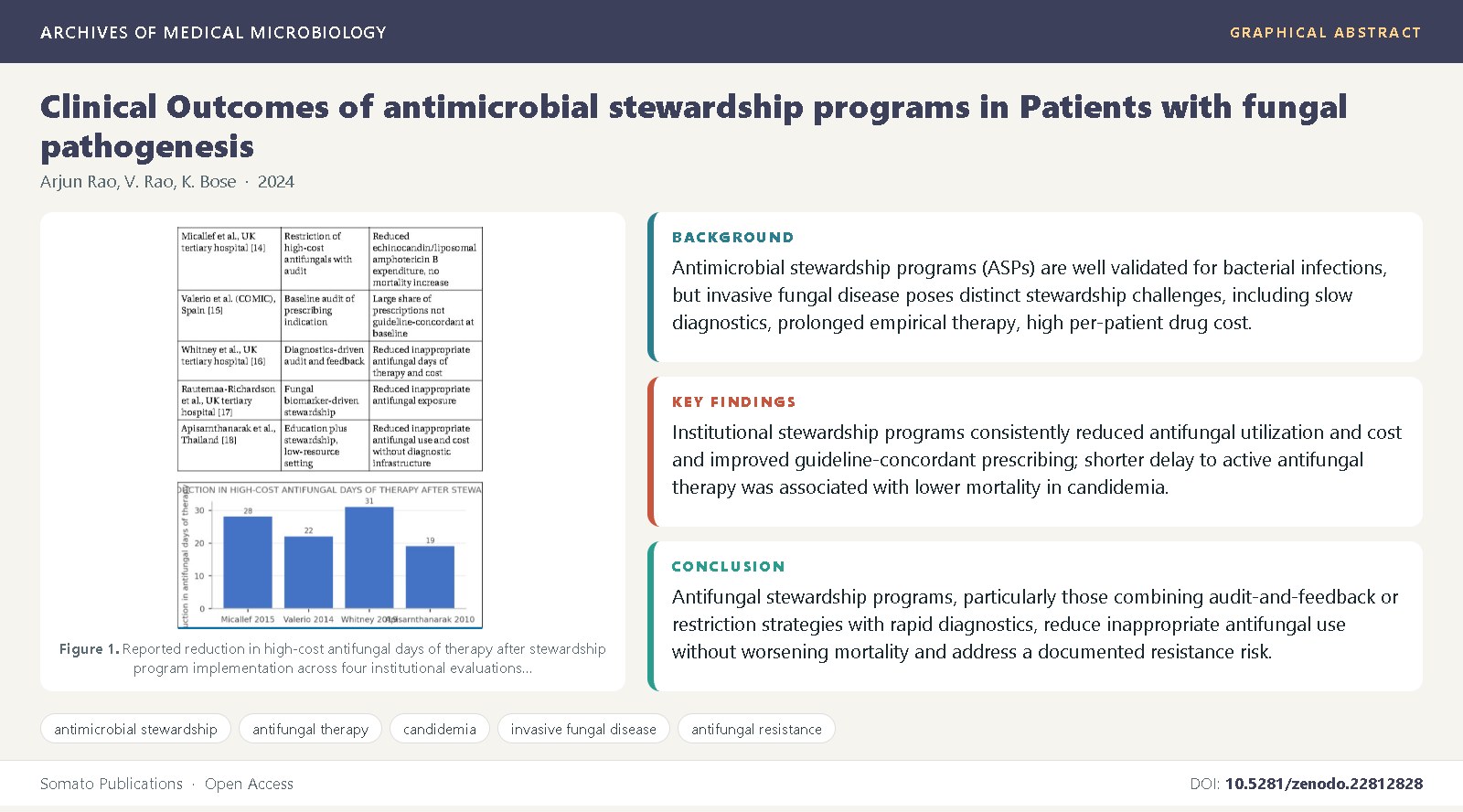
Background: Antimicrobial stewardship programs (ASPs) are well validated for bacterial infections, but invasive fungal disease poses distinct stewardship challenges, including slow diagnostics, prolonged empirical therapy, high per-patient drug cost, and a narrow margin for resistance across the available antifungal classes.
Objective: This article synthesizes the clinical outcomes literature on antimicrobial stewardship programs implemented in patients with fungal pathogenesis, covering antifungal utilization and cost, time-to-therapy, mortality, and resistance outcomes.
Methods: Peer-reviewed institutional stewardship evaluations, multicenter treatment-strategy and surveillance cohorts, and society practice guidelines addressing antifungal prescribing in invasive candidiasis, aspergillosis, and mucormycosis were synthesized descriptively.
Findings: Institutional stewardship programs consistently reduced antifungal utilization and cost and improved guideline-concordant prescribing; shorter delay to active antifungal therapy was associated with lower mortality in candidemia, and rising echinocandin nonsusceptibility in Candida glabrata was tied directly to prior antifungal exposure.
Conclusions: Antifungal stewardship programs, particularly those combining audit-and-feedback or restriction strategies with rapid diagnostics, reduce inappropriate antifungal use without worsening mortality and address a documented resistance risk, supporting stewardship as a clinical outcomes intervention rather than a cost-containment exercise alone.
References
Dellit, T.H., Owens, R.C., McGowan, J.E. Jr., Gerding, D.N., Weinstein, R.A., Burke, J.P., et al. (2007) Infectious Diseases Society of America and the Society for Healthcare Epidemiology of America guidelines for developing an institutional program to enhance antimicrobial stewardship. Clinical Infectious Diseases, 44(2): 159-177. DOI: 10.1086/510393
Barlam, T.F., Cosgrove, S.E., Abbo, L.M., MacDougall, C., Schuetz, A.N., Septimus, E.J., et al. (2016) Implementing an antibiotic stewardship program: guidelines by the Infectious Diseases Society of America and the Society for Healthcare Epidemiology of America. Clinical Infectious Diseases, 62(10): e51-e77. DOI: 10.1093/cid/ciw118
Fishman, N. (2006) Antimicrobial stewardship. American Journal of Infection Control, 34(5 Suppl 1): S55-S63.
Davey, P., Marwick, C.A., Scott, C.L., Charani, E., McNeil, K., Brown, E., et al. (2017) Interventions to improve antibiotic prescribing practices for hospital inpatients. Cochrane Database of Systematic Reviews, 2: CD003543. DOI: 10.1002/14651858.CD003543.pub4
Pappas, P.G., Kauffman, C.A., Andes, D.R., Clancy, C.J., Marr, K.A., Ostrosky-Zeichner, L., et al. (2016) Clinical practice guideline for the management of candidiasis: 2016 update by the Infectious Diseases Society of America. Clinical Infectious Diseases, 62(4): e1-e50. DOI: 10.1093/cid/civ933
Patterson, T.F., Thompson, G.R. 3rd, Denning, D.W., Fishman, J.A., Hadley, S., Herbrecht, R., et al. (2016) Practice guidelines for the diagnosis and management of aspergillosis: 2016 update by the Infectious Diseases Society of America. Clinical Infectious Diseases, 63(4): e1-e60. DOI: 10.1093/cid/ciw326
Ananda-Rajah, M.R., Slavin, M.A., Thursky, K.T. (2012) The case for antifungal stewardship. Current Opinion in Infectious Diseases, 25(1): 107-115. DOI: 10.1097/QCO.0b013e32834e0680
Munoz, P., Bouza, E. (2016) The current treatment landscape: the need for antifungal stewardship programmes. Journal of Antimicrobial Chemotherapy, 71(suppl_2): ii5-ii12. DOI: 10.1093/jac/dkw391
Brown, G.D., Denning, D.W., Gow, N.A.R., Levitz, S.M., Netea, M.G., White, T.C. (2012) Hidden killers: human fungal infections. Science Translational Medicine, 4(165): 165rv13. DOI: 10.1126/scitranslmed.3004404
Pfaller, M.A., Diekema, D.J. (2007) Epidemiology of invasive candidiasis: a persistent public health problem. Clinical Microbiology Reviews, 20(1): 133-163. DOI: 10.1128/CMR.00029-06
Zilberberg, M.D., Shorr, A.F., Kollef, M.H. (2008) Secular trends in candidemia-related hospitalization in the United States, 2000-2005. Infection Control and Hospital Epidemiology, 29(10): 978-980. DOI: 10.1086/591033
Cornely, O.A., Bassetti, M., Calandra, T., Garbino, J., Kullberg, B.J., Lortholary, O., et al. (2012) ESCMID guideline for the diagnosis and management of Candida diseases 2012: non-neutropenic adult patients. Clinical Microbiology and Infection, 18(Suppl 7): 19-37. DOI: 10.1111/1469-0691.12039
Ullmann, A.J., Aguado, J.M., Arikan-Akdagli, S., Denning, D.W., Groll, A.H., Lagrou, K., et al. (2018) Diagnosis and management of Aspergillus diseases: executive summary of the 2017 ESCMID-ECMM-ERS guideline. Clinical Microbiology and Infection, 24(Suppl 1): e1-e38. DOI: 10.1016/j.cmi.2018.01.002
Micallef, C., Aliyu, S.H., Santos, R., Brown, N.M., Rosin, C., Enoch, D.A. (2015) Introduction of an antifungal stewardship programme targeting high-cost antifungals at a tertiary hospital in Cambridge, England. Journal of Antimicrobial Chemotherapy, 70(1): 285-288. DOI: 10.1093/jac/dku385
Valerio, M., Rodriguez-Gonzalez, C.G., Munoz, P., Caliz, B., Sanjurjo, M., Bouza, E. (2014) Evaluation of antifungal use in a tertiary care institution: antifungal stewardship urgently needed. Journal of Antimicrobial Chemotherapy, 69(7): 1993-1999. DOI: 10.1093/jac/dku053
Whitney, L., Al-Ghusein, H., Glass, S., Koh, M., Klammer, M., Ball, J., et al. (2019) Effectiveness of an antifungal stewardship programme at a UK tertiary referral hospital. Journal of Antimicrobial Chemotherapy, 74(5): 1412-1417. DOI: 10.1093/jac/dky564
Rautemaa-Richardson, R., Rautemaa, V., Al-Wathiqi, F., Moore, C.B., Craig, L., Felton, T.W. (2018) Impact of a diagnostics-driven antifungal stewardship programme in a UK tertiary referral centre. Journal of Antimicrobial Chemotherapy, 73(12): 3488-3495. DOI: 10.1093/jac/dky360
Apisarnthanarak, A., Yatrasert, A., Mundy, L.M. (2010) Impact of education and an antifungal stewardship program for candidiasis at a Thai tertiary care center. Infection Control and Hospital Epidemiology, 31(7): 722-727. DOI: 10.1086/653616
Antworth, A., Collins, C.D., Kunapuli, A., Klein, K., Carver, P., Gandhi, T., et al. (2013) Impact of an antimicrobial stewardship program comprehensive care bundle on management of candidemia. Pharmacotherapy, 33(2): 137-143. DOI: 10.1002/phar.1186
Reed, E.E., West, J.E., Litwin, C.M., Skiest, D.J., Mahaffey, T.J. (2014) Improving the management of candidemia through antimicrobial stewardship interventions. Diagnostic Microbiology and Infectious Disease, 78(2): 157-161. DOI: 10.1016/j.diagmicrobio.2013.11.012
Wisplinghoff, H., Bischoff, T., Tallent, S.M., Seifert, H., Wenzel, R.P., Edmond, M.B. (2004) Nosocomial bloodstream infections in US hospitals: analysis of 24,179 cases from a prospective nationwide surveillance study. Clinical Infectious Diseases, 39(3): 309-317. DOI: 10.1086/421946
Kett, D.H., Azoulay, E., Echeverria, P.M., Vincent, J.L. (2011) Candida bloodstream infections in intensive care units: analysis of the extended prevalence of infection in intensive care unit study. Critical Care Medicine, 39(4): 665-670. DOI: 10.1097/CCM.0b013e318206c1ca
Andes, D.R., Safdar, N., Baddley, J.W., Playford, G., Reboli, A.C., Rex, J.H., et al. (2012) Impact of treatment strategy on outcomes in patients with candidemia and other forms of invasive candidiasis: a patient-level quantitative review of randomized trials. Clinical Infectious Diseases, 54(8): 1110-1122. DOI: 10.1093/cid/cis021
Garey, K.W., Rege, M., Pai, M.P., Mingo, D.E., Suda, K.J., Turpin, R.S., et al. (2006) Time to initiation of fluconazole therapy impacts mortality in patients with candidemia: a multi-institutional study. Clinical Infectious Diseases, 43(1): 25-31. DOI: 10.1086/504810
Morrell, M., Fraser, V.J., Kollef, M.H. (2005) Delaying the empiric treatment of candida bloodstream infection until positive blood culture results are obtained: a potential risk factor for hospital mortality. Antimicrobial Agents and Chemotherapy, 49(9): 3640-3645. DOI: 10.1128/AAC.49.9.3640-3645.2005
Lortholary, O., Desnos-Ollivier, M., Sitbon, K., Fontanet, A., Bretagne, S., Dromer, F. (2011) Recent exposure to caspofungin or fluconazole influences the epidemiology of candidemia: a prospective multicenter study involving 2,441 patients. Antimicrobial Agents and Chemotherapy, 55(2): 532-538. DOI: 10.1128/AAC.01128-10
Bassetti, M., Righi, E., Ansaldi, F., Merelli, M., Trucchi, C., De Pascale, G., et al. (2014) A multicenter study of septic shock due to candidemia: outcomes and predictors of mortality. Intensive Care Medicine, 40(6): 839-845. DOI: 10.1007/s00134-014-3310-z
Bailly, S., Leroy, O., Montravers, P., Constantin, J.M., Dupont, H., Guillemot, D., et al. (2015) Antifungal de-escalation was not associated with adverse outcome in critically ill patients treated for invasive candidiasis: post hoc analyses of the AmarCAND2 study data. Intensive Care Medicine, 41(11): 1931-1940. DOI: 10.1007/s00134-015-4053-1
Vallabhaneni, S., Cleveland, A.A., Farley, M.M., Harrison, L.H., Schaffner, W., Beldavs, Z.G., et al. (2015) Epidemiology and risk factors for echinocandin nonsusceptible Candida glabrata bloodstream infections. Open Forum Infectious Diseases, 2(4): ofv163. DOI: 10.1093/ofid/ofv163
Perlin, D.S. (2015) Echinocandin resistance in Candida. Clinical Infectious Diseases, 61(Suppl 6): S612-S617. DOI: 10.1093/cid/civ791
Alexander, B.D., Johnson, M.D., Pfeiffer, C.D., Jimenez-Ortigosa, C., Catania, J., Booker, R., et al. (2013) Increasing echinocandin resistance in Candida glabrata: clinical failure correlates with presence of FKS mutations and elevated minimum inhibitory concentrations. Clinical Infectious Diseases, 56(12): 1724-1732. DOI: 10.1093/cid/cit136
Munoz, P., Valerio, M., Vena, A., Bouza, E. (2015) Antifungal stewardship in daily practice and health economic implications. Mycoses, 58(Suppl 2): 14-25. DOI: 10.1111/myc.12329

Published
Issue
Section
License
Copyright (c) 2024 Arjun Rao, et al.

This work is licensed under a Creative Commons Attribution 4.0 International License.


