
Prevalence and Risk Factors of nosocomial infection in intensive care unit patients
DOI:
https://doi.org/10.5281/zenodo.22812779Keywords:
Nosocomial infection, Intensive care unit, Risk factors, Prevalence, Ventilator-associated pneumoniaAbstract
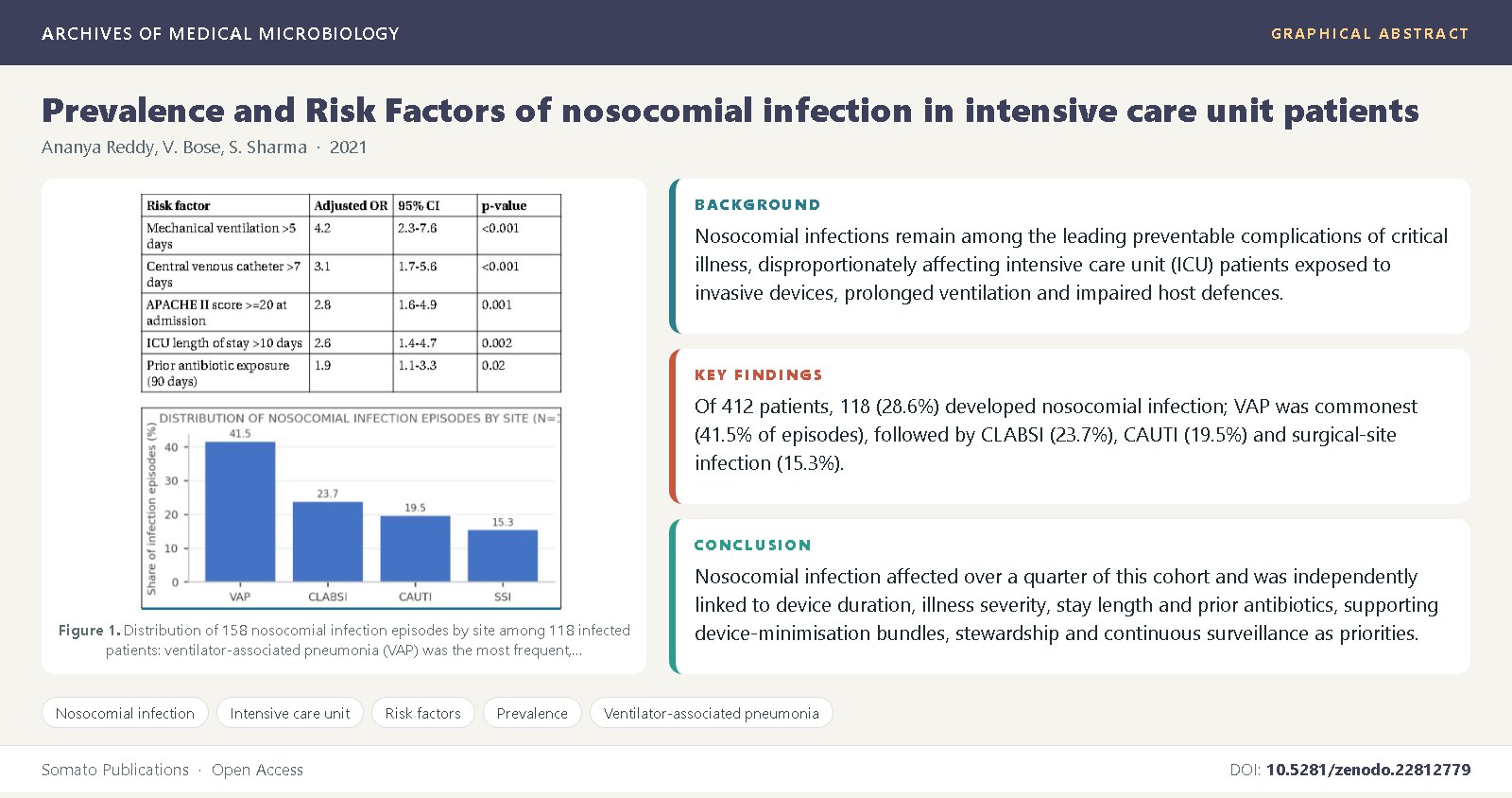
Background: Nosocomial infections remain among the leading preventable complications of critical illness, disproportionately affecting intensive care unit (ICU) patients exposed to invasive devices, prolonged ventilation and impaired host defences. Local prevalence and risk-factor data are needed to target infection-control resources.
Methods: A prospective observational study was conducted over 12 months in a mixed medical-surgical ICU. Patients admitted for over 48 hours were screened daily using CDC/NHSN definitions for ventilator-associated pneumonia (VAP), central-line-associated bloodstream infection (CLABSI), catheter-associated urinary tract infection (CAUTI) and surgical-site infection. Multivariable logistic regression identified independent risk factors for infection.
Results: Of 412 patients, 118 (28.6%) developed nosocomial infection; VAP was commonest (41.5% of episodes), followed by CLABSI (23.7%), CAUTI (19.5%) and surgical-site infection (15.3%). Gram-negative organisms, led by Acinetobacter baumannii, Klebsiella pneumoniae and Pseudomonas aeruginosa, predominated, with substantial multidrug resistance. Independent predictors were mechanical ventilation >5 days (aOR 4.2), central line >7 days (aOR 3.1), APACHE II >=20 (aOR 2.8), ICU stay >10 days (aOR 2.6) and prior antibiotics (aOR 1.9), all p<0.05. Infected patients had higher mortality (34.7% vs 14.1%, p<0.001).
Conclusion: Nosocomial infection affected over a quarter of this cohort and was independently linked to device duration, illness severity, stay length and prior antibiotics, supporting device-minimisation bundles, stewardship and continuous surveillance as priorities.
References
Vincent JL, Rello J, Marshall J, Silva E, Anzueto A, Martin CD, et al. (2009) International study of the prevalence and outcomes of infection in intensive care units. JAMA, 302(21): 2323-2329. DOI: 10.1001/jama.2009.1754
Vincent JL, Bihari DJ, Suter PM, Bruining HA, White J, Nicolas-Chanoin MH, et al. (1995) The prevalence of nosocomial infection in intensive care units in Europe. Results of the European Prevalence of Infection in Intensive Care (EPIC) Study. JAMA, 274(8): 639-644.
Klevens RM, Edwards JR, Richards CL Jr, Horan TC, Gaynes RP, Pollock DA, et al. (2007) Estimating health care-associated infections and deaths in U.S. hospitals, 2002. Public Health Reports, 122(2): 160-166. DOI: 10.1177/003335490712200205
Magill SS, Edwards JR, Bamberg W, Beldavs ZG, Dumyati G, Kainer MA, et al. (2014) Multistate point-prevalence survey of health care-associated infections. New England Journal of Medicine, 370(13): 1198-1208. DOI: 10.1056/NEJMoa1306801
Rosenthal VD, Maki DG, Jamulitrat S, Medeiros EA, Todi SK, Gomez DY, et al. (2010) International Nosocomial Infection Control Consortium (INICC) report, data summary for 2003-2008. American Journal of Infection Control, 38(2): 95-104. DOI: 10.1016/j.ajic.2009.12.004
Rosenthal VD, Al-Abdely HM, El-Kholy AA, AlKhawaja SAA, Leblebicioglu H, Mehta Y, et al. (2016) International Nosocomial Infection Control Consortium (INICC) report, data summary of 50 countries for 2010-2015. American Journal of Infection Control, 44(12): 1495-1504. DOI: 10.1016/j.ajic.2016.08.007
Vincent JL. (2003) Nosocomial infections in adult intensive-care units. Lancet, 361(9374): 2068-2077. DOI: 10.1016/S0140-6736(03)13644-6
Chastre J, Fagon JY. (2002) Ventilator-associated pneumonia. American Journal of Respiratory and Critical Care Medicine, 165(7): 867-903. DOI: 10.1164/ajrccm.165.7.2105078
Klompas M. (2013) Complications of mechanical ventilation--the CDC's new surveillance paradigm. New England Journal of Medicine, 368(16): 1472-1475. DOI:
1056/NEJMp1300633 10. Safdar N, Kluger DM, Maki DG. (2002) A review of risk factors for catheter-related bloodstream infection caused by percutaneously inserted, noncuffed central venous catheters. Medicine, 81(6): 466-479.
Mermel LA. (2000) Prevention of intravascular catheter-related infections. Annals of Internal Medicine, 132(5): 391-402. DOI: 10.7326/0003-4819-132-5-200003070-00009
Pittet D, Hugonnet S, Harbarth S, Mourouga P, Sauvan V, Touveneau S, et al. (2000) Effectiveness of a hospital-wide programme to improve compliance with hand hygiene. Lancet, 356(9238): 1307-1312. DOI: 10.1016/S0140-6736(00)02814-2
Trautner BW, Darouiche RO. (2004) Catheter-associated urinary tract infection: pathogenesis affects prevention. Archives of Internal Medicine, 164(8): 842-850. DOI: 10.1001/archinte.164.8.842
Gaynes R, Edwards JR. (2005) Overview of nosocomial infections caused by gram-negative bacilli. Clinical Infectious Diseases, 41(6): 848-854. DOI: 10.1086/432803
Weinstein RA. (1998) Nosocomial infection update. Emerging Infectious Diseases, 4(3): 416-420. DOI: 10.3201/eid0403.980320
Blot S, Vandewoude K, Colardyn F. (2003) Nosocomial bacteremia involving Acinetobacter baumannii in critically ill patients: a matched cohort study. Intensive Care Medicine, 29(3): 471-475. DOI: 10.1007/s00134-003-1621-8
Kollef MH. (2004) Prevention of hospital-associated pneumonia and ventilator-associated pneumonia. Critical Care Medicine, 32(6): 1396-1405. DOI: 10.1097/01.ccm.0000128569.09113.fb
Rello J, Ollendorf DA, Oster G, Vera-Llonch M, Bellm L, Redman R, et al. (2002) Epidemiology and outcomes of ventilator-associated pneumonia in a large US database. Chest, 122(6): 2115-2121. DOI: 10.1378/chest.122.6.2115
Timsit JF, Soubirou JF, Voiriot G, Chemam S, Neuville M, Mourvillier B, et al. (2014) Treatment of bloodstream infections in ICUs. BMC Infectious Diseases, 14: 489. DOI: 10.1186/1471-2334-14-489
Vincent JL, Sakr Y, Sprung CL, Ranieri VM, Reinhart K, Gerlach H, et al. (2006) Sepsis in European intensive care units: results of the SOAP study. Critical Care Medicine, 34(2): 344-353. DOI: 10.1097/01.ccm.0000194725.48928.3a
Alberti C, Brun-Buisson C, Burchardi H, Martin C, Goodman S, Artigas A, et al. (2002) Epidemiology of sepsis and infection in ICU patients from an international multicentre cohort study. Intensive Care Medicine, 28(2): 108-121. DOI: 10.1007/s00134-001-1143-z
Erbay H, Yalcin AN, Serin S, Turgut H, Tomatir E, Cetin B, et al. (2003) Nosocomial infections in intensive care unit in a Turkish university hospital: a 2-year survey. Intensive Care Medicine, 29(9): 1482-1488. DOI: 10.1007/s00134-003-1858-2
Sydnor ERM, Perl TM. (2011) Hospital epidemiology and infection control in acute-care settings. Clinical Microbiology Reviews, 24(1): 141-173. DOI: 10.1128/CMR.00027-10
Fagon JY, Chastre J, Domart Y, Trouillet JL, Pierre J, Darne C, et al. (1989) Nosocomial pneumonia in patients receiving continuous mechanical ventilation: prospective analysis of 52 episodes with use of a protected specimen brush and quantitative culture techniques. American Review of Respiratory Disease, 139(4): 877-884. DOI: 10.1164/ajrccm/139.4.877
Girou E, Stephan F, Novara A, Safar M, Fagon JY. (1998) Risk factors and outcome of nosocomial infections: results of a matched case-control study of ICU patients. American Journal of Respiratory and Critical Care Medicine, 157(4 Pt 1): 1151-1158. DOI: 10.1164/ajrccm.157.4.9701129
Craven DE, Steger KA. (1995) Epidemiology of nosocomial pneumonia. New perspectives on an old disease. Chest, 108(2 Suppl): 1S-16S. DOI: 10.1378/chest.108.2_Supplement.1S
Legras A, Malvy D, Quinioux AI, Villers D, Bouachour G, Robert R, et al. (1998) Nosocomial infections: prospective survey of incidence in five French intensive care units. Intensive Care Medicine, 24(10): 1040-1046. DOI: 10.1007/s001340050713
Cook D, Walter S, Cook R, Griffith L, Guyatt G, Leasa D, et al. (1998) Incidence of and risk factors for ventilator-associated pneumonia in critically ill patients. Annals of Internal Medicine, 129(6): 433-440. DOI: 10.7326/0003-4819-129-6-199809150-00002
Craven DE, Kunches LM, Kilinsky V, Lichtenberg DA, Make BJ, McCabe WR. (1986) Risk factors for pneumonia and fatality in patients receiving continuous mechanical ventilation. American Review of Respiratory Disease, 133(5): 792-796.
Freeman J, McGowan JE Jr. (1978) Risk factors for nosocomial infection. Journal of Infectious Diseases, 138(6): 811-819. DOI: 10.1093/infdis/138.6.811
Allegranzi B, Nejad SB, Combescure C, Graafmans W, Attar H, Donaldson L, et al. (2011) Burden of endemic health-care-associated infection in developing countries: systematic review and meta-analysis. Lancet, 377(9761): 228-241. DOI: 10.1016/S0140-6736(10)61458-4
Richards MJ, Edwards JR, Culver DH, Gaynes RP. (2000) Nosocomial infections in combined medical-surgical intensive care units in the United States. Infection Control and Hospital Epidemiology, 21(8): 510-515. DOI: 10.1086/501795
Richards MJ, Edwards JR, Culver DH, Gaynes RP. (1999) Nosocomial infections in medical intensive care units in the United States. National Nosocomial Infections Surveillance System. Critical Care Medicine, 27(5): 887-892. DOI: 10.1097/00003246-199905000-00020
World Health Organization. (2011) Report on the Burden of Endemic Health Care-Associated Infection Worldwide. Geneva: World Health Organization.
Kollef MH, Fraser VJ. (2001) Antibiotic resistance in the intensive care unit. Annals of Internal Medicine, 134(4): 298-314. DOI: 10.7326/0003-4819-134-4-200102200-00014

Published
Issue
Section
License
Copyright (c) 2021 Ananya Reddy, et al.

This work is licensed under a Creative Commons Attribution 4.0 International License.


