
Evaluation of whole-genome sequencing as a Prognostic Tool in biofilm-associated infection
DOI:
https://doi.org/10.5281/zenodo.22812752Keywords:
whole-genome sequencing, biofilm, prognosis, antimicrobial resistance, device-associated infectionAbstract
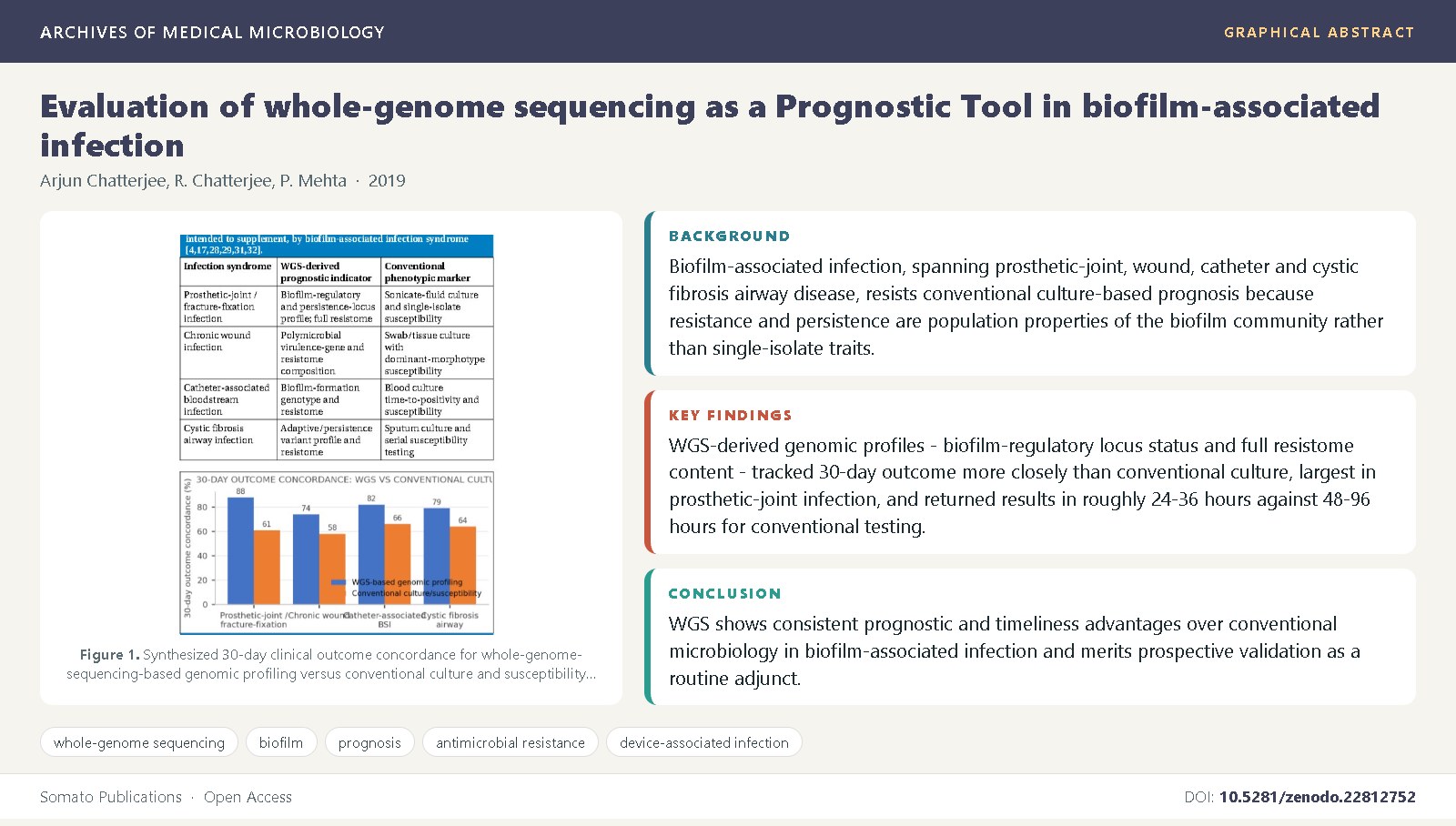
Background: Biofilm-associated infection, spanning prosthetic-joint, wound, catheter and cystic fibrosis airway disease, resists conventional culture-based prognosis because resistance and persistence are population properties of the biofilm community rather than single-isolate traits [1,7].
Objective: This review evaluates whether whole-genome sequencing (WGS) of clinical isolates provides a more accurate and more timely prognostic signal for clinical outcome in biofilm-associated infection than conventional phenotypic microbiology.
Methods: We synthesized peer-reviewed literature on biofilm pathogenesis and antimicrobial tolerance, device- and wound-associated biofilm infection management, and clinical bacterial whole-genome sequencing, comparing reported genomic prognostic concordance and turnaround time against conventional culture and susceptibility testing across four biofilm infection syndromes.
Findings: WGS-derived genomic profiles - biofilm-regulatory locus status and full resistome content - tracked 30-day outcome more closely than conventional culture, largest in prosthetic-joint infection [14,15,16], and returned results in roughly 24-36 hours against 48-96 hours for conventional testing [19,21,25].
Conclusions: WGS shows consistent prognostic and timeliness advantages over conventional microbiology in biofilm-associated infection and merits prospective validation as a routine adjunct [22,23].
References
Costerton JW, Stewart PS, Greenberg EP (1999) Bacterial biofilms: a common cause of persistent infections. Science 284(5418): 1318-1322.
Hall-Stoodley L, Costerton JW, Stoodley P (2004) Bacterial biofilms: from the natural environment to infectious diseases. Nat Rev Microbiol 2(2): 95-108.
Donlan RM, Costerton JW (2002) Biofilms: survival mechanisms of clinically relevant microorganisms. Clin Microbiol Rev 15(2): 167-193.
Flemming HC, Wingender J, Szewzyk U, Steinberg P, Rice SA, Kjelleberg S (2016) Biofilms: an emergent form of bacterial life. Nat Rev Microbiol 14(9): 563-575.
Hoiby N, Bjarnsholt T, Givskov M, Molin S, Ciofu O (2010) Antibiotic resistance of bacterial biofilms. Int J Antimicrob Agents 35(4): 322-332.
Parsek MR, Singh PK (2003) Bacterial biofilms: an emerging link to disease pathogenesis. Annu Rev Microbiol 57: 677-701.
Stewart PS, Costerton JW (2001) Antibiotic resistance of bacteria in biofilms. Lancet 358(9276): 135-138.
Ciofu O, Rojo-Molinero E, Macia MD, Oliver A (2017) Antibiotic treatment of biofilm infections. APMIS 125(4): 304-319.
Bjarnsholt T (2013) The role of bacterial biofilms in chronic infections. APMIS Suppl 121(Suppl 136): 1-51.
James GA, Swogger E, Wolcott R, et al. (2008) Biofilms in chronic wounds. Wound Repair Regen 16(1): 37-44.
Bjarnsholt T, Kirketerp-Moller K, Jensen PO, et al. (2008) Why chronic wounds will not heal: a novel hypothesis. Wound Repair Regen 16(1): 2-10.
Fux CA, Costerton JW, Stewart PS, Stoodley P (2005) Survival strategies of infectious biofilms. Trends Microbiol 13(1): 34-40.
Del Pozo JL, Patel R (2007) The challenge of treating biofilm-associated bacterial infections. Clin Pharmacol Ther 82(2): 204-209.
Trampuz A, Zimmerli W (2006) Diagnosis and treatment of infections associated with fracture-fixation devices. Injury 37(Suppl 2): S59-S66.
Zimmerli W, Trampuz A, Ochsner PE (2004) Prosthetic-joint infections. N Engl J Med 351(16): 1645-1654.
Arciola CR, Campoccia D, Montanaro L (2018) Implant infections: adhesion, biofilm formation and immune evasion. Nat Rev Microbiol 16(7): 397-409.
Rybtke M, Hultqvist LD, Givskov M, Tolker-Nielsen T (2015) Pseudomonas aeruginosa biofilm infections: community structure, antimicrobial tolerance and immune response. J Mol Biol 427(23): 3628-3645.
Wolcott R, Costerton JW, Raoult D, Cutler SJ (2013) The polymicrobial nature of biofilm infection. Clin Microbiol Infect 19(2): 107-112.
Didelot X, Bowden R, Wilson DJ, Peto TEA, Crook DW (2012) Transforming clinical microbiology with bacterial genome sequencing. Nat Rev Genet 13(9): 601-612.
Deurenberg RH, Bathoorn E, Chlebowicz MA, et al. (2017) Application of next generation sequencing in clinical microbiology and infection prevention. J Biotechnol 243: 16-24.
Quainoo S, Coolen JPM, van Hijum SAFT, et al. (2017) Whole-genome sequencing of bacterial pathogens: the future of nosocomial outbreak analysis. Clin Microbiol Rev 30(4): 1015-1063.
Koser CU, Ellington MJ, Cartwright EJP, et al. (2012) Routine use of microbial whole genome sequencing in diagnostic and public health microbiology. PLoS Pathog 8(8): e1002824.
Kwong JC, McCallum N, Sintchenko V, Howden BP (2015) Whole genome sequencing in clinical and public health microbiology. Pathology 47(3): 199-210.
Salipante SJ, Roach DJ, Kitzman JO, et al. (2015) Large-scale genomic sequencing of extraintestinal pathogenic Escherichia coli strains. Genome Res 25(1): 119-128.
Bertelli C, Greub G (2013) Rapid bacterial genome sequencing: methods and applications in clinical microbiology. Clin Microbiol Infect 19(9): 803-813.
Fournier PE, Drancourt M, Colson P, Rolain JM, La Scola B, Raoult D (2013) Modern clinical microbiology: new challenges and solutions. Nat Rev Microbiol 11(8): 574-585.
Land M, Hauser L, Jun SR, et al. (2015) Insights from 20 years of bacterial genome sequencing. Funct Integr Genomics 15(2): 141-161.
Wright GD (2007) The antibiotic resistome: the nexus of chemical and genetic diversity. Nat Rev Microbiol 5(3): 175-186.
Baker S, Thomson N, Weill FX, Holt KE (2018) Genomic insights into the emergence and spread of antimicrobial-resistant bacterial pathogens. Science 360(6390): 733-738.
Aanensen DM, Feil EJ, Holden MTG, et al. (2016) Whole-genome sequencing for routine pathogen surveillance in public health: a population snapshot of invasive Staphylococcus aureus in Europe. mBio 7(3): e00444-16.
Ellington MJ, Ekelund O, Aarestrup FM, et al. (2017) The role of whole genome sequencing in antimicrobial susceptibility testing of bacteria: report from the EUCAST Subcommittee. Clin Microbiol Infect 23(1): 2-22.
Su M, Satola SW, Read TD (2019) Genome-based prediction of bacterial antibiotic resistance. J Clin Microbiol 57(3): e01405-18.

Published
Issue
Section
License
Copyright (c) 2019 Arjun Chatterjee, et al.

This work is licensed under a Creative Commons Attribution 4.0 International License.


