
Iron Overload, Heme Oxygenase-1 Expression and Drug Resistance in Acute Leukemia
DOI:
https://doi.org/10.5281/zenodo.22247851Keywords:
Acute Leukaemia, Iron Overload, Heme Oxygenase-1, Serum Ferritin, ChemoresistanceAbstract
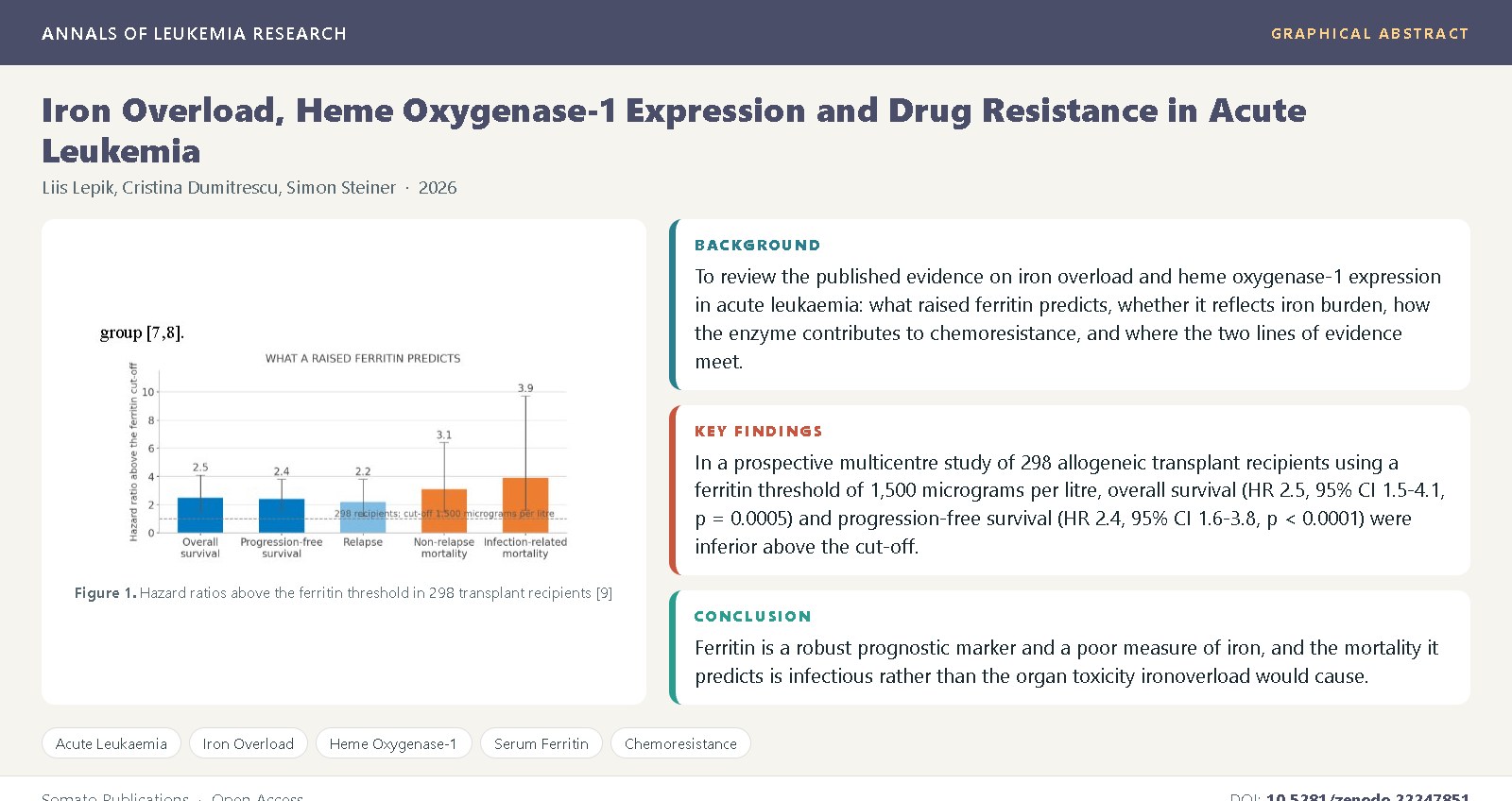
Serum ferritin before transplantation predicts death with unusual reliability, and it is routinely read as a measure of iron overload. The pattern of that mortality, and what direct iron measurement shows, suggest a substantial part of the signal is inflammation rather than iron, which decides whether chelation could help. Objectives: To review the published evidence on iron overload and heme oxygenase-1 expression in acute leukaemia: what raised ferritin predicts, whether it reflects iron burden, how the enzyme contributes to chemoresistance, and where the two lines of evidence meet. Material and Methods: Narrative review of prospective and retrospective transplant cohorts, imaging studies, laboratory work and systematic reviews indexed in PubMed and the major haematology journals. Studies were eligible if they reported the association between iron status or heme oxygenase-1 expression and outcome or drug sensitivity in a defined acute leukaemia or myelodysplastic syndrome population. No new patient data were generated and no patients were recruited; every estimate quoted is one published by the original investigators. Results: In a prospective multicentre study of 298 allogeneic transplant recipients using a ferritin threshold of 1,500 micrograms per litre, overall survival (HR 2.5, 95% CI 1.5-4.1, p = 0.0005) and progression-free survival (HR 2.4, 95% CI 1.6-3.8, p < 0.0001) were inferior above the cut-off, with excess mortality from
both higher relapse (HR 2.2) and higher non-relapse mortality (HR 3.1), the latter driven by infection-related death (HR 3.9, 95% CI 1.6-9.7, p = 0.003). Neither the incidence nor the severity of graft-versus-host disease was associated with ferritin. In a prospective imaging study, ferritin correlated with estimated liver iron concentration at r = 0.75, largely dependent on transfusion history, while labile plasma iron elevation was rare and hepcidin was appropriately raised. In laboratory work, a cytarabine and daunorubicin-resistant cell line showed high heme oxygenase-1 expression, and silencing the gene restored chemosensitivity with reduced hypoxia-inducible factor 1-alpha and glucose transporter 1, increased caspase-3 and caspase-8 and decreased BCL-2. Conclusion: Ferritin is a robust prognostic marker and a poor measure of iron, and the mortality it predicts is infectious rather than the organ toxicity iron
overload would cause. Heme oxygenase-1 sits at the junction of the two, being both an iron-releasing enzyme and a stress-response gene conferring resistance. Abbreviations: AML – Acute Myeloid Leukaemia, ALL – Acute Lymphoblastic Leukaemia, MDS – Myelodysplastic Syndrome, HO-1 – Heme Oxygenase-1, NRF2 – Nuclear Factor Erythroid 2-Related Factor 2, HIF-1α – Hypoxia-Inducible Factor 1-Alpha, GLUT1 – Glucose Transporter 1, LIC – Liver Iron Concentration, LPI – Labile Plasma Iron, SF – Serum Ferritin, NRM – Non-Relapse Mortality, GVHD – Graft-Versus-Host Disease, alloSCT – Allogeneic Stem Cell Transplantation, ROS – Reactive Oxygen Species.
References
Pullarkat, V. (2010) Iron overload in hematologic malignancies and outcome of allogeneic hematopoietic stem cell transplantation. Haematologica, 95(4): 529-531.
Steensma, DP. (2011) The relevance of iron overload and the appropriateness of iron chelation therapy for patients with myelodysplastic syndromes: a dialogue and debate. Curr Hematol Malig Rep, 6(2): 136-144.
Brittenham, GM. (2011) Iron-chelating therapy for transfusional iron overload. N Engl J Med, 364(2): 146-156.
Olivieri, NF., Brittenham, GM. (1997) Iron-chelating therapy and the treatment of thalassemia. Blood, 89(3): 739-761.
Wang, W., Knovich, MA., Coffman, LG., Torti, FM., Torti, SV. (2010) Serum ferritin: past, present and future. Biochim Biophys Acta, 1800(8): 760-769.
Koperdanova, M., Cullis, JO. (2015) Interpreting raised serum ferritin levels. BMJ, 351: h3692.
Armand, P., Kim, HT., Cutler, CS., Ho, VT., Koreth, J., Alyea, EP., et al. (2007) Prognostic impact of elevated pretransplantation serum ferritin in patients undergoing myeloablative stem cell transplantation. Blood, 109(10): 4586-4588.
Alessandrino, EP., Della Porta, MG., Bacigalupo, A., Malcovati, L., Angelucci, E., Van Lint, MT., et al. (2010) Prognostic impact of pre-transplantation transfusion history and secondary iron overload in patients with myelodysplastic syndrome undergoing allogeneic stem cell transplantation. Haematologica, 95(3): 476-484.
Penack, O., Peczynski, C., van der Werf, S., Finke, J., Ganser, A., Schoemans, H., et al. (2020) Association of serum ferritin levels before start of conditioning with mortality after alloSCT: a prospective, non-interventional study of the EBMT Transplant Complications Working Party. Front Immunol, 11: 586.
Armand, P., Sainvil, MM., Kim, HT., Rhodes, J., Cutler, C., Ho, VT., et al. (2011) Iron overload in patients with acute leukemia or MDS undergoing myeloablative stem cell transplantation. Biol Blood Marrow Transplant, 17(6): 852-860.
Ganz, T., Nemeth, E. (2015) Iron homeostasis in host defence and inflammation. Nat Rev Immunol, 15(8): 500-510.
Rushworth, SA., MacEwan, DJ. (2008) HO-1 underlies resistance of AML cells to TNF-induced apoptosis. Blood, 111(7): 3793-3801.
Wei, S., Wang, Y., Chai, Q., Fang, Q., Zhang, Y., Wang, J. (2015) Heme oxygenase-1 plays a crucial role in chemoresistance in acute myeloid leukemia. Hematology, 20(7): 384-391.
Chiang, SK., Chen, SE., Chang, LC. (2018) A dual role of heme oxygenase-1 in cancer cells. Int J Mol Sci, 20(1): 39.
Ferrara, JLM., Levine, JE., Reddy, P., Holler, E. (2009) Graft-versus-host disease. Lancet, 373(9674): 1550-1561.
Tomblyn, M., Chiller, T., Einsele, H., Gress, R., Sepkowitz, K., Storek, J., et al. (2009) Guidelines for preventing infectious complications among hematopoietic cell transplantation recipients: a global perspective. Biol Blood Marrow Transplant, 15(10): 1143-1238.
Kernan, KF., Carcillo, JA. (2017) Hyperferritinemia and inflammation. Int Immunol, 29(9): 401-409.
Cheng, PP., Sun, ZZ., Jiang, F., Tang, YT., Jiao, XY. (2024) Impact of serum ferritin and iron overload on acute myeloid leukemia outcomes: a systematic review and meta-analysis. Ann Hematol, 103(11): 4407-4419.
Zhang, T., Fang, Q., Liu, P., Wang, P., Feng, C., Wang, J. (2022) Heme oxygenase 1 overexpression induces immune evasion of acute myeloid leukemia against natural killer cells by inhibiting CD48. J Transl Med, 20(1): 402.
Rahimi, A., Esmaeili, Y., Dana, N., Manian, M., Mirzaei, Z., Sharifi, M., et al. (2024) The sensitivity of acute myeloid leukemia cells to cytarabine is increased by suppressing the expression of heme oxygenase-1 and hypoxia-inducible factor 1-alpha. Cancer Cell Int, 24(1): 216.
Loboda, A., Damulewicz, M., Pyza, E., Jozkowicz, A., Dulak, J. (2016) Role of Nrf2/HO-1 system in development, oxidative stress response and diseases: an evolutionarily conserved mechanism. Cell Mol Life Sci, 73(17): 3221-3247.
Yusenko, MV., Trentmann, A., Casolari, DA., Abdel Ghani, L., Lenz, M., Horn, M., et al. (2023) Susceptibility of acute myeloid leukemia cells to ferroptosis and evasion strategies. Front Mol Biosci, 10: 1275774.
Tachibana, T., Andou, T., Tanaka, M., Ito, S., Miyazaki, T., Ishii, Y., et al. (2018) Clinical significance of serum ferritin at diagnosis in patients with acute myeloid leukemia: a YACHT multicenter retrospective study. Clin Lymphoma Myeloma Leuk, 18(6): 415-421.
Meyer, SC., O’Meara, A., Buser, AS., Tichelli, A., Passweg, JR., Stern, M. (2013) Prognostic impact of posttransplantation iron overload after allogeneic stem cell transplantation. Biol Blood Marrow Transplant, 19(3): 440-444.
Sivgin, S., Eser, B. (2013) The management of iron overload in allogeneic hematopoietic stem cell transplant recipients: where do we stand? Ann Hematol, 92(5): 577-586.
Majhail, NS., Lazarus, HM., Burns, LJ. (2008) Iron overload in hematopoietic cell transplantation. Bone Marrow Transplant, 41(12): 997-1003.
Kanda, J., Mizumoto, C., Kawabata, H., Tsuchida, H., Tomosugi, N., Matsuo, K., et al. (2009) Serum hepcidin level and erythropoietic activity after hematopoietic stem cell transplantation. Haematologica, 94(12): 1697-1700.
Torti, SV., Torti, FM. (2013) Iron and cancer: more ore to be mined. Nat Rev Cancer, 13(5): 342-355.
Dixon, SJ., Lemberg, KM., Lamprecht, MR., Skouta, R., Zaitsev, EM., Gleason, CE., et al. (2012) Ferroptosis: an iron-dependent form of nonapoptotic cell death. Cell, 149(5): 1060-1072.
Sallmyr, A., Fan, J., Datta, K., Kim, KT., Grosu, D., Shapiro, P., et al. (2008) Internal tandem duplication of FLT3 (FLT3/ITD) induces increased ROS production, DNA damage, and misrepair: implications for poor prognosis in AML. Blood, 111(6): 3173-3182.
Zhang, H., Zhabyeyev, P., Wang, S., Oudit, GY. (2019) Role of iron metabolism in heart failure: from iron deficiency to iron overload. Biochim Biophys Acta Mol Basis Dis, 1865(7): 1925-1937.
Döhner, H., Wei, AH., Appelbaum, FR., Craddock, C., DiNardo, CD., Dombret, H., et al. (2022) Diagnosis and management of AML in adults: 2022 recommendations from an international expert panel on behalf of the ELN. Blood, 140(12): 1345-1377.
Kantarjian, H., Kadia, T., DiNardo, C., Daver, N., Borthakur, G., Jabbour, E., et al. (2021) Acute myeloid leukemia: current progress and future directions. Blood Cancer J, 11: 41.
Konopleva, MY., Jordan, CT. (2011) Leukemia stem cells and microenvironment: biology and therapeutic targeting. J Clin Oncol, 29(5): 591-599.





