
Evaluation of PCR-based surveillance as a Prognostic Tool in malaria
DOI:
https://doi.org/10.5281/zenodo.22811672Keywords:
malaria, polymerase chain reaction, molecular surveillance, parasitemia, diagnostic sensitivityAbstract
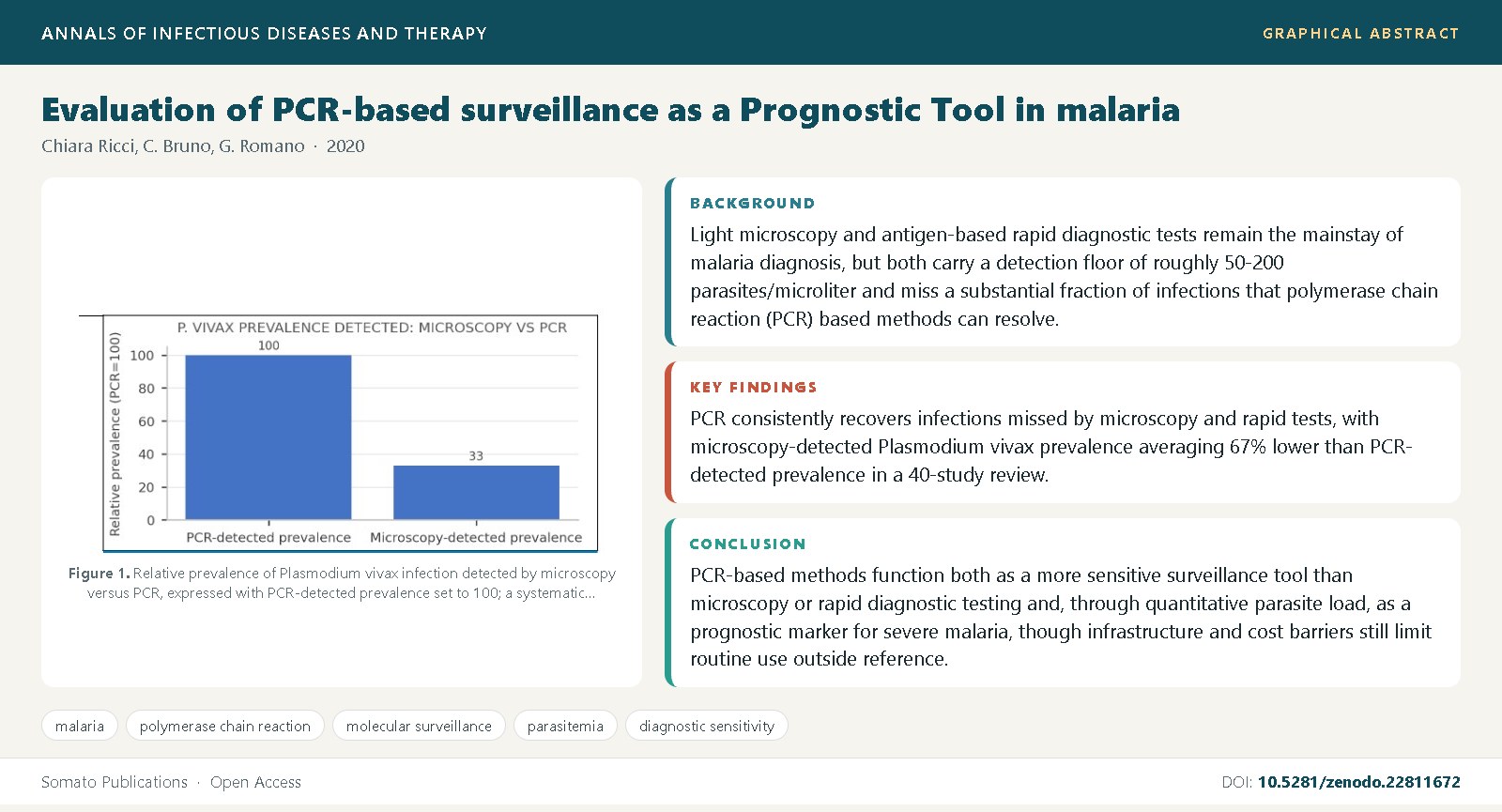
Background: Light microscopy and antigen-based rapid diagnostic tests remain the mainstay of malaria diagnosis, but both carry a detection floor of roughly 50-200 parasites/microliter and miss a substantial fraction of infections that polymerase chain reaction (PCR) based methods can resolve [1,2].
Objective: This review synthesizes the published evidence on PCR-based detection and quantification of Plasmodium species as a surveillance tool, and on whether PCR-derived parasite load carries prognostic value for disease severity.
Methods: We synthesized assay-development and validation studies, field comparisons of microscopy, rapid diagnostic tests and PCR, systematic reviews of submicroscopic infection, and clinical studies relating parasite DNA load to malaria severity, as a narrative synthesis of the 1993-2018 diagnostics literature.
Findings: PCR consistently recovers infections missed by microscopy and rapid tests, with microscopy-detected Plasmodium vivax prevalence averaging 67% lower than PCR-detected prevalence in a 40-study review [8]; plasma parasite DNA concentration was approximately 40-fold and 10-fold higher in severe than uncomplicated falciparum malaria among African children and Asian adults respectively [13]; and submicroscopic carriage becomes proportionally more important as transmission intensity falls [15,16].
Conclusions: PCR-based methods function both as a more sensitive surveillance tool than microscopy or rapid diagnostic testing and, through quantitative parasite load, as a prognostic marker for severe malaria, though infrastructure and cost barriers still limit routine use outside reference and research settings [20,22].
References
Wongsrichanalai, C., Barcus, M.J., Muth, S., Sutamihardja, A., Wernsdorfer, W.H. (2007) A review of malaria diagnostic tools: microscopy and rapid diagnostic test (RDT). American Journal of Tropical Medicine and Hygiene, 77(6 Suppl): 119-127. DOI: 10.4269/ajtmh.2007.77.119
Moody, A. (2002) Rapid diagnostic tests for malaria parasites. Clinical Microbiology Reviews, 15(1): 66-78. DOI: 10.1128/cmr.15.1.66-78.2002
Murray, C.K., Gasser, R.A., Magill, A.J., Miller, R.S. (2008) Update on rapid diagnostic testing for malaria. Clinical Microbiology Reviews, 21(1): 97-110. DOI: 10.1128/cmr.00035-07
Cheng, Q., Gatton, M.L., Barnwell, J., Chiodini, P., McCarthy, J., Bell, D., et al. (2014) Plasmodium falciparum parasites lacking histidine-rich protein 2 and 3: a review and recommendations for accurate reporting. Malaria Journal, 13: 283. DOI: 10.1186/1475-2875-13-283
Snounou, G., Viriyakosol, S., Jarra, W., Thaithong, S., Brown, K.N. (1993) Identification of the four human malaria parasite species in field samples by the polymerase chain reaction and detection of a high prevalence of mixed infections. Molecular and Biochemical Parasitology, 58(2): 283-292. DOI: 10.1016/0166-6851(93)90050-8
Snounou, G., Viriyakosol, S., Zhu, X.P., Jarra, W., Pinheiro, L., do Rosario, V.E., et al. (1993) High sensitivity of detection of human malaria parasites by the use of nested polymerase chain reaction. Molecular and Biochemical Parasitology, 61(2): 315-320. DOI: 10.1016/0166-6851(93)90077-B
Berzosa, P., de Lucio, A., Romay-Barja, M., Herrador, Z., González, V., García, L., et al. (2018) Comparison of three diagnostic methods (microscopy, RDT, and PCR) for the detection of malaria parasites in representative samples from Equatorial Guinea. Malaria Journal, 17: 333. DOI: 10.1186/s12936-018-2481-4
Moreira, C.M., Abo-Shehada, M., Price, R.N., Fowkes, F.J.I. (2015) A systematic review of sub-microscopic Plasmodium vivax infection. Malaria Journal, 14: 360. DOI: 10.1186/s12936-015-0884-z
Coleman, R.E., Sattabongkot, J., Promstaporm, S., Maneechai, N., Tippayachai, B., Kengluecha, A., et al. (2006) Comparison of PCR and microscopy for the detection of asymptomatic malaria in a Plasmodium falciparum/vivax endemic area in Thailand. Malaria Journal, 5: 121. DOI:
1186/1475-2875-5-121 10. Rosanas-Urgell, A., Mueller, D., Betuela, I., Barnadas, C., Iga, J., Zimmerman, P.A., et al. (2010) Comparison of diagnostic methods for the detection and quantification of the four sympatric Plasmodium species in field samples from Papua New Guinea. Malaria Journal, 9: 361. DOI: 10.1186/1475-2875-9-361
Singh, B., Kim Sung, L., Matusop, A., Radhakrishnan, A., Shamsul, S.S.G., Cox-Singh, J., et al. (2004) A large focus of naturally acquired Plasmodium knowlesi infections in human beings. Lancet, 363(9414): 1017-1024. DOI: 10.1016/S0140-6736(04)15836-4
Cox-Singh, J., Davis, T.M.E., Lee, K.S., Shamsul, S.S.G., Matusop, A., Ratnam, S., et al. (2008) Plasmodium knowlesi malaria in humans is widely distributed and potentially life threatening. Clinical Infectious Diseases, 46(2): 165-171. DOI: 10.1086/524888
Imwong, M., Woodrow, C.J., Hendriksen, I.C.E., Veenemans, J., Verhoef, H., Faiz, M.A., et al. (2015) Plasma concentration of parasite DNA as a measure of disease severity in falciparum malaria. Journal of Infectious Diseases, 211(7): 1128-1133. DOI: 10.1093/infdis/jiu590
Dondorp, A.M., Desakorn, V., Pongtavornpinyo, W., Sahassananda, D., Silamut, K., Chotivanich, K., et al. (2005) Estimation of the total parasite biomass in acute falciparum malaria from plasma PfHRP2. PLoS Medicine, 2(8): e204. DOI: 10.1371/journal.pmed.0020204
Okell, L.C., Ghani, A.C., Lyons, E., Drakeley, C.J. (2009) Submicroscopic infection in Plasmodium falciparum-endemic populations: a systematic review and meta-analysis. Journal of Infectious Diseases, 200(10): 1509-1517. DOI: 10.1086/644781
Okell, L.C., Bousema, T., Griffin, J.T., Ouédraogo, A.L., Ghani, A.C., Drakeley, C.J. (2012) Factors determining the occurrence of submicroscopic malaria infections and their relevance for control. Nature Communications, 3: 1237. DOI: 10.1038/ncomms2241
Perandin, F., Manca, N., Calderaro, A., Piccolo, G., Galati, L., Ricci, L., et al. (2004) Development of a real-time PCR assay for detection of Plasmodium falciparum, Plasmodium vivax, and Plasmodium ovale for routine clinical diagnosis. Journal of Clinical Microbiology, 42(3): 1214-1219. DOI: 10.1128/jcm.42.3.1214-1219.2004
Mangold, K.A., Manson, R.U., Koay, E.S., Stephens, L., Regner, M., Thomson, R.B., et al. (2005) Real-time PCR for detection and identification of Plasmodium spp. Journal of Clinical Microbiology, 43(5): 2435-2440. DOI: 10.1128/jcm.43.5.2435-2440.2005
Imwong, M., Hanchana, S., Malleret, B., Rénia, L., Day, N.P.J., Dondorp, A., et al. (2014) High-throughput ultrasensitive molecular techniques for quantifying low-density malaria parasitemias. Journal of Clinical Microbiology, 52(9): 3303-3309. DOI: 10.1128/jcm.01057-14
Hofmann, N., Mwingira, F., Shekalaghe, S., Robinson, L.J., Mueller, I., Felger, I. (2015) Ultra-sensitive detection of Plasmodium falciparum by amplification of multi-copy subtelomeric targets. PLoS Medicine, 12(3): e1001788. DOI: 10.1371/journal.pmed.1001788
Steenkeste, N., Incardona, S., Chy, S., Duval, L., Ekala, M.T., Lim, P., et al. (2009) Towards high-throughput molecular detection of Plasmodium: new approaches and molecular markers. Malaria Journal, 8: 86. DOI: 10.1186/1475-2875-8-86
McMorrow, M.L., Aidoo, M., Kachur, S.P. (2011) Malaria rapid diagnostic tests in elimination settings-can they find the last parasite? Clinical Microbiology and Infection, 17(11): 1624-1631. DOI: 10.1111/j.1469-0691.2011.03639.x
Slater, H.C., Ross, A., Ouédraogo, A.L., White, L.J., Nguon, C., Walker, P.G.T., et al. (2015) Assessing the impact of next-generation rapid diagnostic tests on Plasmodium falciparum malaria elimination strategies. Nature, 528(7580): S94-S101. DOI: 10.1038/nature16040
Tangpukdee, N., Duangdee, C., Wilairatana, P., Krudsood, S. (2009) Malaria diagnosis: a brief review. Korean Journal of Parasitology, 47(2): 93-102. DOI: 10.3347/kjp.2009.47.2.93

Published
Issue
Section
License
Copyright (c) 2020 Chiara Ricci, et al.

This work is licensed under a Creative Commons Attribution 4.0 International License.


