
Evaluation of Pathogen-Reduced Whole Blood for Field Transfusion in Trauma Care
DOI:
https://doi.org/10.5281/zenodo.22818827Keywords:
whole blood, pathogen reduction, trauma resuscitation, hemostasis, prehospital transfusionAbstract
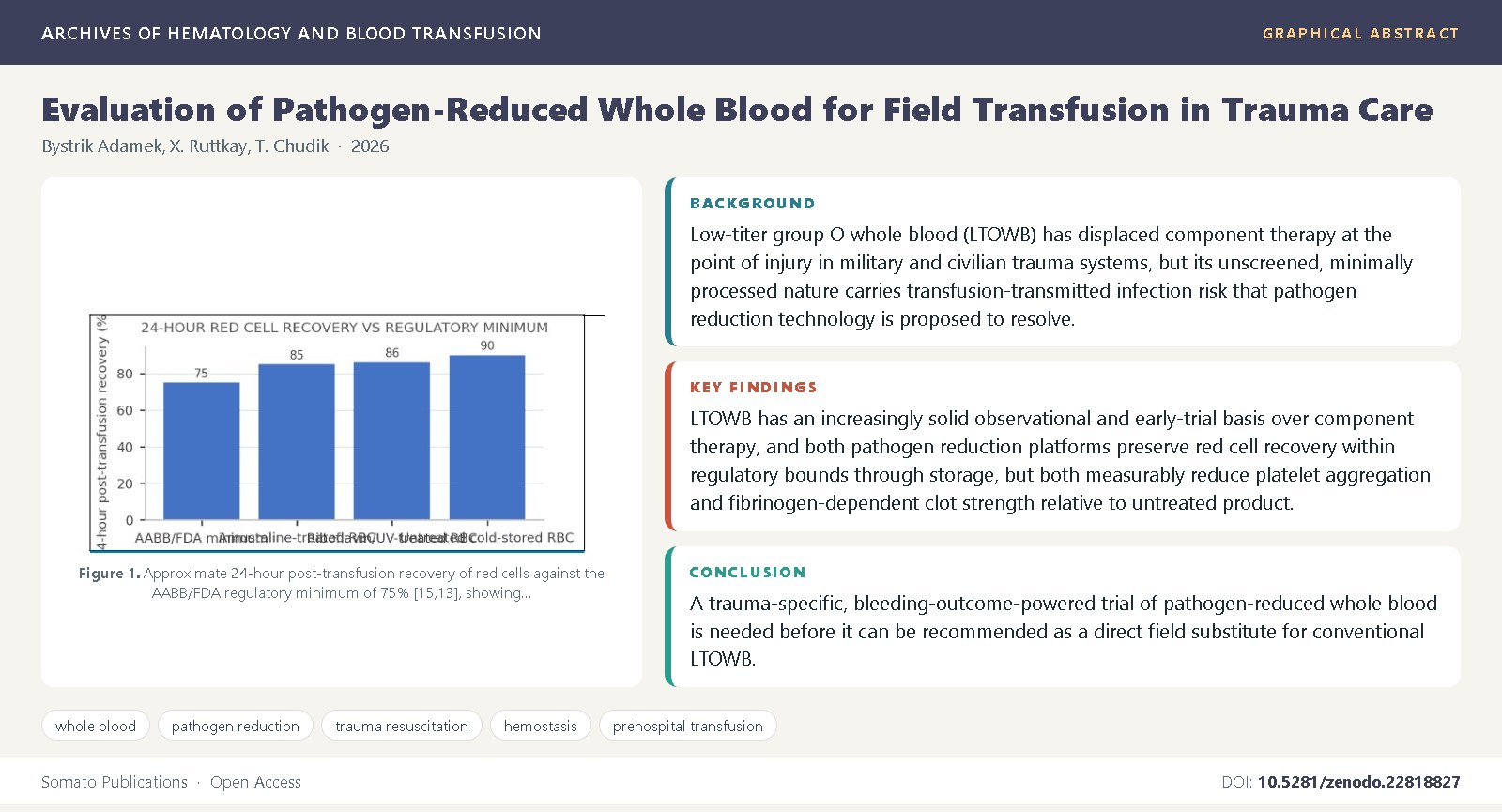
Background: Low-titer group O whole blood (LTOWB) has displaced component therapy at the point of injury in military and civilian trauma systems, but its unscreened, minimally processed nature carries transfusion-transmitted infection risk that pathogen reduction technology is proposed to resolve.
Objective: To synthesize the published evidence on whether pathogen-reduced whole blood, using amustaline/glutathione or riboflavin/UV platforms, preserves the hemostatic performance that makes whole blood valuable for field trauma resuscitation.
Methods: Narrative synthesis of clinical, animal and in vitro literature on LTOWB outcomes in trauma resuscitation and on pathogen reduction chemistries applied to whole blood and whole blood-derived red cells.
Findings: LTOWB has an increasingly solid observational and early-trial basis over component therapy, and both pathogen reduction platforms preserve red cell recovery within regulatory bounds through storage, but both measurably reduce platelet aggregation and fibrinogen-dependent clot strength relative to untreated product.
Conclusions: A trauma-specific, bleeding-outcome-powered trial of pathogen-reduced whole blood is needed before it can be recommended as a direct field substitute for conventional LTOWB.
References
Spinella, P.C., Perkins, J.G., Grathwohl, K.W., Beekley, A.C., Holcomb, J.B. (2009) Warm fresh whole blood is independently associated with improved survival for patients with combat-related traumatic injuries. Journal of Trauma, 66(4 Suppl): S69-S76. DOI: 10.1097/TA.0b013e31819d85fb
Spinella, P.C., Pidcoke, H.F., Strandenes, G., Hervig, T., Fisher, A., Jenkins, D., et al. (2016) Whole blood for hemostatic resuscitation of major bleeding. Transfusion, 56(Suppl 2): S190-S202. DOI: 10.1111/trf.13491
Strandenes, G., Berseus, O., Cap, A.P., Hervig, T., Reade, M., Prat, N., et al. (2014) Low titer group O whole blood in emergency situations. Shock, 41(Suppl 1): 70-75. DOI: 10.1097/SHK.0000000000000150
Pidcoke, H.F., McFaul, S.J., Ramasubramanian, A.K., Parida, B.K., Mora, A.G., Fedyk, C.G., et al. (2013) Primary hemostatic capacity of whole blood: a comprehensive analysis of pathogen reduction and refrigeration effects over time. Transfusion, 53(Suppl 1): 137S-149S. DOI: 10.1111/trf.12048
Cotton, B.A., Reddy, N., Hatch, Q.M., LeFebvre, E., Wade, C.E., Kozar, R.A., et al. (2011) Damage control resuscitation is associated with a reduction in resuscitation volumes and improvement in survival in 390 damage control laparotomy patients. Annals of Surgery, 254(4): 598-605. DOI: 10.1097/SLA.0b013e318230089e
Seheult, J.N., Anto, V., Alarcon, L.H., Sperry, J.L., Triulzi, D.J., Yazer, M.H. (2018) Clinical outcomes among low-titer group O whole blood recipients compared to recipients of conventional components in civilian trauma resuscitation. Transfusion, 58(8): 1838-1845. DOI: 10.1111/trf.14779
Seheult, J.N., Triulzi, D.J., Alarcon, L.H., Sperry, J.L., Murdock, A., Yazer, M.H. (2018) Measurement of haemolysis markers following transfusion of uncrossmatched, cold-stored, low-titer, group O+ whole blood in civilian trauma patients: initial experience at a level 1 trauma centre. Transfusion Medicine, 28(3): 235-241. DOI: 10.1111/tme.12372
Fisher, A.D., Miles, E.A., Cap, A.P., Strandenes, G., Kane, S.F. (2023) Doing more with less: low-titer group O whole blood resulted in less total transfusions and an independent association with survival in adults with severe traumatic hemorrhage. Surgery, 174(3): 555-561.
Crowe, E., DeSantis, S.M., Bonnette, A., Jansen, J.O., Yamal, J.M., Holcomb, J.B., et al. (2020) Whole blood transfusion versus component therapy in trauma resuscitation: a systematic review and meta-analysis. Journal of the American College of Emergency Physicians Open, 1(4): 633-641. DOI:
1002/emp2.12089 10. Gurney, J.M., Staudt, A.M., Del Junco, D.J., Shackelford, S.A., Convertino, V.A., Snow, A., et al. (2022) Prehospital low titer group O whole blood is feasible and safe: results of a prospective randomized pilot trial. Journal of Trauma and Acute Care Surgery, 92(5): 839-847. DOI: 10.1097/TA.0000000000003551
Yazer, M.H., Jenkins, D.H., Cap, A.P. (2019) Low titer group O whole blood for prehospital hemorrhagic shock: it is an offer we cannot refuse. Shock, 52(1S): 22-25. DOI: 10.1111/trf.15408
Sperry, J.L., Guyette, F.X., Yazer, M.H., Brown, J.B., Cotton, B.A., Adams, P.W., et al. (2025) Trauma resuscitation with Low-Titer Group O Whole Blood Or Products: study protocol for a randomized clinical trial (the TROOP trial). Trials, 26(1): 112. DOI: 10.1186/s13063-025-08971-y
Brixner, V., Kiessling, A.H., Madlener, K., Muller, M.M., Points, J., Bux, J., et al. (2018) Red blood cells treated with the amustaline (S-303) pathogen reduction system: a transfusion study in cardiac surgery. Transfusion, 58(4): 905-916. DOI: 10.1111/trf.14528
Reddy, H.L., Dayan, A.D., Cavagnaro, J., Gad, S., Li, J., Goodrich, R.P. (2013) Development of a riboflavin and ultraviolet light-based device to treat whole blood. Transfusion, 53(Suppl 1): 131S-136S. DOI: 10.1111/trf.12047
Cancelas, J.A., Gottschall, J.L., Rugg, N., Graminske, S., Schott, M.A., North, A., et al. (2017) Red blood cells derived from whole blood treated with riboflavin and ultraviolet light maintain adequate survival in vivo after 21 days of storage. Transfusion, 57(5): 1218-1225. DOI: 10.1111/trf.14084
Custer, B., Kamel, H., Kiely, N.E., Murphy, E.L., Bruhn, R., Musso, C., et al. (2022) The Mirasol Evaluation of Reduction in Infections Trial (MERIT): study protocol for a randomized controlled clinical trial. Trials, 23(1): 214. DOI: 10.1186/s13063-022-06137-8
Okoye, O.T., Reddy, S., Wong, M.C.Y., Hilaire, H.S., Batarseh, A., Cotton, B.A., et al. (2015) Large animal evaluation of riboflavin and ultraviolet light-treated whole blood transfusion in a diffuse, nonsurgical bleeding porcine model. Transfusion, 55(9): 2196-2204. DOI: 10.1111/trf.12894
Arbaeen, A.F., Chen, D., Khan, S., Serrano, K., Devine, D.V. (2021) Pathogen reduction of whole blood: supplementing fibrinogen partly corrects clot formation in a massive transfusion model. Transfusion, 61(9): 2652-2662. DOI: 10.1111/trf.16382
Yazer, M.H., Jenkins, D.H., Bank, E.A., Hervig, T., Boissier, L., Rugg, N., et al. (2021) THOR-AABB Working Party recommendations for a prehospital blood product transfusion program. Prehospital Emergency Care, 26(6): 863-875. DOI: 10.1080/10903127.2021.1995089
Yazer, M.H., Spinella, P.C. (2024) It is time to reconsider leukoreduction of whole blood for use in patients with life-threatening hemorrhage. Transfusion, 64(6): 973-978. DOI: 10.1111/trf.18047
Cap, A.P., Pidcoke, H.F., Spinella, P., Strandenes, G., Borgman, M.A., Schreiber, M., et al. (2018) Damage control resuscitation. Military Medicine, 183(suppl_2): 36-43. DOI: 10.1093/milmed/usy112
Weiskopf, R.B. (2013) Transfusion for remote damage control resuscitation. Transfusion, 53(Suppl 1): 208S-215S. DOI: 10.1111/trf.12092

Published
Issue
Section
License
Copyright (c) 2026 Bystrik Adamek, et al.

This work is licensed under a Creative Commons Attribution 4.0 International License.


