
Genomic Landscape of Relapsed Pediatric B-Cell Acute Lymphoblastic Leukemia
DOI:
https://doi.org/10.5281/zenodo.22818794Keywords:
B-cell ALL, relapse, clonal evolution, NT5C2, IKZF1Abstract
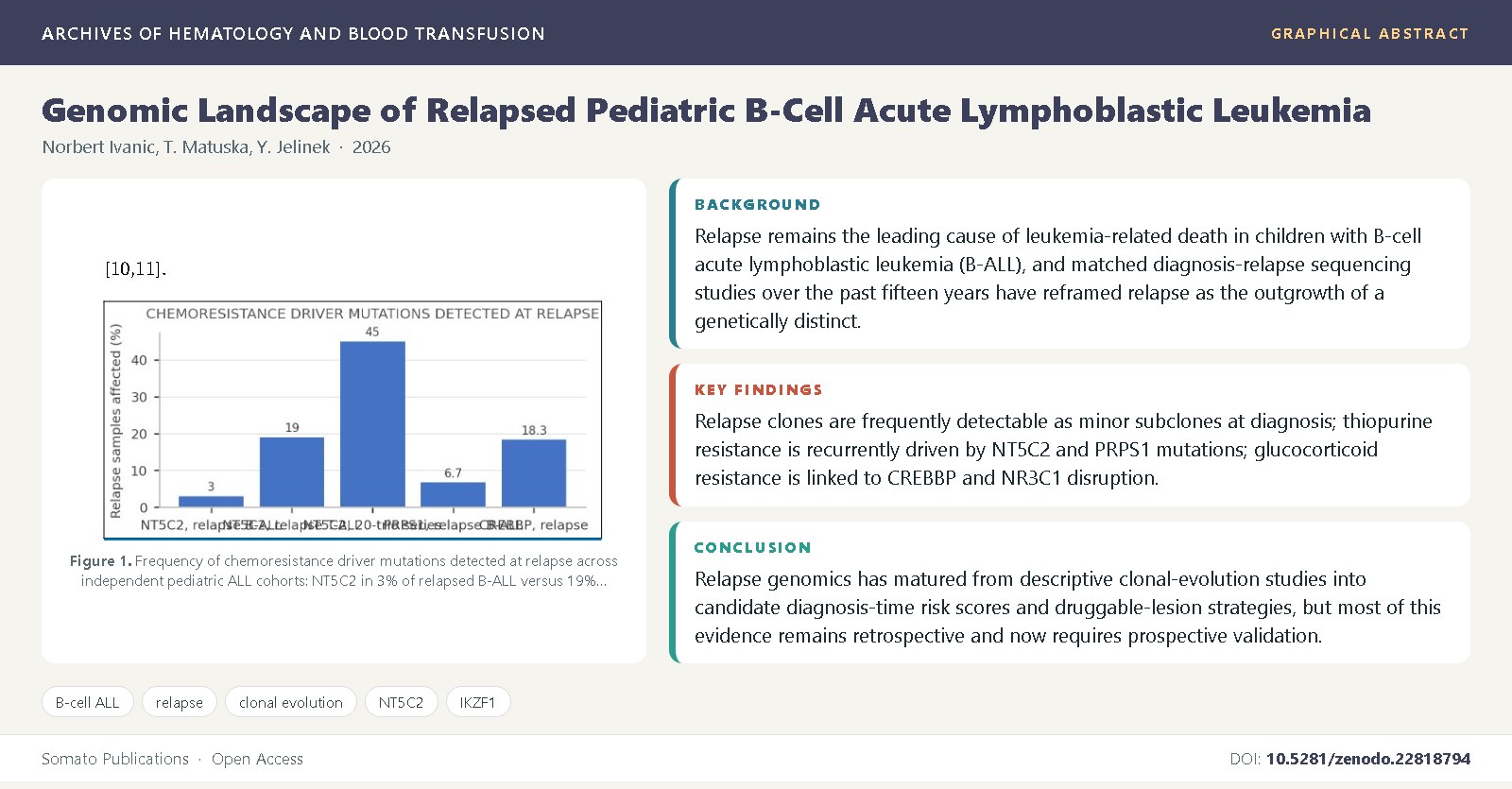
Background: Relapse remains the leading cause of leukemia-related death in children with B-cell acute lymphoblastic leukemia (B-ALL), and matched diagnosis-relapse sequencing studies over the past fifteen years have reframed relapse as the outgrowth of a genetically distinct, therapy-selected clone rather than a resurgence of the original tumor.
Objective: To synthesize the published genomic literature on clonal evolution, relapse-driver mutations, and relapse risk stratification in pediatric B-ALL, focusing on chemoresistance genes such as NT5C2 and PRPS1, glucocorticoid pathway alterations in NR3C1 and CREBBP, and structural lesions such as IKZF1 deletion.
Methods: Narrative review of peer-reviewed genomic-profiling studies of pediatric B-ALL diagnosis-relapse cohorts, clonal tracking and xenograft studies, and genomic risk-stratification and targeted-therapy reports identified through literature search.
Findings: Relapse clones are frequently detectable as minor subclones at diagnosis; thiopurine resistance is recurrently driven by NT5C2 and PRPS1 mutations; glucocorticoid resistance is linked to CREBBP and NR3C1 disruption; and IKZF1 deletion, IKZF1plus, and Ph-like kinase signatures mark relapse risk that is increasingly actionable with targeted agents.
Conclusions: Relapse genomics has matured from descriptive clonal-evolution studies into candidate diagnosis-time risk scores and druggable-lesion strategies, but most of this evidence remains retrospective and now requires prospective validation.
References
Hunger, S.P., Mullighan, C.G. (2015) Acute lymphoblastic leukemia in children. New England Journal of Medicine, 373(16): 1541-1552. DOI: 10.1056/NEJMra1400972
Mullighan, C.G., Phillips, L.A., Su, X., Ma, J., Miller, C.B., Shurtleff, S.A., Downing, J.R. (2008) Genomic analysis of the clonal origins of relapsed acute lymphoblastic leukemia. Science, 322(5906): 1377-1380. DOI: 10.1126/science.1164266
Yang, J.J., Bhojwani, D., Yang, W., Cai, X., Stocco, G., Crews, K., et al. (2008) Genome-wide copy number profiling reveals molecular evolution from diagnosis to relapse in childhood acute lymphoblastic leukemia. Blood, 112(10): 4178-4183. DOI: 10.1182/blood-2008-06-165027
van Delft, F.W., Horsley, S., Colman, S., Anderson, K., Bateman, C., Kempski, H., et al. (2011) Clonal origins of relapse in ETV6-RUNX1 acute lymphoblastic leukemia. Blood, 117(23): 6247-6254. DOI: 10.1182/blood-2010-10-314674
Ma, X., Edmonson, M., Yergeau, D., Muzny, D.M., Hampton, O.A., Rusch, M., et al. (2015) Rise and fall of subclones from diagnosis to relapse in pediatric B-acute lymphoblastic leukaemia. Nature Communications, 6: 6604. DOI: 10.1038/ncomms7604
Mar, B.G., Bullinger, L.B., Basu, E., Schlis, K., Silverman, L.B., Rucker, F.G., et al. (2014) Mutations in epigenetic regulators including SETD2 are gained during relapse in paediatric acute lymphoblastic leukaemia. Nature Communications, 5: 3469. DOI: 10.1038/ncomms4469
Dobson, S.M., Garcia-Prat, L., Vanner, R.J., Wintersinger, J., Waanders, E., Gu, Z., et al. (2020) Relapse-fated latent diagnosis subclones in acute B lineage leukemia are drug tolerant and possess distinct metabolic programs. Cancer Discovery, 10(4): 568-587. DOI: 10.1158/2159-8290.CD-19-1059
Tzoneva, G., Perez-Garcia, A., Carpenter, Z., Khiabanian, H., Tosello, V., Allegretta, M., et al. (2013) Activating mutations in the NT5C2 nucleotidase gene drive chemotherapy resistance in relapsed ALL. Nature Medicine, 19(3): 368-371. DOI: 10.1038/nm.3078
Meyer, J.A., Wang, J., Hogan, L.E., Yang, J.J., Dandekar, S., Patel, J.P., et al. (2013) Relapse-specific mutations in NT5C2 in childhood acute lymphoblastic leukemia. Nature Genetics, 45(3): 290-294. DOI: 10.1038/ng.2558
Dieck, C.L., Tzoneva, G., Forouhar, F., Carpenter, Z., Ambesi-Impiombato, A., Sanchez-Martin, M., et al. (2018) Structure and mechanisms of NT5C2 mutations driving thiopurine resistance in relapsed lymphoblastic leukemia. Cancer Cell, 34(1): 136-147. DOI: 10.1016/j.ccell.2018.06.003
Tzoneva, G., Dieck, C.L., Oshima, K., Ambesi-Impiombato, A., Sanchez-Martin, M., Madubata, C.J., et al. (2018) Clonal evolution mechanisms in NT5C2 mutant-relapsed acute lymphoblastic leukaemia. Nature, 553(7689): 511-514. DOI: 10.1038/nature25186
Li, B., Li, H., Bai, Y., Kirschner-Schwabe, R., Yang, J.J., Chen, Y., et al. (2015) Negative feedback-defective PRPS1 mutants drive thiopurine resistance in relapsed childhood ALL. Nature Medicine, 21(6): 563-571. DOI: 10.1038/nm.3840
Hof, J., Krentz, S., van Schewick, C., Korner, G., Shalapour, S., Rhein, P., et al. (2011) Mutations and deletions of the TP53 gene in childhood acute lymphoblastic leukemia. Journal of Clinical Oncology, 29(23): 3185-3193. DOI: 10.1200/JCO.2011.34.8144
Irving, J., Matheson, E., Minto, L., Blair, H., Case, M., Halsey, C., et al. (2016) Ras pathway mutations are prevalent in relapsed childhood acute lymphoblastic leukemia and confer sensitivity to MEK inhibition. Blood, 128(7): 911-923. DOI: 10.1182/blood-2014-04-531871
Oshima, K., Khiabanian, H., da Silva-Almeida, A.C., Tzoneva, G., Abate, F., Ambesi-Impiombato, A., et al. (2016) Mutational landscape, clonal evolution patterns, and role of RAS mutations in relapsed acute lymphoblastic leukemia. Proceedings of the National Academy of Sciences, 113(40): 11306-11311. DOI: 10.1073/pnas.1608420113
Mullighan, C.G., Zhang, J., Kasper, L.H., Lerach, S., Payne-Turner, D., Phillips, L.A., et al. (2011) CREBBP mutations in relapsed acute lymphoblastic leukaemia. Nature, 471(7337): 235-239. DOI: 10.1038/nature09727
van der Zwet, J.C.G., Smits, W., Buijs-Gladdines, J.G.C.A.M., Pieters, R., Meijerink, J.P.P. (2020) Recurrent NR3C1 aberrations at first diagnosis relate to steroid resistance in pediatric T-cell acute lymphoblastic leukemia patients. HemaSphere, 5(1): e513. DOI: 10.1097/HS9.0000000000000513
Mullighan, C.G., Miller, C.B., Radtke, I., Phillips, L.A., Dalton, J., Ma, J., et al. (2008) BCR-ABL1 lymphoblastic leukaemia is characterized by the deletion of Ikaros. Nature, 453(7191): 110-114. DOI: 10.1038/nature06866
Mullighan, C.G., Su, X., Zhang, J., Radtke, I., Phillips, L.A., Miller, C.B., et al. (2009) Deletion of IKZF1 and prognosis in acute lymphoblastic leukemia. New England Journal of Medicine, 360(5): 470-480. DOI: 10.1056/NEJMoa0808253
Stanulla, M., Dagdan, E., Zaliova, M., Moricke, A., Palmi, C., Cazzaniga, G., et al. (2018) IKZF1plus defines a new minimal residual disease-dependent very-poor prognostic profile in pediatric B-cell precursor acute lymphoblastic leukemia. Journal of Clinical Oncology, 36(12): 1240-1249. DOI: 10.1200/JCO.2017.74.3617
Roberts, K.G., Li, Y., Payne-Turner, D., Harvey, R.C., Yang, Y.L., Pei, D., et al. (2014) Targetable kinase-activating lesions in Ph-like acute lymphoblastic leukemia. New England Journal of Medicine, 371(11): 1005-1015. DOI: 10.1056/NEJMoa1403088
Yang, J.J., Cheng, C., Devidas, M., Cao, X., Fan, Y., Campana, D., et al. (2012) Genome-wide association study identifies germline polymorphisms associated with relapse of childhood acute lymphoblastic leukemia. Blood, 120(20): 4197-4204. DOI: 10.1182/blood-2012-07-440107
Iacobucci, I., Mullighan, C.G. (2017) Genetic basis of acute lymphoblastic leukemia. Journal of Clinical Oncology, 35(9): 975-983. DOI: 10.1200/JCO.2016.70.7836
Nguyen, K., Devidas, M., Cheng, S.C., La, M., Raetz, E.A., Carroll, W.L., et al. (2008) Factors influencing survival after relapse from acute lymphoblastic leukemia: a Children's Oncology Group study. Leukemia, 22(12): 2142-2150. DOI: 10.1038/leu.2008.251
Bhojwani, D., Pui, C.H. (2013) Relapsed childhood acute lymphoblastic leukaemia. Lancet Oncology, 14(6): e205-e217. DOI: 10.1016/S1470-2045(12)70580-6
Waanders, E., Gu, Z., Dobson, S.M., Antic, Z., Crawford, J.C., Ma, X., et al. (2020) Mutational landscape and patterns of clonal evolution in relapsed pediatric acute lymphoblastic leukemia. Blood Cancer Discovery, 1(1): 96-111. DOI: 10.1158/0008-5472.BCD-19-0041

Published
Issue
Section
License
Copyright (c) 2026 Norbert Ivanic, et al.

This work is licensed under a Creative Commons Attribution 4.0 International License.


