
Outcomes of Reduced-Intensity Conditioning Regimens in Elderly Patients with Myelodysplastic Syndrome
DOI:
https://doi.org/10.5281/zenodo.22818831Keywords:
myelodysplastic syndrome, reduced-intensity conditioning, allogeneic transplantation, comorbidity index, hypomethylating agentsAbstract
Background: Allogeneic transplantation is the only curative therapy for myelodysplastic syndrome, but myeloablative conditioning has been considered too toxic for the older, comorbid patients in whom the disease most often arises.
Objective: To synthesize evidence on reduced-intensity conditioning (RIC) transplantation in elderly myelodysplastic syndrome, including comorbidity-based selection and outcomes versus hypomethylating agents.
Methods: Narrative synthesis of randomized trials, biologic-assignment studies and comorbidity-index cohorts addressing RIC transplantation, the HCT-specific comorbidity index (HCT-CI), and transplant-versus-hypomethylating comparisons.
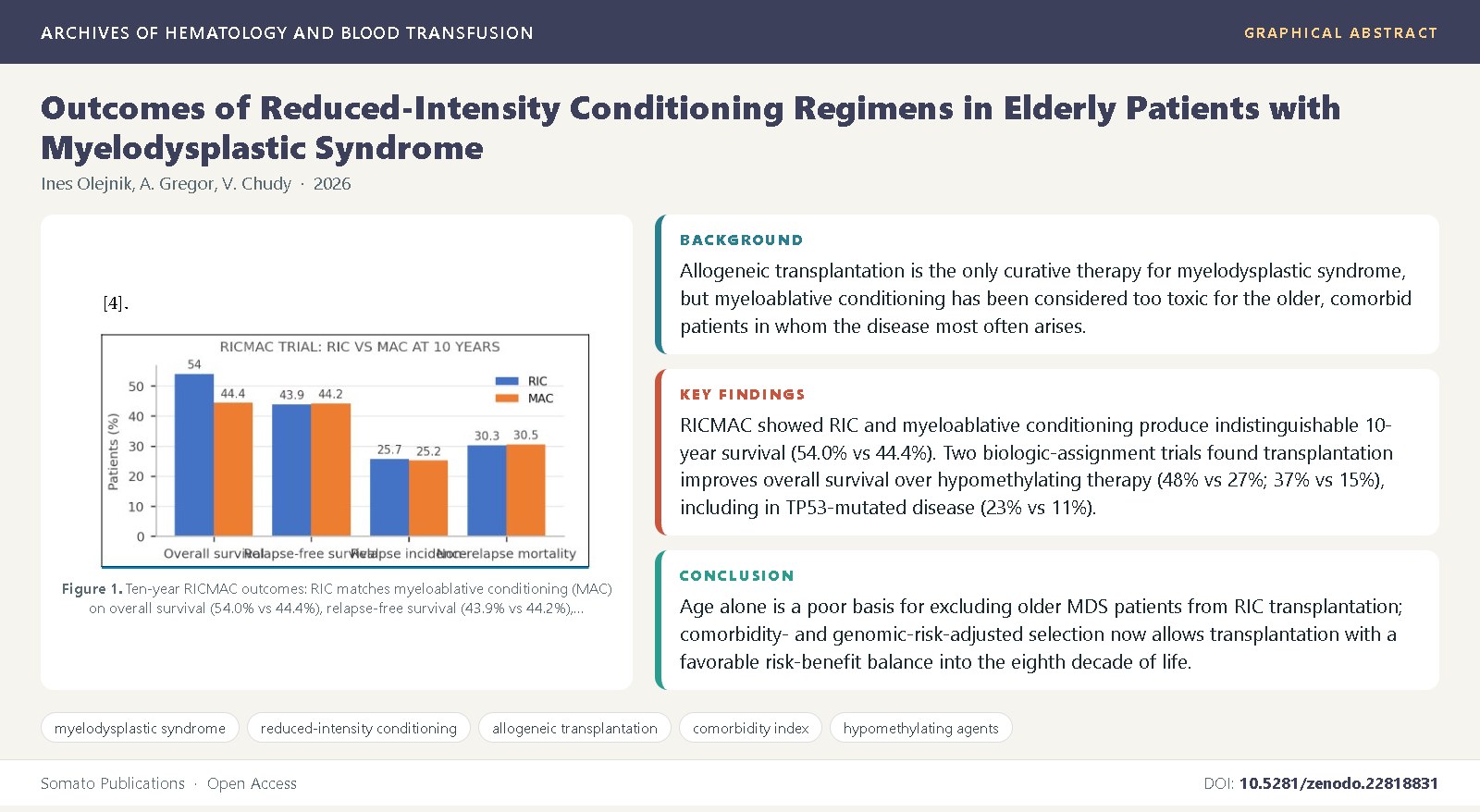
Findings: RICMAC showed RIC and myeloablative conditioning produce indistinguishable 10-year survival (54.0% vs 44.4%). Two biologic-assignment trials found transplantation improves overall survival over hypomethylating therapy (48% vs 27%; 37% vs 15%), including in TP53-mutated disease (23% vs 11%). HCT-CI scores of 0, 1-2 and 3+ stratify 2-year non-relapse mortality at 14%, 21% and 41%.
Conclusions: Age alone is a poor basis for excluding older MDS patients from RIC transplantation; comorbidity- and genomic-risk-adjusted selection now allows transplantation with a favorable risk-benefit balance into the eighth decade of life.
References
Gyurkocza, B., Storb, R., Storer, B.E., et al. (2010) Nonmyeloablative allogeneic hematopoietic cell transplantation in patients with acute myeloid leukemia. Journal of Clinical Oncology, 28(17): 2859-2867. DOI: 10.1200/JCO.2009.27.1460
Niederwieser, C., Iacobelli, S., Franke, G.N., Platzbecker, U., Kroger, N. (2024) Reduced intensity versus myeloablative conditioning for MDS: long-term results of an EBMT phase III study (RICMAC). Bone Marrow Transplantation, 59(8): 1084-1091. DOI: 10.1038/s41409-024-02282-7
Kroger, N., Iacobelli, S., Franke, G.N., et al. (2017) Dose-reduced versus standard conditioning followed by allogeneic stem-cell transplantation for MDS: a prospective randomized phase III study of the EBMT (RICMAC trial). Journal of Clinical Oncology, 35(19): 2157-2164. DOI: 10.1200/JCO.2016.70.7349
Scott, B.L., Pasquini, M.C., Logan, B.R., et al. (2017) Myeloablative versus reduced-intensity conditioning for hematopoietic cell transplantation in AML and myelodysplastic syndromes. Journal of Clinical Oncology, 35(11): 1154-1161. DOI: 10.1200/JCO.2016.70.7091
McClune, B.L., Weisdorf, D.J., Pedersen, T.L., et al. (2010) Effect of age on outcome of reduced-intensity hematopoietic cell transplantation for older patients with AML in first complete remission or MDS. Journal of Clinical Oncology, 28(11): 1878-1887. DOI: 10.1200/JCO.2009.25.4821
Sorror, M.L., Sandmaier, B.M., Storer, B.E., et al. (2011) Long-term outcomes among older patients following nonmyeloablative conditioning and allogeneic hematopoietic cell transplantation for advanced hematologic malignancies. JAMA, 306(17): 1874-1883. DOI: 10.1001/jama.2011.1558
Devine, S.M., Owzar, K., Blum, W., et al. (2015) Phase II study of allogeneic transplantation for older patients with AML in first complete remission using a reduced-intensity conditioning regimen: results from CALGB 100103. Journal of Clinical Oncology, 33(35): 4167-4175. DOI: 10.1200/JCO.2015.62.7273
Alyea, E.P., Kim, H.T., Ho, V., et al. (2005) Comparative outcome of nonmyeloablative and myeloablative allogeneic hematopoietic cell transplantation for patients older than 50 years of age. Blood, 105(4): 1810-1814.
Sorror, M.L., Maris, M.B., Storb, R., et al. (2005) Hematopoietic cell transplantation (HCT)-specific comorbidity index: a new tool for risk assessment before allogeneic HCT. Blood, 106(8): 2912-2919. DOI: 10.1182/blood-2005-05-2004
Sorror, M.L., Giralt, S., Sandmaier, B.M., et al. (2007) Hematopoietic cell transplantation-specific comorbidity index as an outcome predictor for AML in first remission: combined FHCRC and MDACC experiences. Blood, 110(13): 4606-4613. DOI: 10.1182/blood-2007-06-096966
Sorror, M.L., Storb, R.F., Sandmaier, B.M., et al. (2014) Comorbidity-age index: a clinical measure of biologic age before allogeneic hematopoietic cell transplantation. Journal of Clinical Oncology, 32(29): 3249-3256. DOI: 10.1200/JCO.2013.53.8157
Greenberg, P., Cox, C., LeBeau, M.M., et al. (1997) International scoring system for evaluating prognosis in myelodysplastic syndromes. Blood, 89(6): 2079-2088. DOI: 10.1182/blood.v89.6.2079
Greenberg, P.L., Tuechler, H., Schanz, J., et al. (2012) Revised international prognostic scoring system for myelodysplastic syndromes. Blood, 120(12): 2454-2465. DOI: 10.1182/blood-2012-03-420489
Bernard, E., Tuechler, H., Greenberg, P.L., et al. (2022) Molecular international prognostic scoring system for myelodysplastic syndromes. NEJM Evidence, 1(7): EVIDoa2200008. DOI: 10.1056/EVIDoa2200008
Della Porta, M.G., Alessandrino, E.P., Bacigalupo, A., et al. (2014) Predictive factors for the outcome of allogeneic transplantation in patients with MDS stratified according to the revised IPSS-R. Blood, 123(15): 2333-2342. DOI: 10.1182/blood-2013-12-542720
Cutler, C.S., Lee, S.J., Greenberg, P., et al. (2004) A decision analysis of allogeneic bone marrow transplantation for the myelodysplastic syndromes: delayed transplantation for low-risk myelodysplasia is associated with improved outcome. Blood, 104(2): 579-585.
Koreth, J., Pidala, J., Perez, W.S., et al. (2013) Role of reduced-intensity conditioning allogeneic HSCT in older patients with de novo myelodysplastic syndromes: an international collaborative decision analysis. Journal of Clinical Oncology, 31(21): 2662-2670. DOI: 10.1200/JCO.2012.46.8652
Deeg, H.J., Storer, B., Slattery, J.T., et al. (2002) Conditioning with targeted busulfan and cyclophosphamide for hemopoietic stem cell transplantation from related and unrelated donors in patients with myelodysplastic syndrome. Blood, 100(4): 1201-1207.
Nakamura, R., Saber, W., Martens, M.J., et al. (2021) Biologic assignment trial of reduced-intensity hematopoietic cell transplantation based on donor availability in patients 50-75 years of age with advanced MDS. Journal of Clinical Oncology, 39(30): 3328-3339. DOI: 10.1200/JCO.20.03380
Robin, M., Porcher, R., Ades, L., et al. (2015) HLA-matched allogeneic stem cell transplantation improves outcome of higher risk MDS: a prospective study on behalf of SFGM-TC and GFM. Leukemia, 29(7): 1496-1501. DOI: 10.1038/leu.2015.37
Fenaux, P., Mufti, G.J., Hellstrom-Lindberg, E., et al. (2009) Efficacy of azacitidine compared with conventional care regimens in higher-risk myelodysplastic syndromes: a randomised, open-label, phase III study. Lancet Oncology, 10(3): 223-232. DOI: 10.1016/S1470-2045(09)70003-8
Muffly, L., Pasquini, M.C., Martens, M., et al. (2017) Increasing use of allogeneic hematopoietic cell transplantation in patients aged 70 years and older in the United States. Blood, 130(9): 1156-1164.
Atallah, E., Logan, B., Chen, M., et al. (2020) Comparison of patient age groups in transplantation for myelodysplastic syndrome: the Medicare Coverage with Evidence Development study. JAMA Oncology, 6(4): 486-493.
Platzbecker, U., Middeke, J.M., Sockel, K., et al. (2018) Measurable residual disease-guided treatment with azacitidine to prevent haematological relapse in MDS and AML (RELAZA2): an open-label, multicentre, phase 2 trial. Lancet Oncology, 19(12): 1668-1679. DOI: 10.1016/S1470-2045(18)30580-1

Published
Issue
Section
License
Copyright (c) 2026 Ines Olejnik, et al.

This work is licensed under a Creative Commons Attribution 4.0 International License.


