
Role of Minimal Residual Disease Monitoring in Guiding Maintenance Therapy for Multiple Myeloma
DOI:
https://doi.org/10.5281/zenodo.22818820Keywords:
minimal residual disease, multiple myeloma, maintenance therapy, next-generation flow cytometry, next-generation sequencingAbstract
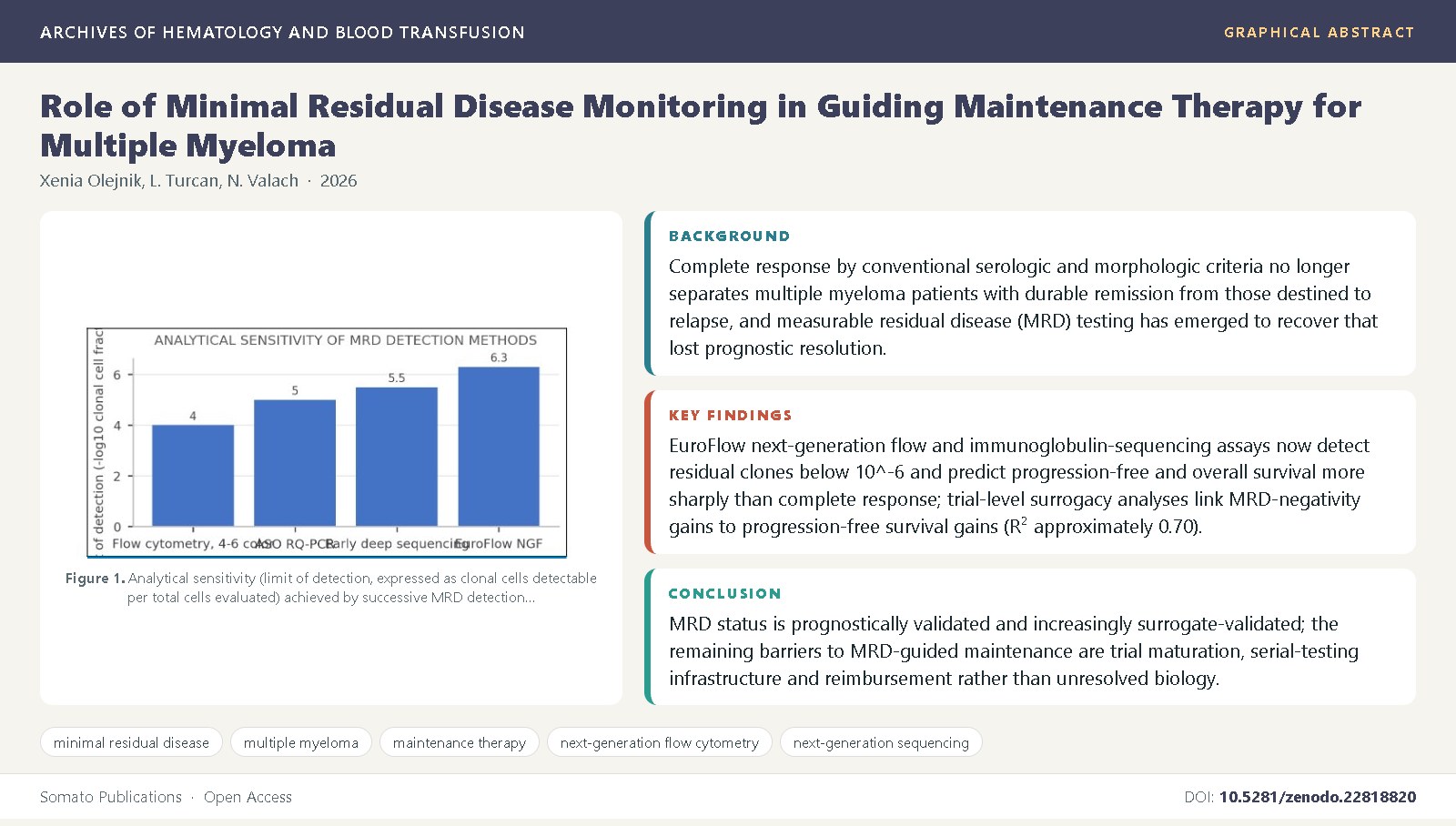
Background: Complete response by conventional serologic and morphologic criteria no longer separates multiple myeloma patients with durable remission from those destined to relapse, and measurable residual disease (MRD) testing has emerged to recover that lost prognostic resolution.
Objective: To synthesize published evidence on MRD detection methods, the prognostic and surrogate value of MRD negativity, and the use of serial MRD results to guide the duration and intensity of post-induction maintenance therapy.
Methods: Narrative synthesis of peer-reviewed literature on next-generation flow cytometry, next-generation sequencing, MRD meta-analyses and surrogacy analyses, and prospective MRD-adapted maintenance trials in newly diagnosed multiple myeloma.
Findings: EuroFlow next-generation flow and immunoglobulin-sequencing assays now detect residual clones below 10^-6 and predict progression-free and overall survival more sharply than complete response; trial-level surrogacy analyses link MRD-negativity gains to progression-free survival gains (R² approximately 0.70); and MRD-adapted trials including MASTER, AURIGA, FORTE and ATLAS show that stopping therapy in sustained MRD-negative patients and intensifying it in persistently MRD-positive patients each changes outcomes.
Conclusions: MRD status is prognostically validated and increasingly surrogate-validated; the remaining barriers to MRD-guided maintenance are trial maturation, serial-testing infrastructure and reimbursement rather than unresolved biology.
References
Kumar, S., Paiva, B., Anderson, K.C., Durie, B., Landgren, O., Moreau, P., et al. (2016) International Myeloma Working Group consensus criteria for response and minimal residual disease assessment in multiple myeloma. Lancet Oncology, 17(8): e328-e346. DOI: 10.1016/S1470-2045(16)30206-6
Flores-Montero, J., Sanoja-Flores, L., Paiva, B., Puig, N., Garcia-Sanchez, O., Bottcher, S., et al. (2017) Next generation flow for highly sensitive and standardized detection of minimal residual disease in multiple myeloma. Leukemia, 31(10): 2094-2103. DOI: 10.1038/leu.2017.29
Martinez-Lopez, J., Lahuerta, J.J., Pepin, F., Gonzalez, M., Barrio, S., Ayala, R., et al. (2014) Prognostic value of deep sequencing method for minimal residual disease detection in multiple myeloma. Blood, 123(20): 3073-3079. DOI: 10.1182/blood-2014-01-550020
Puig, N., Sarasquete, M.E., Balanzategui, A., Martinez, J., Paiva, B., Garcia, H., et al. (2014) Critical evaluation of ASO RQ-PCR for minimal residual disease evaluation in multiple myeloma. A comparative analysis with flow cytometry. Leukemia, 28(2): 391-397. DOI: 10.1038/leu.2013.217
Paiva, B., Vidriales, M.B., Cervero, J., Mateo, G., Perez, J.J., Montalban, M.A., et al. (2008) Multiparameter flow cytometry remodels complete response definition and immunophenotypic detection of minimal residual disease in multiple myeloma. Blood, 112(10): 4017-4023. DOI: 10.1182/blood-2008-05-159624
Rawstron, A.C., Child, J.A., de Tute, R.M., Davies, F.E., Gregory, W.M., Bell, S.E., et al. (2013) Minimal residual disease assessed by multiparameter flow cytometry in multiple myeloma: impact on outcome in the Medical Research Council Myeloma IX study. Journal of Clinical Oncology, 31(20): 2540-2547. DOI: 10.1200/JCO.2012.46.2119
Avet-Loiseau, H., Corre, J., Lauwers-Cances, V., Robillard, N., Bouhya, S., Falconi, A., et al. (2015) Evaluation of minimal residual disease (MRD) by next generation sequencing (NGS) is highly predictive of progression free survival in the IFM/DFCI 2009 trial. Blood, 126(23): 191. DOI: 10.1182/blood.V126.23.191.191
Moreau, P., Attal, M., Caillot, D., Macro, M., Karlin, L., Garderet, L., et al. (2017) Prospective evaluation of magnetic resonance imaging and [18F]fluorodeoxyglucose positron emission tomography-computed tomography at diagnosis and before maintenance therapy in symptomatic patients with multiple myeloma included in the IFM/DFCI 2009 trial: results of the IMAJEM study. Journal of Clinical Oncology, 35(25): 2911-2918. DOI: 10.1200/JCO.2017.72.2975
Paiva, B., Puig, N., Cedena, M.T., Rosinol, L., Cordon, L., Vidriales, M.B., et al. (2020) Measurable residual disease by next-generation flow cytometry in multiple myeloma. Journal of Clinical Oncology, 38(8): 784-792. DOI:
1200/JCO.19.01231 10. Costa, L.J., Derman, B.A., Bal, S., Sidana, S., Chhabra, S., Silbermann, R., et al. (2021) International harmonization in performing and reporting minimal residual disease assessment in multiple myeloma trials. Leukemia, 35(1): 18-30. DOI: 10.1038/s41375-020-01012-4
Munshi, N.C., Avet-Loiseau, H., Rawstron, A.C., Owen, R.G., Child, J.A., Thakurta, A., et al. (2017) Association of minimal residual disease with superior survival outcomes in patients with multiple myeloma: a meta-analysis. JAMA Oncology, 3(1): 28-35. DOI: 10.1001/jamaoncol.2016.3160
Landgren, O., Devlin, S., Boulad, M., Mailankody, S. (2016) Role of MRD status in relation to clinical outcomes in newly diagnosed multiple myeloma patients: a meta-analysis. Bone Marrow Transplantation, 51(12): 1565-1568. DOI: 10.1038/bmt.2016.222
Perrot, A., Lauwers-Cances, V., Corre, J., Robillard, N., Hulin, C., Chretien, M.L., et al. (2018) Minimal residual disease negativity using deep sequencing is a major prognostic factor in multiple myeloma. Blood, 132(23): 2456-2464. DOI: 10.1182/blood-2018-06-858613
Dimopoulos, M.A., Oriol, A., Nahi, H., San-Miguel, J., Bahlis, N.J., Usmani, S.Z., et al. (2016) Daratumumab, lenalidomide, and dexamethasone for multiple myeloma. New England Journal of Medicine, 375(14): 1319-1331. DOI: 10.1056/NEJMoa1607751
Palumbo, A., Chanan-Khan, A., Weisel, K., Nooka, A.K., Masszi, T., Beksac, M., et al. (2016) Daratumumab, bortezomib, and dexamethasone for multiple myeloma. New England Journal of Medicine, 375(8): 754-766. DOI: 10.1056/NEJMoa1606038
Facon, T., Kumar, S., Plesner, T., Orlowski, R.Z., Moreau, P., Bahlis, N., et al. (2019) Daratumumab plus lenalidomide and dexamethasone for untreated myeloma. New England Journal of Medicine, 380(22): 2104-2115. DOI: 10.1056/NEJMoa1817249
Landgren, O., Hultcrantz, M., Diamond, B., Lesokhin, A.M., Mailankody, S., Hassoun, H., et al. (2022) Prognostic value of minimal residual disease negativity in myeloma: combined analysis of POLLUX, CASTOR, ALCYONE, and MAIA. Blood, 139(6): 835-844. DOI: 10.1182/blood.2021011101
San-Miguel, J., Avet-Loiseau, H., Paiva, B., Kumar, S., Dimopoulos, M.A., Facon, T., et al. (2022) Sustained minimal residual disease negativity in newly diagnosed multiple myeloma and the impact of daratumumab in MAIA and ALCYONE. Blood, 139(4): 492-501. DOI: 10.1182/blood.2020010439
Paiva, B., Zherniakova, A., Nunez-Cordoba, J.M., Rodriguez-Otero, P., Shi, Q., Munshi, N.C., et al. (2024) Impact of treatment effect on MRD and PFS: an aggregate data analysis from randomized clinical trials in multiple myeloma. Blood Advances, 8(1): 219-220. DOI: 10.1182/bloodadvances.2023010821
Costa, L.J., Chhabra, S., Medvedova, E., Dholaria, B.R., Schmidt, T.M., Godby, K.N., et al. (2022) Daratumumab, carfilzomib, lenalidomide, and dexamethasone with minimal residual disease response-adapted therapy in newly diagnosed multiple myeloma. Journal of Clinical Oncology, 40(25): 2901-2912. DOI: 10.1200/JCO.21.01935
Costa, L.J., Chhabra, S., Medvedova, E., Dholaria, B.R., Schmidt, T.M., Godby, K.N., et al. (2023) Minimal residual disease response-adapted therapy in newly diagnosed multiple myeloma (MASTER): final report of the multicentre, single-arm, phase 2 trial. Lancet Haematology, 10(11): e890-e901. DOI: 10.1016/S2352-3026(23)00236-3
Badros, A.Z., Foster, L., Anderson, L.D., Chaulagain, C.P., Pettijohn, E.M., Ye, J.C., et al. (2025) Daratumumab with lenalidomide as maintenance after transplant in newly diagnosed multiple myeloma: the AURIGA study. Blood, 145(3): 300-310. DOI: 10.1182/blood.2024025746
Voorhees, P.M., Kaufman, J.L., Laubach, J., Sborov, D.W., Reeves, B., Rodriguez, C., et al. (2020) Daratumumab, lenalidomide, bortezomib, and dexamethasone for transplant-eligible newly diagnosed multiple myeloma: the GRIFFIN trial. Blood, 136(8): 936-945. DOI: 10.1182/blood.2020005288
Gay, F., Musto, P., Rota-Scalabrini, D., Bertamini, L., Belotti, A., Galli, M., et al. (2021) Carfilzomib with cyclophosphamide and dexamethasone or lenalidomide and dexamethasone plus autologous transplantation or carfilzomib plus lenalidomide and dexamethasone, followed by maintenance with carfilzomib plus lenalidomide or lenalidomide alone for patients with newly diagnosed multiple myeloma (FORTE): a randomised, open-label, phase 2 trial. Lancet Oncology, 22(12): 1705-1720. DOI: 10.1016/S1470-2045(21)00535-0
Dhakal, B., Yong, K., Harrison, S.J., Mateos, M.V., Miguel, J.S., Beksac, M., et al. (2022) Carfilzomib, lenalidomide, and dexamethasone or lenalidomide alone as maintenance therapy after autologous stem-cell transplantation in patients with multiple myeloma (ATLAS): interim analysis of a randomised, open-label, phase 3 trial. Lancet Oncology, 23(12): 1518-1530. DOI: 10.1016/S1470-2045(22)00738-0

Published
Issue
Section
License
Copyright (c) 2026 Xenia Olejnik, et al.

This work is licensed under a Creative Commons Attribution 4.0 International License.


