
Population Screening for Sickle Cell Trait Among Blood Donors in Multiethnic Urban Centers
DOI:
https://doi.org/10.5281/zenodo.22818776Keywords:
sickle cell trait, blood donors, hemoglobinopathy screening, transfusion medicine, donor notificationAbstract
Background: Sickle cell trait (HbAS) carrier frequency is highest in donor communities with West African, Afro-Caribbean, South Asian, and Latin American ancestry, populations well represented at multiethnic urban blood centers.
Objective: To synthesize published evidence on sickle cell trait prevalence among blood donors, the methods used to detect it, and the clinical and ethical issues raised once a donor's status is known.
Methods: Narrative synthesis of peer-reviewed prevalence surveys, donor-safety evaluations, and cohort studies of exertional, thrombotic, and renal outcomes associated with sickle cell trait.
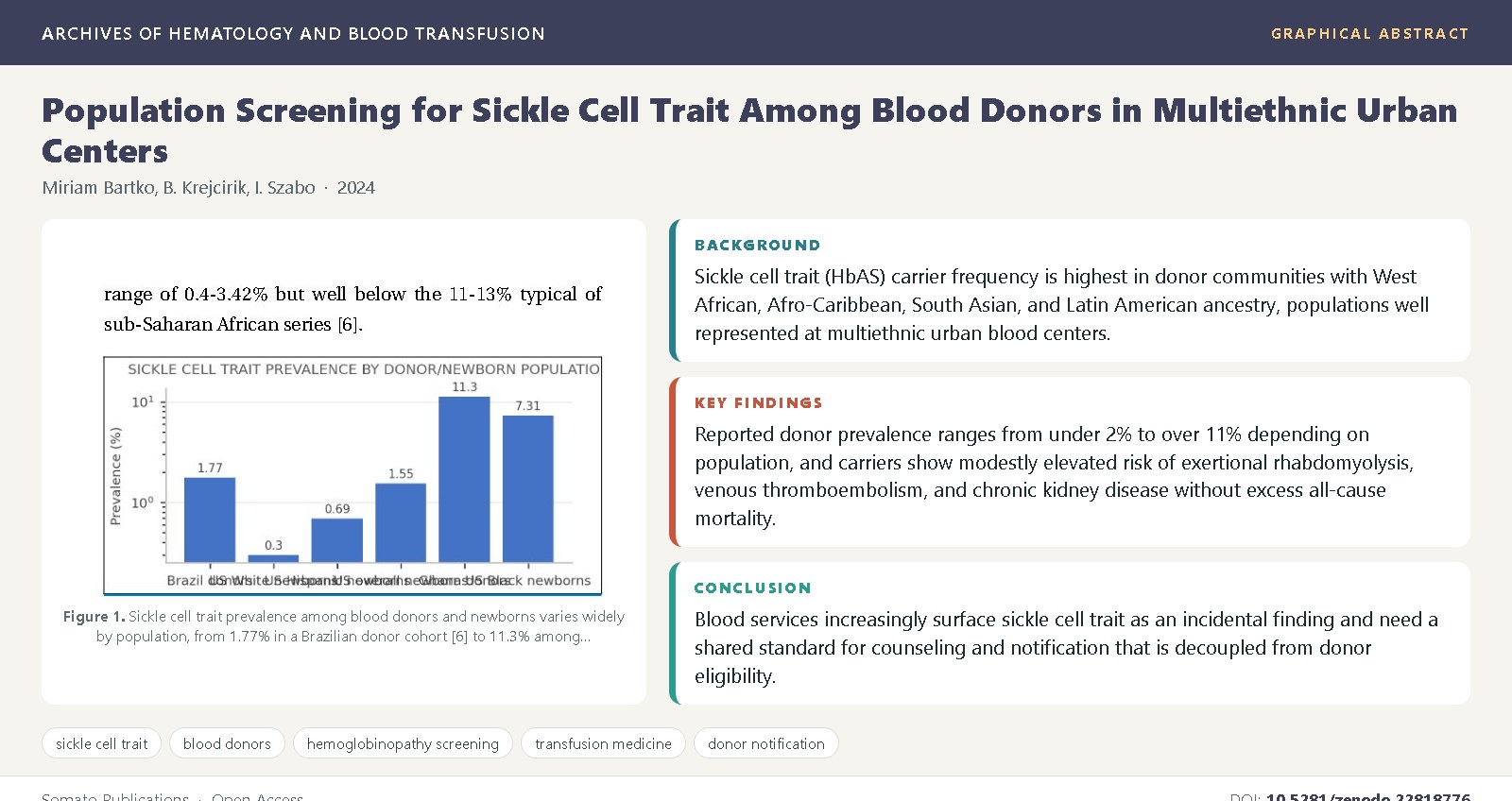
Findings: Reported donor prevalence ranges from under 2% to over 11% depending on population, and carriers show modestly elevated risk of exertional rhabdomyolysis, venous thromboembolism, and chronic kidney disease without excess all-cause mortality.
Conclusions: Blood services increasingly surface sickle cell trait as an incidental finding and need a shared standard for counseling and notification that is decoupled from donor eligibility.
References
Kato, G.J., Piel, F.B., Reid, C.D., Gaston, M.H., Ohene-Frempong, K., Krishnamurti, L., et al. (2018) Sickle cell disease. Nature Reviews Disease Primers, 4: 18010. DOI: 10.1038/nrdp.2018.10
Rees, D.C., Williams, T.N., Gladwin, M.T. (2010) Sickle-cell disease. Lancet, 376(9757): 2018-2031. DOI: 10.1016/S0140-6736(10)61029-X
Xu, J.Z., Thein, S.L. (2019) The carrier state for sickle cell disease is not completely harmless. Haematologica, 104(6): 1106-1111. DOI: 10.3324/haematol.2018.206060
Piel, F.B., Patil, A.P., Howes, R.E., Nyangiri, O.A., Gething, P.W., Williams, T.N., et al. (2010) Global distribution of the sickle cell gene and geographical confirmation of the malaria hypothesis. Nature Communications, 1: 104. DOI: 10.1038/ncomms1104
Antwi-Baffour, S., Asare, R.O., Adjei, J.K., Kyeremeh, R., Adjei, D.N. (2015) Prevalence of hemoglobin S trait among blood donors: a cross-sectional study. BMC Research Notes, 8(1): 583. DOI: 10.1186/s13104-015-1583-0
Kroger, F.L., Ernesto, I.C., Silva, M.S., Santos, O.F., de Medeiros, R.L., Rodrigues, D.O.W. (2022) Hemoglobin S identification in blood donors: a cross section of prevalence. Hematology, Transfusion and Cell Therapy, 44(3): 336-340. DOI: 10.1016/j.htct.2020.11.009
Ojodu, J., Hulihan, M.M., Pope, S.N., Grant, A.M. (2014) Incidence of sickle cell trait--United States, 2010. MMWR Morbidity and Mortality Weekly Report, 63(49): 1155-1158.
Alvarez, O.A., Santos, L.B., De Castro, L.M. (2026) Sickle cell disease, sickle cell trait, and hemoglobin C trait in Spanish-speaking Latin America: a systematic review. Blood Global Hematology, 3(1): 100152. DOI: 10.1016/j.bglo.2026.100152
Bodensteiner, D. (1994) White cell reduction in blood from donors with sickle cell trait. Transfusion, 34(1): 84. DOI:
1046/j.1537-2995.1994.34194098613.x 10. Diaz Padilla, N., van der Torren, C., Paalvast, Y., Kubbenga, I., Wiersum-Osselton, J. (2026) Evaluating blood donation safety for donors with sickle cell trait. Vox Sanguinis, 121(7): 959-963. DOI: 10.1111/vox.70271
Kark, J.A., Posey, D.M., Schumacher, H.R., Ruehle, C.J. (1987) Sickle-cell trait as a risk factor for sudden death in physical training. New England Journal of Medicine, 317(13): 781-787. DOI: 10.1056/NEJM198709243171301
Bonham, V.L., Dover, G.J., Brody, L.C. (2010) Screening student athletes for sickle cell trait--a social and clinical experiment. New England Journal of Medicine, 363(11): 997-999. DOI: 10.1056/NEJMp1007639
Nelson, D.A., Deuster, P.A., Carter, R., Hill, O.T., Wolcott, V.L., Kurina, L.M. (2016) Sickle cell trait, rhabdomyolysis, and mortality among U.S. Army soldiers. New England Journal of Medicine, 375(5): 435-442. DOI: 10.1056/NEJMoa1516257
Folsom, A.R., Tang, W., Roetker, N.S., Kshirsagar, A.V., Derebail, V.K., Pankow, J.S., et al. (2015) Prospective study of sickle cell trait and venous thromboembolism incidence. Journal of Thrombosis and Haemostasis, 13(1): 2-9. DOI: 10.1111/jth.12787
Naik, R.P., Wilson, J.G., Ekunwe, L., Mwasongwe, S., Duan, Q., Li, Y., et al. (2016) Elevated D-dimer levels in African Americans with sickle cell trait. Blood, 127(18): 2261-2263. DOI: 10.1182/blood-2016-01-694422
Little, I., Vinogradova, Y., Orton, E., Kai, J., Qureshi, N. (2017) Venous thromboembolism in adults screened for sickle cell trait: a population-based cohort study with nested case-control analysis. BMJ Open, 7(3): e012665. DOI: 10.1136/bmjopen-2016-012665
Noubiap, J.J., Temgoua, M.N., Tankeu, R., Tochie, J.N., Wonkam, A., Bigna, J.J. (2018) Sickle cell disease, sickle trait and the risk for venous thromboembolism: a systematic review and meta-analysis. Thrombosis Journal, 16(1): 27. DOI: 10.1186/s12959-018-0179-z
Naik, R.P., Derebail, V.K., Grams, M.E., Franceschini, N., Auer, P.L., Peloso, G.M., et al. (2014) Association of sickle cell trait with chronic kidney disease and albuminuria in African Americans. JAMA, 312(20): 2115-2125. DOI: 10.1001/jama.2014.15063
Castro-Sesquen, Y.E., Barboza Justiniano, G., Aparcana-Granda, D.J., Aquino Colon, A., Adelson, P.L., Mondragon, R.D., et al. (2025) Chronic kidney disease in adults with sickle cell trait: a systematic review and meta-analysis. Blood Advances, 9(14): 3644-3657. DOI: 10.1182/bloodadvances.2025015920
Davis, C.J., Mostofi, F.K., Sesterhenn, I.A. (1995) Renal medullary carcinoma. The seventh sickle cell nephropathy. American Journal of Surgical Pathology, 19(1): 1-11. DOI: 10.1097/00000478-199501000-00001
Pecker, L.H., Naik, R.P. (2018) The current state of sickle cell trait: implications for reproductive and genetic counseling. Hematology American Society of Hematology Education Program, 2018(1): 474-481. DOI: 10.1182/asheducation-2018.1.474
Lee, L.M., Marks, P. (2014) When a blood donor has sickle cell trait: incidental findings and public health. Hastings Center Report, 44(4): 17-21. DOI: 10.1002/hast.327
Naik, R.P., Haywood, C. (2015) Sickle cell trait diagnosis: clinical and social implications. Hematology American Society of Hematology Education Program, 2015(1): 160-167. DOI: 10.1182/asheducation-2015.1.160

Published
Issue
Section
License
Copyright (c) 2024 Miriam Bartko, et al.

This work is licensed under a Creative Commons Attribution 4.0 International License.


