
Comparative Safety of Weight-Based versus Fixed-Dose Anticoagulation in Antiphospholipid Syndrome
DOI:
https://doi.org/10.5281/zenodo.22818754Keywords:
antiphospholipid syndrome, anticoagulation, warfarin, direct oral anticoagulants, thrombosis recurrenceAbstract
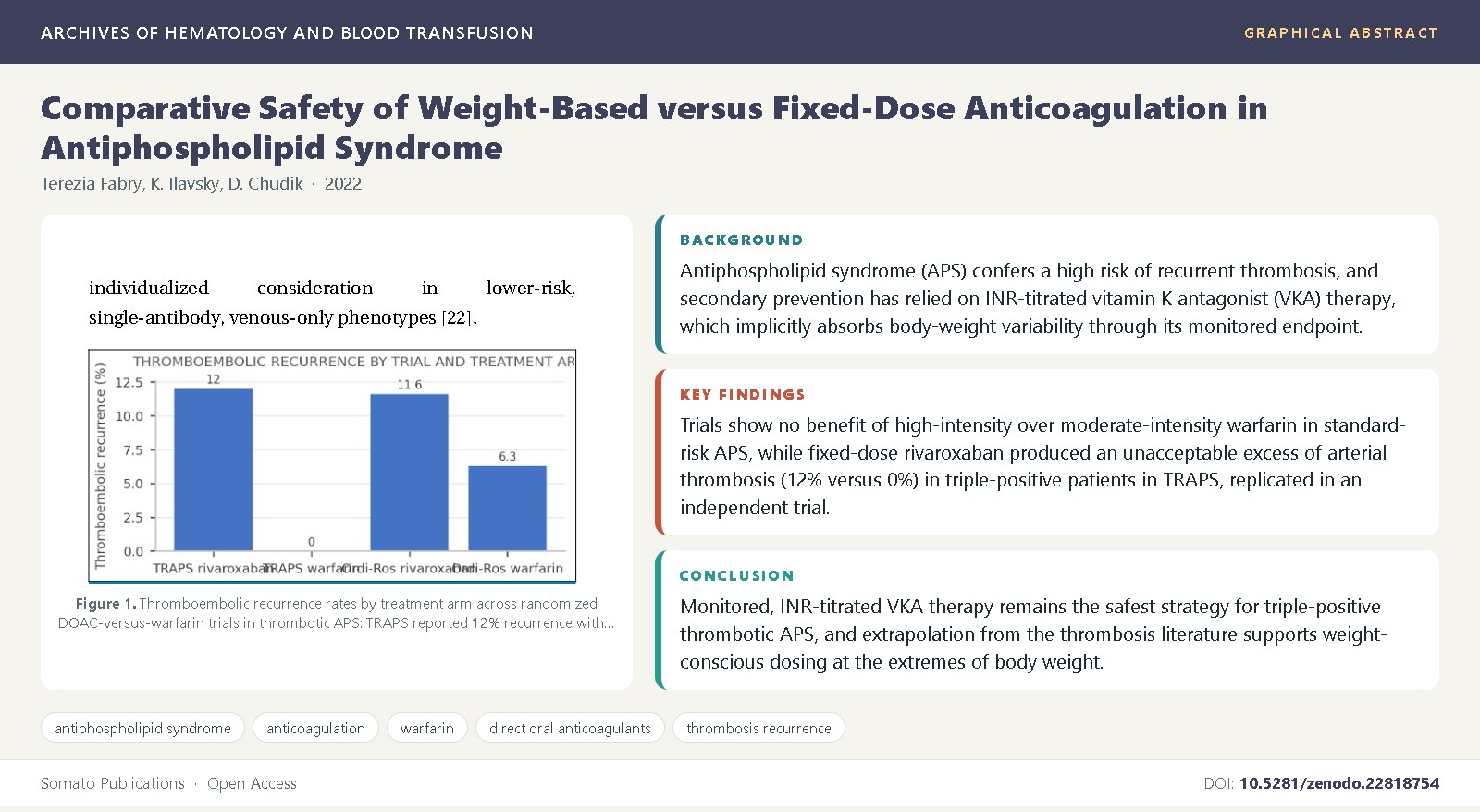
Background: Antiphospholipid syndrome (APS) confers a high risk of recurrent thrombosis, and secondary prevention has relied on INR-titrated vitamin K antagonist (VKA) therapy, which implicitly absorbs body-weight variability through its monitored endpoint.
Objective: To synthesize evidence on anticoagulation intensity, direct oral anticoagulant (DOAC) performance, and weight-based versus fixed-dose strategies for long-term anticoagulation in APS.
Methods: Narrative review of randomized trials of warfarin intensity, randomized DOAC-versus-warfarin trials in thrombotic APS, a patient-level meta-analysis of DOAC failures, and weight-based dosing evidence from other thrombotic indications.
Findings: Trials show no benefit of high-intensity over moderate-intensity warfarin in standard-risk APS, while fixed-dose rivaroxaban produced an unacceptable excess of arterial thrombosis (12% versus 0%) in triple-positive patients in TRAPS, replicated in an independent trial and a meta-analysis showing roughly sixfold higher recurrence odds with DOACs in triple-positive disease.
Conclusions: Monitored, INR-titrated VKA therapy remains the safest strategy for triple-positive thrombotic APS, and extrapolation from the thrombosis literature supports weight-conscious dosing at the extremes of body weight.
References
Miyakis, S., Lockshin, M.D., Atsumi, T., Branch, D.W., Brey, R.L., Cervera, R., et al. (2006) International consensus statement on an update of the classification criteria for definite antiphospholipid syndrome (APS). Journal of Thrombosis and Haemostasis, 4(2): 295-306. DOI: 10.1111/j.1538-7836.2006.01753.x
Barbhaiya, M., Zuily, S., Naden, R., Hendry, A., Manneville, F., Amigo, M.C., et al. (2023) 2023 ACR/EULAR antiphospholipid syndrome classification criteria. Arthritis & Rheumatology, 75(10): 1687-1702. DOI: 10.1002/art.42624
Devreese, K.M.J., Ortel, T.L., Pengo, V., de Laat, B. (2020) Laboratory criteria for antiphospholipid syndrome: communication from the SSC of the ISTH. Journal of Thrombosis and Haemostasis, 18(11): 2828-2839. DOI: 10.1111/jth.13976
Raschke, R.A., Reilly, B.M., Guidry, J.R., Fontana, J.R., Srinivas, S. (1993) The weight-based heparin dosing nomogram compared with a "standard care" nomogram. Annals of Internal Medicine, 119(9): 874-881. DOI: 10.7326/0003-4819-119-9-199311010-00002
Martin, K.A., Beyer-Westendorf, J., Davidson, B.L., Huisman, M.V., Sandset, P.M., Moll, S. (2016) Use of direct oral anticoagulants in patients with obesity for treatment and prevention of venous thromboembolism: guidance from the SSC of the ISTH. Journal of Thrombosis and Haemostasis, 14(6): 1308-1313. DOI: 10.1111/jth.13323
Pengo, V., Ruffatti, A., Legnani, C., Testa, S., Fierro, T., Marongiu, F., et al. (2010) Clinical course of high-risk patients diagnosed with antiphospholipid syndrome. Journal of Thrombosis and Haemostasis, 8(2): 237-242. DOI: 10.1111/j.1538-7836.2009.03674.x
Sciascia, S., Sanna, G., Murru, V., Roccatello, D., Khamashta, M.A., Bertolaccini, M.L. (2013) GAPSS: the Global Anti-Phospholipid Syndrome Score. Rheumatology, 52(8): 1397-1403. DOI: 10.1093/rheumatology/kes388
Erkan, D., Aguiar, C.L., Andrade, D., Cohen, H., Cuadrado, M.J., Danowski, A., et al. (2014) 14th International Congress on Antiphospholipid Antibodies: task force report on antiphospholipid syndrome treatment trends. Autoimmunity Reviews, 13(6): 685-696. DOI: 10.1016/j.autrev.2014.01.053
Tektonidou, M.G., Andreoli, L., Limper, M., Amoura, Z., Cervera, R., Costedoat-Chalumeau, N., et al. (2019) EULAR recommendations for the management of antiphospholipid syndrome in adults. Annals of the Rheumatic Diseases, 78(10): 1296-1304. DOI: 10.1136/annrheumdis-2019-215213
Crowther, M.A., Ginsberg, J.S., Julian, J., Denburg, J., Hirsh, J., Douketis, J., et al. (2003) A comparison of two intensities of warfarin for the prevention of recurrent thrombosis in patients with the antiphospholipid antibody syndrome. New England Journal of Medicine, 349(12): 1133-1138. DOI: 10.1056/NEJMoa035241
Finazzi, G., Marchioli, R., Brancaccio, V., Schinco, P., Wisloff, F., Musial, J., et al. (2005) A randomized clinical trial of high-intensity warfarin vs. conventional antithrombotic therapy for the prevention of recurrent thrombosis in patients with the antiphospholipid syndrome (WAPS). Journal of Thrombosis and Haemostasis, 3(5): 848-853. DOI: 10.1111/j.1538-7836.2005.01340.x
Khamashta, M.A., Cuadrado, M.J., Mujic, F., Taub, N.A., Hunt, B.J., Hughes, G.R. (1995) The management of thrombosis in the antiphospholipid-antibody syndrome. New England Journal of Medicine, 332(15): 993-997. DOI: 10.1056/NEJM199504133321504
Ruiz-Irastorza, G., Cuadrado, M.J., Ruiz-Arruza, I., Brey, R., Crowther, M., Derksen, R., et al. (2011) Evidence-based recommendations for the prevention and long-term management of thrombosis in antiphospholipid antibody-positive patients. Lupus, 20(2): 206-218. DOI: 10.1177/0961203310395803
Schulman, S., Kearon, C., Kakkar, A.K., Schellong, S., Eriksson, H., Baanstra, D., et al. (2015) Extended use of dabigatran, warfarin, or placebo in venous thromboembolism. New England Journal of Medicine, 368(8): 709-718. DOI: 10.1056/NEJMoa1113697
Pengo, V., Denas, G., Zoppellaro, G., Jose, S.P., Hoxha, A., Ruffatti, A., et al. (2018) Rivaroxaban vs warfarin in high-risk patients with antiphospholipid syndrome. Blood, 132(13): 1365-1371. DOI: 10.1182/blood-2018-04-848333
Pengo, V., Hoxha, A., Andreoli, L., Tincani, A., Silvestri, E., Prisco, D., et al. (2021) Trial of Rivaroxaban in AntiPhospholipid Syndrome (TRAPS): Two-year outcomes after the study closure. Journal of Thrombosis and Haemostasis, 19(2): 531-535. DOI: 10.1111/jth.15158
Cohen, H., Hunt, B.J., Efthymiou, M., Arachchillage, D.R., Mackie, I.J., Clawson, S., et al. (2016) Rivaroxaban versus warfarin to treat patients with thrombotic antiphospholipid syndrome, with or without systemic lupus erythematosus (RAPS): a randomised, controlled, open-label, phase 2/3, non-inferiority trial. Lancet Haematology, 3(9): e426-e436. DOI: 10.1016/S2352-3026(16)30079-5
Ordi-Ros, J., Saez-Comet, L., Perez-Conesa, M., Vidal, X., Riera-Mestre, A., Castro-Salomo, A., et al. (2019) Rivaroxaban versus vitamin K antagonist in antiphospholipid syndrome: a randomized noninferiority trial. Annals of Internal Medicine, 171(10): 685-694. DOI: 10.7326/M19-0291
Woller, S.C., Stevens, S.M., Kaplan, D.A., Wang, T.F., Branch, D.W., Groat, D., et al. (2022) Apixaban compared with warfarin to prevent thrombosis in thrombotic antiphospholipid syndrome: a randomized trial. Blood Advances, 6(6): 1661-1670. DOI: 10.1182/bloodadvances.2021005808
Dufrost, V., Risse, J., Reshetnyak, T., Satybaldyeva, M., Du, Y., Yan, X.X., et al. (2018) Increased risk of thrombosis in antiphospholipid syndrome patients treated with direct oral anticoagulants. Results from an international patient-level data meta-analysis. Autoimmunity Reviews, 17(10): 1011-1021. DOI: 10.1016/j.autrev.2018.04.009
Khairani, C.D., Bejjani, A., Piazza, G., Jimenez, D., Monreal, M., Chatterjee, S., et al. (2023) Direct oral anticoagulants vs vitamin K antagonists in patients with antiphospholipid syndromes. Journal of the American College of Cardiology, 81(1): 16-30. DOI: 10.1016/j.jacc.2022.10.008
Zuily, S., Cohen, H., Isenberg, D., Woller, S.C., Crowther, M., Dufrost, V., et al. (2020) Use of direct oral anticoagulants in patients with thrombotic antiphospholipid syndrome: guidance from the Scientific and Standardization Committee of the ISTH. Journal of Thrombosis and Haemostasis, 18(9): 2126-2137. DOI: 10.1111/jth.14935
Crowther, M.A., Ginsberg, J.B., Kearon, C., Harrison, L., Johnson, J., Massicotte, M.P., et al. (1999) A randomized trial comparing 5-mg and 10-mg warfarin loading doses. Archives of Internal Medicine, 159(1): 46-48. DOI: 10.1001/archinte.159.1.46
Kearon, C., Akl, E.A., Ornelas, J., Blaivas, A., Jimenez, D., Bounameaux, H., et al. (2016) Antithrombotic therapy for VTE disease: CHEST guideline and expert panel report. Chest, 149(2): 315-352. DOI: 10.1016/j.chest.2015.11.026
Garcia, D., Erkan, D. (2018) Diagnosis and management of the antiphospholipid syndrome. New England Journal of Medicine, 378(21): 2010-2021. DOI: 10.1056/NEJMra1705454
Bala, M.M., Celinska-Lowenhoff, M., Szot, W., Padjas, A., Kaczmarczyk, M., Swierz, M.J., et al. (2020) Antiplatelet and anticoagulant agents for secondary prevention of stroke and other thromboembolic events in people with antiphospholipid syndrome. Cochrane Database of Systematic Reviews, 10: CD012169. DOI: 10.1002/14651858.CD012169.pub3
Arachchillage, D.R.J., Laffan, M. (2017) Pathogenesis and management of antiphospholipid syndrome. British Journal of Haematology, 178(2): 181-195. DOI: 10.1111/bjh.14632
Legault, K., Schunemann, H., Hillis, C., Yeung, C., Akl, E.A., Carrier, M., et al. (2018) McMaster RARE-Bestpractices clinical practice guideline on diagnosis and management of the catastrophic antiphospholipid syndrome. Journal of Thrombosis and Haemostasis, 16(8): 1656-1664. DOI: 10.1111/jth.14192

Published
Issue
Section
License
Copyright (c) 2022 Terezia Fabry, et al.

This work is licensed under a Creative Commons Attribution 4.0 International License.


